— Atharvaveda 13.1.6
“`
Hidden in the oldest strata of the Rigveda, rarely invoked by name, never the subject of a full hymn in his own right — Aja Ekapada is one of the most ancient, enigmatic, and spiritually potent deities in all of Hinduism. He is a Rudra who upholds the sky with a single foot. He is the lightning bolt striking earth in one unbroken line. He is the cosmic pillar without which heaven and earth would collapse into each other. And he is the ruling deity of Purva Bhadrapada — one of the most transformative, fierce, and spiritually electrifying of the 27 Nakshatras. This is his complete story.
Who Is Aja Ekapada? — Name, Origins & First Appearance
Breaking Down the Sacred Name
The name Aja Ekapada is a Sanskrit compound of extraordinary depth. Aja (अज) carries at least three distinct meanings — “unborn” or “uncreated” (the most mystical interpretation), “driver” or “propeller” (referring to one who drives all things forward), and also “goat” or “ram” (Agni’s vahana, or sacred vehicle). Eka (एक) means “one,” “unique,” “singular,” or “excellent.” Pada (पाद) means “foot” but also “base,” “root,” “column,” or “that upon which everything else rests.”
Putting these together, Aja Ekapada can be understood as: “The One Unborn Foundation,” “The Singular Cosmic Pillar,” “The Uncreated One Who Stands on a Single Foot,” or even “The Lightning Goat Who Drives the Universe.” Each interpretation illuminates a different facet of this ancient and layered deity.
| Sanskrit Name | Aja Ekapada / Ajaikapada (अजैकपाद) |
| Meaning | “The One-Footed Unborn One” / “The Uncreated Cosmic Pillar” |
| Classification | One of the 11 Rudras; epithet of Shiva; Vedic atmospheric/celestial deity |
| First Vedic Mention | Rigveda 2.31.6 (earliest); also RV 6.50.14, 7.35.13, 10.65.13, 10.66.11 |
| Ruling Nakshatra | Purva Bhadrapada (20° Aquarius – 3°20′ Pisces) — the 25th Nakshatra |
| Twin / Companion Deity | Ahi Budhnya — the Serpent of the Deep; they are almost always invoked together |
| Ruling Planet (Jyotish) | Jupiter (Brihaspati / Guru) |
| Nakshatra Shakti | Yajamana Udyamana Shakti — “The Power to Raise the Spiritual Level of the Aspirant” |
| Animal Symbol | Male Lion (Nakshatra); Goat/Ram (Vedic iconography) |
| Nakshatra Symbol | Front legs of a funeral cot; a two-faced man; a sword; a single ray of the Sun |
| Temple Forms | Ekapada-murti; Ekapada-Trimurti; Ekapada-Bhairava (Odisha/Tamil Nadu) |
First Appearance: The Rigveda’s Great Mystery
Aja Ekapada is first mentioned in the Rigveda — humanity’s oldest surviving scripture. He appears in six hymns in total: five times alongside his twin deity Ahi Budhnya, and once alone (RV 2.31.6). This is remarkable because the Rigvedic sages almost never invoke him independently — he is always part of a cosmic pair, a duality of above and below, fire and serpent, sky and deep. Scholars such as the Rigveda Wiki note with fascination that “the Rigvedic sages do not pray directly to Aja Ekapada — it’s a nice mystery.” He is mentioned, enumerated alongside other great forces, but never addressed in a direct, extended hymn of his own. He stands behind the cosmos, not in front of it.
In Rigveda 2.31.6, he appears alongside Ahirbudhnya, Trita, the Ribhus, and Savitar — all forces of atmosphere and cosmic maintenance. In Rigveda 10.65.13 he is called upon alongside “Thunder, the lightning’s daughter” and named “heaven’s bearer,” evoking rapid propulsion through celestial space. In Rigveda 7.35.13 the hymn explicitly beseeches Aja Ekapada for graciousness, linking him to oceanic swells and protective guardianship. In the Atharvaveda (13.1.6), one of the most important verses about him explicitly credits him with “making firm the two worlds.” In the Taittiriya Brahmana (3.1.2.8), he is described as “rising in the east.” In the domestic ritual Paraskara Grihya Sutra (2.15.2), Aja Ekapada receives a libation — evidence that despite his obscurity, cultic recognition persisted right through into household ritual practice.
The Many Identities — Storm God, Solar Fire, Cosmic Pillar
One of the most fascinating things about Aja Ekapada is that scholars across centuries have disagreed profoundly about what kind of deity he actually is. The Vedic text itself is deliberately fluid, and multiple perfectly coherent interpretations co-exist — suggesting that he may embody a cosmic principle so fundamental that it cannot be confined to a single domain.
|
⚡
The Lightning Strike
Scholars Macdonnell and Keith interpret Aja Ekapada as Agni in his lightning form — the “goat” representing his swift descent and the “one foot” his solitary streak striking earth. This makes him a deity of sudden, piercing divine energy arriving from above in an unbroken line. |
☀
The Solar Deity
The Nirukta commentator Durga and scholars Victor Henry, Bloomfield, and Dumont interpret him as the Sun. The Taittiriya Brahmana saying he “rises in the east” strongly supports this reading. He establishes himself as the Sun to nourish the universe, as one Puranic text puts it. |
|
🔥
The Form of Agni (Sacred Fire)
The commentator on the Taittiriya Brahmana and the modern scholar V. S. Agrawala both identify Aja Ekapada with Agni, the fire god. This reading aligns with his association with sacrifice, transformation, the east (where the sacred fire is kindled), and the Tantric fire rituals of Ekapada-Bhairava. |
🏛
The Axis Mundi — Cosmic Pillar
Perhaps the most compelling interpretation: Aja Ekapada as the Skambha — the cosmic pillar or axis mundi that holds heaven and earth apart. One foot rooted in the earth supports the entire sky above. This reading is supported by Atharvaveda 13.1.6 and is echoed in his later form as Ekapada-Trimurti, where Shiva stands on one leg with Vishnu and Brahma emerging from his sides. |
|
🌊
The Storm Deity
Scholar Roth takes “aja” as “driver” and attaches him to storms — a wild, driving force that herds clouds and floods. In RV 10.65.13 he is enumerated alongside “the thundering flood” and appears in the atmospheric region. The Vedic astrology tradition associates Purva Bhadrapada with floods, storms, and lightning — directly reflecting this identity. |
💫
The Kundalini / Sushumna
In Tantric and yogic readings, Aja Ekapada’s single pillar of cosmic support has a direct parallel in the human body: the sushumna nadi — the central energy channel of the spine. The nakshatra tradition explicitly identifies his “pillar of light” with the sushumna, making him a deity of awakened Kundalini energy and the path toward samadhi. |
“Like Aja Ekapada, he supports the whole expanse of the earth; he supports the heavens with the mantras that he has realized.”
— Rigveda 1.67, comparing Agni to Aja Ekapada
The Twin Deities — Aja Ekapada & Ahi Budhnya
One of the most profound and underexplored aspects of Vedic religion is the pairing of Aja Ekapada with Ahi Budhnya — the Serpent of the Deep. They appear together in five of the six Rigvedic hymns that mention Aja Ekapada, and are almost always invoked as a pair. Scholar V. S. Agrawala concluded they are “twin aspects of the same deity.” What exactly is this cosmic pairing?
| Aspect | Aja Ekapada | Ahi Budhnya |
|---|---|---|
| Literal Meaning | The One-Footed Unborn One | Serpent of the Deep / Dragon of the Abyss |
| Domain | Sky, atmosphere, above — the celestial pillar rising upward | Ocean depths, below — the serpent coiling at the base |
| Cosmic Principle | Light, fire, Agni, upward movement, Soma | Darkness, water, subterranean power, Agni (the two are swapped by some scholars) |
| Nakshatra Ruled | Purva Bhadrapada (25th) | Uttara Bhadrapada (26th) |
| Stellar Identity | Part of the modern constellation Pegasus (front portion) | Part of the modern constellation Pegasus (rear portion) |
| Cosmic Role Together | Together they represent the full axis of the universe — the pillar from heaven’s summit to the ocean’s floor — holding all three worlds in place. They are the two poles of a single cosmic reality: the winged horse of Pegasus, both soaring and anchored. | |
The Scribd research document on Ahirbudhanya beautifully expresses this: Ajaikapada and Ahirbudhanya “represent the dual principles of light and darkness, heat and cold” — one is personified as Agni while the other as Soma, one is fire above and the other is serpent below. Together they are described as guardians of Kubera’s gold, protectors of cosmic treasure. The fact that Purva Bhadrapada and Uttara Bhadrapada together constitute two parts of the constellation Pegasus — the mythological flying horse — adds an extraordinary layer of cosmic poetry to their pairing.
“We wish you to be glorified following the example of the priests who perform the fire ritual: Ahir Budhnya and Aja Ekapad, Trita, Chief of Ribhu, Savitar — may they be pleased.”
— Rigveda Mandala II, Hymn 31
Fascinating Vedic Facts & Rare Stories
1. He Is Never Directly Prayed To in the Rigveda — A Cosmic Deliberate Mystery
In the entire Rigveda — a collection of over a thousand hymns — Aja Ekapada never receives a dedicated hymn addressed solely to him. He is mentioned, included in lists of great cosmic forces, and invoked as part of ritual enumerations, but the Vedic poets never spoke directly to him the way they addressed Indra, Agni, or Varuna. This is deeply unusual and has fascinated scholars for generations. The Rigveda Wiki notes this as “a nice mystery.” One interpretation is that Aja Ekapada represents a principle so fundamental and so beyond personal relationship — like the cosmic pillar itself — that addressing it directly in a personal hymn would be like addressing the law of gravity in prayer. He is the structure behind the prayer, not the recipient of it.
2. In Ancient Yajna Ritual, He Personally Conducted the Sacrifice for the Devotee
This is perhaps the most extraordinary fact about Aja Ekapada in Vedic practice. According to T. S. Kuppanna Shastri’s commentary on the Vedanga Jyotish, when a yajna (fire sacrifice) was performed during the Purva Bhadrapada Nakshatra, the officiating priest did not say “I perform this yajna for the devotee.” Instead, the priest said: “Aja Ekapad conducts this yajna.” The deity himself was understood to be the priest, the yajman, and the fire all at once. This astonishing identification — that Aja Ekapada performs the sacrifice through the human priest — reflects his ancient role as Agni, the divine fire that is itself both the offering and the offerer.
3. The Only Known Terracotta Image Shows a One-Legged Goat — Kept in the Bikaner Museum
The Puratattva research journal records that the only surviving terracotta image of Aja Ekapada in his literal Vedic form — as a one-legged goat — is preserved in the Bikaner Museum, Rajasthan, and dates to the Gupta period (3rd–5th centuries CE). This is all that remains of what must once have been a far more widespread iconographic tradition. All later representations evolved into the more abstract Ekapada-Shiva or Ekapada-Bhairava forms of the temple tradition. That single terracotta goat in Bikaner is thus one of the rarest religious artifacts in India.
4. Sage Vishwamitra’s Ekapada Tapasya — The Penance That Mirrors the Deity
During his most intense penance to attain the rank of Brahma Rishi, Sage Vishwamitra stood on one foot — the Ekapada asana — for an extended period. The Milky Way Astrology research on Purva Bhadrapada notes this explicitly: it was the most extreme tapasya possible, designed to conquer all six inner enemies (Shadripu: kama, krodha, lobha, moha, mada, matsarya). Vishwamitra’s one-footed stance directly mirrors the single-footed nature of Aja Ekapada himself. The deity who holds up the cosmos with one foot inspired one of history’s greatest spiritual disciplines — embodied by one of the Ramayana’s most complex sages.
5. He Guards the Gold of the Gods Alongside Kubera
In the Mahabharata, both Ajaikapada and Ahi Budhnya are described together as twin guardians of celestial treasure — specifically associated with Kubera, the God of Wealth, as protectors of divine gold. This adds a surprising material dimension to what appears an entirely abstract deity: Aja Ekapada is not only the pillar of heaven but also a guardian of its riches. For those seeking material as well as spiritual prosperity, this aspect of his mythology is significant. His Purva Bhadrapada Nakshatra is in fact listed as favorable for financial transformation and radical change in wealth patterns.
6. The “Two-Faced Man” Symbol and the Mystery of Duality
Purva Bhadrapada’s symbol is a man with two faces — looking simultaneously backward and forward. Some traditions describe Aja Ekapada himself as having “one body with two heads” — a twin-headed dragon, a deity of duality held in one singular form. This duality is central to his mystery: light and shadow, past and future, ascent and descent, destruction and renewal, the human and the divine. The funeral cot’s front legs — another symbol — remind us that genuine transformation requires the death of the old self before the new can be born. Aja Ekapada presides over this threshold: not death itself, but the active moment of crossing over.
7. He Appears in the Atharvaveda as “Made of Two Worlds”
The Atharvaveda contains a description of Aja Ekapada as being “made of two worlds” — heaven and earth simultaneously incorporated into his being. This is not merely metaphor but a precise cosmological statement: he is the junction point between the celestial and the terrestrial, the principle by which the two realms remain distinct yet connected. In Shaivite philosophy, this became the basis of the Ekapada-Trimurti iconography — Shiva standing on one leg with Vishnu and Brahma emerging from his body — representing the one unborn source from which all apparent multiplicity arises.
From Vedas to Temples — His Journey Through Hindu History
The Gradual Absorption into Shaivism
Over the centuries following the Vedic period, Aja Ekapada’s independent identity gradually merged into the expanding theology of Rudra and Shiva. The Mahabharata lists him as one of the 11 Rudras born from the sage sons of Brahma. The Linga Purana describes Ajaikapada as a Rudra with Shiva as the governing deity. The Vishnu Purana, interestingly, mentions Aja Ekapada and Ahirbudhnya as sons of Vishvakarma alongside Tvasta and Rudra — a slightly different genealogy that places him within the divine craftsman’s lineage. As Shaivism grew dominant, his abstract Vedic presence was transformed into the concrete Ekapada-Shiva iconography of South Indian and Odishan temples.
Appears in six Rigvedic hymns, the Atharvaveda, and the Taittiriya Brahmana. Never the subject of direct prayer; an atmospheric / celestial force, cosmic pillar, and guardian of sacrifice. Paired always with Ahi Budhnya.
Named as one of the 11 Rudras in the Mahabharata and Matsya Purana. Listed as a Rudra in the Linga Purana. Mentioned as son of Vishvakarma in the Vishnu Purana. The abstract Vedic deity begins acquiring the attributes of fierce Shaivism.
The only terracotta image of Aja Ekapada as a one-legged goat is created and eventually preserved in what is now the Bikaner Museum. This is the last direct representation of the literal Vedic form.
The earliest Ekapada icons appear in Odisha (Bhairo Pahad, Hirapur) dating to the 8th–9th centuries CE — fierce Bhairava-like figures standing on one leg. In South India, Chola temples begin featuring the Ekapada-Trimurti, notably at the Jambukeswarar Temple in Tiruchirappalli, Tamil Nadu. The Vatulasuddhagama Agama text lists him among the 25 manifestations of Mahesha-murtis.
In Odisha, Ekapada-Bhairava becomes the most popular aspect of Bhairava, worshipped also by the Kapalika sect, and appears as the guardian attendant of the Saptamatrika goddesses. In the Jyotish (Vedic astrology) tradition, his identity as ruler of Purva Bhadrapada Nakshatra keeps him actively relevant in astrological remedies, homas, and mantric practice to this day.
Iconography of the Ekapada-Trimurti
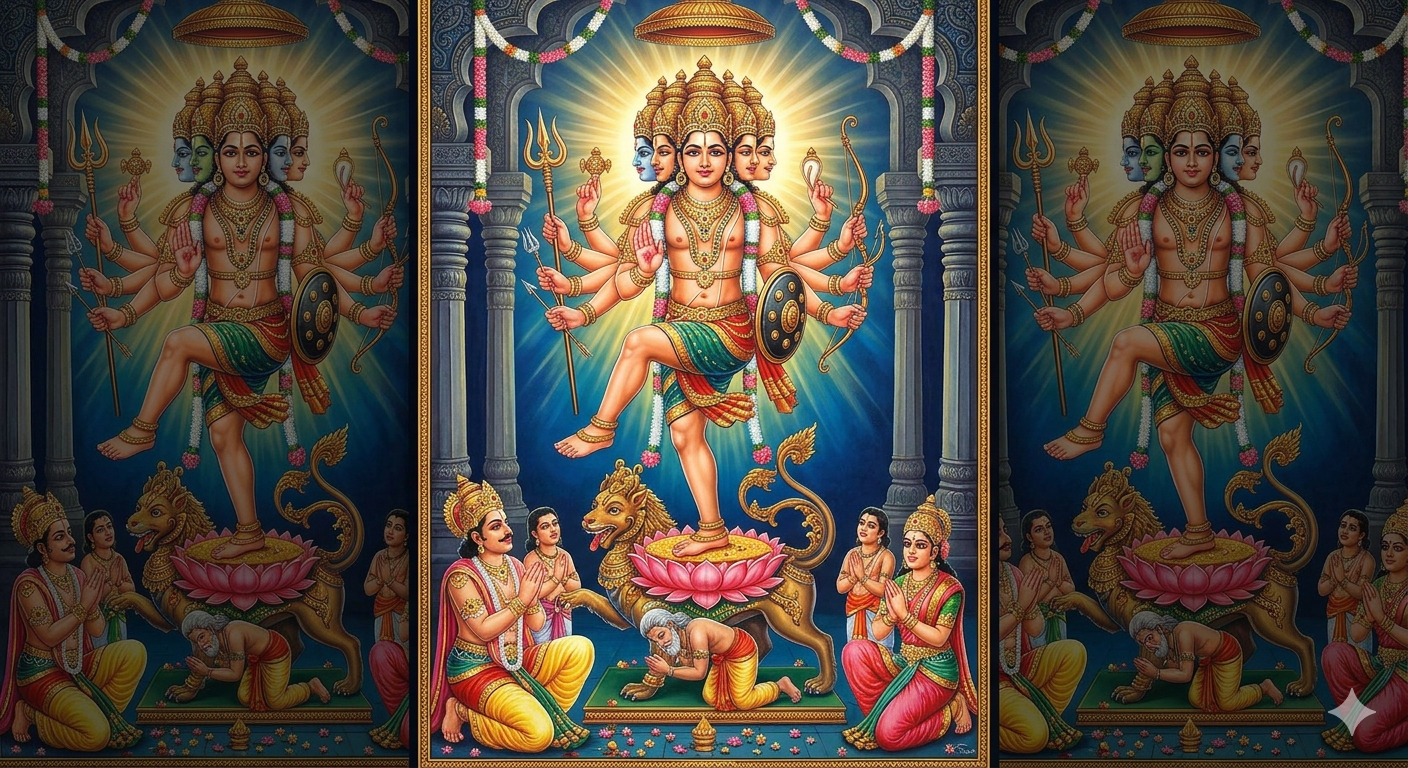
The Amsumadbhedagama describes the Ekapada-Trimurti precisely: he stands on a single leg over a lotus pedestal (padmapitha), has three eyes and four arms. His two forearms are in varada-mudra (the boon-giving gesture, palm outward) and abhaya-mudra (the gesture of fearlessness, palm raised). His two rear arms hold a tanka (small hammer) and a trishula (trident) or mriga (deer). From his sides emerge the upper bodies of Vishnu (left) and Brahma (right) — the entire Hindu Trinity arising from his single-footed form. Ekapada icons are found in most important Shiva temples of South India, carved on at least one pillar in the temple complex.
Rituals, Mantras & Practices to Receive His Blessings
Aja Ekapada’s blessings are those of radical spiritual elevation, protection against chaos, the burning away of illusion, grounded transformation, and access to the deep cosmic fire that drives genuine inner change. His Shakti — the Yajamana Udyamana Shakti — literally means “the power to raise the evolutionary level of the aspirant.” The following practices draw from Vedic ritual instruction, Jyotish tradition, Tantric lineage, and traditional Nakshatra-based remedies.
Meaning: “Salutations to the One-Footed Unborn One.”
How to chant: 108 times per session, using a rudraksha or crystal mala. Chant in the morning facing east (the direction associated with Aja Ekapada’s rising, per the Taittiriya Brahmana) or at dusk. Thursday is the most auspicious day as Jupiter rules this Nakshatra.
For intense periods: Supplement with Rudra mantras — particularly the Maha Mrityunjaya Mantra (Om Tryambakam Yajamahe Sugandhim Pushtivardhanam Urvarukamiva Bandhanan Mrityor Mukshiya Maamritat) — as Aja Ekapada is a Rudra.
Secondary mantra (Jupiter / ruling planet): Om Brihaspataye Namah or Om Gurave Namah, chanted 108 times on Thursdays.
Since Aja Ekapada is intimately connected with Agni (fire), the fire ritual is the most powerful and direct offering to him. In ancient yajna tradition, he was understood to personally conduct the sacrifice. The Purva Bhadrapada Nakshatra Homam is performed specifically to invoke his blessings.
Oblations used: Ghee (clarified butter), sesame seeds, rice, sacred herbs — offered into the fire while chanting the primary mantra. Ghee specifically is mentioned in the Nakshatra ritual traditions as the correct offering for Aja Ekapada’s Nakshatra.
When to perform: Ideally on the day when the Moon transits Purva Bhadrapada Nakshatra (this occurs roughly once per month — check a Vedic calendar or Panchang). You can also perform on Thursdays during Brahma Muhurta (the auspicious hour 1.5 hours before sunrise).
Purpose: Cleansing of negative karmic patterns, invoking spiritual elevation, protection from storms of life (both literal and metaphorical), and awakening the inner fire of transformation. Vedic Folks and other traditional services offer this Homam conducted by qualified priests.
The following offerings are traditional for honoring Aja Ekapada and the energy of Purva Bhadrapada Nakshatra:
| Milk & Ghee | Offer to a Shiva lingam or Rudra image while chanting the primary mantra. These are the most traditional offerings for Rudra-form deities. |
| Incense & Camphor | Burn during mantra recitation. The rising smoke symbolizes the ascending pillar of Aja Ekapada connecting earth to heaven. |
| Yellow Items | Donate turmeric, yellow cloth, bananas, or yellow flowers on Thursdays to reduce karmic burdens and honor Jupiter, the ruling planet. |
| Sesame Seeds (Til) | Offer into fire or to a Shiva temple. Black sesame seeds are associated with Saturn’s energy of transformation; white sesame with purity. Both are appropriate. |
| Sacred Water Libation | The Paraskara Grihya Sutra (2.15.2) records that Aja Ekapada received a water libation in domestic ritual practice. Pouring water eastward while chanting his name is thus the most ancient recorded offering to him. |
Because Aja Ekapada is literally “the one-footed one” — and because the Nakshatra tradition associates Purva Bhadrapada with health concerns relating to the feet and nervous system — a unique ritual practice has emerged in modern Nakshatra traditions:
Weekly foot soaking: Soak your feet in warm water with Epsom salts or rock salt (sendha namak) once a week. While doing so, hold the intention of grounded transformation — letting go of what no longer serves, asking Aja Ekapada’s single pillar of support to stabilize you. The Astrojyoti Healing tradition describes this as a practice unique to this Nakshatra’s one-footed deity, combining physical care with spiritual intention.
Sesame oil foot massage: Follow the soak with a sesame oil massage of the feet while setting intentions for the week ahead. Sesame oil is associated with Shani (Saturn), the planet of karma and discipline, whose transformation mirrors Aja Ekapada’s fierce purifying energy.
When the Moon transits Purva Bhadrapada (check monthly Panchang), the energy of Aja Ekapada is most active and intense. The Learn Vedic Astrology source notes: “Aja Ekapada is a fierce and unrestrained deity of sudden spiritual progress. When Moon transits his Nakshatra, we tend to become short-tempered and impulsive — but it is an ideal day for connecting with your spiritual self in meditation, yoga, or pranayama.”
Meditation visualization: Sit in stillness and visualize a single column of fire or light rising from the base of your spine to the crown of your head — the sushumna nadi. This is Aja Ekapada’s pillar in your own body. Hold this visualization for 10–20 minutes while breathing slowly.
Ekapada Asana (Tree Pose / Vrikshasana): Inspired by Sage Vishwamitra’s one-footed penance and the deity’s own single-footed nature, practice standing on one foot (Vrikshasana) during your mantra recitation. This physical mirror of the deity’s form deepens the energetic connection.
Pranayama: Nadi Shodhana (alternate nostril breathing) cleanses the two primary nadis — ida and pingala — and activates the sushumna, the central channel Aja Ekapada embodies. Practice 15 minutes daily before mantra recitation.
Thursday fast: Observe a partial or full fast on Thursdays (Guruvar) to honor Jupiter, the ruling planet of Purva Bhadrapada. This enhances spiritual clarity, channels Aja Ekapada’s transformative fire constructively, and generates merit (punya) that supports spiritual progress.
Charitable donations: Donate to spiritual organizations, educational institutions, or healthcare causes on Thursdays. Yellow items (turmeric, yellow cloth, yellow fruits), books on spiritual subjects, or money given to temples and teachers all honor both Jupiter’s domain and Aja Ekapada’s role as a spiritual elevator.
Yellow Sapphire (Pukhraj): The traditional gemstone for Jupiter and Purva Bhadrapada. Wearing a natural yellow sapphire (after proper astrological consultation) is said to carry the sacred energy of Jupiter, harmonizing Aja Ekapada’s intense inner fire with divine guidance. Consult a qualified Jyotishi before wearing any gemstone.
Visit Shiva temples: Since Aja Ekapada is one of the 11 Rudras and closely identified with Shiva’s form, any Shiva temple visit — particularly on Mondays and Thursdays — constitutes direct worship of his energy. In South India, temples housing the Ekapada-Trimurti icon include the Jambukeswarar Temple, Tiruchirappalli (Tamil Nadu) and various Chola-era temples. In Odisha, temples at Bhairo Pahad and the Hirapur yogini temple feature Ekapada-Bhairava.
Durga worship (for Rahu in Purva Bhadrapada): The Milky Way Astrology tradition notes that meditating on the image of Sri Ramakrishna Paramahansa (a devotee of Kali) and worshipping Durga — especially during Navaratri — is a powerful remedy for those with Rahu in this Nakshatra. Since Aja Ekapada appears in Odishan temples as a guardian of the Saptamatrikas and Mahishasuramardini, Durga and Aja Ekapada’s energies are ritually linked.
The month of Maasi (Tamil Nadu, February–March): Every year in Tamil Nadu, when the Sun transits Aquarius (the first portion of which is Purva Bhadrapada), significant Shiva temple festivals occur specifically connected to this Nakshatra’s energy. Attending these festivals is considered particularly auspicious for receiving Aja Ekapada’s blessings.
| Spiritual Elevation | Rapid advancement on the spiritual path; activation of the inner fire (tapas) needed for genuine transformation |
| Stability in Chaos | The cosmic pillar energy grounds the devotee during life’s most intense storms — he stabilizes what would otherwise collapse |
| Destruction of Illusion | As a Rudra, he destroys the hypocrisy of the mind — false beliefs, self-deception, and the illusions that bind us to suffering |
| Karmic Purification | Fire ritual and mantra practice under his domain burns away accumulated karmic residue, particularly from past life pride and arrogance |
| Protection of Wealth | As a guardian of divine gold alongside Kubera, he can protect material resources — particularly for those undergoing financial transformation |
| Universal Perspective | Purva Bhadrapada “grants a universal view through internal purification” — Aja Ekapada elevates consciousness beyond the personal and selfish toward the universal and divine |
The Pillar That Holds the Sky
Aja Ekapada is one of the oldest spiritual intelligences in the human record — present in the Rigveda at the very dawn of written religious thought, never the subject of a full hymn, never demanding centre stage, yet absolutely essential to the structure of the cosmos itself. He is the pillar without which the sky falls. He is the fire before which sacrifice becomes divine. He is the single streak of lightning that illuminates, in an instant, everything that was hidden in darkness.
His worship is not the worship of comfort. The energy of Purva Bhadrapada — his Nakshatra — is described across every traditional source as fierce, intense, transformative, and demanding. He does not grant blessings to those who seek an easy path. He grants blessings to those willing to stand, like Vishwamitra, on a single foot — to commit fully to the upward journey, burning away everything that is not essential, until what remains is as singular, stable, and unshakeable as the cosmic pillar itself.
“Aja Ekapada represents the axis of the inner and outer universe: the pillar of light — the all-unifying Divine principle in the external universe, and the sushumna nadi in our inner universe.”
— The Nakshatras (thenakshatras.com)
- Wikipedia — “Ekapada”: en.wikipedia.org/wiki/Ekapada
- Rigveda Wiki Blog — “Aja Ekapad in Rigveda”: rigveda-wiki.blogspot.com
- Nathas.org — “Aja Ekapada” (Natha Tradition Dictionary): nathas.org
- Puratattva — “Origins and Iconographical Developments of the Shiva-Ekapada-murti”: puratattva.in
- Historified — “Aja Ekapada: The Mysterious One-Footed God of Storms and Rudra”: historified.in
- Grokipedia — “Ekapada”: grokipedia.com
- Scribd — “Ahirbudhanya and Aja Ekapada Deities”: scribd.com
- The Nakshatras — “Purva Bhadrapada Nakshatra”: thenakshatras.com
- Rudraksha Ratna — “Purva Bhadrapada Nakshatra”: rudraksha-ratna.com
- Cosmic Insights Blog — “Aja Ekapada – Purva Bhadrapada Nakshatra”: cosmicinsights.net
- Astrojyoti Healing — “Purva Bhadrapada Nakshatra in Vedic Astrology”: astrojyotihealing.com
- Milky Way Astrology — “Purva Bhadrapada: The Mystic Fire”: milkywayastrology.com
- Hutam.in — “Purva Bhadrapada Nakshatra Rituals and Remedies”: hutam.in
- Vedic Folks — “Purva Bhadrapada Nakshatra and Aja Ekapada Devata Homam”: vedicfolks.com
- Vastutantraastro — “Ekapada, the Less Known Form of Shiva”: vastutantraastro.wordpress.com
- Rahasyavedicastrology — “Purva Bhadrapada Nakshatra”: rahasyavedicastrology.com
- Rigveda — Hymns 2.31.6, 6.50.14, 7.35.13, 10.65.13, 10.66.11 (primary source)
- Atharvaveda — 13.1.6 (primary source)
- Taittiriya Brahmana — 3.1.2.8 (primary source)
- Paraskara Grihya Sutra — 2.15.2 (primary source — domestic ritual)
- Mahabharata — Listing of 11 Rudras (primary source)
- Linga Purana, Vishnu Purana, Matsya Purana — Rudra listings (primary sources)
“`