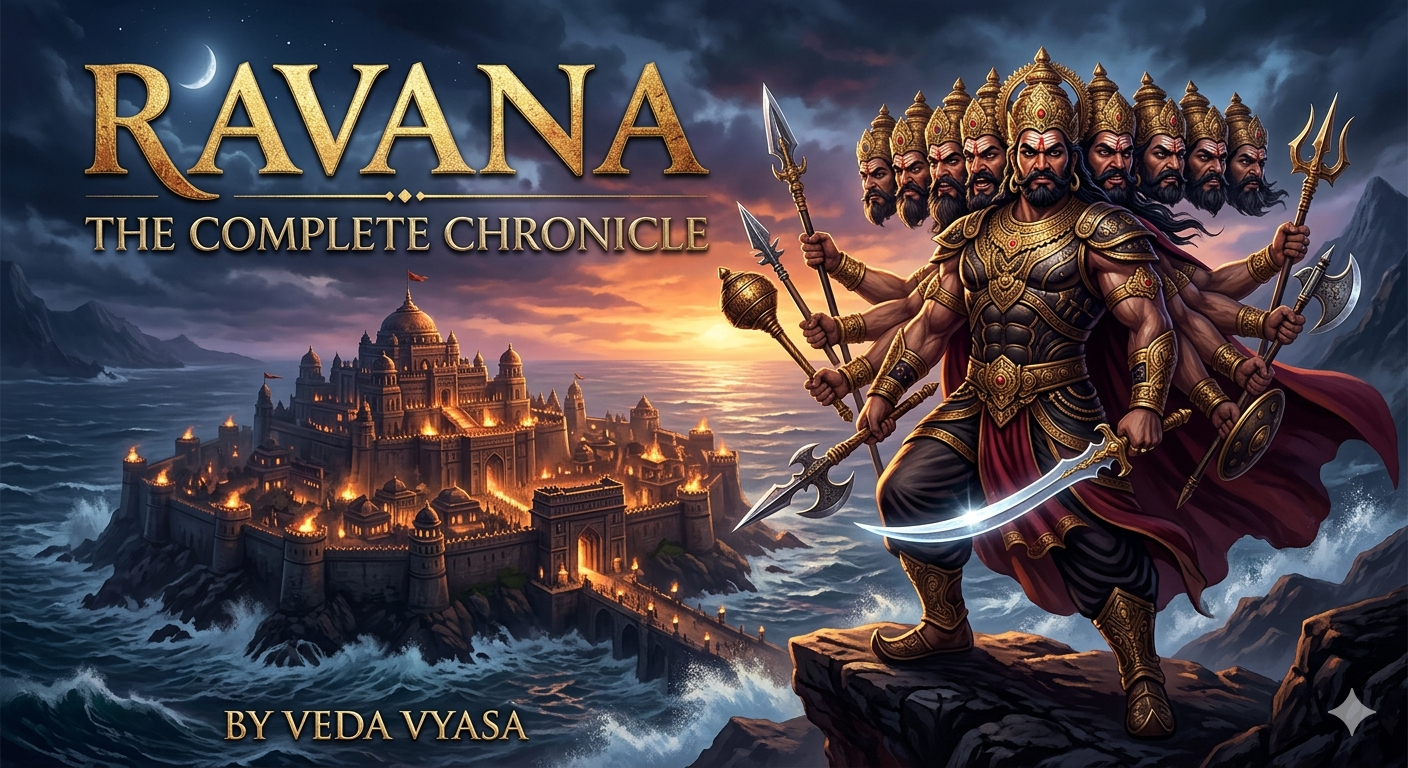
“`
Ancient Hindu Mythology · Deep Research · Treta Yuga
“`
“`
He is burned in effigy every Dussehra, yet revered in temples across the subcontinent. He kidnapped a goddess yet never touched her. He was a Brahmin scholar who became the king of demons. Ravana — whose very name means “He Who Roars” — is perhaps the most paradoxical figure in all of Hindu mythology. This is his complete story.
The Birth of Dashagriva — Cosmic Origins of a Legend
The Divine Lineage: A Great-Grandson of Brahma
Ravana was born to the Brahmin sage Vishrava and the Daitya princess Kaikesi in the Treta Yuga. His paternal grandfather, the sage Pulastya, was one of the ten Prajapatis — the mind-born sons of Brahma himself — and counted among the Saptarishis, the seven great sages of the first age of Manu. This made Ravana the great-grandson of Brahma, the Creator — a lineage of staggering divine prestige.
His maternal grandfather, Sumali, was the powerful king of the Rakshasas. Ravana thus entered the world carrying two opposing streams of cosmic heritage: the pure Brahminical wisdom of Pulastya’s line, and the ferocious, earthen power of the Rakshasa clan.
| Great-Grandfather (Paternal) | Brahma, the Creator of the Universe |
| Grandfather (Paternal) | Sage Pulastya — one of the Saptarishis (Seven Great Sages) |
| Father | Sage Vishrava — a Brahmin of immense learning |
| Mother | Kaikesi — daughter of Sumali, Rakshasa king |
| Half-brother | Kubera — the God of Wealth and original king of Lanka |
| Siblings | Kumbhakarna, Vibhishana, Shurpanakha |
| Birth Name | Dashagriva / Dashanana — “Ten-Necked / Ten-Faced” |
| Name “Ravana” Means | “He Who Roars” — acquired after his encounter with Shiva at Kailash |
The Strategic Marriage: How Kaikesi Won Vishrava
The story of Ravana’s conception is itself a tale of cosmic strategy. Sumali, the Rakshasa king, once saw Kubera — son of Sage Vishrava — flying gloriously in his golden aerial chariot, the Pushpaka Vimana. Consumed by ambition, Sumali devised a plan: if his daughter could bear children by Vishrava, those children would possess both Brahminical genius and demonic might. He instructed his most beautiful daughter, Kaikesi, to seek out the sage.
Kaikesi joined Vishrava’s ashram as a devoted disciple, working tirelessly until she earned his complete trust. When she finally made her request for marriage, Vishrava accepted — but issued a solemn warning. She had approached him at an inauspicious hour, during his twilight prayers. “Your children will be powerful,” he warned, “but inclined toward evil due to the timing of your request and your Rakshasa lineage.” Kaikesi accepted this condition without hesitation.
“The sky rained blood at Dashagriva’s birth. Jackals howled, and other vicious beasts ran in ill-omened circles around the Rakshasi mother and her child.”
— Tiny Tales from the Ramayana, based on Valmiki’s original text
The Birth Itself: Omens and Wonders
When the eldest child was born, he arrived with ten heads and twenty arms — a sight dreadful to behold. Vishrava named this fearsome infant Dashagriva, meaning “Ten-Necked.” At the moment of his birth, terrible omens filled the world: the heavens wept blood, jackals bayed, carrion birds circled. Yet even in this darkness, the child radiated a ferocious spiritual energy that could not be denied.
Three more children followed: Kumbhakarna, the prodigious giant; Vibhishana, the righteous one; and a daughter, Shurpanakha. Together, these four would alter the history of the three worlds forever. The name “Ravana” came later — earned through blood and agony at the foot of Mount Kailash, when Shiva’s mountain crushed Ravana’s arms and his screams of anguish shook the cosmos itself.
Childhood & Youth: The Making of a Scholar-Warrior
Education Under Sage Vishrava
Contrary to popular imagination, Ravana’s childhood was not one of savagery and chaos. Raised under the direct tutelage of his sage father, young Dashagriva mastered all four Vedas — the Rigveda, Yajurveda, Samaveda, and Atharvaveda — as well as the six Shastras. His intellectual hunger was described as insatiable; from childhood, he absorbed knowledge that most mortals could not master in several lifetimes.
The ten heads of Ravana, in one of the tradition’s most powerful symbolic interpretations, represent precisely this mastery: four heads for the four Vedas, six for the six Shastras. He became a ten-headed repository of the universe’s highest wisdom, and mastered 64 different forms of knowledge including weaponry, music, medicine, astrology, and statecraft.
The Great Penance of Gokarna: Earning His Boons from Brahma
After completing his education, Ravana’s youth was defined by extraordinary tapasya (spiritual austerity). He and his brothers performed penance at Gokarna for thousands of years to appease Brahma. So severe was Ravana’s devotion that he sacrificed his own heads — one every thousand years — casting each into the sacred fire. When he was about to offer his tenth and final head, Brahma himself appeared.
Brahma restored all of Ravana’s heads and granted near-invincibility from all celestial and demonic beings — because Ravana, in his arrogance, had omitted humans from his list, considering them too weak to threaten him. That single act of pride wrote the final chapter of his life before it had truly begun. Brahma also revealed a crucial secret: that Ravana’s life force would be concentrated in his navel.
“Ask any boon!” Brahma declared. Ravana’s list was vast — protection from Devas, Danavas, Nagas, Gandharvas, Rakshasas… but he omitted humans. That single act of pride wrote the final chapter of his life before it had truly begun.
— Based on Valmiki Ramayana, Uttara Kanda & Amar Chitra Katha
A Timeline of Ravana’s Rise
Masters the four Vedas, six Shastras, and 64 arts under his Brahmin father. Grows up absorbing his mother Kaikesi’s burning desire for Lanka.
Performs thousands of years of tapasya, sacrificing nine heads to the fire. Brahma appears and grants near-invincibility against all gods and demons.
Defeats his half-brother Kubera and seizes Lanka and the Pushpaka Vimana. His father Vishrava, disgusted, returns to his first wife forever.
Attempts to uproot Mount Kailash. Shiva pins him with a toe. His screams birth his eternal name. He composes the Shiva Tandava Stotra and receives the divine sword Chandrahasa.
Rules as an extraordinarily able king. Writes foundational texts in astrology, medicine, and tantra. Manipulates planetary alignments for his son Meghnad’s birth.
The Conquest of Lanka
With Brahma’s boons secured, Ravana marched on Lanka and challenged his half-brother Kubera to battle. Vishrava himself advised Kubera to yield, recognizing that Ravana was now virtually invincible. Kubera retreated and eventually became the treasurer of the Gods under Indra. Although Ravana seized Lanka by force, ancient accounts consistently describe him as a benevolent and effective ruler — under his reign the island flourished and Lanka became the most magnificent kingdom in the three worlds.
Origins of the Shiva Tandava Stotra
The Hymn That Moved a God to Dance
Of all Ravana’s contributions to Hindu civilization, none resonates more powerfully across millennia than the Shiva Tandava Stotra — a Sanskrit hymn so rhythmically perfect and emotionally potent that even today it is among the most chanted prayers in the Shaiva tradition. Its origin is a story of arrogance shattered into the purest devotion.
The Kailash Incident: Two Versions of One Truth
Version One (Shiva Purana tradition): Ravana, travelling in his Pushpaka Vimana, was blocked by Nandi — Shiva’s divine bull — from proceeding near Mount Kailash. Enraged, Ravana mocked Nandi, who cursed him: “Your Lanka shall be destroyed by monkeys.” Infuriated, Ravana placed his twenty arms beneath Kailash and began to lift the entire sacred mountain, intending to carry it to Lanka for his ailing mother. As Kailash trembled, Parvati gripped Shiva in fear. Shiva merely pressed the ground with his big toe. The mountain descended with crushing force, pinning Ravana’s arms beneath its immense weight.
Version Two (Isha / Sadhguru tradition): Ravana came to Kailash from the south as a fierce devotee, carrying a small drum, and began composing 1,008 verses extempore in divine inspiration. Shiva became so enraptured by the music he didn’t notice Ravana climbing the southern face. Only when Parvati alerted him did Shiva push Ravana down with his foot — and Ravana slid down the south face, his drum dragging behind him, leaving a furrow on the mountain that legend says can still be seen today.
The Composition: Pain Transformed into Sacred Art
Trapped beneath the mountain — for a thousand years according to some texts — Ravana’s arrogance dissolved completely. He tore sinews from his own body to create the strings of an instrument, then began to sing. The hymn he composed in that moment of anguish and ecstasy became the Shiva Tandava Stotra.
The Stotra is structured in 17 quatrains, each line containing 16 syllables in alternating short and long meter — a form called iambic octameter that gives the hymn its unmistakable, thunderous rhythm. The onomatopoeic phrase “Damat Damat Damat Damat” imitates the sound of Shiva’s Damaru drum, making the verses themselves feel like cosmic percussion.
| Author | Ravana (traditionally attributed) |
| Language | Sanskrit |
| Structure | 17 quatrains — 16 syllables per line |
| Meter | Iambic octameter — laghu-guru alternating pattern |
| Sources citing it | Shiva Purana; Uttara Kanda of Valmiki Ramayana |
| Key refrain | “Damad damad damaddama ninadavadamarvayam” |
| Reward from Shiva | The divine sword Chandrahasa and restoration of all boons |
| Best time to chant | Pradosh Kaal — one hour before and after sunset |
“The hymn he composed that day became the Shiva Tandava Stotra — a song not of defeat but of surrender, not of ego but of enlightenment.”
— Times of India Spiritual Analysis
Pleased by the sincerity and brilliance of Ravana’s composition, Shiva forgave him, freed him from the mountain, granted him the sacred sword Chandrahasa, and restored his boons. The incident reveals perhaps the deepest truth about Ravana: that within the demon king lived a devotee of extraordinary purity, capable of producing sacred art of the absolute highest order.
The Ravana Samhita — A Deep Dive into His Greatest Work
While the Shiva Tandava Stotra is Ravana’s most famous composition, the Ravana Samhita (also spelled Ravan Sanhita) is his most intellectually staggering. It is a vast compendium of esoteric knowledge, preserved across millennia in Sanskrit manuscripts held in libraries throughout India, available today through publishers such as Chaukhamba and translated by scholars including Swami Premanand and Bharti Agrawal.
The Exotic India Art catalogue and the publisher’s foreword to the Kumara Tantra volume (Chaukhamba Krishnadas Academy, ISBN 9788121802601) acknowledge that while Ravana is the traditional ascribed author, some sections within the broader Samhita corpus may reflect later compilation. The core text carries the tradition that it was “transcribed by Hanuman” — suggesting it encapsulates Ravana’s final knowledge as witnessed on the battlefield. Manuscripts are preserved in multiple Indian libraries. Readers may consult the Chaukhamba edition or the Internet Archive’s digitised multi-volume Hindi editions by Acharya Pt. Shivkant Jha.
The Six Parts of the Ravana Samhita
A biographical narrative tracing Ravana’s lineage from Brahma through Pulastya and Vishrava, establishing the philosophical authority for the works that follow. This section argues that Ravana’s mastery in these sciences comes from divine inheritance and hard-won austerity across thousands of years.
The most famous and widely circulated section. Contains detailed frameworks for reading planetary positions (Graha Rasyadi Phaladesa) and nakshatra influences (Rasi Naksatradi Phaladesa). Ravana was such a supreme astrologer that he reportedly manipulated the positions of all planets at the moment of Meghnad’s birth — and physically attacked Saturn with his mace when it moved to an inauspicious position. Covers birth charts, muhurtas, and advanced predictive techniques.
A deep technical examination of the 27 Nakshatras and their Padas (quarters), including detailed predictive techniques for each. The scholarly journal Saptarishis Astrology has published modern commentary drawn from this section, attesting to its ongoing relevance among serious Vedic astrologers.
Covers a vast spectrum of Tantric knowledge including Ganesha mantras, Kali Sadhana, Tara Sadhana, the ten Mahavidyas (Tripurasundari, Bhuvaneshwari, Bhairavi, Chhinnamasta, Dhumavati, Bagala, Matangi, and Kamala), Yakshini Sadhana, and the Ashta-Nayika traditions. A comprehensive manual of mantric science.
Contains specific ritual experiments covering Sarva-Shanti (universal peace), disease removal, and the six occult actions of classical tantra: Shanti, Vashikaran, Stambhan, Vidveshan, Uchchatan, and Maran karma. Also contains Yoga Mudra descriptions — specific hand and body gestures used to balance the body’s energy flow and enhance concentration, based on Ravana’s own yogic attainment.
Hymns and mantras dedicated to Lord Shiva, including material related to the Shiva Tandava tradition. This section is considered the most devotionally pure and is recommended for recitation at Pradosh Kaal — in any Shiva temple or before a Shiva idol at home, without restriction of caste, gender, or time.
| Internet Archive | Multi-volume Hindi edition by Acharya Pt. Shivkant Jha — free at archive.org |
| Wisdomlib.org | English translation by Swami Premanand and Bharti Agrawal |
| Exotic India Art | Tantratmak Ravan Samhita — 2-volume Sanskrit set |
| Chaukhamba Krishnadas Academy | Kumara Tantram of Ravana — ISBN 9788121802601 |
Other Works Attributed to Ravana
The Ravana Samhita is only the beginning. Traditional scholarship and manuscript evidence preserved in Indian libraries point to a remarkable corpus of works attributed to this Brahmin-king. The publisher’s foreword to the Chaukhamba Krishnadas Academy edition of Kumara Tantram explicitly states: “There are other works said to have been authored by Ravana, the King of Demons — manuscripts are available in various libraries in India for further study.”
| Work | Field | Contents |
|---|---|---|
| Arka Prakasha | Ayurveda / Distillation | Foundational text on extraction of volatile oils and aromatic essences from plants — a method superior to standard decoction for preserving medicinal potency. Structured as a dialogue between Ravana and Queen Mandodari. Ravana credited as founder of Sindhuram medicine, said to heal wounds instantly. |
| Kumara Tantra | Paediatrics & Gynaecology | Complete health guide to pregnancy and child medicine. Describes causes, symptoms, and treatments of over 100 diseases. Contains 1,000+ medical prescriptions. Written upon request of pregnant queen Mandodari for Meghnad’s welfare. |
| Nadi Pariksha | Pulse Diagnosis | Reading the quality, rhythm, and character of the pulse at specific body points as a comprehensive diagnostic tool — foundational to both Ayurveda and Siddha medicine. |
| Uddisa Tantra | Occult / Indrajala | Works on hypnotism, tantra vidya (optical illusion of thoughts), and the 64 forms of Indrajala that Ravana deployed in battle as battlefield magic and psychological warfare. |
| Arka Shastra | Herbal Pharmacology | Compiles dosage, usage, and cures of every known herb for complex diseases. Covers tinctures and extracts — distinct from Arka Prakasha in its pharmacological application focus. |
| Vatina Prakaranaya | Traditional Medicine (Sri Lanka) | Works preserved in Sri Lankan tradition relating to disease classification and treatment. Records Ravana as chairman of an Ayurveda seminar held in the Himalayas — suggesting aerial travel was part of his administration. |
The Ravanahatha: Inventor of the World’s First Bowed String Instrument
Beyond written texts, Ravana is credited with inventing the Ravanahatha — an ancient bowed string instrument still played today as a living folk instrument in Rajasthan. He designed his own version of the veena, narrated the very first ragas, and some scholars argue that the bow of the violin traces its origins ultimately back to the Ravanahatha carried along the Silk Road. This places Ravana among the most significant contributors to the history of world music.
Rare & Mysterious Stories — The Ravana Most Don’t Know
|
👁
Was Ravana a Cursed Gatekeeper of Vishnu?
According to the Bhagavata Purana, Ravana and Kumbhakarna were originally Jaya and Vijaya — divine gatekeepers of Vaikuntha. When the Sanata Kumara sages were denied entry, they cursed the gatekeepers to be expelled from paradise. Vishnu gave them a choice: be born seven times as devotees, or three times as enemies. They chose the faster path home — appearing as Hiranyakashipu and Hiranyaksha, then as Ravana and Kumbhakarna, then as Shishupala and Dantavakra. The entire Ramayana is Vishnu honouring a divine promise to his own servants. |
🌌
Ravana Attacked Saturn to Secure His Son’s Immortality
When Meghnad was about to be born, Ravana commanded all planets to hold the most auspicious positions to grant his son immortality. All obeyed except Saturn (Shani), who moved to an inauspicious position. In fury, Ravana attacked Saturn with his mace and broke off one of its legs — said to explain Saturn’s slow, “lame” movement across the sky. This reveals both his supreme command over celestial mechanics and his ultimate inability to override destiny. |
|
⚔
Rama Asked Lakshmana to Learn from the Dying Ravana
After delivering the fatal blow, Rama told Lakshmana: “Go to Ravana quickly before he dies. A brute he may be, but he is also a great scholar.” Ravana’s final wisdom: delay evil as long as possible; never delay good. Maintain relations with your charioteer, cook, gatekeeper, and brothers — these are the people who can harm you most. Never underestimate an enemy. Trust a minister who dares criticise you. He confessed these were lessons he himself had failed to practise. |
🙎
Ravana Performed the Priestly Rites for Rama’s Bridge
When Rama was preparing to build the Ram Setu, he needed a learned Brahmin to perform the sacred purification rites. No one present could match the requirements. According to some traditions, it was Ravana himself — as a Brahmin of the highest order — who performed the priestly rites that consecrated the very bridge built to destroy him. Rama reportedly bowed to Ravana as a Brahmin after receiving this service, even as war was imminent. |
|
🌊
Vedavati’s Curse — Sita Was Born to Destroy Ravana
Long before the Ramayana, Ravana encountered a tapasvini named Vedavati meditating in a forest. He proposed marriage; she refused. When he forcibly grabbed her hair, she cursed him: “I shall be reborn and be the cause of your death.” She then leapt into fire and self-immolated. According to several traditions, Vedavati was reborn as Sita — not merely Ravana’s hostage but his doom incarnate, born specifically to fulfil a curse he himself had provoked centuries before. |
🎵
The Sinews of Devotion: How the Ravanahatha Was Invented
When pinned under Kailash and needing music to appease Shiva, Ravana tore his own sinews out with his bare hands, wound them around his fingers and toes, and used them as strings to play. From this act of extreme devotion, the Ravanahatha — the world’s first bowed string instrument — was born. The drum he carried as he slid down Kailash’s southern face left a scar still visible on the mountain today. |
|
📗
Ravana Will Return as the Buddha Avatar in Kali Yuga
In the Tibetan Ramayana (Rin-spuns-pa text), an astonishing prophecy is recorded: Ravana will return as the Buddha incarnation of Vishnu in the Kali Yuga — our current age. This is a complete cosmic rehabilitation: the being who played Vishnu’s enemy across three births is prophesied to return as Vishnu’s most enlightened form. The curse of Jaya and Vijaya, fully discharged, ends not in damnation but in transcendence. |
▴
Ravana Had Airports in Ancient Sri Lanka
In Sri Lankan tradition, Ravana is remembered as a king of extraordinary technological sophistication. Sites identified as ancient airports — Weragantota in Mahiyangana, Thotupola Kanda at Horton Plains, Wariyapola in Kurunegala, and Gurulupotha — are associated with his fleet of Pushpaka Vimanas. The Kumara Thanthraya tradition records that Ravana chaired an Ayurveda seminar held in the Himalayas, suggesting intercontinental aerial travel was commonplace in his world. |
|
💎
The Nectar of Immortality Hidden in Ravana’s Navel
Brahma’s boon contained a second secret: the nectar of immortality (amrita) was stored within Ravana’s navel. This is why Rama’s arrows had no lasting effect through the long battle — every head cut off grew back, every wound healed. Only when Vibhishana revealed this secret and Rama used the Brahmastra (given by sage Agastya) to pierce the navel directly could the demon king finally fall. The amrita in the navel had transformed Ravana’s body into an almost indestructible cosmic vessel. |
|
The Ten Heads as a Map of Human Psychology
Perhaps the deepest mystery of Ravana is encoded in the ten heads themselves. While they represent his mastery of the Vedas and Shastras, another tradition reads them as a precise psychological map of human consciousness. The ten heads symbolise: Kaam (lust), Krodh (anger), Moha (delusion), Lobh (greed), Mada (pride), Maatsarya (envy), Manas (the reactive mind), Buddhi (intellect), Chitta (will/consciousness), and Ahamkara (ego).
Ravana had one head of pure Buddhi that controlled his destiny — and nine other heads representing the passions that ultimately overrode it. When Mahabali once advised Ravana to eliminate the nine and keep only intellect, Ravana disagreed: he argued all ten facets are necessary to make a complete being. That philosophy — mastery, not suppression, is the answer — was both his greatest wisdom and his most fatal flaw.
“Having all this knowledge but not being able to harness his powers was one of his biggest regrets as he lay dying on the battlefield.”
— Hindu American Foundation
The Eternal Paradox of the Ten-Headed King
Ravana remains, across five thousand years, what he always was: a contradiction too large to dismiss as either hero or villain. He was born of divine Brahmin lineage and demonic blood. He was a devoted sage’s student who became history’s most feared conqueror. He was a healer who wrote medical texts for his unborn child’s sake, and a tyrant who kidnapped a goddess. He invented music that still moves the human heart, and composed a hymn that brought even Shiva to tears.
The Gondi people of central India still carry his image in procession every Dussehra — not to burn him, but to honour him as their dharmaguru. The Sachora Brahmins of Gujarat carry “Ravan” as a surname with pride. Temples across Tamil Nadu and Karnataka welcome his worship. And every time the thunderous syllables of the Shiva Tandava Stotra roll across a Shiva temple at Pradosh Kaal, the voice of the Roaring One — half sage, half demon, entirely himself — is heard once more.
In the end, the story of Ravana is the story of what happens when supreme knowledge fails to produce supreme wisdom — when mastery of the cosmos cannot master the self. It is perhaps the most achingly human story in all of mythology, because most of us too know more than we practise, and possess more than we have learned to surrender.
- Wikipedia — “Ravana”: en.wikipedia.org/wiki/Ravana
- New World Encyclopedia — “Ravana”: newworldencyclopedia.org
- Hindu American Foundation — “The Untold Story of Ravana”: hinduamerican.org
- Amar Chitra Katha — “Ravana and Brahma”: amarchitrakatha.com
- Pressbooks / Tiny Tales from the Ramayana: pressbooks.pub
- Wikipedia — “Shiva Tandava Stotra”: en.wikipedia.org
- Isha Sadhguru — “Shiv Tandav Strotam”: isha.sadhguru.org
- Grokipedia — “Shiva Tandava Stotra”: grokipedia.com
- Wisdomlib.org — “Ravan Sanhita”: wisdomlib.org
- Exotic India Art — “Kumara Tantram of Ravana”: exoticindiaart.com
- Scribd — “Ravana Samhita” summary: scribd.com
- Dolls of India — “The Tale of Jaya and Vijaya”: dollsofindia.com
- MDPI Religions — “Reincarnations of Jaya and Vijaya”: mdpi.com
- India TV News — “Teachings Ravana gave to Lakshmana on his deathbed”: indiatvnews.com
- Vedic Feed — “Ravana: The Emperor of Lanka”: vedicfeed.com
- AstroKapoor — “Ravana Samhita and Medical Astrology”: astrokapoor.com
- Internet Archive — “Ravan Samhita” (Hindi edition): archive.org
- Times Life — “Why Ravana Created Shiv Tandav Stotram”: timeslife.com
- Valmiki Ramayana — Bala Kanda & Uttara Kanda (primary source)
- Bhagavata Purana — Book III, on Jaya-Vijaya (primary source)
- Shiva Purana — Rudra Samhita, on the Kailash episode (primary source)
“`