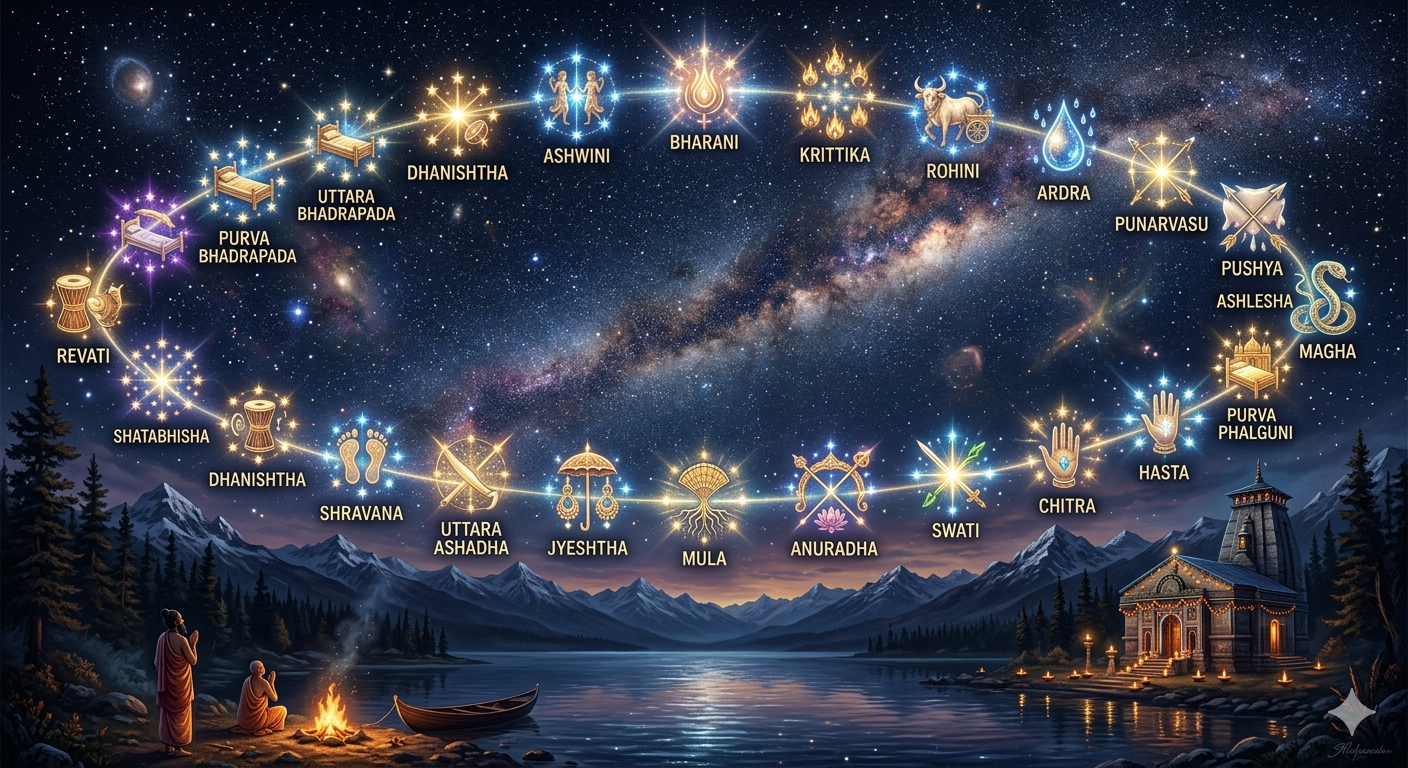
Vedic Cosmology & Sacred Astronomy
Why These Gods? The Theology Behind Every Nakshatra Deity
A deep study into why each of the 27 Nakshatras was assigned its specific divine lord — drawn from the Rigveda, Taittiriya Brahmana, Brihat Parashara Hora Shastra and Puranic tradition
The 27 Nakshatras are not merely astronomical coordinates for the Moon’s journey around the zodiac. Each one is a cosmic temple presided over by a specific deity — and that assignment is anything but arbitrary. The ancient rishis encoded profound mythological, cosmological, and psychological logic into each pairing. Understanding why a particular god was handed stewardship of a particular star cluster is to understand the entire architecture of Vedic consciousness.
The primary textual sources for these deity assignments are the Taittiriya Brahmana (particularly III.1.4 and I.5.1), the Rigveda, the Brihat Parashara Hora Shastra, and the classical commentaries. Scholar and Vedic astrologer Dr. David Frawley (Vamadeva Shastri) of the American Institute of Vedic Studies has done pioneering work translating the Taittiriya Brahmana’s nakshatra sections, much of which informs the deeper layers of this study.
What follows is a nakshatra-by-nakshatra examination of each deity’s mythological identity and the theological reason they were specifically chosen to lord over their stellar domain.
“`
“`
1. Ashwini (0°–13°20′ Aries)Deity: The Ashwini Kumaras (Nasatya & Dasra) |
The twin horsemen Nasatya and Dasra are the celestial physicians of the gods — born when Surya (the Sun) and his wife Sanjna took the form of horses in the forest. Sons of the Sun himself, they are forever young, golden-armoured, and eternally ready to heal. The Rigveda dedicates 57 entire hymns to them — more than almost any other deity — celebrating their miraculous cures: restoring sight to the blind, youth to the aged, and limbs to the lame.
Why Ashwini? The Taittiriya Brahmana records: “The Ashwins desired, ‘May we be possessed of good hearing and not become deaf.’” Ashwini, the very first nakshatra, represents the dawn impulse — the first breath, the first movement from darkness into light. The Ashwini Kumaras personify this exact quality: speed of response, the power to initiate healing, the transition from night to morning. Their Shakti is Shidhra Vyapani Shakti — the power to quickly reach and heal. They are “harbingers of Usha (Dawn),” riding across the sky in a three-wheeled golden chariot drawn by tireless horses. No deity could more perfectly lord over the nakshatra of new beginnings than the divine twins who literally herald each new day.
Source: Taittiriya Brahmana III.1.4; Rigveda (57 dedicated hymns); Brihat Parashara Hora Shastra
2. Bharani (13°20′–26°40′ Aries)Deity: Yama — God of Death, Dharma & Ancestral Justice |
Yama is the son of Vivasvat (the Sun) and twin brother of Yami. He is the first mortal to die and thereby became the Lord of the Dead, ruling over Pitriloka (the realm of the ancestors). He is simultaneously the God of Death and the God of Dharma — for only one who is perfectly just can judge the deeds of souls. He holds the danda (rod of punishment) and a noose, and is assisted by his messengers the Yamadoota.
Why Bharani? The Taittiriya Brahmana records Yama’s desire: “May I win the lordship of the ancestors.” Bharani’s very name comes from bharana — “to bear, to carry, to maintain.” Its symbol is the Yoni (the celestial womb), a “clay pot” or vessel that carries. Yama carries souls across from one world to the next. After Ashwini’s dawn burst of birth and beginning, cosmic order demands a force of accountability, containment, and passage — Yama. His Shakti of Apabharani — “the power to take away and move on” — perfectly matches Bharani’s role as the nakshatra of the soul’s passage between lives. Bharani holds the seeds of mortality, creativity, and karmic consequence simultaneously — and Yama, as both Lord of the Dead and the first dharmic judge, is its only fitting regent.
Source: Taittiriya Brahmana III.1.4; Dr. David Frawley, Shaktis of the Nakshatras, AIVS; Brihat Parashara Hora Shastra
3. Krittika (26°40′ Aries–10°00′ Taurus)Deity: Agni — God of Sacred Fire, Purification & Divine Nourishment |
Agni is one of the most frequently invoked deities of the Rigveda. He is the divine messenger between humans and gods, carrying the sacrificial offerings upward in smoke. He is the god with seven tongues of flame, the “eater of food for the gods,” the priest of the cosmic sacrifice. The six Krittika stars (the Pleiades) are the foster-mothers of Kartikeya (Skanda), born to Agni’s desire. Agni himself is connected to this nakshatra through his infatuation with the wives of the Seven Sages.
Why Krittika? The Taittiriya Brahmana is explicit: “Agni desired, ‘May I be the eater of food for the Gods.’” Agni both cooks and digests — fire transforms raw matter into nourishment. Krittika means “the cutter” and its symbol is a razor or sharp blade — fire cuts through impurity. The Shakti is Dahana Shakti — the power to burn and purify. The Pleiades, astronomically, were once the nakshatra through which the vernal equinox passed — the “starting point” of ancient star-lore — making them a place of primordial solar power. Agni, who is in truth the visible form of the Sun on earth, is the only deity worthy of this fiery, nourishing, purifying cluster.
Source: Taittiriya Brahmana III.1.4; Rigveda (hymns to Agni); Dennis Harness, The Nakshatras of Vedic Astrology
4. Rohini (10°00′–23°20′ Taurus)Deity: Prajapati (Brahma) — The Creator, Lord of All Creatures |
Prajapati is the primordial Creator-God of the Vedas, the “Lord of Creatures,” who willed the universe into existence. He is the celestial progenitor from whom all life springs. Rohini is the most beloved of the Moon’s 27 wives (the 27 nakshatras) — the one the Moon (Chandra) always lingered at, neglecting his other wives, earning a curse from their father Daksha.
Why Rohini? The Taittiriya Brahmana gives one of its most poetic passages here: “Prajapati created creatures but thus created they went away. Of them he thought about Rohini. He desired, ‘May she approach me. May we unite together.’” This passage encodes the very nature of Rohini — it is the nakshatra of desire, union, beauty, and abundance. Rohini’s star is Aldebaran, the reddest and most brilliant of the Hyades — and its name means “the red one,” “the one who ascends.” Prajapati is its lord because creation itself is the story of the Creator desiring reunion with his own creation. Rohini’s Shakti is Rohana Shakti — the power to grow, to ascend, to bring forth. Sri Krishna was born in this nakshatra, as was the concept of divine abundance (Lakshmi).
Source: Taittiriya Brahmana III.1.4; Dr. David Frawley, AIVS; Shatapatha Brahmana
5. Mrigashira (23°20′ Taurus–6°40′ Gemini)Deity: Soma (Chandra) — Moon God, Lord of Plants & Immortal Nectar |
Soma is simultaneously the Moon god, the god of the sacred hallucinogenic nectar, and the lord of all plants in Vedic cosmology. He is described as ever-blissful, connected to rejuvenation, the healing properties of herbs, and immortality. He rules over the inner emotional world and the subtle body.
Why Mrigashira? The Taittiriya Brahmana says: “Soma desired, ‘May I win the lordship of the plants.’” Mrigashira’s symbol is the “deer’s head” — the most graceful, gentle, and eternally searching creature. The deer is perpetually seeking, sniffing, alert to the world. So too is Soma — the healing essence that the rishi seeks in plants and in the cosmos. Mrigashira’s Shakti is Prinana Shakti — the power of fulfillment, the joy of finding what the soul craves. The nakshatra sits at the junction of Taurus (sensory pleasure) and Gemini (mental seeking), making it a liminal zone of desire — perfectly suited to Soma, the god of bliss, inner joy, and the nectar of immortality.
Source: Taittiriya Brahmana III.1.4; Rigveda Soma hymns; Dr. David Frawley, AIVS
6. Ardra (6°40′–20°00′ Gemini)Deity: Rudra — The Howler, Lord of Storms, Wild Animals & Destruction |
Rudra is the most primordially fierce deity of the Rigveda — the “Howler,” the archer who shoots disease and affliction but who also holds the herbs of healing. He is the lord of wild animals (Pashupati), the deity of storms and wilderness, the predecessor to Lord Shiva. He is simultaneously the most feared and the most merciful of Vedic gods.
Why Ardra? The Taittiriya Brahmana records: “Rudra desired, ‘May I become the lord of the animals (Pashupati).’” Ardra means “the moist one” — it corresponds to Betelgeuse, the great red star in Orion, which the Vedic tradition connected to storms, tears, and thunder. Ardra’s Shakti is Yatna Shakti — the power of effort, of striving, of the hunt. Rudra is the hunter who draws back his bow and aims at the target of cosmic truth. The emotional intensity of Ardra — raw, weeping, stormy — perfectly mirrors Rudra’s energy. Just as Rudra can tear down and rebuild, Ardra natives experience radical transformations. The wild storm that breaks the drought is Rudra’s grace.
Source: Taittiriya Brahmana III.1.4; Rigveda hymns to Rudra (RV 1.43, 2.33); Dr. David Frawley, AIVS
7. Punarvasu (20°00′ Gemini–3°20′ Cancer)Deity: Aditi — The Boundless Mother, Mother of All Gods |
Aditi is the primordial mother goddess of the Rigveda — the “boundless one,” the cosmic matrix from whom the twelve Adityas (solar gods) were born. She represents infinite space, the expanse of the sky, and the nurturing principle that makes all existence possible. She is the Earth as Great Mother, the womb of the universe.
Why Punarvasu? The Taittiriya Brahmana says: “The Earth in the beginning had no growths. She desired, ‘May I produce herbs and trees.’” Punarvasu literally means “the return of light” or “restoring goodness” — Punar means “again” and Vasu means “ray of light.” This nakshatra governs renewal, restoration, and the return after absence — like the monsoon rains returning to quench the dry earth. Aditi is this nurturing cosmic mother who returns again and again to restore what was lost. Lord Rama was born in this nakshatra, and its Shakti is Vasutva Prapana Shakti — the power to gain substance, wealth, and renewal. Aditi’s boundless nature means this nakshatra gives again and again.
Source: Taittiriya Brahmana III.1.4; Rigveda hymns to Aditi; Brihat Parashara Hora Shastra
8. Pushya (3°20′–16°40′ Cancer)Deity: Brihaspati — Divine Priest, Guru of the Gods, Lord of Sacred Speech |
Brihaspati is the preceptor and high priest of the Devas — the divine guru whose very name means “Lord of Prayer.” He wields the power of the sacred word (Vak), and it is he who guides the gods through spiritual knowledge, ritual correctness, and the power of mantra. He is identified with the planet Jupiter and embodies wisdom, dharma, and devotion.
Why Pushya? The Taittiriya Brahmana states: “Brihaspati desired, ‘May I possess the splendor of spiritual knowledge.’” Pushya — from pushti meaning “nourishment” — is considered the most auspicious of all nakshatras. It is the nakshatra that feeds and nourishes the soul. Jupiter himself is exalted in Cancer (the sign Pushya inhabits), and Brihaspati’s rulership here is considered supremely fitting. Just as Brihaspati nourishes the gods with wisdom and dharmic guidance, Pushya nourishes whoever it touches with spiritual grace. Its Shakti is Brahmavarchasa Shakti — the power to create and radiate spiritual energy. This is the nakshatra where good karma is rewarded, where dharma feeds the soul.
Source: Taittiriya Brahmana III.1.4; Rigveda; Brihat Parashara Hora Shastra; Taittiriya Brahmana I.5.1
9. Ashlesha (16°40′–30°00′ Cancer)Deity: Naga (Sarpa) — The Serpent Gods, Keepers of Hidden Wisdom & Poison |
The Nagas are the divine serpent beings of Hindu cosmology — keepers of the earth’s hidden treasures, rulers of the underworld (Patala), and embodiments of kundalini shakti (the coiled life force). They possess both lethal venom and profound wisdom; their forked tongue speaks in double meanings, and they inhabit the deepest regions of the psyche and earth.
Why Ashlesha? The Taittiriya Brahmana records: “The Gods and the Demons were at war. The Gods made an offering to Ashlesha. This drove away the Demons.” Ashlesha means “the clinger,” “the entwiner” — its symbol is a coiled serpent. The Nagas cling to what they protect, constricting enemies with their coils. They are feared because their venom kills — but the Nagas’ poison is also the poison of wisdom that kills ignorance. The star marks the end of Cancer, the boundary of the Moon’s sign — where security ends and the deep unknown begins. The serpent guards this threshold. Its Shakti is Visasleshana Shakti — the power to paralyze with poison, to neutralize enemies, or to deliver the venom of enlightenment.
Source: Taittiriya Brahmana III.1.4; Dr. David Frawley, AIVS; Brihat Parashara Hora Shastra
10. Magha (0°00′–13°20′ Leo)Deity: The Pitris — The Ancestral Fathers, Progenitors of Humanity |
The Pitris (Pitaras) are the divine ancestors — the first humans who completed their earthly journey and ascended to Pitriloka. They are honoured through the Shraddha ceremony and the Pitru Paksha fortnight. They are the root of human lineage, and without their blessings, no descendant can truly prosper.
Why Magha? The Taittiriya Brahmana records: “The Fathers desired, ‘May we flourish in the world of the ancestors.’” Magha, whose star is the great royal Regulus (the heart of the Lion), is the nakshatra of kings, thrones, and ancestral heritage. Magha means “the mighty” or “the magnificent.” Its symbol is a royal throne room with a palanquin and fly-whisk — the trappings of kingly power. Power is only legitimate when rooted in ancestry — the Pitris bless royal lineages. Magha’s Shakti is Tyage Kshepani Shakti — the power of leaving the body to move on. The Pitris have done exactly this and now hold the collective karma of their descendants.
Source: Taittiriya Brahmana III.1.4; Rig Veda X.15 (Pitri Sukta); Dr. David Frawley, AIVS
11. Purva Phalguni (13°20′–26°40′ Leo)Deity: Bhaga — Solar God of Fortune, Delight & Marital Bliss |
Bhaga is one of the twelve Adityas (solar gods) — his very name means “fortune,” “prosperity,” “one who distributes happiness.” He is the god of marital happiness, beauty, sensual delight, and the enjoyment of life’s best gifts. He oversees the allocation of cosmic abundance among beings.
Why Purva Phalguni? The Taittiriya Brahmana says: “Bhaga desired, ‘May I partake of the best portion of the Gods.’” Purva Phalguni’s symbol is a hammock or the front legs of a bed — rest, relaxation, and the enjoyment of pleasure after work. This is the nakshatra of leisure, romance, art, and the savoring of abundance. Bhaga, as the god of the “best portion,” perfectly mirrors this energy of enjoying the finest that life offers. Its Shakti is Prajanana Shakti — the creative power of procreation, union, and reproduction. The Phalguna month (in which Holi is celebrated) is named after this nakshatra family — a time of colour, joy, and festivity.
Source: Taittiriya Brahmana III.1.4; Dr. David Frawley, AIVS; Brihat Parashara Hora Shastra
12. Uttara Phalguni (26°40′ Leo–10°00′ Virgo)Deity: Aryaman — Solar God of Contracts, Patronage & Social Obligation |
Aryaman is another of the twelve Adityas — his domain is sacred friendship, social contracts, and the obligations between host and guest, patron and client. He presides over marriage contracts, the honour code of Aryan society, and mutual aid. Lord Krishna in the Bhagavad Gita (10.29) names Aryaman as the foremost among the Pitris.
Why Uttara Phalguni? The Taittiriya Brahmana states: “Aryaman desired, ‘May I become the lord of the animals.’” Where Purva Phalguni represents the joy of union, Uttara Phalguni is the institution that sustains it — formal marriage, contractual obligation, social support. Aryaman governs the Chayani Shakti — the power to accumulate prosperity through partnership and union. Uttara Phalguni natives are the ones who honour contracts, build families, and weave the fabric of society through service. The nakshatra bridges Leo’s royal individualism and Virgo’s service orientation — exactly what Aryaman does: dignified patronage combined with social duty.
Source: Taittiriya Brahmana III.1.4; Bhagavad Gita 10.29; Dr. David Frawley, AIVS
13. Hasta (10°00′–23°20′ Virgo)Deity: Savitar — The Solar Creator, Inspirer of the Gayatri |
Savitar is the solar deity of creative inspiration — distinct from Surya (the physical sun). He is the Sun as the divine impulse behind creation, the force that sets everything in motion. The supreme Gayatri mantra is addressed to Savitar’s divine light. He is the “golden-handed” god who literally sets the universe into motion each morning.
Why Hasta? The Taittiriya Brahmana records: “Savitar desired, ‘May the Gods place their faith in me.’” Hasta literally means “the hand” — its symbol is the open hand of blessing and skilled craft. Savitar’s “golden hands” are famous in the Rigveda as the hands that lift, bless, and set all existence moving. The five stars of Hasta correspond to the five fingers of the hand. Savitar directs the Gayatri yoga — the highest spiritual discipline — and Hasta is the nakshatra of yoga, healing arts, craftsmanship, and skillful action. Its Shakti is Hasta Sthapaniya Agama Shakti — the power to place what one seeks firmly in one’s own hands through creative action.
Source: Taittiriya Brahmana III.1.4; Rigveda (Savitar hymns, Gayatri mantra RV 3.62.10); Dennis Harness, AIVS
14. Chitra (23°20′ Virgo–6°40′ Libra)Deity: Tvashtar (Vishwakarma) — The Divine Architect & Cosmic Craftsman |
Tvashtar (also spelled Tvashtr) is the master craftsman of the gods — the celestial smith who fashioned the weapons of Indra (the thunderbolt), the golden chariot of the Ashwini Kumaras, and the original forms of all creatures. He is the divine sculptor of the cosmos, the god of art, form, and multiplicity. His daughter Saranyu married Vivasvat (the Sun).
Why Chitra? The Taittiriya Brahmana says: “Tvashtar desired, ‘May I gain a wonderful progeny.’” Chitra means “brilliant,” “shining,” “picture” — its star is Spica (Virgo’s star), the brightest in the constellation, blazing like a rare gem. Tvashtar creates enduring, brilliant forms — and Chitra is the nakshatra of jewels, art, architecture, and brilliant minds. Its Shakti is Punya Cayani Shakti — the power to accumulate good karma through righteous, skilful work. The divine craftsman lord over the nakshatra of craftsmanship, aesthetic beauty, and the yearning to create something of lasting brilliance is both obvious and elegant.
Source: Taittiriya Brahmana III.1.4; Rigveda (Tvashtar hymns); Dr. David Frawley, AIVS
15. Swati (6°40′–20°00′ Libra)Deity: Vayu — God of Wind, Vital Breath & Free Movement |
Vayu is the wind god — but in the Vedic framework, he is far more than meteorology. He is the primary Prana (life force) itself. He is the carrier of the sacred breath, the father of Hanuman and Bhima, the divine principle that permeates all space with life. He moves freely between worlds, carrying messages, seeds, and spiritual blessings wherever he goes.
Why Swati? The Taittiriya Brahmana records Vayu’s desire: “May I win the freedom to move as I wish in all the worlds.” Swati’s symbol is a single blade of grass blowing in the wind — delicate, flexible, but impossible to uproot entirely because it bends. Its star is Arcturus — a lone bright star standing independent in the sky. Vayu as the free, boundary-crossing wind is the only deity who can rule a nakshatra whose essential nature is independence, autonomy, and freedom of movement. Swati’s Shakti is Pradhvamsa Shakti — the power to scatter like wind, transforming and dispersing stagnant energy. This is the nakshatra of traders, diplomats, and artists who must cross boundaries to thrive.
Source: Taittiriya Brahmana III.1.4; Dr. David Frawley, AIVS; Taittiriya Brahmana I.5.1
16. Vishakha (20°00′ Libra–3°20′ Scorpio)Deity: Indra & Agni — King of Gods + Sacred Fire: The Dual Power of Lightning & Ambition |
Vishakha is unique among the 27 nakshatras in having two deities — Indra (king of the gods, lord of thunder and lightning) and Agni (the sacred fire). This dual lordship reflects Vishakha’s own dual nature: it straddles two signs (Libra and Scorpio) and two energies (social refinement and fierce ambition). It is the only nakshatra with co-regents.
Why Vishakha? The Taittiriya Brahmana records: “Indra and Agni desired, ‘May I gain the greatest splendor among the Gods.’” Vishakha means “the forked one” or “the branched” — its symbol is a triumphal arch or the forked branch of a lightning bolt. The combination of Indra (lightning) and Agni (fire) represents the supreme forces of heat and illumination in the atmosphere — the two cosmic powers that together drive ambition, conquest, and victory. Lord Buddha attained enlightenment under this nakshatra. Vishakha’s Shakti is Vyapana Shakti — the power to achieve many fruits through persistence, like a farmer cultivating a harvest across seasons.
Source: Taittiriya Brahmana III.1.4; Dr. David Frawley, AIVS; Dennis Harness
17. Anuradha (3°20′–16°40′ Scorpio)Deity: Mitra — God of Covenants, Friendship & Divine Compassion |
Mitra is one of the Adityas — his very name (from the same root as the Persian Mithra) means “friend” or “covenant.” He presides over the sacred bonds between beings — friendship, alliances, and mutual devotion. He is always paired with Varuna, who governs cosmic order, while Mitra governs the human implementation of that order through righteous relationship.
Why Anuradha? The Taittiriya Brahmana says: “Mitra desired, ‘May I be regarded as a friend in all the worlds.’” Anuradha means “the one after Radha” (following Vishakha) — its symbol is a lotus flower blooming in the mud of Scorpio’s transformative waters. This is the nakshatra that finds beauty in depth, devotion in darkness. The three stars of Anuradha form a line — the row of offerings to Mitra. Its Shakti is Radhana Shakti — the power of worship, devotion, and honoring the sacred bond. Scorpio’s intensity, channeled through Mitra’s principle of friendship and covenant, becomes the nakshatra of deep devotional friendship — perhaps the most profound form of human love.
Source: Taittiriya Brahmana III.1.4; Rigveda (Mitra-Varuna hymns); Dr. David Frawley, AIVS
18. Jyeshtha (16°40′–30°00′ Scorpio)Deity: Indra — King of the Gods, Supreme Individual Hero |
Indra returns as sole ruler of Jyeshtha (having co-ruled Vishakha). Here he is in his supreme, most powerful, and most individual form — the dragon-slayer, the wielder of the thunderbolt, the king who stood alone against Vritra (the cosmic dragon). Indra represents the transcendent self that overcomes its greatest fear by standing entirely alone.
Why Jyeshtha? The Taittiriya Brahmana is precise: “Indra desired, ‘May I gain supremacy among the gods.’” Jyeshtha means “the eldest,” “the most senior,” “the greatest.” Its star is Antares — the heart of the Scorpion, one of the brightest stars in the sky, a rival to Mars (Antares literally means “rival of Ares”). Indra at Jyeshtha is the culmination of individual power — the hero who has fought every battle, who may be arrogant or even flawed, but who nonetheless holds the throne of heaven. Its Shakti is Arohana Shakti — the power to rise, conquer, and gain courage in battle. The talisman (kavaca) is its symbol, because Jyeshtha natives feel they must protect themselves from all sides.
Source: Taittiriya Brahmana III.1.4; Dr. David Frawley, AIVS; Rigveda (Indra hymns, dragon-slaying myths)
19. Mula (0°00′–13°20′ Sagittarius)Deity: Nirriti — Goddess of Dissolution, Calamity & the Kingdom of Decay |
Nirriti is one of the most ancient goddesses of the Rigveda — the personification of nirrita, meaning “dissolution,” “absence of cosmic order,” and “decay.” The Sanskrit word is literally the negation of rita (cosmic order). She lives in the kingdom of the dead, wears dark garments, and her sacrificial share is dark husks. In the Taittiriya Brahmana she is described as the force that threatens to consume those who fail in their sacred duties. She is identified with Alakshmi (anti-Lakshmi) and is the sister of death itself. Later tradition associates her with Mahakali.
Why Mula? The Taittiriya Brahmana grants Mula the power of ruin: “Its basis above is breaking things apart, its basis below is ruin, and the result is destruction.” Mula means “root” — its stars point directly toward the galactic center, the very root of our galaxy. This is the nakshatra of radical uprooting, of ripping out what is false to reveal the bedrock of truth. Nirriti rules over the area of existence that most humans flee — death, decay, the dissolution of comfortable illusion. Yet this is precisely why she is placed here: only by confronting what Nirriti governs can one find the true root of things. The galactic center in Mula holds the supermassive black hole at our galaxy’s heart — the cosmic force that devours and from whose event horizon creation itself radiates. Nirriti is this force.
Source: Rigveda X.59 (Nirriti hymn); Taittiriya Brahmana I.6.1.4 and III.1.4; Wikipedia – Nirrti; Dr. David Frawley, AIVS
20. Purva Ashadha (13°20′–26°40′ Sagittarius)Deity: Apah (Apo Devi) — The Water Goddesses, Purifiers of the Cosmos |
The Apah (Apas) are the collective divine waters — the cosmic female forces that govern all water from the drops of rain to the vast oceans to the primordial waters of space. They are among the oldest deities in the Rigveda, invoked for purification, healing, and the sustaining of all life. Water, in Vedic cosmology, is amrita (nectar) in its earthly form.
Why Purva Ashadha? The Taittiriya Brahmana records: “The Water Goddesses desired, ‘May we at our wish gain the sea.’” Purva Ashadha means “the early invincible one” — its symbol is a fan or a winnowing basket (which separates grain from chaff with the help of air and water). But its deeper symbol is the hand fan of a royal — and water is the great purifier that separates truth from impurity. The nakshatra’s Shakti is Varshodyamana Shakti — the power to energize and invigorate, like water rushing to join the ocean. Purva Ashadha gives its natives an irresistible quality, like a river that cannot be stopped from reaching the sea — expansive, nurturing, healing, and ultimately victorious.
Source: Taittiriya Brahmana III.1.4; Rigveda (Apas/Apah hymns); Dr. David Frawley, AIVS
21. Uttara Ashadha (26°40′ Sagittarius–10°00′ Capricorn)Deity: Vishvedevas — The Universal Gods, Embodiments of Goodness |
The Vishvedevas (Vishvadevas) are a collective body of ten universal gods — they represent no single divine quality but the combination of all virtuous divine principles together. They include Kratu (will), Daksha (skill), Vasu (brightness), Satya (truth), Kama (desire), Kala (time), and others. They are invoked at ancestral rites for their all-encompassing goodness.
Why Uttara Ashadha? The Taittiriya Brahmana records: “The Universal Gods desired, ‘May we win a victory that can never be lost.’” This is the nakshatra of permanent victory — the kind that does not come through individual brilliance (like Jyeshtha/Indra) but through universal virtue and broad alliance. Uttara Ashadha spans the junction of Sagittarius (universal ideals) and Capricorn (practical achievement) — it is the point where cosmic vision becomes earthly accomplishment. The Vishvedevas’ collective nature means this victory endures because it is built on universal principles, not personal ambition.
Source: Taittiriya Brahmana III.1.4; Dr. David Frawley, AIVS; Brihat Parashara Hora Shastra
22. Shravana (10°00′–23°20′ Capricorn)Deity: Vishnu — The All-Pervading Preserver, Upholder of Cosmic Order |
Vishnu is the Preserver of the cosmic order, the one who sustains and maintains the balance between creation and dissolution. His three cosmic strides (trivikrama) span all three worlds. He reclines in yogic sleep on the cosmic serpent Ananta Shesha, dreaming the universe into existence. He is Hari, the remover of sins, and Narayana, the one who dwells in the cosmic waters.
Why Shravana? The Taittiriya Brahmana records Vishnu’s wish: “May I hear people say good words about me. May I not suffer any bad reputation.” Shravana literally means “hearing” — its symbol is three footprints (Vishnu’s three strides) and an ear. The Shruti (the Vedas) means “that which is heard” — Shravana is the nakshatra of sacred listening, of the oral tradition of Vedic knowledge. Vishnu’s three cosmic strides encompass all three worlds — past, present, and future — just as the three stars of Shravana form a straight line across the sky. To hear Vishnu’s name, to preserve his stories (the Bhagavata Purana), is to maintain the cosmic order this nakshatra embodies. Its Shakti is the power of hearing that grants wisdom and sustains reputation.
Source: Taittiriya Brahmana III.1.4; Rigveda (Vishnu Sukta); Brihat Parashara Hora Shastra; Srimad Bhagavatam
23. Dhanishtha (23°20′ Capricorn–6°40′ Aquarius)Deity: The Ashta Vasus — Eight Elemental Gods of Nature & Earthly Abundance |
The eight Vasus are elemental deities representing the foundational forces of nature: Apa (water), Dhruva (the pole star/steadfastness), Soma (moon), Dhara (earth), Anala (fire), Anila (wind), Pratyusha (dawn), and Prabhasa (light). The Vishnu Purana notably links Prabhasa directly to the 27 Nakshatras. Their most famous story is the curse of Sage Vashishtha — for stealing his sacred cow Kamadhenu, all eight were cursed to be born as mortals. They approached Ganga, who gave birth to them and drowned seven immediately, liberating them. The eighth, Prabhasa, lived out a full mortal life as Bhishma Pitamaha of the Mahabharata.
Why Dhanishtha? The Taittiriya Brahmana records: “The Vasus desired, ‘May we revolve around the summit of the Gods.’” Dhanishtha means “the wealthiest” — Dhan means wealth, ishtha means attained. Its symbol is the drum (mridanga) — the instrument of Shiva’s Tandava dance and of collective celebration. The Vasus, as the elemental forces of nature, are literally the substrate of all earthly wealth — water, fire, wind, earth, and light are the raw materials from which all abundance flows. The collective, rhythmic quality of the eight Vasus also gives Dhanishtha its association with music, dance, and communal celebration. Its Shakti is Khyapayitri Shakti — the power to bring abundance and fame by bringing people together.
Source: Taittiriya Brahmana III.1.4; Mahabharata (Bhishma birth story); Vishnu Purana; Dr. David Frawley, AIVS; Brihadaranyaka Upanishad (names of Vasus)
24. Shatabhisha (6°40′–20°00′ Aquarius)Deity: Varuna — God of Cosmic Waters, Karma, Sin & Divine Grace |
Varuna is among the most majestic deities in the Rigveda — the omniscient cosmic sovereign who sees all deeds of mortals, who holds the cosmic order (rita) in place, who dispenses justice for transgressions, and who grants forgiveness to the repentant. He governs the night sky, the cosmic ocean, and the karmic ledger of human deeds. He is associated with the west (where the sun sets into his ocean).
Why Shatabhisha? The Taittiriya Brahmana says: “Varuna desired, ‘May I be firm and not unsteady.’” Shatabhisha literally means “a hundred healers” or “a hundred physicians” — its stars form a large empty circle (like a magical healing enclosure). Varuna, as the god of cosmic waters and karmic balance, is the cosmic physician of the soul — he removes sin (karma) just as water washes away physical impurity. The Rigveda contains some of its most moving prayers to Varuna, begging release from guilt: “Whatever wrong I have committed against a friend, a stranger, or the divine order — release me from that.” Shatabhisha’s Shakti is the power to become firm and overcome disease and karmic debt. The empty circle of its stars is Varuna’s magical healing circle — the noose he holds that binds karma, and which he can choose to loosen.
Source: Taittiriya Brahmana III.1.4; Rigveda VII.86 (Varuna hymn of repentance); Dr. David Frawley, AIVS; Taittiriya Brahmana I.5.1
25. Purva Bhadrapada (20°00′ Aquarius–3°20′ Pisces)Deity: Aja Ekapada — The One-Footed Unborn One, Pillar of Cosmic Fire |
Aja Ekapada is one of the most enigmatic and ancient deities in the Rigveda — first mentioned at RV 2.031.06 and 6.050.14. The name means “the one-footed unborn one” (aja = unborn/goat, ekapada = one-footed). He appears in juxtaposition with Ahirbudhnya (the serpent of the deep) in five Rigvedic hymns. The Taittiriya Brahmana describes him as “rising from the east” and commentators interpret him as a form of Agni (fire). Later tradition identifies him as one of the eleven Rudras — a fierce form of Shiva associated with lightning, storms, floods, and the axis mundi (the cosmic pillar). His one foot represents the singular, unwavering pillar of light that holds the universe together — the cosmic axis that does not waver even in dissolution (pralaya).
Why Purva Bhadrapada? The Taittiriya Brahmana records Aja Ekapada’s desire: “May I gain the radiance and the splendor of spiritual knowledge.” Purva Bhadrapada sits at the spiritual threshold — bridging Aquarius (collective consciousness) and Pisces (cosmic dissolution). Its symbol is the front legs of a funeral cot — the beginning of the final journey. Aja Ekapada as the one-footed pillar of cosmic fire is the force that, when everything else dissolves, still stands. Its Shakti is Yajamana Udyamana Shakti — the power to raise and elevate the spiritual aspirant. This is the nakshatra of the fierce tapas that purifies — the inner fire that burns away ego before liberation. The “one foot” is the single, unwavering point of spiritual concentration. As the Vedic nakshatras.com describes it: Aja Ekapada represents the axis mundi — the pillar of light, the all-unifying divine principle in the external universe, and the sushumna nadi in our inner universe.
Source: Rigveda 2.031.06, 6.050.14; Taittiriya Brahmana III.1.4 and I.5.1; Wikipedia — Ekapada; Dr. David Frawley, AIVS; The Nakshatras (thenakshatras.com)
26. Uttara Bhadrapada (3°20′–16°40′ Pisces)Deity: Ahirbudhnya — Serpent of the Primordial Deep, Ananta Shesha |
Ahirbudhnya means “the serpent of the deep” (ahir = serpent, budhnya = depth, foundation). He appears alongside Aja Ekapada in five Rigvedic hymns as twin aspects of the same cosmic principle — fire above and water below. He is one of the eleven Rudras (fierce forms of Shiva) and is identified with Ananta Shesha — the cosmic serpent on whom Vishnu reclines in his yogic sleep, who holds all the worlds on his countless hoods. The Srimad Bhagavatam calls him the “serpent of the unknown depths who carries the burden of all the worlds — yet has no foundation for himself.” He is also the son of Vishwakarma (the celestial architect) and a deity of kundalini shakti, fertility, and seclusion.
Why Uttara Bhadrapada? The Taittiriya Brahmana records Ahirbudhnya’s desire: “May I find a firm foundation.” This is the profoundest pairing in the nakshatra system. Where Purva Bhadrapada’s Aja Ekapada is the blazing one-footed fire that rises, Ahirbudhnya is the vast serpent that rests in the deep — carrying everything without needing to be carried. Uttara Bhadrapada spans the final degrees of Pisces, right before the zodiac completes its cycle. The back legs of the funeral cot (its symbol) complete what the front legs began — the final, stabilising support after the transformative fire. Ahirbudhnya’s Shakti is Varshodyamana Shakti — the power to bring the slow, nourishing rain that grows deep roots. The cosmic serpent holding all worlds at the bottom of the primordial ocean is the only deity capacious enough to govern the nakshatra of final integration, depth, and the wisdom that sustains without needing to be seen.
Source: Rigveda 6.49.14; Taittiriya Brahmana III.1.4; Srimad Bhagavatam; Dr. David Frawley, AIVS; The Nakshatras (thenakshatras.com); Vedicgrace Institute
27. Revati (16°40′–30°00′ Pisces)Deity: Pushan — Nurturer of Flocks, Guide of the Paths, Protector of Travelers |
Pushan is one of the twelve Adityas and holds a unique place among the solar deities — he is the gentle, toothless nurturer (he lost his teeth when Shiva knocked them out at Daksha’s yajna). He feeds on gruel rather than the sacred soma. He carries a golden goad and a wicker basket. He is the “seer among the sun gods,” the guide of lost souls, the protector of cattle and travelers, the one who knows every path in the cosmos.
Why Revati? The Taittiriya Brahmana states: “Pushan desired, ‘May I become the lord of the animals.’” Revati is the final nakshatra — the completion of the zodiac’s cycle, the last step before the eternal return. Revati means “the wealthy one,” and the wealthiest person at journey’s end is the one who returns home safely with their flock intact. Pushan, as the guide who knows every path, who watches over flocks and herds and those who travel between worlds, is the only deity fitting for the nakshatra of final arrival, of completing the journey, of safe passage. Its stars are in Pisces — the cosmic ocean where individual consciousness dissolves back into the infinite. Pushan guides souls through this final dissolution with the same gentle care with which he guides a lost traveler home. Its Shakti is the power of nourishing abundance that comes from the fulfilled journey.
Source: Taittiriya Brahmana III.1.4; Rigveda (Pushan hymns); Dr. David Frawley, AIVS; Dennis Harness
Quick Reference: All 27 Nakshatras & Their Divine Lords
| # | Nakshatra | Presiding Deity | Core Reason for Assignment |
| 1 | Ashwini | Ashwini Kumaras | Divine physicians who herald the dawn — speed, initiation, healing of first beginnings |
| 2 | Bharani | Yama | God who carries souls across — the womb of mortality, birth-death-rebirth cycle |
| 3 | Krittika | Agni | Fire god who cooks, purifies, and carries divine offerings — nourishment and transformation |
| 4 | Rohini | Prajapati (Brahma) | Creator’s desire for reunion — growth, fertility, the most beloved of the Moon’s wives |
| 5 | Mrigashira | Soma (Chandra) | Blissful nectar, healing essence of plants, gentle seeking like the deer |
| 6 | Ardra | Rudra | Lord of storms, tearful intensity, the hunter-archer who aims at cosmic truth |
| 7 | Punarvasu | Aditi | Boundless cosmic mother who renews and returns — the monsoon after drought |
| 8 | Pushya | Brihaspati | Divine priest of Jupiter who nourishes souls with wisdom; most auspicious nakshatra |
| 9 | Ashlesha | Naga (Sarpa) | Serpent gods who guard thresholds, coil to protect, and dispense wisdom-venom |
| 10 | Magha | The Pitris | Royal ancestral fathers bless lineage and royal power; throne of Regulus |
| 11 | Purva Phalguni | Bhaga | Solar god of fortune claims the best portion — joy, beauty, marital delight |
| 12 | Uttara Phalguni | Aryaman | God of contracts sustains what joy established — marriage institutions, social service |
| 13 | Hasta | Savitar | “Golden-handed” solar creator who sets the universe moving — the Gayatri’s own star |
| 14 | Chitra | Tvashtar | Divine craftsman whose brilliant creations are the jewels of the cosmos |
| 15 | Swati | Vayu | Wind god moves freely through all worlds — prana, independence, and dispersion |
| 16 | Vishakha | Indra & Agni | Dual gods of lightning and fire — competitive splendor, the forked star of ambition |
| 17 | Anuradha | Mitra | Friend-god of sacred covenants — devotional friendship blooming in Scorpio’s depths |
| 18 | Jyeshtha | Indra | Indra’s singular supremacy — the eldest, the dragon-slayer standing alone at Antares |
| 19 | Mula | Nirriti | Goddess of dissolution presides at galactic center — uprooting to reach the true root |
| 20 | Purva Ashadha | Apah (Water Goddesses) | Cosmic waters flow irresistibly toward the sea — purification and invincibility |
| 21 | Uttara Ashadha | Vishvedevas | Universal gods grant victory through collective virtue — permanent triumph via goodness |
| 22 | Shravana | Vishnu | Preserver’s cosmic ear — sacred hearing, three strides, preservation of divine reputation |
| 23 | Dhanishtha | Ashta Vasus | Eight elemental nature-gods whose curse became Bhishma — collective wealth and rhythm |
| 24 | Shatabhisha | Varuna | Cosmic ocean sovereign who sees all deeds, dispenses karma, and grants divine forgiveness |
| 25 | Purva Bhadrapada | Aja Ekapada | One-footed cosmic fire pillar — the axis mundi that stands when all else dissolves |
| 26 | Uttara Bhadrapada | Ahirbudhnya | Serpent of the primordial deep — Ananta Shesha carries all worlds, firm foundation of being |
| 27 | Revati | Pushan | Gentle guide of the paths leads all souls safely home — nourishment at journey’s end |
The Cosmic Logic of Nakshatra Theology
What emerges from this comprehensive study is a breathtaking coherence. The 27 Nakshatra deity assignments are not a random list accumulated across centuries — they form a single, integrated theology in which every deity’s essential mythological nature corresponds perfectly to the stellar domain they govern.
The Taittiriya Brahmana’s key formulation says it all: each deity desired a quality — and that desire, when perfectly honoured by the rishis who mapped the sky, became the very essence of the nakshatra placed under that deity’s care. The sky was not merely measured — it was theologised.
The sequence itself tells the story of a soul’s journey: from the first dawn breath (Ashwini) through mortality and fire (Bharani, Krittika), through the joys and sorrows of embodied life, through the galactic crucible of dissolution (Mula), through the cosmic waters and universal virtue, and finally through the twin mysteries of the cosmic fire-pillar and the cosmic serpent-depth — to arrive at Pushan’s gentle guidance home (Revati).
The 27 Nakshatras are, in the most profound sense, the 27 faces of the Divine looking at the soul — and the soul looking back.
Primary Sources & Bibliography
Vedic Texts: Rigveda; Taittiriya Brahmana (III.1.4 and I.5.1); Shatapatha Brahmana; Brihadaranyaka Upanishad; Atharvaveda; Bhagavad Gita
Classical Astrology: Brihat Parashara Hora Shastra; Hora Shastra of Varaha Mihira
Scholarly Works: Dr. David Frawley (Vamadeva Shastri), Wishes Granted through the 27 Nakshatras and Shaktis of the Nakshatras, American Institute of Vedic Studies (vedanet.com); Dennis Harness, The Nakshatras of Vedic Astrology
Reference: Wikipedia entries on Ashvins, Nirrti, Ekapada, Vasu; Dharmawiki (Ashvini Kumaras); Srimad Bhagavatam (Ahirbudhnya passages); Mahabharata (Bhishma/Vasus episode; Ashwini Kumaras as fathers of Nakula-Sahadeva)
Note: The material from the Taittiriya Brahmana translated by Dr. David Frawley reflects research first published at vedanet.com. The Shakti assignments cited in this article derive from Taittiriya Brahmana I.5.1 and III.1.4, with commentary from Bhattabhaskara Mishra, as interpreted and translated by Frawley.