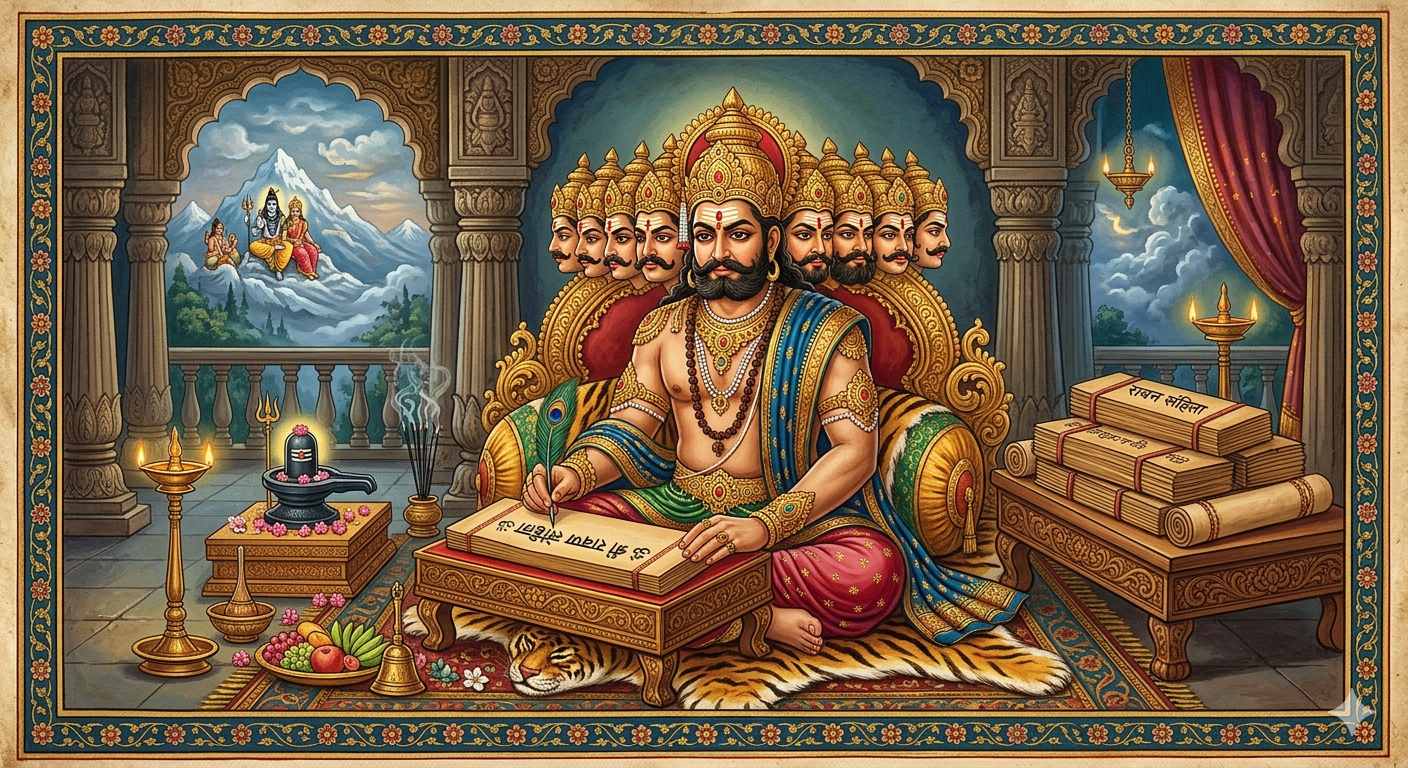
Ancient Tantric Scripture · Deep Research
रावण संहिता
Rāvaṇa Saṃhitā — The King’s Forbidden Knowledge
Structure · Rituals · Mantras · Success Secrets · Esoteric Teachings
“Things which are hidden even to the gods — those I shall reveal to you. Pay attention to what I tell you. Whosoever shall accept what I have to say, he shall be freed from the burden of wrongdoing.”
— Lord Śiva to Rāvaṇa, Rāvaṇa Saṃhitā
Table of Contents
1. Who Was Rāvaṇa? The Scholar-King of Laṅkā
2. Origin of the Rāvaṇa Saṃhitā — The Divine Transmission
3. Structure of the Rāvaṇa Saṃhitā — The Six Khaṇḍas
4. Other Works Attributed to Rāvaṇa
5. Śiva’s Secret Teachings — Direct Dialogue with Rāvaṇa
6. Rituals Humans Can Practise from the Rāvaṇa Saṃhitā
7. Special Mantras from the Rāvaṇa Saṃhitā
8. Secrets of Success — What Rāvaṇa Saṃhitā Reveals
9. Jyotiṣa (Astrology) in the Rāvaṇa Saṃhitā — Nakṣatra Wisdom
1. Who Was Rāvaṇa? The Scholar-King of Laṅkā
History has remembered Rāvaṇa chiefly as the antagonist of the Rāmāyaṇa — the ten-headed demon-king who abducted Sītā and was slain by Rāma. But this portrait is a sliver of a vastly more complex figure. Rāvaṇa was simultaneously one of the greatest scholars, astrologers, musicians, physicians and devotees in all of Hindu cosmology. He mastered all four Vedas at the age of four. The gods themselves feared his intellectual and spiritual power.
Rāvaṇa was born to Viśravaṇa Ṛṣi — a great Brahmin sage — and Kaikasī, a demoness. He thus united in his blood the highest Brahminical wisdom and the raw power of the Rākṣasa lineage. He made the best use of his demoniacal strength and Brahmanical wisdom, and became the most ardent devotee of Lord Śiva in all the three worlds.
Rāvaṇa’s Known Mastery (as documented in various Purāṇas):
| Jyotiṣa (Astrology) | Considered the standard reference even today |
| Āyurveda (Medicine) | Invented the Arka Śāstra — medicinal distillates |
| Music (Vīṇā) | Invented the Rāvaṇahasta Vīṇā; performed for Śiva himself |
| Tantra & Mantra | Author of the most powerful Śabara/Aghora mantras |
| Architecture (Vāstu) | Designed and built the golden city of Laṅkā |
| Yoga & Pulse Diagnosis | Documented in dialogue with Mandodarī |
| All Four Vedas | Mastered at age four; well versed in Śāstras |
It is interesting to note that Rāvaṇa did not harm Hanumān during the latter’s visit to Laṅkā — and was unable to harm him. Scholars believe this was because Hanumān is considered an avatāra of Lord Śiva, whom Rāvaṇa worshipped with the deepest devotion. Even an enemy’s devotion commands cosmic respect.
2. Origin of the Rāvaṇa Saṃhitā — The Divine Transmission
The Rāvaṇa Saṃhitā (Sanskrit: रावण संहिता) is not a text composed by a mortal scholar at a writing desk. It is a divine transmission — a compilation of secrets and rules revealed by Lord Śiva himself to Rāvaṇa. The text is considered a Tantric-Āgamic scripture of the highest order.
The story of how this transmission happened is itself remarkable. One day, Śiva entered the house of Rāvaṇa and found him sleeping. Rāvaṇa prostrated himself upon the floor in reverence. With folded hands, he requested Śiva to forgive him for his offence of sleeping when a divine guest had arrived. Śiva replied that human birth was a difficult one to achieve, and it did no credit to Rāvaṇa’s intelligence to be daydreaming during such a time.
Rāvaṇa asked Śiva to order him as to which undesirable works he must shed. Śiva replied: “My friend, things which are hidden even to the gods — those I shall reveal to you.” This is the origin moment of the Rāvaṇa Saṃhitā: a god choosing a demon-scholar as the worthy vessel for cosmic secrets precisely because of his capacity for devotion and learning.
According to one tradition, the text was originally compiled in Sanskrit and is thought to have been transcribed by Hanumān — making this one of the great cosmic ironies: Rāvaṇa’s greatest enemy preserved his greatest wisdom for the world.
The text is structured as a dialogue between Rāvaṇa and his wife Mandodarī — one of the most learned women of her age, who poses the questions and draws out the knowledge. This dialogic structure (Saṃvāda) is shared with other great Sanskrit texts like the Bhagavad Gītā (Kṛṣṇa-Arjuna) and Devī Bhāgavata (Śiva-Pārvatī).
3. Structure of the Rāvaṇa Saṃhitā — The Six Khaṇḍas
The Rāvaṇa Saṃhitā is organized into six main Khaṇḍas (sections or divisions), each dedicated to a distinct domain of knowledge. This structure reflects the encyclopaedic breadth of Rāvaṇa’s learning — no single field of human or divine knowledge escaped his attention.
4. Other Works Attributed to Rāvaṇa
Beyond the Saṃhitā, Rāvaṇa is attributed with several other remarkable texts, each reflecting a different dimension of his knowledge:
| Text | Subject | Significance |
|---|---|---|
| Arka Prakāśa | Āyurveda | A treatise on medicinal distillates (Arka Kalpanā) from the Arka plant; bridges medicine and astrology |
| Kumāra Tantra | Paediatric Medicine | Written for Queen Mandodarī; treatments specifically for infant diseases |
| Uḍḍīśa Tantra | Tantra | Advanced tantric practices; written upon Mandodarī’s request |
| Śiva Tāṇḍava Stotra | Devotional Hymn | One of the greatest Sanskrit hymns ever composed; recited by devotees globally |
| Rāvaṇa Saṃhitā (Jyotiṣa) | Astrology & Palmistry | Still used as standard reference by Vedic astrologers; English translation by Swami Premanand & Bharti Agrawal |
5. Śiva’s Secret Teachings — The Direct Dialogue
One of the most remarkable preserved portions of the Rāvaṇa Saṃhitā is the direct dialogue section where Śiva imparts hidden wisdom to Rāvaṇa. These are not mantras or rituals — they are eternal life principles, presented as Śiva’s personal guidance. Below are the most significant teachings, drawn from the publicly available portion of the text:
THE TEACHINGS OF ŚIVA TO RĀVAṆA
“`
“A man should not blow out a burning lamp.” — Extinguishing a lit lamp on sacred occasions destroys spiritual merit and invites Alakṣmī (misfortune) into the home.
“On the day of the fast, the deity being worshipped resides in the body of the person. Thus one should be clean, sleep upon the floor and stay away from company. If one subsists on a diet of fruits and donates to Brahmins, the gods will be pleased.”
“Among all the metals, copper is the purest. When a person bathes with a copper vessel, the effect is the same as bathing in the waters of the holy Gaṅgā.”
“Whatever works you do, do so in the name of Nārāyaṇa (God); no blame shall come upon you, and you shall remain free from distress.”
“No harsh and malicious words should escape from the lips of a married man to his wife. Because his wife is his better half and the first among his well-wishers.”
“If, morning to nightfall, a man sits idly upon the threshold of his home, then the wealth he has acquired through meritorious deeds shall be depleted; and his debts shall grow.” — Idleness at the threshold is spiritually and practically ruinous.
“If a person is sitting in the company of others and brings food along, he should not eat alone.” — Sharing food is a sacred duty; eating alone while others go hungry is a sin.
“The person who makes still the mind and listens to religious discourses with emotion and feeling, he shall attain to heaven.”
“Cutting down a Mango tree is no less than killing a Brahmin; and the merit gained from planting a garden full of trees is equal to a thousand sacrifices.”
“The person who is wrathful and displeased at the wealth or prosperity of others, that person will become a pauper in this world and will suffer in the other world.” — Envy is the single most powerful destroyer of personal prosperity.
“`
6. Rituals Humans Can Practise from the Rāvaṇa Saṃhitā
The Rāvaṇa Saṃhitā contains several practical rituals — grounded in Śaiva Tantra and Jyotiṣa — that are accessible to sincere practitioners. Below are the key rituals described in the text and its commentaries, with instructions drawn from published sources.
7. Special Mantras from the Rāvaṇa Saṃhitā
The Rāvaṇa Saṃhitā contains what are considered the most powerful Śabara and Aghora mantras in the entire Sanskrit corpus. Rāvaṇa’s mantras have a reputation for instant results — but also for severe consequences if performed incorrectly. The following are publicly documented mantras from scholarly and devotional sources:
① Śiva Tāṇḍava Stotra (Selected Verse) — For All-Round Blessings
The most famous composition of Rāvaṇa. Reciting at Pradoṣa time brings stable Lakṣmī.
kadā nilimpanirjharī nikuñjakoṭare vasan
vimuktadurmatiḥ sadā śiraḥsthamañjaliṃ vahan |
vimuktalolalocano lalāṭaphālalagnakaḥ
śiveti mantramuccaran sadā sukhī bhavāmyaham ||
“When shall I, dwelling in the hollow by the celestial stream, free from evil thoughts, with joined palms upon my head, with unsteady eyes fixed on the forehead’s centre, chanting the mantra of Śiva, be forever happy?”
Rāvaṇa’s Promise (verse 15): “He who recites this hymn sung by the ten-headed one at the conclusion of worship, at the time of Pradoṣa — Lord Śambhu will bestow upon him steady wealth accompanied by elephants, chariots and horses, and a pleasant Lakṣmī.”
② Mahāmṛtyuñjaya Mantra — For Protection, Health and Long Life
The most important Śiva mantra for overcoming death, disease and fear. Rāvaṇa Saṃhitā describes the Mahāmṛtyuñjaya as the supreme protective mantra for all practitioners.
ॐ त्र्यम्बकं यजामहे सुगन्धिं पुष्टिवर्धनम्।
उर्वारुकमिव बन्धनान् मृत्योर्मुक्षीय मामृतात्॥
Om Tryambakaṃ Yajāmahe Sugandhiṃ Puṣṭivardhanam | Urvārukamiva Bandhanān Mṛtyormukṣīya Māmṛtāt ||
Meaning: “We worship the three-eyed Lord Śiva who is fragrant and who nourishes all beings; may He liberate us from death for the sake of immortality, even as the cucumber is severed from its bondage to the creeper.”
Practice: 108 times daily on a Rudraksha mālā. Especially powerful during Śrāvaṇa (July–August), Mahāśivarātri, and on Mondays.
③ Sarasvatī Dhana Mantra — For Wealth Through Knowledge
For those facing obstacles in acquiring wealth. This Tantric mantra is to be chanted for 40 consecutive days without break.
ॐ सरस्वती ईश्वरी भगवती माता
क्रम् क्लीं श्रीं श्रीं मम धनं देहि फट स्वाहा
Om Sarasvatī Īśvarī Bhagavatī Mātā Kram Klīm Śrīm Śrīm Mama Dhanaṃ Dehi Phaṭ Svāhā
Practice: Morning and evening chanting for 40 unbroken days. Face East during morning session; face West during evening session.
Source: Sadhguru.org.in — Unlocking Destiny’s Glow from the Rāvaṇa Saṃhitā (June 2024)
④ Rāvaṇa’s Vijayadaśamī Mantra — For Overcoming Enemies and Discord
This mantra was written by Rāvaṇa in his final moments after being slain by Rāma. It is to be chanted on Vijayadaśamī (Daśaharā day) — 108 times. It is especially effective for those facing family discord, legal battles and persistent enemies.
लां लां लां लंकाधिपतये लीं लीं लीं लंकेश
लूं लूं लूं जिव्हान् शीघ्र आगच्छ आगच्छ
चन्द्रनहास खादेन मम शत्रुन् विर्दारय विर्दारय
मारय मारय काटय काटय हूं फट स्वाहा
Lām Lām Lām Laṅkādhipataye Līm Līm Līm Laṅkeśa Lūm Lūm Lūm Jivhān, Śīghra Āgaccha Āgaccha Candranāhāsa Khādena Mama Śatrun Virdāraya Virdāraya Mārayamārayakāṭaya Kāṭaya Hūṃ Phaṭ Svāhā
Source: Boldsky.com — Rāvaṇa Mantra for Abundant Wealth, Domestic Bliss and Wish Fulfilment (April 2023)
⑤ Mahāmṛtyuñjaya Yantra Upāsanā — For Relief from Disease
The Rāvaṇa Saṃhitā prescribes the Mahāmṛtyuñjaya Yantra as particularly efficacious against dreadful diseases. The yantra is to be engraved or written on copper or silver plate, or on Bhojapatra (birch bark) during an auspicious Lagṇa.
Procedure:
• Inscribe the Yantra on a copper plate during a Śubha Muhūrta
• Purify it with Pañcāmṛta (milk, curd, honey, ghee, sugar) and mantra chanting
• Perform 10,000 Japas of the Mahāmṛtyuñjaya Mantra over the Yantra
• Offer 1,000 Tarpanas (water offerings) with cool pure water
• Perform a Homa (fire ritual) with Bilva fruits and honey
• Wear or place the Yantra as directed — it relieves all dreadful diseases
Source: Scribd — Secrets of Mantra Tantra and Yantra (document index 327573989)
8. Secrets of Success — What the Rāvaṇa Saṃhitā Reveals
Beyond mantras and rituals, the Rāvaṇa Saṃhitā contains profound psychological and karmic principles for worldly success. These are not mere platitudes — they are encoded wisdom from Śiva himself, delivered through the most intellectually powerful demon-king in history. Implement these principles and watch your life transform.
“`
🔑 Secret 1: Envying others’ wealth is the single greatest destroyer of your own wealth
Śiva explicitly states: “The person who is wrathful and displeased at the wealth or prosperity of others, that person will become a pauper in this world and will suffer in the other world.” This is not moral advice — it is a karmic law. Every moment of envy at another’s success actively transfers your prosperity to them. The Saṃhitā prescribes instead the practice of Muditā — genuine joy at others’ success — as the highest prosperity ritual.
🔑 Secret 2: Idleness at the threshold of home destroys earned merit
“If morning to nightfall a man sits idly upon the threshold of his home, the wealth he has acquired through meritorious deeds shall be depleted and his debts shall grow.” The threshold (Dehaḷī) of the home is a liminal space — neither inside nor outside. Habitual loitering there signals to the cosmic forces a confusion of purpose and direction. Rāvaṇa’s success principle: move with intent, always. Begin each day before sunrise with clear purpose.
🔑 Secret 3: Focus on one mantra — dig one well deep, not many shallow pits
Rāvaṇa’s own commentary on his mantras warns: “Focus on one particular wish and get it fulfilled rather than chanting all the mantras at once. You will always find water if you dig the well deeper in one place than digging many pits all over the place.” This principle applies to careers, investments and spiritual practices equally. Rāvaṇa’s success came from absolute, unwavering focus on Śiva — one deity, one devotion, the highest mastery.
🔑 Secret 4: The copper vessel — use it for your morning bath
Śiva tells Rāvaṇa: “Among all the metals, copper is the purest. When a person bathes with a copper vessel, the effect is the same as bathing in the waters of the holy Gaṅgā.” Modern science confirms that copper has powerful antimicrobial properties. Store water overnight in a copper vessel and use it for your morning bath. This single daily practice — according to the Rāvaṇa Saṃhitā — purifies the energy body and opens the channels of prosperity.
🔑 Secret 5: Perform everything in the name of God — this makes you karma-free
“Whatever works you do, do so in the name of Nārāyaṇa (God); no blame shall come upon you, and you shall remain free from distress.” This is the Karma Yoga principle at its most practical: dedicate every action — professional, personal, creative — to the divine. This does not mean passivity; it means operating from a space of surrender rather than ego. Rāvaṇa himself, for all his power, attributes every achievement to his devotion to Śiva. The lesson is clear: cosmic alignment amplifies human effort.
🔑 Secret 6: Plant trees — this merit equals a thousand sacrifices
“The merit gained from planting a garden full of trees is equal to a thousand sacrifices.” The Rāvaṇa Saṃhitā encodes a principle that modern environmental science is only beginning to understand: our relationship with trees is a karmic investment. Cutting a Mango tree is equated with killing a Brahmin. Planting five or more trees in one’s lifetime is described as a merit so vast it outweighs thousands of formal rituals. For those unable to perform elaborate Yajñas — plant a tree.
🔑 Secret 7: Honour the ancestors — this removes the deepest karmic blocks
The Saṃhitā repeatedly emphasises Pitṛ Ṛṇa — the debt to ancestors. “Fasting, paying respect to one’s deceased ancestors, and worship — one must observe these; one must not be indifferent to them.” In Jyotiṣa, Pitṛ Doṣa (the planetary affliction caused by unsatisfied ancestors) is responsible for the most intractable life problems: financial ruin that persists despite effort, repeated miscarriages, broken marriages, and mental illness. The Rāvaṇa Saṃhitā prescribes monthly Pitṛ Tarpaṇa on the New Moon as a minimum duty.
🔑 Secret 8: Equanimity is the highest practice — happiness and sorrow, seen with one eye
“Man should be satisfied with what God has given; happiness and sorrow, gain and loss, good and bad — these should be seen with equanimity. When the end approaches, mother and father cannot help you, nor can your brother; it is only your good deeds that stand by you.” This is the ultimate success philosophy of the Rāvaṇa Saṃhitā: success is not measured in gold but in the karma you accumulate. The most stable foundation for worldly achievement is spiritual equanimity — because a mind that is not disturbed by failure is also not destroyed by it.
“`
9. Jyotiṣa in the Rāvaṇa Saṃhitā — Nakṣatra Wisdom
The Nakṣatra Khaṇḍa of the Rāvaṇa Saṃhitā is considered an extraordinary contribution to Vedic astrology. Rāvaṇa analyses each of the 27 Nakṣatras with a granularity that no other single text provides. Below is a sample of the astrological logic embedded in the text:
The Rāvaṇa Saṃhitā’s Core Astrological Principle:
“The beauty of the Rāvaṇa Saṃhitā is that a planet in one Pāda will give bad results, but in the very next Pāda of the same Nakṣatra it can give excellent results. This difference is subtly highlighted.” (Saptarishis Astrology Magazine, Nakṣatra Pādas in Rāvaṇa Saṃhitā — Rohiṇī)
This principle — that destiny shifts not just at the level of the Nakṣatra but at the level of its quarter-degree divisions — is what makes the Rāvaṇa Saṃhitā a precision instrument. Most astrology works at the sign or Nakṣatra level; Rāvaṇa works at the Pāda level, giving four times the resolution.
| Nakṣatra | Key Rāvaṇa Saṃhitā Insight |
|---|---|
| Rohiṇī | Sun here with Moon aspect: earns through serving women, transport and water-related work. Jupiter’s aspect makes one religious and devoted to parents. |
| Punarvasu | Moon with Sun aspect: fears relatives, unable to gain wealth away from home. Jupiter’s aspect: expert in Tantra-Mantra and Astrology. |
| Ārdrā | The golden period for natives is between age 32 and 42. Often settled in foreign lands. May work in transport, shipping or communication. |
| General Rule | Saturn’s aspect almost always brings government benefits and wealth, but delayed. Venus’s aspect brings vehicles, ornaments and domestic comfort but sometimes debt. |
10. Sources and References
All sources used are publicly available. Primary texts are classical Sanskrit scriptures; secondary sources are scholarly, devotional and academic publications.
Primary Texts
• Rāvaṇa Saṃhitā (Sanskrit original) — Khanda 1–7. Multiple manuscript traditions.
• Ravan Sanhita (Mantra, Tantra and Yantra) — English trans. Swami Premanand & Bharti Agrawal. DPB Publications. ASIN: B00I3L041I
• Tantratmak Ravan Samhita (2 Vols.) — Pt. Shivakant Jha. (Hindi)
• Asli Pracheen Ravan Samhita — Pt. Kishan Lal Sharma. Manoj Publications, Delhi. Available: archive.org
• Ravan Samhita — Acharya Pt. Shivkant Jha. Internet Archive: archive.org/details/ravan-samhita-1
Online Published Sources
“Only after a great deal of effort, and a good deal of prayer and devotion, does a man attain to his ends. Man should be satisfied with what God has given — happiness and sorrow, gain and loss, good and bad — these should be seen with equanimity.”
— Lord Śiva to Rāvaṇa · Rāvaṇa Saṃhitā