Puranic Deep Research
समुद्र मंथन
The Churning of the Cosmic Ocean
Origins · Characters · Svarbhānu’s Secret Life · The 14 Ratnas · Hidden Mysteries
“When the Ocean of Milk was churned, creation itself held its breath — for from the same cosmic womb emerged both the deadliest poison and the sweetest nectar of immortality.”
— Vishnu Purāṇa
Table of Contents
1. The Cosmic Crisis — Why Did Samudra Manthan Happen?
2. Key Characters and the Events That Led to the Churning
3. Svarbhānu — Birth, Lineage, Youth and Destiny
4. The Daring Infiltration and the Beheading
5. The 14 Ratnas — A Complete Detailed Account
1. The Cosmic Crisis — Why Did Samudra Manthan Happen?
The story of the Churning of the Ocean of Milk — Samudra Manthana (Sanskrit: समुद्रमन्थन) — is one of the grandest episodes in all of Hindu cosmology. The event is elaborated in the Vishnu Purāṇa, a major sacred text of Hinduism, and explains the origin of amṛta, the elixir of eternal life. It also appears in the Bhāgavata Purāṇa and the Mahābhārata.
To understand why this event happened, we must first travel far back — before the churning itself — to a single, seemingly small act of arrogance that shattered the divine order of the three worlds.
1.1 The Eternal Conflict: Devas vs. Asuras
The Devas occupied heaven (Svarga) and represented the forces of good, while the Asuras represented their opposite. Indra was the king of all Devas — others included Varuna (the water god), Pawan (the wind god), and many more. The demons were their strong opponents, in constant battle to overpower the heavenly lands.
There were constant wars between the Devas and the Asuras. The Asuras always won, due to their guru Shukracharya’s Mṛtasañjīvanī power — obtained through penance to Lord Shiva — which could resurrect the dead back to life. This gave the Asuras an almost unassailable military edge, for every fallen demon could be brought back, while fallen Devas remained dead.
1.2 Sage Durvāsā and the Fateful Garland
Into this already tense cosmic scenario came one of Hinduism’s most volatile sages: Durvāsā. In the Vishnu Purāṇa, Vayu Purāṇa, and the Padma Purāṇa, a curse that Durvāsā laid upon Indra is described as the indirect reason for the Samudra Manthana.
According to the Vishnu Purāṇa, Durvāsā, while wandering the earth in a state of ecstasy due to a vow he was observing, came by a Vidyādharī (nymph of the air) and demanded her heavenly wreath of flowers. The nymph respectfully gave the garland to the sage, whereupon he wore it on his brow. Resuming his wanderings, Durvāsā came across Indra riding his elephant, Airāvata, attended by the gods.
What happened next was a cosmic turning point. Indra placed the garland on his mount, Airāvata, an elephant, who tossed the garland to the ground when swarmed by bees. Known for his irascible nature, Durvāsā was enraged and cursed Indra and all the Devas, causing them to lose their divine strength.
The garland was no ordinary gift. It was a representation of the great spiritual power of Lakṣmī, a symbol of fortune itself. By having Airāvata trample it, Indra had not merely disrespected a sage — he had spurned the very goddess of prosperity. With this act, Goddess Lakṣmī vanished from the world. The three realms were plunged into scarcity, weakness and fear.
“Durvāsā was enraged to see his gift treated so callously and cursed Indra that he would be cast down from his position of dominion over the three worlds, just as the garland had been cast down. Indra immediately begged Durvāsā’s forgiveness, but the sage refused to retract or soften his curse.”
1.3 The Fall of the Devas and Bali’s Conquest
Because of the curse, Indra and the Devas were diminished in strength and stripped of their lustre. Seizing this opportunity, the Asuras led by Bali waged war against the gods. The gods were routed and turned to Brahmā for help. Brahmā directed them to seek refuge with Vishnu.
Taking advantage of the Devas’ weakness, the Asuras, led by their king Bali, waged war and gained control over the three worlds — Svarga (heaven), Bhūmi (earth), and Pātāla (the underworld).
1.4 Vishnu’s Cunning Solution
Vishnu advised the Devas to call a truce with the Asuras and help them churn the ocean of milk to obtain the amṛta (nectar of immortality), on the pretext of sharing it with them. The strategy was brilliant in its deception: Vishnu knew the Devas could not defeat the Asuras in their weakened state, but if they could acquire amṛta, immortality itself would be their weapon.
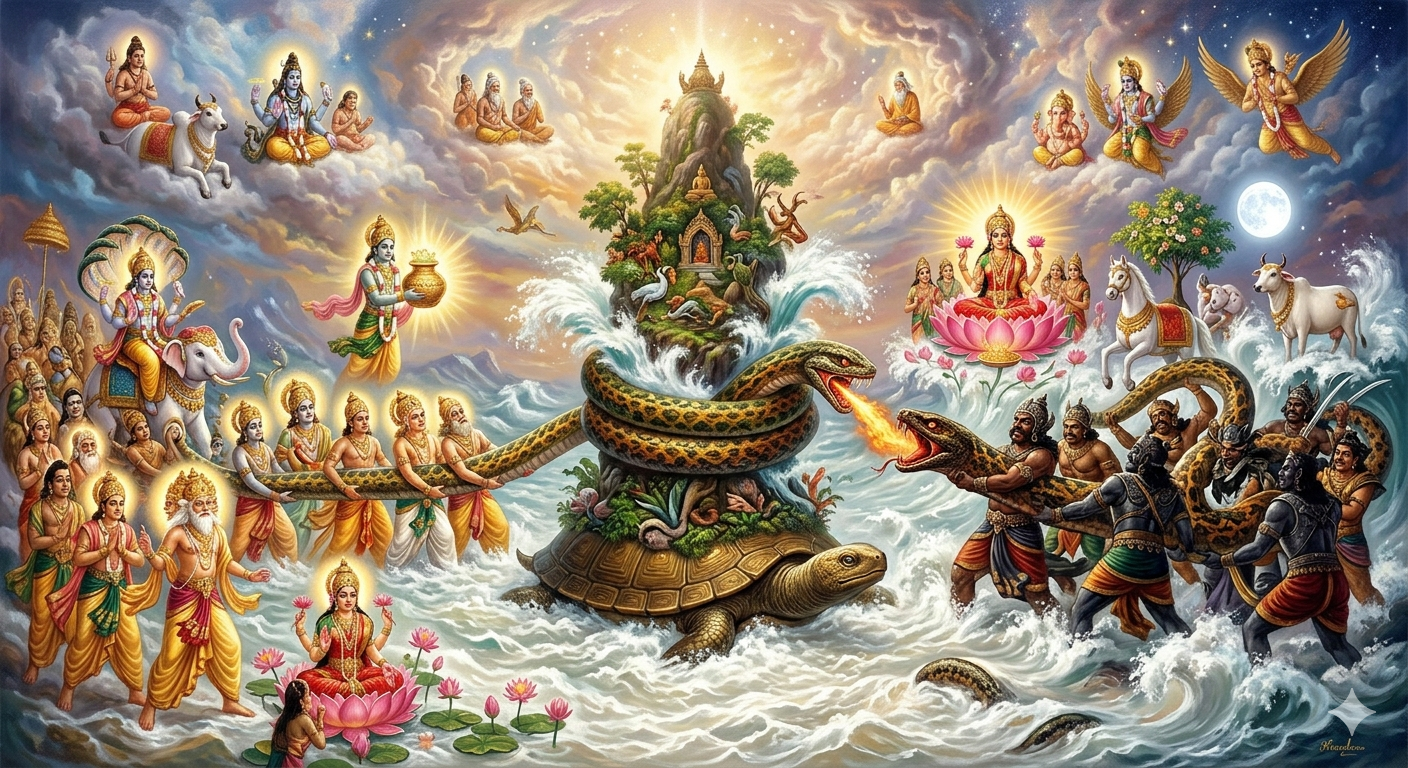
The ocean churning operation was not a regular assignment. Both Devas and Asuras agreed to a temporary truce and started the cosmic process: Mount Mandara was used as the churning rod; Vāsuki, the serpent king, was used as the churning rope; and Lord Vishnu took the form of a giant tortoise (Kūrma Avatāra) and supported the mountain on his back to prevent it from sinking.
The Devas held Vāsuki’s tail while the Asuras took his head. This arrangement, though seemingly advantageous to the Asuras, actually placed them directly in the path of the serpent’s toxic fumes — yet another layer of Vishnu’s divine strategy.
2. Key Characters and Their Roles
| Character | Nature | Role in the Event |
|---|---|---|
| Indra | Deva (King of Gods) | His arrogance triggers Durvāsā’s curse; he leads the weakened Devas |
| Sage Durvāsā | Ṛṣi (Sage) | Offers the Lakṣmī garland; curses Indra when it is disrespected |
| Vishnu | Deva (Preserver) | Devises the churning plan; takes Kūrma & Mohinī avatāras |
| Bali | Asura (Demon King) | Leads the Asuras in the conquest of the three worlds and the churning |
| Shukrācārya | Asura Guru | Possessor of Mṛtasañjīvanī — revives dead Asuras, making them near-invincible |
| Vāsuki | Nāga King | Used as the churning rope; his head-end breathes poison on the Asuras |
| Lord Shiva | Deva (Destroyer) | Consumes the deadly Halāhala poison to save all creation; becomes Nīlakaṇṭha |
| Svarbhānu | Asura | The demon who disguises himself as a Deva to drink Amṛta; becomes Rāhu and Ketu |
| Mohinī | Vishnu’s Avatāra | The enchantress form of Vishnu who distributes Amṛta only to the Devas |
3. Svarbhānu — Birth, Lineage, Youth and Destiny
Of all the characters woven into the fabric of Samudra Manthana, none carries a more tragic, complex and astronomically significant fate than Svarbhānu (Sanskrit: स्वर्भानु — lit. “Splendour of Radiance”). He is the demon who would become two of the nine celestial bodies that govern human destiny in Jyotiṣa (Vedic astrology): Rāhu and Ketu.
3.1 The Family Tree — A Lineage of Titans
Svarbhānu’s origins run back to the very roots of Asura cosmology. All demons, gods, and divine beings shared an ancestral lineage. Dakṣa’s thirteen daughters were married to Sage Kaśyapa. Among them were two sisters — Diti and Aditi. While Aditi gave birth to the Devas (gods), Diti gave birth to the demons (Daityas).
Sage Kaśyapa’s wife Diti is the ancestral mother of Asuras. Siṃhikā was the daughter of Diti and Kaśyapa. Siṃhikā got married to a demon known as Viprasiddhi (also called Vipracitta). They gave birth to a child known as Svarbhānu.
Let us examine the meaning of these names, for in Sanskrit, names are not random labels but cosmic titles:
Vipracitta — “Vipra” means a seer, priest, holy one, highest intelligence in motion; “Citta” means mind, intention, thought and memory. Together: a pure, elevated intelligence in action. Vipracitta is a pure, elevated intelligence in action — an Asura king of remarkable mental power.
Siṃhikā — “The Little Lioness.” Siṃhī means lioness, symbolising rulership and the control of life and death. Lion symbolises rulership — the power to protect one’s family and people, and even to control life and death.
Svarbhānu — “Svar” means vowels, a musical note, sound energy, sunshine, bright space, heaven, the air breathed through the nose, the number seven, and the space between the Sun and the Pole Star. “Bhānu” means the Sun, master, king, appearance, ray of light, illumination. Thus Svarbhānu would be the conscious intelligence of the very prāṇa (vital energy) one breathes in — the light seen at the topmost point of one’s internal Meru, the radiance of the king.
3.2 Birth and Physical Form
Svarbhānu’s body, from birth, had the head of a demon and the torso of a serpent, appearing dark and fearsome. This extraordinary form was not merely a physical feature — it was prophetic. The serpentine lower body prefigured his eventual transformation into the two shadow-planets of the lunar nodes.
His mother Siṃhikā was no ordinary demoness. Lord Brahmā granted Siṃhikā the power to control anyone’s shadow. This power — of grasping through shadows — would later be passed, in a sense, to Svarbhānu’s transformed selves, Rāhu and Ketu, who operate as shadow planets in astrology — unseen forces that wield immense power precisely because they act through darkness and illusion.
Siṃhikā was also the offspring of the demon king Hiranyakaśipu and the sibling of the great devotee Prahlāda. This is remarkable — the same bloodline that produced Prahlāda, one of Vishnu’s most beloved devotees, also produced Svarbhānu. Light and shadow born from the same cosmic womb.
3.3 The Prophecy — A Demon Destined for Divinity
One of the most startling facts about Svarbhānu is that his cosmic elevation was predicted before birth. As soon as Rāhu was born, the guru of the demons, Śukrācārya, predicted — after examining his horoscope — that the son of the famous Siṃhikā would attain the status of a deity. Until then, no demon had achieved such a position.
This prophecy terrified the Devas. When the gods learned of this, they devised a plan to remove Svarbhānu from their path. But Siṃhikā kept her son well-guarded, and with every generation the demonic lineage grew stronger.
3.4 His Youth — A Warrior Among Warriors
Rāhu (Svarbhānu) was the eldest of 100 brothers. He also had a sister by the name Māhiṣmatī. His brothers included Śalya, Nabha, Vātāpi, Ilvala and Namuci. This was a dynasty of powerful and battle-hardened Asuras.
From the Rigveda’s earliest hymns, Svarbhānu was already a cosmic force. In Rigveda 5.40.5–9, attributed to the seer Atri, Svarbhānu is described as piercing Sūrya (the Sun) “through and through with darkness,” bewildering all creatures and halting the Sun’s course. This act — predating the Purāṇic story of Samudra Manthana — shows that Svarbhānu was already ancient, already feared, already a wielder of cosmic-scale power before the ocean was ever churned.
In the Mahābhārata, Svarbhānu is depicted as a formidable Asura and celestial entity antagonistic to Sūrya (the Sun) and Candra (the Moon), embodying the cosmic tensions between Asuras and Devas. A key description appears in the Bhīṣma Parva, where Svarbhānu is characterized as a massive globular planet, larger than the Sun and Moon, capable of enveloping them — measuring 12,000 yojanas in diameter and 42,000 yojanas in circumference, compared to the Sun’s 10,000 yojanas in diameter and the Moon’s 11,000 yojanas in diameter.
Svarbhānu was also an assistant of Śukra, the teacher of the Asuras and deity of the planet Venus. He was thus deeply embedded in the inner circle of Asura power — not a minor demon, but a cosmic force with royal lineage, a divine prophecy, and command of the very mechanisms of eclipse.
4. The Daring Infiltration — and the Birth of Rāhu & Ketu
When Mohinī — Vishnu’s enchanting female form — began distributing Amṛta to the Devas, the Asuras sat in their own row, entranced by her beauty, their judgment clouded. It was in this moment that Svarbhānu executed what may be history’s most audacious act of cosmic deception.
An Asura named Svarbhānu disguised himself as a Deva and drank some nectar. Due to their luminous nature, the deities of the Sun and Moon — Sūrya and Candra — noticed this disguise. They informed Mohinī who cut off his head with her discus, the Sudarśana Cakra.
However, a few drops of Amṛta had already gone into his mouth, hence both severed parts acquired immortality. The head is called Rāhu and the body Ketu. Siṃhikā nurtured the head of Svarbhānu, which was joined with a snake’s body. The severed body of Svarbhānu was nurtured by a Brahmin named Mini.
Lord Brahmā made Svarbhānu’s head and body join with a snake — the head joining a snake’s body became known as Rāhu, and the snake’s head joined with Svarbhānu’s body became known as Ketu. Lord Brahmā then granted Rāhu and Ketu a boon for accepting this new form: a place amidst the planets — the Navagraha.
And so from one demon, two eternal celestial forces were born — forces that to this day govern the lunar nodes of Vedic astrology and are held responsible for every solar and lunar eclipse on Earth.
Rāhu and Ketu constantly chase the Sun and the Moon for revenge, as they are the cause of separating the head and body of the Asura Svarbhānu. When they succeed in catching the Sun and Moon, they swallow them, causing a solar or lunar eclipse — but they cannot hold them for long, and the Sun and Moon emerge again intact as they also had nectar and are immortal.
5. The 14 Ratnas — Complete Detailed Account
Though the ratnas are usually enumerated as 14, the list in the scriptures ranges from 9 to 14. According to the quality of the treasures produced, they were claimed by Shiva, Vishnu, Maharishis, the Devas, and the Asuras. Each Ratna is not merely a mythological object — it carries cosmological, philosophical and astronomical significance.
6. Secrets and Esoteric Truths of Svarbhānu
Beyond the popular narrative of an Asura who drank nectar by deceit, Svarbhānu holds layers of cosmological, astronomical and spiritual meaning that most retellings never reach. Here are the deepest secrets preserved in the texts.
🔮 Secret 1: Svarbhānu Predates the Samudra Manthana by Cosmic Ages
Svarbhānu appears in the Family Books of the Rigveda as a malevolent Asura who disrupts cosmic order by attacking Sūrya (the Sun), enveloping him in darkness to create an eclipse-like obscurity. This is not the same narrative as Samudra Manthana — it is far older. There is no evidence in the Rigveda that Svarbhānu was identified as a graha (planet). In the epics, however, Svarbhānu is explicitly called a graha. This means the entity we know as Rāhu/Ketu existed as an ancient cosmic force long before the Purāṇic story elevated him to planetary status.
🔮 Secret 2: His Name Contains a Paradox — A “Radiant” Being of Darkness
Svarbhānu literally means “Splendour of Radiance.” Yet he is the lord of darkness, of eclipses, of shadow. This linguistic duality underscores the figure’s role in early astronomical mythology, blending light and shadow in its semantic core. The Vedic Svarbhānu is portrayed as an entity whose “radiance” manifests through the imposition of darkness during eclipses. The name is thus a perfect cosmological paradox: he is brilliance expressed as shadow — the hidden light. In Jungian terms, he is the Shadow-Self of the solar divine order: what is suppressed, denied, and yet eternally powerful.
🔮 Secret 3: He Was Larger Than the Sun and Moon — A Planet of Staggering Proportions
A key description in the Bhīṣma Parva of the Mahābhārata characterises Svarbhānu as a massive globular planet, larger than the Sun and Moon, capable of enveloping them due to its superior dimensions — measuring 12,000 yojanas in diameter and 42,000 yojanas in circumference, compared to the Sun’s 10,000 yojanas and the Moon’s 11,000 yojanas in diameter. This description is strikingly consistent with modern astronomy’s understanding that the lunar nodes (Rāhu and Ketu) define orbital planes of enormous cosmic scale. The “size” described is not physical but orbital and energetic — the sphere of influence of the node axis.
🔮 Secret 4: Rāhu and Ketu Are Mathematical Points, Not Physical Planets
The intelligence of the time/space around the Earth where the Sun and Moon apparently travel is called Svah (स्वः). In astronomy, Rāhu and Ketu are the points where the orbit of the Moon around the Earth intersects with the ecliptic — the apparent path of the Sun around the Earth. Our ancient sages identified these mathematically computed sensitive points on the ecliptic and gave them graha (planetary) status, recognising their enormous power over earthly and human cycles despite having no physical mass. Rāhu and Ketu are shadow planets without any physical existence. They acquire the qualities of the planets associated with them. Rāhu acts like Saturn and Ketu acts like Mars.
🔮 Secret 5: Śukrācārya Foresaw His Divinity — He Was Meant to Ascend
As soon as Svarbhānu was born, the guru of the demons, Śukrācārya, predicted after examining his horoscope that the son of the famous Siṃhikā would attain the status of a deity. Until then, no demon had achieved such a position. This means Svarbhānu’s ascension to the Navagraha was not an accident of deception — it was cosmically ordained from his very first breath. The “deception” at the ocean was the mechanism of destiny, not its subversion.
🔮 Secret 6: Svarbhānu Reincarnated as Ugrasena — Father of Kaṃsa
According to the Mahābhārata, Ādi Parva, Chapter 67, Verse 12 — Ugrasena, the father of Kaṃsa, was the rebirth of Svarbhānu. This is one of the most startling reincarnation links in all of Purāṇic literature. Ugrasena was the king of Mathurā, father of the demonic Kaṃsa, and grandfather — by lineage — of the very political drama that Lord Kṛṣṇa was born to resolve. The shadow of Svarbhānu thus fell across the Dvāpara Yuga, shaping the circumstances of Kṛṣṇa’s own birth and mission.
🔮 Secret 7: His Mother’s Shadow-Power Is His True Inheritance
Lord Brahmā granted Siṃhikā the power to control anyone’s shadow. She used this power during Hanumān’s journey across the ocean to Laṅkā — hidden beneath the water, she grasped Hanumān’s shadow and began pulling him down. Svarbhānu inherited this shadow-nature. As Rāhu and Ketu, he operates in the domain of the unseen — past karmas, subconscious patterns, collective illusions. In astrology, Rāhu is the shadow of desire and worldly obsession, while Ketu is the shadow of liberation and detachment. Both operate not through light but through what is cast behind the light.
🔮 Secret 8: Rāhu’s Eclipse Power Never Ceases — An Eternal Cosmic Mechanism
Rāhu and Ketu hold a grudge against Sūrya and Candra and continue endlessly to eclipse the Sun and Moon. Rāhu makes the Moon wax and wane daily and causes the lunar eclipse. Ketu is set to travel on the higher circuit of the Sun and causes the solar eclipse. Rāhu and Ketu’s power increases between sunset and sunrise. Their power of vengeance is so strong that they cause an astrological moment called Rāhu Kāl — which lasts every day for 1 hour and 30 minutes — representing inauspicious hours during which important activities should be avoided. Svarbhānu thus does not merely live in mythology — he governs daily human life through the Rāhu Kāl that every practising Hindu observes.
7. Sources and References
All sources used in this article are publicly available. Primary textual sources are ancient scriptures; secondary sources are academic and encyclopaedic works cited below.
Primary Sanskrit Scriptures
| Scripture | Key Sections | Relevance |
|---|---|---|
| Vishnu Purāṇa | Book I, Chapters 9–10 | Primary account of Samudra Manthana; Durvāsā’s curse |
| Bhāgavata Purāṇa (Śrīmad Bhāgavatam) | Canto 8, Chapters 5–12 | Detailed Samudra Manthana; Mohinī form; Rāhu-Ketu |
| Mahābhārata | Ādi Parva Ch. 16–18; Bhīṣma Parva | Svarbhānu’s cosmic dimensions; his reincarnation as Ugrasena |
| Rigveda | Book 5, Hymn 40 (5.40.5–9) | Earliest mention of Svarbhānu causing eclipse of Sūrya |
| Taittirīya Saṃhitā (Kṛṣṇa Yajurveda) | Kāṇḍa 2, Prapāṭhaka 1 | Svarbhānu piercing Āditya with darkness |
| Śatapatha Brāhmaṇa | Kāṇḍa 5, Adhyāya 3 | Ritualistic restoration of cosmic order after Svarbhānu’s eclipse |
| Hari-vaṃśa | Appendix to Mahābhārata | Svarbhānu ushering Kālanemī through the galaxy |
| Vārāha Purāṇa | Chapter 94 | Svarbhānu among the eight Rākṣasas in cosmic battle |
Online Academic & Encyclopaedic Sources
Academic Books (Public Domain / Widely Available)
• Bhattacharji, Sukumari. The Indian Theogony. Cambridge University Press, 1970.
• Mitchiner, John E. Traditions of the Seven Rishis. Motilal Banarsidass, Delhi, 1982.
• Kramrisch, Stella. The Presence of Śiva. Princeton University Press, 1981.
• Dumézil, Georges. Mythe et épopée. Gallimard, Paris, 1968–1973.
“From the churning of life emerge both poison and nectar — suffering and wisdom. What we choose to consume, and how we bear what we must, determines the gods and demons within us.”
— Interpretation of the Samudra Manthana metaphor, Bhāgavata Purāṇa