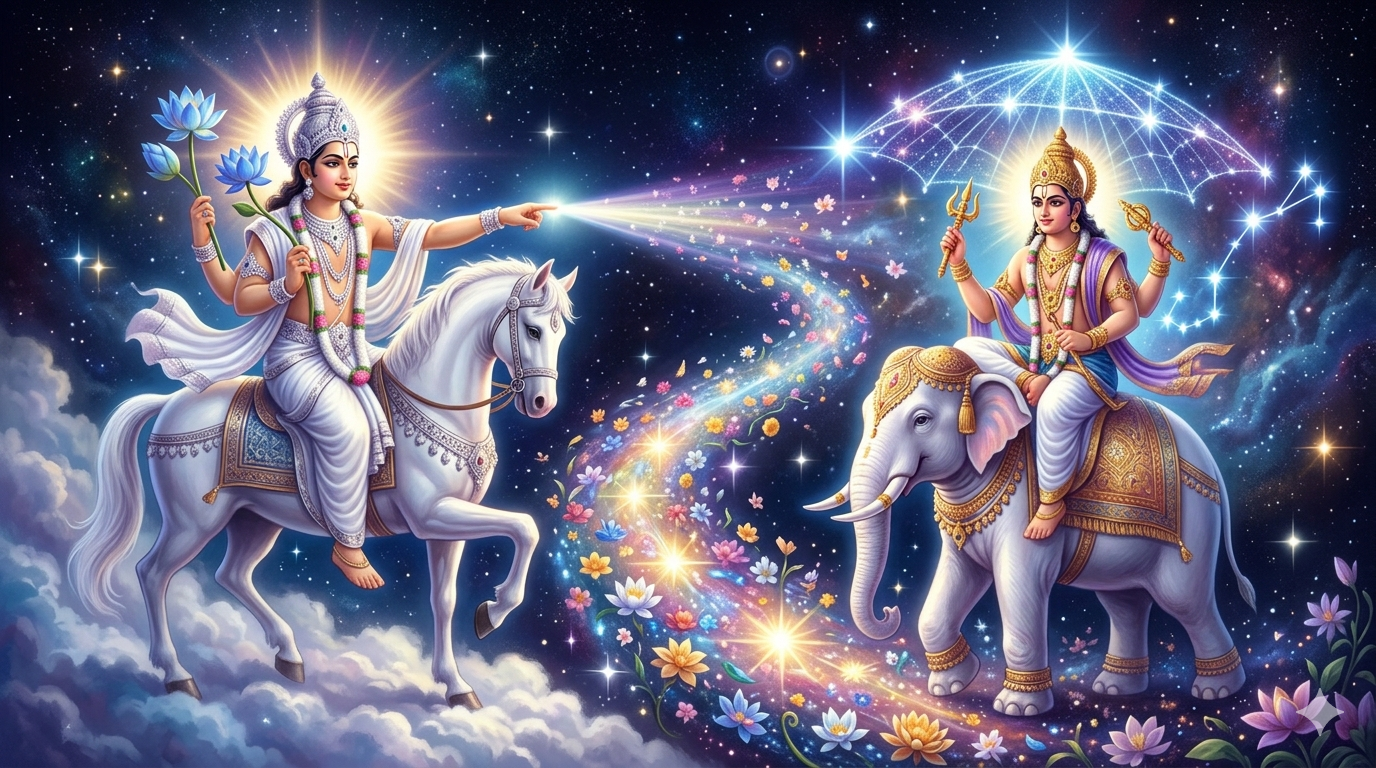
The Hundred Names of the Bright One
Jyeshthanakshatrasambhutāya
ज्येष्ठनक्षत्रसम्भूताय नमः
Why is Shukra — the planet Venus, preceptor of the Asuras — called He Who Arose from the Jyeshtha Nakshatra?
“`
How This Research Began
“`
The Name
“`
This is the 100th name in the Shukra Ashtottara Shatanamavali — the sacred litany of 108 names of the planet Venus. Its translation: “The One connected with / born of the Jyeshtha lunar mansion.”
Not merely a label, but a precise theological and astronomical statement about Shukra’s cosmic identity — encoding his lordship, his divine kinship, his supreme excellence, and his celestial origin all at once.
“`
Five Reasons
“`
I · The Calendrical Bond
Lord of the Month of Jyeshtha
Shukra is the presiding lord — the masa-adhipati — of Jyeshtha Masa, the Hindu month of May–June. In Vedic tradition, months are named after the nakshatra in which the full moon (Purnima) occurs. The month of Jyeshtha is so called because the full moon of that month falls in or near the Jyeshtha nakshatra.
Since Shukra holds dominion over this month, he is intrinsically bound to the Jyeshtha nakshatra — the 108-name litany enshrines this lordship in the very name Jyeshthanakshatrasambhutāya.
II · The Divine Kinship
Both Governed by Indra
The Adhidevata (secondary deity) of Shukra is Indra — King of the Gods. And Jyeshtha nakshatra is also presided over by Indra. This is a profound mythological convergence: both the planet and the asterism share the same divine patron.
There is a delicious cosmic irony here. Shukra was the preceptor of the Asuras — perennially at war with Indra. He led the underdog Asuras to victory again and again; on most occasions, Vishnu himself had to intervene to undo the damage Shukra wrought. Yet both Shukra and Jyeshtha nakshatra are presided over by Indra himself.
When both a graha and a nakshatra honour the same devatā, they are in sambandha — deep cosmic relation — and the graha is said to be “born of” or “arising from” that nakshatra in a celestial-genealogical sense.
III · The Semantic Cluster
Three Names, One Truth
In the Ashtottara, three consecutive names form a deliberate thematic block celebrating Shukra’s supreme excellence:
| 100 | Jyeshthanakshatrasambhutāya | He who arose from the Jyeshtha star |
| 101 | Jyeshthāya | The most excellent One |
| 102 | Shresthāya | The most excellent One |
This clustering is intentional. “Jyeshtha-ness” — seniority, brilliance, supremacy — is one of Shukra’s defining cosmic attributes. The poets of the Ashtottara encoded this truth by placing his connection to Jyeshtha nakshatra immediately before calling him “the eldest” and “the most excellent.”
IV · The Astronomical Affinity
Venus Thrives in Jyeshtha
Classical Jyotisha texts specify that Venus produces auspicious results when transiting the nakshatras of Ashlesha, Jyeshtha, Revati, Krittika, Swati, and Ardra. Jyeshtha is thus a nakshatra where Shukra finds natural resonance — a friendly dwelling in the sky.
When Venus transits Jyeshtha, the combination produces a person who is skilled in mathematics, a noted astrologer, spiritual, sensual, successful in love, scholarly, head of family, full of religious depth, and a propagator of dharma — quintessential Shukra qualities, flourishing because the planet dwells in a sympathetic star.
V · The Mythological Mirror
The Solitary Elder Who Bears All
Jyeshtha nakshatra carries a profound mythological archetype: the eldest who bears supreme, solitary, hidden power; who shoulders immense responsibility; who rises to positions of great authority and carries the weight alone. Its deity Indra is powerful, but always afraid of losing his throne. Jyeshtha asks: “You wanted power, respect, position. Are you ready for the loneliness and weight that comes with it?”
Shukra’s biography lives this archetype completely. He acquired the supreme secret — the Sanjeevini Vidya, the art of reviving the dead — through a hundred years of solitary penance inside Shiva’s own body. He bore the entire weight of the Asura race upon his shoulders, reviving the slain time and again, fighting a cosmic battle where Vishnu himself was arrayed against him. He was swallowed by Shiva and literally sambhuta — reborn — through the divine body.
“`
Jyeshtha Nakshatra
“`
“`
The Cosmic Irony
“`
Shukra was the Asura-guru — the teacher of the demons — perpetually at war with Indra, the King of the Gods. He outsmarted Indra and the Devas time and again. Only Vishnu’s direct avatāric intervention could contain him. And yet —
|
Shukra’s Adhidevata Indra King of the Gods · Lord of Heaven · Indrani’s Consort |
Jyeshtha’s Deity Indra Deity of the 18th Nakshatra · Protector of Heaven · Dragon-Slayer |
Both the planet Shukra and the nakshatra Jyeshtha orbit the same divine centre: Indra. The cosmos arranged it so that the Asura-guru and the King of the Gods are bound together through the nakshatra’s very identity — a profound Vedic statement that opposition and kinship are not mutually exclusive.
“`
♀
Shukra Ashtottara · Name 100 of 108