Jyotish Vidya · Moksha Trikona
The Three Gates of the Soul
The 4th, 8th & 12th Houses of the Kundali — Complete Karakatwas & the Sacred Journey from Birth to Moksha
In the celestial architecture of a Vedic birth chart, twelve houses map the entire arc of human existence. Among them, three stand apart — not as houses of worldly ambition, but as chambers of the soul. The 4th, 8th, and 12th houses form the Moksha Trikona — the liberation triangle — the hidden road that the Atman walks from its first breath to its final dissolution.
“The horoscope is a map of karma. The Moksha Trikona is the map of evolution — not of what you own or whom you marry, but of who your soul is becoming.”
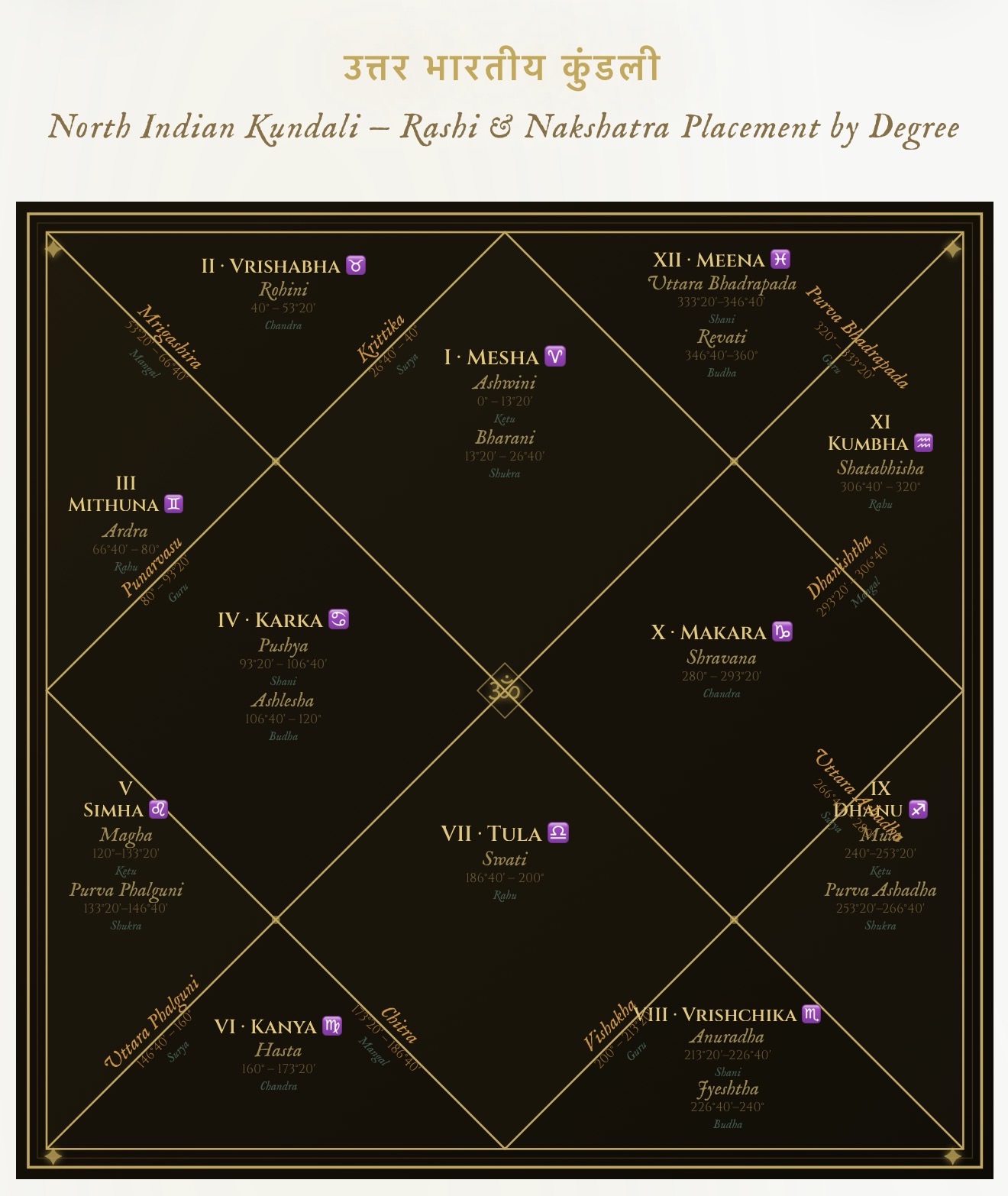
The twelve houses of the Kundali are grouped into four sacred trikonas: Dharma (1-5-9), Artha (2-6-10), Kama (3-7-11), and Moksha (4-8-12). While the first three trikonas govern how we live in the world — our purpose, wealth, and desires — the Moksha Trikona governs how we transcend it. These are the water houses, ruled by emotion, depth, mystery, and the invisible. They are the houses where the soul confronts what it truly is, beneath every role, every body, every lifetime.
The 4th house represents home, roots, and emotional peace — the soul’s first anchor in incarnated existence. The 8th house represents transformation, death, and the occult — the soul’s crucible of fire. The 12th house represents dissolution, liberation, and return to source — the soul’s ultimate exit. Together, they narrate the oldest story in creation: coming into being, being tested, and returning to the infinite.
✦ The Soul’s Journey Through All 12 Houses ✦
From First Breath to Final Liberation
“`
|
1
|
Lagna Bhava — The First Breath Tanu Bhava · Karaka: Sun The soul departs the formless and enters form. The 1st house is the cosmic timestamp — the exact moment the Atman takes on a body, a face, a name. It is raw identity: the self before the world has shaped it. Here, the soul declares, “I AM.” Every house that follows is a consequence of this single moment of incarnation. |
|
2
|
Dhana Bhava — The Family Nest House of Wealth, Speech, Family · Karaka: Jupiter The infant discovers it is not alone. The family is its first world. Food, voice, the warmth of belonging — the soul learns it is held. Here, speech is born, and with speech, the ability to name reality. Wealth is first known not as money but as the security of being fed and loved. |
|
3
|
Sahaja Bhava — The First Steps House of Courage, Siblings, Short Journeys · Karaka: Mars The child begins to move. Curiosity pulls it into the world beyond the doorstep. Siblings, neighbours, and playmates become the first social universe. Courage is tested, communication sharpens, and the soul learns that the world is wide and it must be bold to explore it. |
|
4
|
⚡ Sukha Bhava — The Soul Finds Home MOKSHA GATE I · The Foundation The deepest, most primal longing of the soul is answered here: to belong, to be held, to be safe. The soul touches the earth and puts down roots. This is the first awakening — the recognition that inner peace is the true wealth. Beneath all the seeking, the soul is homesick for God. |
|
5
|
Putra Bhava — Joy & Creation House of Children, Intelligence, Past-Life Merit · Karaka: Jupiter From security, joy is born. The soul creates — children, ideas, art, love affairs. Poorva Punya (merit from past lives) ripens here. The soul discovers it has a unique intelligence, a creative spark no one else carries. This is the house of play, and play is the soul’s closest approximation of freedom. |
|
6
|
Shatru Bhava — The Trial House of Enemies, Disease, Service · Karaka: Mars & Saturn Comfort breeds complacency. The universe sends challenges — illness, rivals, debt, daily grind. Here, the soul learns discipline, humility, and service. The body becomes a teacher. Obstacles are not punishments; they are invitations to develop strength. The soul that conquers the 6th house conquers itself. |
|
7
|
Kalatra Bhava — The Mirror of the Other House of Marriage, Partnership, the Other · Karaka: Venus Directly opposite the 1st house — the self meets its reflection in another. Marriage is the supreme kama: the longing for union. But the 7th teaches that no external union can fill the void that only God fills. Every great love in the 7th house is, at its deepest, the soul searching for its divine origin. |
|
8
|
🔥 Randhra Bhava — The Soul Is Shattered & Reborn MOKSHA GATE II · The Crucible The soul cannot grow without being broken. The 8th house is the cosmic forge — where identity is stripped, illusions incinerated, and the raw Atman is revealed. Crisis, death of loved ones, sudden losses, occult encounters: all are the same thing — the universe ripping away what is not truly you, so what remains can be real. The 8th house does not destroy. It purifies. |
|
9
|
Dharma Bhava — The Guiding Light House of Guru, Philosophy, Grace · Karaka: Sun & Jupiter After the devastation of the 8th house, the soul is hungry for meaning. The 9th house arrives like the first light after a long night — the Guru, the philosophy, the pilgrimage. Here, wisdom replaces knowledge, and faith replaces certainty. The soul discovers that it is not alone on this journey; it is guided. |
|
10
|
Karma Bhava — The Sacred Action House of Career, Duty, Public Dharma · Karaka: Sun, Saturn, Mercury, Jupiter Wisdom must become action. The 10th house is the peak — the soul now acts in the world with purpose, not out of desire but from dharma. Nishkama Karma (action without attachment) is the ideal of the 10th house. The soul at its highest here does not seek fame; it fulfills its cosmic duty. |
|
11
|
Labha Bhava — The Final Harvest House of Gains, Aspirations, Elder Siblings · Karaka: Jupiter Desires are fulfilled — wealth, friendships, recognition, ambitions. But the soul now notices something profound: even the fulfilment of every desire leaves a residue of longing. The 11th house is the last classroom of the world. It teaches that no earthly gain can satisfy a soul that was born for eternity. |
|
12
|
🕉️ Vyaya Bhava — The Soul Dissolves into the Infinite MOKSHA GATE III · The Liberation The soul finally understands: there is nothing to hold, nowhere to arrive, no self to protect. The 12th house is the great release — the open hand, the silent room, the empty sky. Every loss here is a gift. Every ending here is a beginning. The drop returns to the ocean, and in that return, discovers it was always the ocean. |
“`
First Gate of Moksha
The Fourth House
Sukha Bhava · Bandhu Bhava · Matru Sthana
Sanskrit Names: Sukha (happiness), Bandhu (relatives), Vidya (education), Matru (mother) Bhava | Ruling Sign: Cancer (Karka) | Natural Karaka: Moon (Chandra); Mercury as secondary karaka
“`
The 4th house is the astrological womb — the first Moksha gate, where the soul discovers it is not merely a body wandering the earth but a consciousness rooted in something deeper. As the Maharishi Parashara describes in the Brihat Parashara Hora Shastra, this house is the foundation of existence, governing our sense of belonging, the quality of our inner world, and the ancestral inheritance we carry. It is a water house — ruled by feeling, memory, and the subconscious tides that run beneath daily life. To understand the 4th house is to understand why a person can be surrounded by luxury and still feel utterly homeless — or surrounded by simplicity and feel completely at peace.
Complete Karakatwas of the 4th House
|
👤 Living Karakatwas (Jiva)
|
🏛️ Non-Living Karakatwas (Jada)
|
Moksha Insight · The 4th House
The 4th house reveals a profound spiritual truth: the soul is homesick for God. The deepest hunger of the 4th house — the longing for a mother’s love, the comfort of a safe home, the peace of belonging — is ultimately the soul’s memory of its divine origin. Every human being carries an innate longing for the unconditional love they experienced before birth, in the formless state of pure consciousness. The mother is the first symbol of that divine source.
In the Moksha Trikona, the 4th house is the Sanchita Karma house — it shows what karma the soul carried from its past life into the present. A strong 4th house indicates past-life merit. A troubled 4th house signals karmic wounds around belonging and security that this lifetime is meant to heal. The 4th house is also the 9th house counted from the 8th house of death — the ancestral blessings and ceremonies that guide the soul after it leaves the body.
“`
Second Gate of Moksha
The Eighth House
Randhra Bhava · Ayu Bhava · Nidhan Bhava · Mrityu Sthana
Sanskrit Names: Randhra (gap/hole), Ayu (longevity), Nidhan (death/treasure), Mrityu (death) Bhava | Ruling Sign: Scorpio (Vrishchika) | Natural Karaka: Saturn (Shani) as Ayushkaraka
“`
The 8th house is the most feared, most misunderstood, and most spiritually potent house in the entire Kundali. Ancient texts call it Randhra — the gap, the hole in the fabric of ordinary existence through which extraordinary truth leaks in. The Phaladeepika calls it Leena Sthana, the secretive place. B.V. Raman calls it the house that “touches the deepest anxieties of human existence.” And yet, within that anxiety lies the seed of the most profound liberation.
The 8th house does not destroy. It purifies. Whatever it burns away was never truly yours to begin with. It is the cosmic crucible — the house that tests whether your identity is rooted in something real or merely in the accumulation of things, roles, and illusions. Ketu, the natural moksha karaka, finds immense power here, signifying the soul’s readiness to detach from the material world and penetrate deeper mysteries.
Complete Karakatwas of the 8th House
|
👤 Living Karakatwas (Jiva)
|
🔥 Non-Living Karakatwas (Jada)
|
Moksha Insight · The 8th House
The 8th house carries the Prarabdha Karma — the karma that was specifically loaded into this lifetime for the soul to confront and resolve. This is why 8th house events feel so unavoidable, so destined. They are. They are the curriculum the soul itself chose before it took birth.
In the Moksha Trikona, the 8th house is the subconscious mind laid bare — the mask is removed. The 8th house also reveals how the soul died in its previous life, and therefore the fears and patterns the Atman carries unconsciously into the present incarnation.
Perhaps most profoundly: the 8th house is the 5th house counted from the 4th house of death. It is the creative intelligence of the dying moment — the ability of the soul to choose, in full consciousness, its next direction of travel. Spiritual practitioners and Yogis who can hold awareness at the moment of death access the highest potential of the 8th house: the choice of whether to reincarnate or to merge into Brahman itself.
“`
Third Gate of Moksha
The Twelfth House
Vyaya Bhava · Moksha Sthana · House of the Final Door
Sanskrit Names: Vyaya (expenditure/loss), Moksha (liberation), Shayana (bed/sleep), Pravasa (foreign land) Bhava | Ruling Sign: Pisces (Meena) | Natural Karaka: Saturn (primary), Ketu (secondary/moksha karaka)
“`
The 12th house is the last chamber in the cosmic architecture of the Kundali — and it is the most paradoxical. It is simultaneously the house of the greatest loss and the greatest liberation. B.V. Raman, the father of modern Vedic astrology, described it as indicating “misery, loss, expenditure, waste, extravagance, sympathy, piety, divine knowledge and worship, moksha, and the state after death.” Every one of those qualities is both a shadow and a light.
It is the house of Sanchita Karma — the vast storehouse of all unresolved karma from every previous lifetime. While the 1st house is the new body the soul enters, the 12th house is the old baggage it carries in. What we call “irrational fears,” “unexplained longing for distant places,” or “feeling like a stranger in one’s homeland” — these are 12th house echoes of lifetimes lived and incompletely resolved. The 12th house teaches the deepest truth: you cannot hold onto what was never yours to keep.
Complete Karakatwas of the 12th House
|
👤 Living Karakatwas (Jiva)
|
🕉️ Non-Living Karakatwas (Jada)
|
Moksha Insight · The 12th House
The 12th house is simultaneously the exit gate and the entrance hall. It is the end of the current cycle and the waiting room for the next. When a soul achieves true moksha through the 12th house, it does not enter a new Kundali — it dissolves entirely into the infinite. The 12th house, in its highest expression, is the experience of Aham Brahmasmi — “I am Brahman.” The drop realizes it was always the ocean.
The 12th house is 12th from the 1st house of self — it is the undoing of self. It is 5th from the 8th house of death — it is the creative intelligence of the moment of departure. And it is the house of Sanchita Karma — the storehouse. Every night when we sleep, we rehearse the 12th house experience: the ego dissolves, the body rests, and something beyond the self is briefly touched.
Paramahansa Yogananda, himself a master of the 12th house reality, wrote: “Seclusion is the price of greatness.” The silence, the aloneness, the apparent loss — these are not punishments. They are initiations. The soul that can sit in the 12th house and be at peace has already begun to touch moksha.
“`
The Three Karmas & the Moksha Trikona
How the 4th, 8th & 12th Houses Hold the Keys to Liberation
“`
|
🏠 4th House Sanchita Karma The accumulated karma from all past lives — what the soul carries as its foundational inheritance into the present incarnation. Reveals: Past-life conditions, the soul’s emotional foundations, what it is destined to experience in the domain of home and belonging. In the Moksha story: The soul’s first anchor in incarnated existence. The place where karmic patterns are formed in childhood and carried through life. |
🔥 8th House Prarabdha Karma The specific karma activated and loaded into this particular lifetime — the destined trials, transformations, and lessons the soul must face. Reveals: The nature of destined suffering and destined gains; how the soul died in its previous life; the code of evolution unique to this Atman. In the Moksha story: The crucible. The ego is shattered. What remains after all illusions are burned away is the true self. |
🕉️ 12th House Agami Karma / Resolution The karma that is newly created in this life and the final resolution — where the soul chooses: to reincarnate with new seeds, or to dissolve into the infinite. Reveals: Post-death journey, conditions of the next birth, whether moksha is attained, or the soul plants new seeds of return. In the Moksha story: The final door. Ego dissolves. The Atman chooses liberation or rebirth — and in that choice, one entire cosmic cycle completes. |
“`
Key Moksha Yogas in the Moksha Trikona
Classical combinations that indicate a soul’s proximity to liberation in this lifetime
“`
| Combination | Spiritual Significance |
| Jupiter or Ketu in 12th House | Strongest classical indicator of moksha attainment — either in this life or the next. The soul has developed the wisdom (Jupiter) or detachment (Ketu) necessary for liberation. |
| Saturn in 9th House | Makes the native a deep seeker of moksha — a renunciant in spirit, regardless of outer circumstances. Saturn’s discipline applied to dharma creates the pathway. |
| Lords of 5th, 9th, 10th in 12th | Classical texts state that these lords placed in the 12th house grant moksha to the native — past merit, dharma, and karma all converge at the threshold of liberation. |
| Parivraja Yoga | Saturn, Jupiter, or Ketu associated with the 12th lord: deep desire for solitude, detachment from material desires, renunciation — outward or inward. |
| Strong 4th + 8th + 12th lords interconnected | When all three gates of the Moksha Trikona are mutually connected and strong, the native carries a profound spiritual mandate in this lifetime — the entire three-act drama of liberation is written into the chart. |
| Vipreet Raja Yoga (6th/8th/12th lords in trik houses) | Hidden king yoga — through apparent loss and suffering, the soul breaks free of all attachment and emerges radically liberated. Pain itself becomes the path. |
“`
The Complete Arc: From Birth to Moksha
The soul begins its journey at the 1st house — raw, incarnated, full of potential and karma. It proceeds through the cycle of the twelve houses, learning the lessons of family, courage, security, creativity, service, love, crisis, wisdom, duty, fulfillment, and ultimately — release.
Three times along this journey, it enters a Moksha gate. In the 4th house, it discovers that its deepest longing is not for a house or a mother, but for the infinite peace from which it came. In the 8th house, it discovers that everything it thought it was — its identity, its security, its attachments — can be taken in an instant, and what remains is indestructible. In the 12th house, it discovers that even that indestructible self is not separate from everything else.
“Some pain is inevitable. Suffering is optional.” — The 12th house teaches us that the only question is: how ready is the soul to let go?
The Kundali is not a map of your limitations. It is a map of your liberation — the precise karmic curriculum the soul designed for itself before it arrived. Every difficult placement in the Moksha Trikona is not a punishment; it is a tailored instruction. The universe does not punish souls. It educates them.
When the soul has truly learned what the 4th house offers (inner peace), what the 8th house offers (fearlessness before the unknown), and what the 12th house offers (the willingness to surrender completely) — it does not need to return. The cycle of rebirth ends. The Atman recognizes itself as Brahman. And in that recognition, the entire cosmic drama dissolves into what it always was: the One playing all the parts, remembering itself.
Tat Tvam Asi · That Thou Art · Aham Brahmasmi
Sources drawn from: Brihat Parashara Hora Shastra (BPHS) · Phaladeepika · Sarvartha Chintamani · Jataka Parijata · B.V. Raman’s writings · Classical Jyotish traditions of Sage Parashara and Jaimini. This content is offered for the purpose of spiritual education and knowledge sharing.