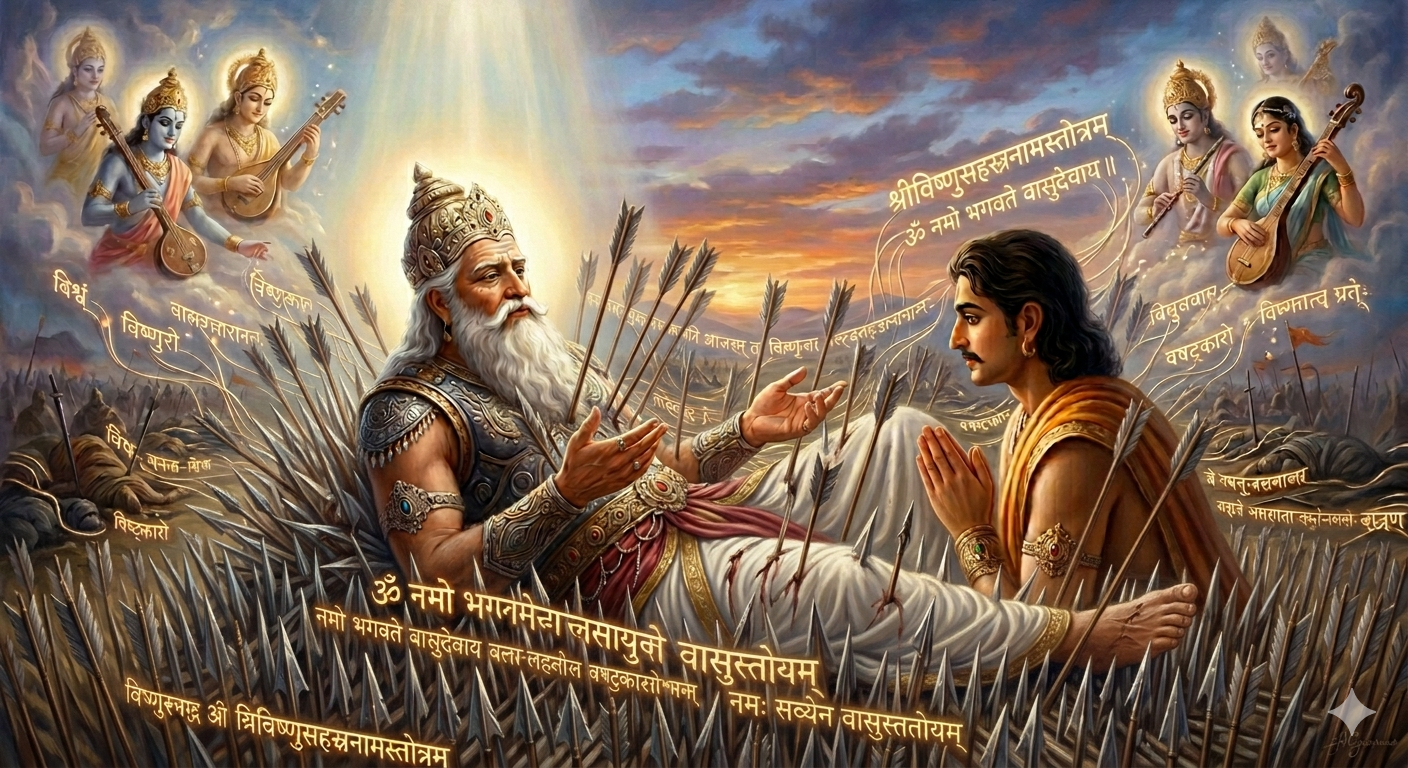
The Sacred Texts of Sanatana Dharma
The Vishnu Sahasranama
Origin, Characters, and the Eternal Message Behind the Thousand Names
विष्णुसहस्रनाम · Mahabharata · Anushasana Parva · Veda Vyasa
“Who is the one greatest Lord in the world? Who is the one sole refuge for all beings? By glorifying whom can humanity reach auspiciousness? By chanting which mantra can a living being be freed from the bonds of birth and death?”
— Yudhishthira to Bhishma, Anushasana Parva
Table of Contents
| I. What Is the Vishnu Sahasranama? | II. Where It Sits in the Vedic World |
| III. The Setting — Why It Was Spoken | IV. The Characters |
| V. The Six Questions That Opened the Door | VI. The Underlying Message |
| VII. Why Bhishma — and Not Krishna? | VIII. Legacy and Commentaries |
| IX. Sources and References | |
“`
I. What Is the Vishnu Sahasranama?
The Name That Needs No Introduction
The Vishnu Sahasranama — Sahasra meaning thousand, Nāma meaning name — is a Sanskrit hymn of the one thousand names of Lord Vishnu. It is one of the most sacred and universally revered stotras in all of Hinduism, and its stature within the tradition is unique: so central is it that when Hindus simply say “The Sahasranama” without any qualifier, they mean this one. Every other deity’s Sahasranama must carry its own name for identification. Vishnu’s does not. That single fact tells you more about its place in Hindu consciousness than any description could.
It was composed and embedded within the Mahabharata by the sage Veda Vyasa — the same rishi who compiled the four Vedas, authored the Mahabharata in its entirety, and composed the eighteen Puranas. The text appears in the 135th chapter of the Anushasana Parva, the thirteenth book of the Mahabharata, and comprises 149 verses written in the Anushtup metre — eight syllables per quarter, the same metre as the Bhagavad Gita.
At a Glance
| Full Name | Vishnu Sahasranama Stotram (विष्णुसहस्रनाम) |
| Meaning | “Having a Thousand Names” — a Bahuvrihi compound in Sanskrit |
| Author / Compiler | Maharishi Veda Vyasa (composer); Bhishma Pitamaha (original reciter) |
| Source Text | Anushasana Parva, Chapter 149 — Mahabharata |
| Metre | Anushtup (eight syllables per quarter) |
| Actual Name Count | 1,031 individual names (31 serve as qualifying adjectives; 20 double-names in first half, 11 in second) |
| Other Versions | Padma Purana, Skanda Purana, Garuda Purana (Mahabharata version is the primary and most revered) |
“`
“`
II. Where It Sits in the Vedic World
Mapping the Sahasranama in the Sacred Corpus
This is the question most people skip — and it is the most important one for understanding why the Vishnu Sahasranama carries the weight it does. To answer it properly, one must understand the hierarchy of the Vedic literary corpus.
At the highest level sits Shruti — “that which was heard.” This is the body of the four Vedas: Rigveda, Samaveda, Yajurveda, and Atharvaveda. The Vedas are considered apaurusheya — not authored by any human being. They are eternal sound, cognised by the Rishis in deep meditation. No human hand wrote them; they were received. The Upanishads — the philosophical culmination of each Veda — also belong to this category, and together they form what we call Vedanta, the end and essence of the Vedas.
Below Shruti sits Smriti — “that which was remembered.” Smriti literature was composed by human sages to make the deep truths of the Vedas accessible to everyone — not merely the trained Brahmin scholar, but the warrior, the farmer, the householder, the king, the woman, the child. Smriti encompasses the Dharmashastra texts (law codes), the Itihasas (epics), and the Puranas (mythological encyclopaedias).
The Mahabharata is the greatest of the Itihasas — and Vyasa himself, in the Adiparva, declared that whatever is not found in the Mahabharata is not found anywhere. The tradition regards it as the Panchama Veda — the Fifth Veda — not because it replaces the four, but because it makes their essence available to all of humanity regardless of birth, gender, or scholarly training.
So the Vishnu Sahasranama is technically Smriti — not Shruti. But it carries an authority that few Smriti texts can claim, for a remarkable reason. It is the only Sahasranama in the entire tradition that was recited for the first time in the direct presence of God himself. When Bhishma spoke the thousand names, Krishna — who is identified throughout as the Supreme Being — stood there as a living witness. Bhishma knew this. He began by pointing to Krishna and telling Yudhishthira: the one who brought you here is himself the Lord whose names I am about to recite.
“`
“`
III. The Setting — Why It Was Spoken at All
Kurukshetra After the War
The context of the Vishnu Sahasranama is everything. Understanding it transforms the text from a liturgical chant into something far more philosophically alive. Without the setting, you have a list of names. With the setting, you have one of the most poignant moments in all of Sanskrit literature.
The eighteen-day Kurukshetra War has ended. The Pandavas have won. But victory looks nothing like the word suggests. The battlefield is a graveyard of uncles, teachers, cousins, friends — an entire generation of warriors erased. Yudhishthira, the eldest Pandava, is now King of Hastinapura by right of conquest. He has the throne. He is in ruins.
The man called Dharmaraja — the very King of Dharma — no longer knows what dharma means. How do you rule justly after watching your own family die? How do you govern with wisdom when your hands feel stained with blood? What is the purpose of kingship, of life itself, when the cost of being right is this?
The Scene on the Battlefield
Bhishma Pitamaha — Commander-in-Chief of the Kaurava army for the first ten days of the war — had been felled by Arjuna through the Pandava strategy of placing Shikhandi before him. Bhishma had taken a vow never to wage war against a woman; he regarded Shikhandi as female (born female, having changed sex), and so he dropped his arms. Arjuna’s arrows found their mark.
But Bhishma possessed the boon of Iccha Mrityu — the power to choose his own moment of death. He lay on a bed of arrows, his body pierced, waiting for the solar solstice of Uttarayana — the most auspicious time for a soul to depart — which was nearly two months away.
In eight days after Bhishma’s fall, the war ended and the Kaurava forces were destroyed. Yudhishthira was crowned King. And then Krishna told him: before this last great teacher departs, go to him. Ask him everything.
This is the quiet genius of the Anushasana Parva’s framing. Krishna, who had delivered the entire Bhagavad Gita to Arjuna, redirects Yudhishthira to a dying man on a bed of arrows — and does not answer the questions himself. Why? Because there is a wisdom that can only come from someone who has lived it, suffered it, and transcended it. The Gita was spoken before the war, to a man who needed courage to act. The Sahasranama was spoken after the war, to a man who needed wisdom to live — and to govern — with the full weight of what action costs.
“`
“`
IV. The Characters
The Seeker, the Sage, the Witness, and the Lord
Four figures inhabit the moment of the Sahasranama’s first utterance. Each plays a role that is simultaneously historical, allegorical, and theological.
|
The Seeker Yudhishthira The eldest Pandava, called Dharmaraja — King of Dharma. He is not a student asking intellectual questions. He is a man who has just survived his own Kurukshetra and carries the weight of every soul lost in it. He represents every sincere seeker who, after great suffering, looks at the wreckage of life and asks: what endures? What is the truth underneath all of this? His sincerity is total, his need is existential. |
The Teacher Bhishma Pitamaha Son of the Ganga, grandson of Maharishi Shantanu. He had renounced kingship, marriage, and fatherhood through a single terrible vow taken in his youth — Bhishma Pratigya — and spent an entire lifetime in service of a throne he could never sit upon. He fought on what proved to be the losing, and morally compromised, side of the war. And yet he lies there on his arrows and teaches the path to liberation with perfect serenity. His very circumstance is the teaching. |
|
The Author Veda Vyasa The great rishi who compiled the Vedas, authored the Mahabharata, and composed the eighteen Puranas. He is present as witness to the Sahasranama’s first utterance. In the tradition, Vyasa is considered a Chiranjivi — an immortal being who exists across all ages as the preserver of sacred knowledge. He is both the literary architect of the moment and its eternal keeper. |
The Witness Krishna Vasudeva The orchestrator of the entire scene. He is the one who brought Yudhishthira to Bhishma. He stands present as Bhishma recites. And Bhishma’s first act, upon seeing Krishna standing beside Yudhishthira, is to smile — and reveal to Yudhishthira that the very Lord who brought him here is himself the Supreme Being whose names he is about to receive. God stands as witness to the recitation of his own names. This makes the Vishnu Sahasranama unique in all of sacred literature. |
“`
“`
V. The Six Questions That Opened the Door
Yudhishthira’s Questions to Bhishma
Yudhishthira does not ask Bhishma to simply recite divine names. He poses six questions of extraordinary weight — questions that carry the full gravity of a man who has just survived the end of the world as he knew it. These six questions are the opening of the Vishnu Sahasranama, and they are the reason for everything that follows.
Question One
“Kim ekam daivatam loke?”
Who is the one greatest Lord in the world?
Question Two
“Kim vā apyekam parāyanam?”
Who is the one sole refuge for all beings?
Question Three
“Stuvantah kam prāpnuyuḥ shubham?”
By glorifying whom can human beings reach auspiciousness — peace and prosperity?
Question Four
“Arcantaḥ kam prāpnuyuḥ kalyānam?”
By worshipping whom does one attain the highest good and welfare?
Question Five
“Ko dharmaḥ sarva-dharmāṇām?”
What is the greatest dharma — the highest law and right action — of all dharmas?
Question Six
“Japatāṃ kim japyam?”
By chanting which mantra can a living being be freed from the bonds of birth and death?
Bhishma’s answer to all six questions is the same: Vishnu. The one greatest Lord, the one refuge, the one by glorifying whom man reaches peace, the one whose worship brings all welfare, the highest dharma, and the mantra that liberates — all of these point to the same reality. And having given this unified answer, Bhishma says: “I will now teach you His thousand names. Listen with full attention.” The Sahasranama then begins.
“That Purusha with endless devotion, who chants a thousand names of He who is the Lord of the Universe, the God of gods, the Limitless — shall be freed from the bondages of life.”
— Bhishma Pitamaha, Vishnu Sahasranama Phala Shruti
“`
“`
VI. The Underlying Message
Three Philosophical Dimensions
The Vishnu Sahasranama is not merely a liturgical list. Each name is a meditation on a different facet of the Absolute — from the most transcendent metaphysical reality down to the most intimate practical divine function. The message operates simultaneously on three philosophical levels.
Level One: Cosmological
Vishnu is not one god in a pantheon of many. The Sahasranama opens with the name Vishvam — the universe itself. The text declares Vishnu to be both the cause and the effect, the creator and the created, the sustainer and the one into whom all things dissolve at the end of the cosmic cycle. Bhishma explicitly states: “That from which all beings are born at the beginning of the Kalpa, that in which they merge back at the end of the Kalpa — that is the Vishnu whose thousand names you should receive.” The thousand names collectively map the totality of existence onto a single divine principle. This is not polytheism but sophisticated cosmological monotheism.
Level Two: Philosophical (Vedantic)
The tradition asks: if the Supreme is infinite and beyond all description, why does it have a thousand names? The answer is profound. The Infinite cannot be captured by any single concept. It exceeds all language, all category, all definition. And yet it has infinite manifestations. Therefore it can have infinite names — each one a different window into the same infinite reality. No single name is complete; the thousand together are not complete either. But the accumulation, the meditation upon each name and its meaning, gradually dissolves the limitation of the perceiving mind until something beyond the names is glimpsed. This is deeply Vedantic — the names are not the truth, but they are the path toward it. Adi Shankaracharya, in his 8th-century commentary on the Sahasranama, uses this principle to interpret every name as pointing ultimately to Brahman — the one undivided Absolute.
Level Three: Devotional and Karmic (Bhakti)
Bhishma’s most practical teaching is that the act of reciting the Sahasranama is itself a form of grace — a means by which even ordinary human beings, without scholarly training, can come into alignment with the divine. The concluding Phala Shruti (the passage of benefits) lists what is attained through regular recitation: liberation from karma, protection from misfortune, peace of mind, prosperity, and ultimately moksha — release from the cycle of birth and death. The Bhakti dimension is crucial: the Sahasranama is not meant to be understood intellectually before it is chanted. It is meant to be chanted so that understanding may arise. The sound itself — the vibration of sacred Sanskrit syllables in the correct metre — is considered to carry a purifying power independent of whether the reciter understands every word.
“`
“`
VII. Why Bhishma — and Not Krishna?
The Philosophy of the Teacher’s Circumstance
This is perhaps the most searching philosophical question one can ask about the Sahasranama, and it is rarely asked. Krishna had just delivered the Bhagavad Gita — one of the greatest spiritual documents in human history. He was physically present. He was acknowledged by everyone, including Bhishma himself, as the Supreme Being incarnate. Why, then, would Krishna redirect Yudhishthira to a dying man lying on a bed of arrows, when he could simply have answered the questions himself?
The answer illuminates something profound about how the Vedic tradition understands the transmission of wisdom. The Gita was spoken before the war to a man who needed the courage to enter into righteous action. Arjuna’s crisis was one of paralysis — he could see what had to be done but could not move himself to do it. The teaching he needed was about duty, courage, and the eternal nature of the soul.
Yudhishthira’s crisis is the opposite. He has done what had to be done. He has acted. And now he must live with the consequences of that action — must govern, must build, must continue — carrying the full weight of what righteous action costs in the real world. The teaching he needs is not about courage but about wisdom in the aftermath of loss.
And who better to teach that than a man who embodies it? Bhishma renounced kingship for loyalty. He fought on the wrong side out of a bond of duty he could not break. He was brought down through a ruse he could not resist without violating his own vow. He lies pierced and dying — and from that bed of arrows he teaches the path to ultimate liberation with a serenity that surpasses anything a comfortable sage on a peaceful mountain could offer. His suffering is his authority.
The Vishnu Sahasranama was imparted with the welfare of future generations also in mind. Bhishma was not answering only Yudhishthira. He was speaking across time — to every human being who would one day stand at the end of their own Kurukshetra, exhausted and uncertain, and wonder: what is the one thing that endures?
His answer: the names of the one who pervades everything.
“`
“`
VIII. Legacy and Commentaries
Two Thousand Years of Interpretation
The Vishnu Sahasranama has generated over forty major commentaries across the centuries, making it one of the most intensively studied texts in all of Sanskrit literature. Each commentary reflects the philosophical school of its author, and their differences reveal the extraordinary richness and interpretive depth of the text.
| Commentator | Century | School | Perspective |
|---|---|---|---|
| Adi Shankaracharya | 8th century CE | Advaita Vedanta | Every name of Vishnu is ultimately a name of Brahman, the one undivided Absolute. Earliest surviving commentary; still the most widely studied. |
| Parasara Bhattar | 12th century CE | Vishishtadvaita (Ramanuja) | Each name describes a unique quality (guna) of Lord Vishnu as the Supreme Personal God. Title: Bhagavad Guna Dharpana. |
| Vidyadhiraja Tirtha | 14th century CE | Dvaita Vedanta (Madhva) | Vishnu is eternally distinct from the individual soul and the world. Commentary: Vishnusahasranamavivrti. |
| Satyasandha Tirtha | 18th century CE | Dvaita Vedanta | Detailed Dvaita school analysis. Commentary: Vishnusahasranamabhashya. |
A well-known story preserved in the tradition records that Adi Shankaracharya, before setting out on his great work of reviving Vedantic thought across India, was tested by his guru Govindapadacharya with a single task: write an exhaustive commentary on the Vishnu Sahasranama. Shankaracharya completed it. Govindapadacharya was satisfied, and blessed his student to proceed. The fact that this was the test — not a commentary on the Upanishads, not on the Brahmasutras, but on the Sahasranama — speaks to how central this text was considered even in the most rigorous philosophical circles.
The tradition also records an addendum: that after the Sahasranama, Goddess Parvati asked Shiva for an easier way to obtain the same benefit. Shiva replied that one recitation of the name Rama is equivalent to chanting the full Vishnu Sahasranama — a passage known as the Ramanama Phala Shruti. This is consistently interpreted by scholars not as a dismissal of the Sahasranama but as a testament to the extraordinary potency of the name Rama, and as a concession made specifically for the very learned who may not have time for the full recitation daily.
“`
In Closing
The Vishnu Sahasranama was not written in a library. It was spoken on a battlefield, by a dying man, to a broken king, in the presence of God. That origin is inseparable from its message. Wisdom does not arise in the absence of suffering — it is forged by it. The thousand names are not a catalogue. They are a map back to the one who pervades everything, offered by the one who had nothing left to lose and everything left to give.
ॐ नमो नारायणाय ।
“`
IX. Sources & References
1. Veda Vyasa. Mahabharata — Anushasana Parva, Chapter 149. Trans. Kisari Mohan Ganguli. 1883–1896. Sacred Texts Archive. Available at: https://www.sacred-texts.com/hin/maha/
2. Adi Shankaracharya. Vishnu Sahasranama Bhashya (Commentary on the Thousand Names of Vishnu). 8th century CE. Trans. Swami Tapasyananda. Sri Ramakrishna Math, Chennai.
3. Parasara Bhattar. Bhagavad Guna Dharpana (Commentary on Vishnu Sahasranama from Vishishtadvaita perspective). 12th century CE. Sri Vaishnava tradition.
4. Hindu University of America. “Exploring the Vishnu Sahasranama.” Course overview and literary context. Available at: https://www.hua.edu/vishnu-sahasranama
5. Wikipedia. “Vishnu Sahasranama.” Encyclopaedic overview, textual history, and commentarial tradition. Available at: https://en.wikipedia.org/wiki/Vishnu_Sahasranama
6. Hindupedia — The Hindu Encyclopedia. “Vishnu Sahasranamam.” Structural and contextual analysis. Available at: https://www.hindupedia.com/en/Vishnu_Sahasranamam
7. Indica Today. “Vishnu Sahasranama Stotram — A Dive into Adi Shankaracharya’s Commentary.” Detailed philosophical analysis of Poorva Bhaga and Uttara Bhaga. Available at: https://www.indica.today/long-reads/vishnu-sahasranama-stotram-a-dive-into-adi-sankaracharyas-commentary
8. India Facts. “Sri Vishnusahasranama — Contrasting Interpretations of Adi Shankara and Parasara Bhattar.” Comparative commentary study. Available at: https://indiafacts.org/sri-visnusahasranama-adi-sankara-parasara-bhattar/
9. Sadagopan.org. Vishnu Sahasranama Vols. I and II. Detailed verse-by-verse explication based on Adi Shankaracharya’s commentary. Available at: https://www.sadagopan.org/ebook/pdf/Vishnu%20Sahasranama%20v1.pdf
10. A Few Good Things (vak1969.com). “Vishnu Sahasranamam — Insights and Nuggets.” Including the oral tradition of Kanchi Maha Periyava. Available at: https://vak1969.com/2024/02/20/vishnu-sahasranamam-insights-nuggets/
11. Exotic India Art. “Vishnu Sahasranamam — The Story Behind It.” Narrative and devotional context. Available at: https://www.exoticindiaart.com/blog/vishnu-sahasranamam-the-story-behind-it/
12. The Gentleman Philosopher. “Sri Vishnu Sahasranama Stotram — Sankara’s Commentary.” Available at: https://thegentlemanphilosopher.com/sri-visnu-sahasranama-stotram/
13. Hinduism Facts. “Vishnu Sahasranama Lyrics in English with Meaning.” Including the six opening questions of Yudhishthira. Available at: https://hinduismfacts.org/hindu-prayers/vishnu-sahasranama/
14. Amit Ray. “Sri Vishnu Sahasranamam — Lyrics, Meanings, Benefits, and Significance.” Comprehensive devotional and philosophical overview. Available at: https://amitray.com/sri-vishnu-sahasranamam/
“`
HINDU MYTHOLOGY & VEDIC SPIRITUALITY
Original research compiled from publicly available sources with full citations. All rights reserved.