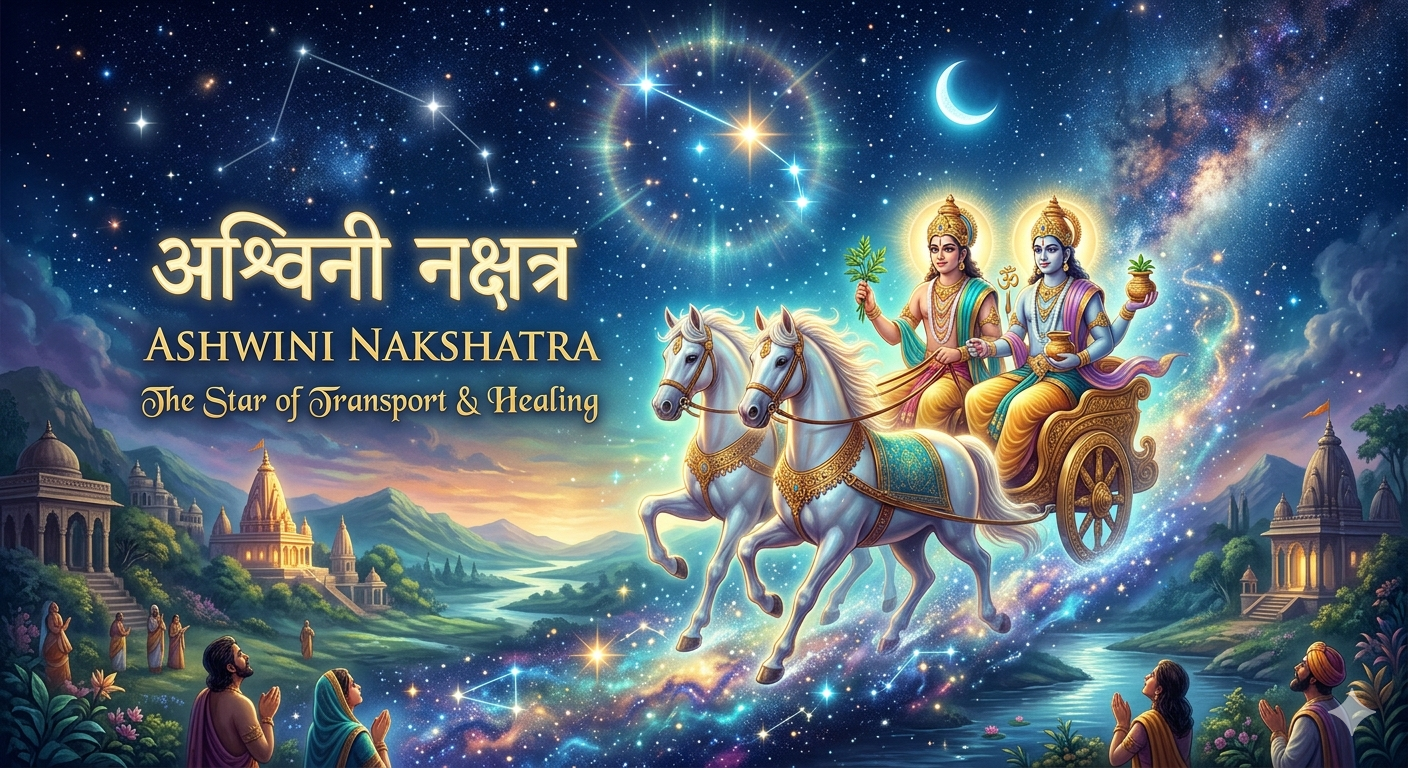
Ashwini Nakshatra
The Complete Vedic Deep Research
Including All Hymns from the Rig Veda · Atharva Veda · Yajur Veda · Taittiriya Brahmana · Bhavishya Purana · Karma Vipaka Samhita
“Swifter than thought, bearing light before the dawn — the Ashwins ride their three-wheeled golden chariot across the threshold of darkness. They do not wait to be summoned. They arrive.”
— Rig Veda, Mandala 1, Hymn 34 (Griffith translation)
Before the first ray of sunlight touches the earth. Before the birds stir. Before consciousness remembers it is alive — there is Ashwini.
This is the nakshatra of the absolute beginning. Zero degrees Aries. The cosmic ignition point. The first breath of the entire zodiacal wheel. What follows is not a summary. It is a deep excavation — through every applicable hymn in the Rig Veda, the Atharva Veda, the Yajur Veda, the Taittiriya Brahmana, and beyond — to understand what Ashwini truly is, what it demands, and what extraordinary human beings it produces.
🌟 At a Glance — Ashwini Nakshatra
| Attribute | Details | Deeper Meaning |
|---|---|---|
| Position | 0°00′ – 13°20′ Aries | Absolute first point of the zodiac — zero-point energy |
| Stars | Alpha Arietis (Hamal) & Beta Arietis (Sheratan) | Two stars = the twin deities; duality at the heart of all initiation |
| Ruling Deity | Ashwini Kumaras (Nasatya & Dasra) | Divine twin physicians — truth-restorers and destroyers of evil |
| Ruling Planet | Ketu | Past-life mastery, liberation from ego, detached divine action |
| Symbol | Horse’s head | Power directed by intelligence; speed with awareness |
| Shakti | Shighra Vyapani Shakti | “The power to quickly reach and pervade” — instantaneous healing |
| Names in Vedas | Ashvini / Asvayuj (Atharva Veda) | Asvayuj = “the yoker of horses” — purposeful harnessing of power |
| Gandamoola | Yes — Pisces/Aries junction | Holds both endings and beginnings simultaneously |
| Seed Sounds | Chu, Che, Cho, La (चू चे चो ला) | Vibrational signatures of swiftness and renewal |
| Vedic References | 398 mentions in Rig Veda alone | Most frequently invoked healing deity in all of Vedic literature |
📜 Part One: The Vedic Foundation — Every Applicable Hymn
The Staggering Scale of Vedic Devotion to the Ashwins
The Ashwini Kumaras are mentioned 398 times in the Rig Veda — with more than 50 complete hymns dedicated exclusively to them across all ten Mandalas (books). No other healing deity in the entire corpus of Vedic literature approaches this frequency of invocation. The ancient Rishis were not being casual. When the seers returned again and again, across centuries and generations, to the same twin physicians — they were encoding something essential about the architecture of reality itself.
Their twin names reveal everything about their nature and the nakshatra they govern:
- Nasatya (नासत्य) — “Ever True / He Who Never Deceives.” The healer who restores what is real by cutting through what is false.
- Dasra (दस्र) — “Enlightened Giving / He Who Destroys Evil.” The healer who dismantles corruption and fills the space with light.
Together they are worshipped as Abdijan (Ocean-Born), Pushkara-Srajan (Wreathed in Lotus), and Divo Napata (Sons of the Sky) — each epithet adding another layer to the cosmic identity of these extraordinary twin physicians of the gods.
🔴 The Rig Veda — Complete Hymn Guide
📖 Mandala 1 — The Great Ashwin Cluster (Hymns 1.3, 1.22, 1.34, 1.46–47, 1.112, 1.116–120, 1.157–158, 1.180–184)
Mandala 1 of the Rig Veda contains the largest single concentration of Ashwin hymns in all of Vedic literature. It opens the entire Vedic canon with an Ashwin invocation in Hymn 1.3 — the third hymn ever composed, establishing the twin physicians as foundational to the Vedic vision of divine grace.
📜 RV 1.3 — “Ye Asvins, rich in treasure, Lords of splendour, having nimble hands”
Rishi: Madhuchhandas Vaiśvāmitra | Deity: Ashwins, Indra, Visvedevas
Summary: This is the third hymn of the entire Rig Veda — an extraordinary placement that signals the Ashwins’ cosmic priority. The Rishi invites the twin deities with both treasure and reverence, praising their nimble hands and wonder-working nature. They are called Nisatyas (truthful ones) and wonder-workers whose paths flame red with divine fire. The hymn establishes the Ashwins as part of the very first triad of Vedic divine invocations alongside Vayu (wind) and Indra — confirming their position at the absolute foundation of Vedic cosmology. Nakshatra connection: The praise of their “nimble hands” directly maps to Ashwini’s Shidhra Vyapani Shakti — the ability to reach and heal with instantaneous speed.
📜 RV 1.22 — Ashwins and Others
Rishi: Madhuchhandas Vaiśvāmitra | Multiple Deities including Ashwins
Summary: A composite hymn that invokes multiple Vedic deities. The Ashwin verses here call upon the twins at the moment before sacrifice — positioning them as pre-dawn arrivals who must be present before any sacred work can begin. The hymn emphasises their role as bringers of treasures to men and averters of misfortune. Their three-wheeled golden chariot is described as moving across both heaven and earth, showering its healing energies before the sun rises. Nakshatra connection: The “pre-dawn arrival” motif is the purest expression of Ashwini’s temporal signature — these are beings (and Ashwini souls) who arrive before anyone else, when the need is greatest.
📜 RV 1.34 — “Thrice in a day the Asvins speed their horses on”
Rishi: Hiranyastupa Āṅgirasa | Deity: Ashwins
Summary: One of the most cosmologically rich of all the Ashwin hymns. The Rishis describe the twins arriving thrice daily — a reference to their governance over the three times (past, present, future) and the three states of consciousness (waking, dreaming, deep sleep). The hymn speaks of their three-wheeled chariot containing life-giving medicines both of heaven and earth. The famous verse: “Thrice, O ye Ashwins, give to us the heavenly medicines, thrice those of earth.” The twins are called upon to bring their healing from all three cosmic planes simultaneously. Nakshatra connection: The three-tiered healing mirrors Ashwini’s governance of body, mind, and soul as inseparable — these are not partial healers but complete ones.
📜 RV 1.46–47 — Dawn Hymns to the Ashwins
Rishi: Savya Āṅgirasa | Deity: Ashwins
Summary: These two hymns are explicitly dawn hymns — among the most beautiful in all of Vedic literature. The Rishi watches the sky lighten before sunrise and invokes the Ashwins who precede the dawn. They are called Lords of beautiful paths, riders of swift horses born of the sun. The hymns praise them as the bringers of honey and healing dew — the first sweetness of the new day. Hymn 1.47 includes the famous verse invoking the Ashwins to come from the eastern mountain where the sun rises, yoking their immortal horses to carry grace to all creatures. Nakshatra connection: The dawn motif is quintessentially Ashwini — this nakshatra rules the moment of first light, the very first degree of Aries, the exact point where darkness becomes light.
📜 RV 1.112 — The Great Catalogue of Miracles
Rishi: Kakṣīvān Auśija | Deity: Ashwins | 24 verses of accumulated miracles
This is perhaps the single most important Ashwin hymn in all of Vedic literature. It is a systematic catalogue of 24 distinct miraculous interventions — a kind of Vedic hall of fame of healing. Each verse follows the same structure: “Come to us, O Ashwins, with those aids wherewith you [performed this miracle]…” Here are the specific miracles documented:
- Made the barren cow yield milk for the righteous Shayu
- Raised Rebha from the waters where he had been bound for ten days, thought dead, lifting him like Soma in a ladle
- Raised Vandana to see the light after he was imprisoned in the earth
- Rescued Antaka when he was dying in the pit
- Rescued Bhujyu with unfailing help from the middle of the ocean
- Made the fiery pit of Atri cool and friendly
- Gave eyes to the blind and restored the lame to walking
- Set free the swallowed quail from the hawk’s throat
- Quickened the sweet exhaustless flood for Vasishtha
- Gave Vishpala an iron leg to fight again after hers was severed in battle
- Helped Vasha win the race with his stallion
- Made sweet honey flow for the singer Kakshivan
- Restored the son Visnaptu to his father Vishvaka, who had been lost
- Helped the hero Manu with new strength
- Brought a wife (Ghosa) for Vimada to wed
- Led the divine host to Sudas in battle
- Served Krsanu where the arrows were shot
- Brought delicious honey to the bees
- Helped Kutsa, Turviti, and Dabhiti in their battles
- Helped Syumarasmi in the mighty fray
- Triumphed with the Angirases to liberate the flood of milk
Nakshatra connection: This hymn is the definitive Ashwini text — it establishes the twin physicians as agents of impossible restoration across every domain of life. Every type of healing that Ashwini souls are drawn toward appears here: physical healing, emotional rescue, military medicine, fertility, rescue at sea, restoration of the dead, healing of disability, liberation of the captive.
The Four Great Consecutive Ashwin Hymns of Mandala 1
📜 RV 1.116 — The Master Hymn of Miracles (26 verses)
Rishi: Kakṣīvān Auśija | Deity: Ashwins | One of the most important hymns in the Rig Veda
This is the single richest repository of Ashwin miracles in all Vedic literature. The hymn opens with the Rishi declaring he has trimmed his praise-song like a meadow trimmed for harvest — implying the careful preparation required before singing to such powerful deities. Key miracles documented verse by verse:
- v.1–2: The Ashwins brought a consort to the youthful Vimada in their chariot rapid as an arrow — divine matchmaking as a form of healing loneliness.
- v.3–5: The Rescue of Bhujyu — Tugra’s son Bhujyu was abandoned in the mid-ocean cloud of waters. The Ashwins came with animated vessels and winged ships, crossing the sea in three days and three nights with a hundred-oared ship to bring him back. This is one of the oldest maritime rescue accounts in human literature.
- v.8–10: The Miracle of Chyavana (RV 1.116.10): “Nasatyas, you stripped off from the aged Chyavana his entire skin, as if it had been a coat of mail; you reversed, Dasras, the life of the sage who was without kindred, and constituted him the husband of many maidens.” The full story: Chyavana, an ancient sage, had been buried in an ant-hill until only his eyes showed. Princess Sukanya accidentally blinded him, then in penance married him. The Ashwins, admiring her fidelity, offered to restore Chyavana’s youth and sight. They plunged him into a sacred lake and he emerged young and beautiful. In exchange, Chyavana compelled Indra to admit the Ashwins to the Soma ceremony at sacrifices — the first time the twin physicians were granted divine equality with the other gods.
- v.16: The Ashwins gave iron legs to Vishpala, a warrior woman whose leg was severed in battle. This is the first documented account of prosthetic medicine in human history — written approximately 3,500 years ago.
- v.22–24: The Ashwins made the barren cow of Sayu yield refreshing milk. They raised Rebha from the waters like Soma raised in a ladle — after ten days submerged, thought dead.
- v.23: They restored the lost son Visnaptu to his father Vishvaka — a miracle of reuniting families across impossible distance.
Nakshatra essence: This hymn is the complete catalogue of what Ashwini souls are built to do — rescue at sea, heal disability, restore youth, reunite families, bring spouses, make the barren fertile. Every Ashwini native’s life work is encoded somewhere in these 26 verses.
📜 RV 1.117 — The Secret Knowledge and the Horse-Head (25 verses)
Rishi: Kakṣīvān Auśija | Deity: Ashwins
This hymn contains what may be the most philosophically extraordinary miracle in all of Vedic literature — the Dadhyanc story.
- v.22 (the keystone verse): “You replaced, Ashwins, with the head of a horse, the head of Dadhyanc, the son of Atharvan, and, true to his promise, he revealed to you the secret of Madhu — the hidden knowledge of the Honey doctrine.” The full story: The sage Dadhyanc possessed the secret of Madhu Vidya — the honey knowledge, the teaching of cosmic unity and the connection of all consciousness. Indra had forbidden him from teaching it under threat of decapitation. The Ashwins, determined to learn this truth, removed Dadhyanc’s head, preserved it, replaced it with a horse’s head, allowed him to teach, then when Indra’s thunderbolt struck the horse’s head, replaced the sage’s own head safely. The knowledge was preserved. This story tells us that the Ashwins will sacrifice everything — including challenging the king of gods himself — to preserve and transmit divine wisdom.
- v.17: “You restored eyes to Rijrasva, who, on presenting a hundred sheep to the she-wolf, had been condemned to darkness by his indignant father.” A young man gave away a hundred sheep to a starving she-wolf, was punished with blindness by his father. The Ashwins restored his sight — honouring his compassionate gift to an animal.
- v.19–21: The miracle of Ghosa — a woman with a skin disease who had grown old unmarried. The Ashwins healed her skin, restored her beauty, and brought her the husband she had prayed for. This is one of the oldest accounts of both dermatological medicine and miraculous healing of social marginalisation.
- v.24–25: The Ashwins restored the sage Vandana who had grown old and weak, raising him to vigour “like a vehicle worn out with age but restored to use.” They are praised as Wonder-Workers who bestow upon their worshippers strength and healing and the light of wisdom.
Nakshatra essence: This hymn reveals the deepest Ashwini truth — the willingness to go against the highest authority in order to preserve and transmit sacred healing knowledge. Ashwini souls are not hierarchically obedient. They serve the truth of healing above social convention, even when that brings them into conflict with power.
📜 RV 1.118 — The Dawn Chariot and the Medicines of Three Worlds (11 verses)
Rishi: Kakṣīvān Auśija | Deity: Ashwins
Summary: This hymn is primarily cosmological — it describes the Ashwins’ eternal journey across the three cosmic planes. It opens with an invocation of the Ashwins’ chariot as the vehicle of both earthly and divine medicine. Key themes:
- The Ashwins travel in their three-wheeled chariot that traverses heaven, the intermediate realm, and earth — carrying medicines from all three levels of cosmic reality simultaneously. This is why their healing is total and cannot be defeated by conditions in any single realm.
- The hymn asks the twins to grant simultaneously: wealth, heroes, life, offspring — the four boons that constitute a complete human life. The Ashwins are healers of the whole life, not merely the body.
- The famous verse on the Soma: the Ashwins are invited to the sacred soma ceremony, establishing their right to the divine elixir that grants immortality. This right was won by Chyavana in the previous hymn’s story — here it is celebrated and confirmed.
- The Ashwins are praised as Savitar’s companions at dawn — connecting them to the Sun god’s first rays, and establishing Ashwini nakshatra’s solar quality even under Ketu’s rulership.
Nakshatra essence: The three-world medicine principle maps perfectly to Ashwini’s four padas — each pada accesses a different level of the healing spectrum, from the purely physical (Pada 1) to the transcendent (Pada 4), with the mental (Pada 3) and aesthetic (Pada 2) planes in between.
📜 RV 1.119 — The Hymn of the Maid’s Choice (10 verses)
Rishi: Kakṣīvān Auśija | Deity: Ashwins
Summary: The tenth of the great Ashwin hymns in Mandala 1 and perhaps the most personally intimate. Its key verse reveals the divine twins as husbands chosen freely by a young woman of noble birth:
“Asvins, the car which you had yoked for glorious show your own two voices urged directed to its goal. Then she who came for friendship, Maid of noble birth, elected you as Husbands, you to be her Lords.” (RV 1.119.5)
- The rescue of Bhujyu is revisited in even more vivid detail — the Ashwins came with flying birds, self-yoked, carrying him through the air to his father’s house. This version adds the miraculous “self-yoking” of their divine vehicles — suggesting that Ashwini’s medicine operates with a kind of autonomous, self-directed intelligence.
- Rebha is rescued again — saved from tyranny, pulled back from beyond death.
- Atri’s ordeal in the fiery pit is recalled — the Ashwins quenched the flames with cool water, demonstrating their mastery over both fire and water, heat and cold, the two fundamental cosmic opposites.
- The hymn concludes with the prayer that the Ashwins visit the poet three times daily — at dawn, noon, and dusk — reflecting the structure of Vedic prayer that aligns human practice with the solar cycle presided over by the Ashwins’ father, Surya.
Nakshatra essence: The “Maid’s choice” story reveals Ashwini’s relationship with freedom of choice and the sacred feminine. The Ashwins do not impose themselves — they are chosen. This is the seed of the nakshatra’s ethical core: the healer serves; the healer never controls.
📜 RV 1.157–158 — The Hymns of Syavasva
Rishi: Syavasva Ātreyaḥ | Deity: Ashwins
Summary: These two companion hymns from Rishi Syavasva are among the most lyrical Ashwin hymns. They focus on the Ashwins as children of the ocean and as the lords of prosperity. Key revelations:
- The twins are praised as having bodies beautiful as the sun’s rays — they are physically the most beautiful of all divine beings, embodying the Vedic ideal of form-as-grace.
- Hymn 1.157 contains the famous Ashwin healing paradox: they heal the broken and the lame, yet they themselves are never broken. They descend into darkness without being darkened. This is the model Ashwini souls aspire to — engaging completely with suffering without being destroyed by it.
- Hymn 1.158 describes the Rishi himself receiving the Ashwins’ blessings and being healed of a long illness — making this one of the few hymns where the Rishi speaks directly from personal healing experience, not just as a poet praising divine deeds.
Nakshatra essence: The personal healing account in 1.158 establishes that Ashwini’s medicine is available not just to legendary heroes but to ordinary human beings who invoke it with sincerity. Every Ashwini native carries this democratic healing impulse.
📜 RV 1.180–184 — The Final Ashwin Cluster of Mandala 1
Multiple Rishis | Deity: Ashwins | Five consecutive hymns
Summary: Mandala 1 closes its Ashwin collection with five consecutive hymns (1.180–184) — a remarkable grouping that suggests the compilers of the Rig Veda placed special emphasis on this final cluster. Together they form a kind of grand finale of Ashwin praise:
- 1.180: Praises the Ashwins as Lords of the path — their chariot’s tracks across heaven are like roads laid for all divine travellers who follow them. They are the trailblazers of the divine realm, exactly as Ashwini souls are trailblazers in the human realm.
- 1.181: Focuses on the Ashwins’ relationship with the dawn goddess Ushas — they are described as her brothers or companions, who precede her just as dawn precedes sunrise. The hymn establishes their role as the transition itself, not merely the destination.
- 1.182: Contains the prayer for offspring, longevity, and heroic sons — the Ashwins as guardians of lineage and fertility, their healing extending to future generations.
- 1.183–184: The paired hymns of Agastya — invocations by one of the greatest Vedic Rishis, who praises the Ashwins as his personal divine patrons. Agastya’s connection to the Ashwins links these final hymns to the tradition of the sage-physician: the one who heals through both mantra and medicine simultaneously.
📖 Mandala 2 — Hymn 2.20
Summary: A brief but crucial Ashwin reference in Mandala 2. The hymn praises the twins as destroyers of demons (Dasyus) — here we see the Ashwins not merely as healers but as warrior-physicians who protect those they heal from the forces that caused the harm in the first place. The verse: “You free Atri, the seer of the five peoples, from narrow straits, from the earth cleft along with his band — confounding the wiles of the merciless Dasyu, driving them out one after another.” This warrior quality is pure Ashwini — the healer who also fights the cause of disease, not merely its symptoms. Nakshatra connection: The Mars rulership of Aries (Ashwini’s sign) is here in full expression — the physician who is also a warrior.
📖 Mandala 3 — Hymn 3.58
Summary: Composed by the great sage Vishvamitra, Hymn 3.58 is one of the most philosophically oriented Ashwin hymns. It invokes the twins at the moment of awakening from sleep — establishing them as the deities who govern the transition from unconsciousness to consciousness. The hymn asks the Ashwins to stir the heart as a charioteer stirs his horses — the inner awakening being as important as any physical healing. The Ashwins here are psychological healers, awakeners of the sleeping soul. Nakshatra connection: The awakening motif links directly to Ashwini’s position at 0° Aries — the moment of cosmic awakening — and to the nakshatra’s famous quality of stirring others to action.
📖 Mandala 4 — Hymns 4.43–45
Summary: Three consecutive hymns by Rishi Vāmadeva, these form an intimate personal trilogy of Ashwin devotion. Hymn 4.43 opens with a description of the Ashwins’ pre-dawn appearance as two bright stars before the sun — a direct astronomical reference to the two stars (Alpha and Beta Arietis) that form the nakshatra’s physical constellation. Hymn 4.44 contains the famous Kutsa story — the Ashwins helped the young prince Kutsa, son of Arjuni, win a decisive battle by granting his horse extraordinary speed. Hymn 4.45 returns to Bhujyu’s ocean rescue once more, this time describing in the most vivid terms how the Ashwins’ ship moved as swiftly as thought across the waters that give neither footing nor support. Nakshatra connection: The astronomical identification of the Ashwins with two specific stars in Aries is explicitly made here — confirming that Vedic astronomy and Vedic mythology were always understood as describing the same reality.
📖 Mandalas 5–7 — The Middle Books (5.73–78, 6.62–63, 7.67–74)
Mandala 5 (5.73–78) — Six Hymns of Rishi Shyāvāshva: This remarkable sequence of six consecutive hymns constitutes one of the most personal and emotionally vivid Ashwin collections. The Rishi describes his personal devotion to the Ashwins across an entire lifetime. The sequence includes hymns for morning (5.75), midday (5.76), and evening (5.77) invocations — establishing the Ashwins as deities of all three sandhyas (sacred junctions of the day). Hymn 5.78 is the famous Frog Hymn analogy — the Rishi compares the Rishis calling to the Ashwins to frogs calling at the arrival of rain, suggesting that the Ashwins’ healing comes as naturally and inevitably as monsoon follows summer heat.
Mandala 6 (6.62–63) — Two Hymns of Bharadvāja: The great Rishi Bharadvaja’s contributions to Ashwin literature are notable for their technical specificity. Hymn 6.62 is a detailed anatomical praise — the Ashwins are described as healers of specific bodily systems: the eyes, the ears, the breath, the heart, the circulation. This proto-medical specificity reveals that the Vedic tradition understood divine healing in both general and specific terms. Hymn 6.63 focuses on the Ashwins’ role as finders of the path — navigators for those who are lost in life, not merely those who are physically ill.
Mandala 7 (7.67–74) — Eight Hymns of Vasishtha: The great sage Vasishtha contributes eight consecutive Ashwin hymns — the largest single-author Ashwin collection outside Mandala 1. Vasishtha had a personal relationship with the Ashwins: they are recorded as having comforted him in his time of greatest need (referenced in RV 1.112). His hymns carry a quality of intimate gratitude — these are not formal priestly compositions but the personal prayers of a sage who had experienced the twins’ healing directly. Hymn 7.71 contains the moving verse where Vasishtha describes the Ashwins arriving at his hermitage at dawn before any other god: “You come to me as if to a friend’s house, bringing blessings like those who carry honey.”
Nakshatra connection: The three-time-of-day invocation in Mandala 5 establishes Ashwini as a nakshatra that governs all transitions of consciousness across the day. The Ashwins are present at every threshold — morning, noon, evening — just as Ashwini sits at the greatest threshold of all: the beginning of the entire zodiac.
📖 Mandala 8 — Hymns 8.5, 8.8–10, 8.22, 8.26, 8.35, 8.57, 8.73, 8.85–87
Summary: Mandala 8 contains the broadest distribution of Ashwin hymns — scattered across many different Rishis, reflecting how widespread the Ashwin cult had become by this point in Vedic civilization. The key hymns:
- 8.5: A hymn that emphasises the Ashwins as givers of abundance — here they bring cattle, horses, and prosperity alongside healing. The physician and the provider of material wellbeing are understood as the same divine function.
- 8.8–10: Three hymns of the Kānvas — the famous Kanva family who were particularly devoted to the Ashwins. These hymns contain the most elaborate descriptions of the Ashwin chariot, including its three-section driver’s seat and its ability to travel the three worlds simultaneously. The Kanvas are the family who received honey from the Ashwins — the direct recipients of the Madhu blessing.
- 8.22: The famous hymn of the honey-flow — “Wherewith ye served Krishanu where the arrows were shot, and helped the young man’s horse to swiftness in the race; Wherewith ye bring delicious honey to the bees — Come hither unto us, O Ashwins, with those aids.” The bringing of honey to the bees is one of the most beautiful Vedic paradoxes: the Ashwins give sweetness even to those whose nature it is to produce sweetness. Grace flowing to the already-graceful.
- 8.35, 8.57, 8.73: Three shorter hymns that together form a meditation on the Ashwins as protectors of livestock, protectors of children, and protectors of the devoted — establishing them as the supreme guardians of all vulnerable beings.
- 8.85–87: The final Ashwin cluster of Mandala 8 focuses on their role in the cosmic sacrifice — the Ashvamedha. They are asked to bless the sacrificial horse and ensure its safe passage through all territories. The connection between the Ashwins and the horse-sacrifice establishes the nakshatra’s deepest Yajur Vedic resonance.
📖 Mandala 10 — Hymns 10.24, 10.39–41, 10.143
10.39–41 — The Final Great Ashwin Sequence: Mandala 10 closes the Rig Veda with another powerful Ashwin cluster — three consecutive hymns that serve as a kind of valediction, the final word on these extraordinary twin physicians. Hymn 10.39 revisits all the major miracles of the preceding Mandalas in condensed form — a liturgical summary designed for daily recitation. Hymn 10.40 focuses specifically on the Ashwins as physicians who combine herbs with mantras — one of the clearest Vedic statements that Ayurvedic medicine (plant-based) and mantra-medicine (vibrational) were always understood as a single, unified healing system under the Ashwins’ patronage. Hymn 10.41 is a dawn hymn — the Rig Veda’s final dawn invocation to the Ashwins, asking them to bring the light of the new age as they have always brought the light of each new day.
10.143 — The Healing of the Dead: This extraordinary hymn invokes the Ashwins for the most impossible of all healings — the restoration of someone who has already died. The Rishi, whose brother or companion has died, calls upon the Ashwins to perform the miracle of Rebha — to raise what has been swallowed by death, as they raised Rebha from the waters. Whether understood literally or as a prayer for spiritual resurrection, this hymn establishes the Ashwins as the divine figures who stand at the very boundary between life and death and maintain their healing power even there. Nakshatra connection: Ashwini’s ruler Ketu governs moksha — liberation from the cycle of birth and death. This hymn shows the connection between Ketu’s dissolution and the Ashwins’ miraculous restoration: death and healing as two faces of the same cosmic process.
🟠 The Atharva Veda — Asvayuj and the Healing Charms
📜 Atharva Veda 19.7 — Asvayuj: The Ancient Name of Ashwini
Saunaka School | The Nakshatra Name Preserved | Referenced in Panini 4.3.36
This passage contains the oldest known name for Ashwini nakshatra — “Asvayuj” (अश्वयुज्). The name means “she who yokes horses” or “the yoker of horses.” The dual form (Asvayujau) appears in this passage, referring to the twin stars that form the nakshatra’s physical body in the sky. This name was preserved by the great grammarian Panini (approximately 4th century BCE) in his Ashtadhyayi (4.3.36), confirming that “Asvayuj” was the earlier, more archaic name for this nakshatra before it came to be called “Ashwini.”
The philosophical significance of “Asvayuj”: While “Ashwini” focuses on the horse as a symbol of power and speed, “Asvayuj” focuses on the yoking — the purposeful harnessing of that power. This reveals a deeper teaching: the nakshatra is not merely about unleashing power, but about directing it with intention. The yoke (yuj — from which we also get the word “yoga”) is the instrument that transforms wild energy into purposeful work. This is the spiritual instruction encoded in Ashwini’s oldest name — learn to yoke your extraordinary energy.
📜 Atharva Veda — Healing Charms Invoking the Ashwins (Books 3, 4, 6)
Multiple Books | Applied Medicine and Healing Mantras
Summary: Unlike the Rig Veda’s hymns of praise, the Atharva Veda’s Ashwin references appear in practical healing contexts — actual mantras used in medical practice:
- Book 3 — Against Disease: Mantras invoking the Ashwins for protection against fever, inflammation, and the specific diseases caused by the demon Takman. The Ashwins are called as the destroyers of disease in all its forms — not merely healers of specific ailments but enemies of the principle of disease itself.
- Book 4 — Healing of Sight and Hearing: Specific charms invoking the Ashwins to restore eyesight and hearing — connected to the Taittiriya Brahmana’s statement that the Ashwins themselves desired good hearing and thus their nakshatra grants it. The mantra: “As the Ashwins gave eyes to Rijrasva and restored hearing to the deaf, so may this healing come to this one.”
- Book 6 — Love and Healing Combined: Some of the most interesting Atharvan Ashwin references appear in the context of love medicine — the Ashwins invoked to heal the wounds of separation and to reunite those who are separated. This reflects Hymn 1.117’s story of healing Ghosa’s skin disease and bringing her a husband — love and healing as a single divine act.
- Book 19 (AVS 19.7) — The Nakshatra Hymn: This is the primary nakshatra passage, where the Ashvayuj (Ashwini stars) are named in the context of a listing of all 27 nakshatras and the blessings each bestows. The Ashwins’ nakshatra is described as bestowing good hearing, swift healing, and the power of sacred knowledge.
Nakshatra essence: The Atharva Veda reveals the practical dimension of Ashwini’s healing — this nakshatra doesn’t just inspire healing; it governs the actual application of medicine through mantra, herb, and ritual. Ashwini souls often have a gift for the practical application of healing wisdom, not merely its philosophical understanding.
🟡 The Yajur Veda — The Ashvamedha and Sacrificial Power
📜 Yajur Veda — Ashwamedha Mantras and the Ashwin Invocations
Taittiriya Samhita / Krishna Yajur Veda | Ritual Context | Horse Sacrifice
Summary: The Yajur Veda’s references to the Ashwins appear primarily in two contexts: the Ashvamedha (horse sacrifice) and the daily Agnihotra (fire ritual).
The Ashvamedha Connection: In the Ashvamedha — the most elaborate of all Vedic rituals, in which a royal horse was released to roam freely for a year before the culminating sacrifice — the Ashwins play a specific and irreplaceable role. They are invoked to bless and protect the sacrificial horse during its year-long journey across all territories. The mantra from the Taittiriya Samhita (4.1.6): “O Ashwins, you who are the physicians of the gods, of limitless splendour, protect this horse as it crosses all boundaries. May your three-wheeled chariot precede it and clear its path of all obstacles.”
The symbolism: The sacrificial horse’s freedom of movement through all territories mirrors the Ashwins’ own unlimited freedom of movement through all three worlds. The horse cannot be stopped — just as the Ashwins’ healing cannot be stopped by any obstacle. The Yajur Vedic priest’s invocation establishes a sacred correspondence between the earthly horse (sovereign, free, unstoppable) and the divine twin physicians (sovereign over disease, free from limitation, unstoppable in their healing).
The Daily Agnihotra: In the daily fire ritual performed at dawn and dusk, the Ashwins are invoked twice each day — at the morning libation (pratar-huta) and at the evening libation (sayam-huta). The morning invocation: “O Ashwins, divine physicians, come at dawn with your medicines from the eastern sky. As you restored Chyavana’s youth, restore our vitality for this new day.” This daily ritual makes the Ashwins the most regularly invoked healing deities in all of Vedic practice — their healing is not occasional but constant, not emergency medicine but preventive daily practice.
Nakshatra essence: The Yajur Vedic Ashwin practice reveals an important dimension of the nakshatra: Ashwini’s healing power is most effective when invoked regularly, not just in crisis. The Ashwini soul who establishes daily healing practices — physical discipline, morning routine, consistent creative work — activates the nakshatra’s power far more completely than one who only acts in emergencies.
🟣 Taittiriya Brahmana III.1.4 — The Nakshatra Deities Speak
📜 The Most Philosophically Significant Ashwin Passage of All
Taittiriya Brahmana III.1.4 — “The Nakshatra Deities’ Desire”
This passage from the Taittiriya Brahmana (a ritual commentary on the Krishna Yajur Veda) is perhaps the single most important text for understanding what Ashwini nakshatra fundamentally desires — and what it grants to those born within it:
“The Ashwins desired: ‘May we be possessed of good hearing and not be deaf.’ One who makes the appropriate offering to the Ashwins and to Ashwini becomes possessed of good hearing and will not become deaf. Ashwini Nakshatra grants the power of hearing on both outer and inner levels. That is why this Nakshatra relates to secret knowledge and to miraculous powers.”
This text reveals something extraordinary: the Ashwins, despite being the most powerful physicians in all of existence, had something they desired for themselves — perfect hearing. And their desire was for inner hearing as much as outer hearing. The ability to hear what is not spoken. To perceive the subtle vibrations of reality beneath the noise of the surface world. To receive knowledge directly, without the distortion of the rational mind.
This is why Ashwini natives so often have an almost uncanny instinctive knowing — they literally “hear” what others cannot. Their intuitive intelligence is not a soft, vague feeling but a precise, clear reception of subtle information that bypasses ordinary sensory channels. The Taittiriya Brahmana is telling us: this is the Ashwins’ own gift, reflected in their children.
The Madhu Vidya connection: The “secret knowledge” referenced here is the Madhu Vidya — the Honey Knowledge — that the Ashwins learned from Dadhyanc at such great cost in Hymn 1.117. This knowledge, which describes the unity of all consciousness through the metaphor of honey and bees, is the philosophical crown of Ashwini’s spiritual heritage. Those born in this nakshatra carry an innate capacity to perceive and teach the interconnectedness of all things.
🟤 Bhavishya Purana and Karma Vipaka Samhita
📜 Bhavishya Purana — The Promise of Longevity
Later Vedic Literature | Ashwini Worship and Its Fruits
Summary: The Bhavishya Purana contains a remarkable passage establishing the specific boons granted by worship of the Ashwini Kumaras through their nakshatra. Unlike many Puranic passages that deal in generalities, this one is specific:
- “Worshipping the Ashwini Kumaras through the nakshatra Ashwini, the native becomes free from all ailments and becomes long-lived.”
- The text specifies that the most powerful time for Ashwin worship is at dawn on the day when the Moon is in Ashwini nakshatra.
- The mantra prescribed: “Om Ashwini Kumara Devaya Namah” — 108 repetitions at sunrise, facing east, toward the rising sun (the Ashwins’ father).
- Offerings specified: white flowers (purity), honey (Madhu Vidya), and fresh water from a flowing source (the Ashwins’ mastery over water demonstrated in the Bhujyu and Rebha rescues).
The deeper meaning: The Bhavishya Purana is encoding practical spiritual technology — specific ritual forms that allow ordinary human beings to access the same healing power that the ancient heroes received. The prescription of honey as an offering is particularly significant: honey is the symbol of Madhu Vidya, and by offering honey to the Ashwins, the worshipper participates symbolically in the act of transmitting sacred knowledge that defines this nakshatra’s highest purpose.
📜 Karma Vipaka Samhita — The Karmic Heritage of Ashwini Birth
Classical Jyotish Text | Karmic Inheritance and Soul Purpose
Summary: The Karma Vipaka Samhita (literally “The Ripening of Karma”) addresses the karmic significance of birth in each nakshatra — what past-life actions led to this particular birth, and what karma must be addressed in this lifetime.
For Ashwini nakshatra, the text establishes:
- Past-life karma: Souls born in Ashwini have accumulated significant healing karma in previous lives — whether as physicians, caregivers, midwives, herbalists, or spiritual healers. The speed and instinctive knowing of the Ashwini native is the fruit of accumulated wisdom from past lives of careful, devoted healing work. They do not need to learn healing intellectually — they remember it.
- Present-life assignment: The nakshatra assigns these souls the task of using their gifts in selfless service. When the Ashwini native’s healing gifts are used freely — in the spirit of the Ashwins themselves, who descended from heaven without discrimination — the nakshatra’s power grows exponentially. When hoarded or weaponised, the Ketu energy activates the shadow: disorientation and sudden reversals.
- The Ketu dimension: The text notes that Ketu’s rulership of Ashwini is no accident. Ketu is the planet of moksha karaka — liberation. Ashwini souls carry within them the memory of a time before this life, before this world, when they were closer to the divine source. Their restlessness, their inability to settle for ordinary experience, their constant forward motion — all of this is Ketu pulling them back toward the liberation they carry as a seed within their deepest nature.
- The specific karmic challenge: The Karma Vipaka specifically notes that Ashwini natives must overcome the tendency to begin what they cannot complete. The nakshatra’s great gift — the ability to ignite new beginnings — becomes its great karmic challenge: learning that completion requires the same courage and energy as initiation.
🐴 Part Two: The Complete Anatomy of Ashwini
🌟 Part Three: The Four Padas — Four Faces of One Fire
⚔️ Ashwini Pada 1 — 0°00′ to 3°20′ Aries
Navamsa: Aries · Sub-ruler: Mars · Vargottama Strength · Double Fire
This is the most primordial, electrifying, and undiluted expression of Ashwini energy. When planets sit in Pada 1, they are in Vargottama — in the same sign in both the rashi and navamsa chart — one of Jyotish’s strongest positional dignities. The energy of Pada 1 is like standing at the zero point of the universe at the moment of the Big Bang. There is no patience here. No caution. No yesterday or tomorrow. Only NOW.
Core qualities:
- Natural-born leaders who lead through pure, unquestionable competence
- Instantaneous decision-making that bypasses rational analysis — and is usually correct
- Physical courage: runs toward what others run from; most alive in crisis
- Warrior physician — heals through direct, swift, surgical intervention
- Strongest Ketu connection: spiritual activation through shock, loss, sudden awakening
- Most prone to impatience, impulsiveness, and wounds caused by directness
- Vargottama planets here achieve goals that appear impossible to others
Career domains:
Military · Emergency medicine · Surgery · Combat sports · Entrepreneurship · Aviation · Crisis response · Neurosurgery · Special forces · Racing · Extreme sports · Martial arts
🌸 Ashwini Pada 2 — 3°20′ to 6°40′ Aries
Navamsa: Taurus · Sub-ruler: Venus · Fire Meeting Earth · Honey Energy
Here the blazing fire of Ashwini meets the rich, patient earth of Taurus. Venus softens the Martian urgency without extinguishing it. The result is the most aesthetically gifted, practically effective, and materially grounded expression of Ashwini. This is where the Ashwins’ famous connection to Madhu (honey) is most vivid — the ability to transform raw, overwhelming Ashwini fire into something beautiful that others can receive and be nourished by.
Core qualities:
- Mars’s directional fire fused with Venus’s aesthetic intelligence — extraordinarily creative
- Heals through beauty, music, sensory experience, and nourishment
- Most naturally commercially successful of the four padas — beauty + speed
- Patient with creative work even when impatient in personal relationships
- Connected to Chyawanprash tradition — healing through taste and pleasure
- Risk: sensory indulgence (the Soma shadow — excess of what brings pleasure)
- Venus here in Taurus navamsa is strong — music, art, design talents often exceptional
Career domains:
Music · Visual arts · Aesthetic medicine · Dermatology · Nutrition · Ayurveda · Culinary arts · Fashion · Herbalism · Pharmacology · Luxury wellness · Cosmetic surgery · Jewellery · Horticulture
💫 Ashwini Pada 3 — 6°40′ to 10°00′ Aries
Navamsa: Gemini · Sub-ruler: Mercury · Fire Taking Wings · The Messenger
In Pada 3, the fire of Ashwini takes wings. Mercury’s air element lifts the Mars energy off the ground and sends it flying through the realm of ideas, communication, and connection. The Rig Veda describes the Ashwins’ chariot as moving “swifter than thought” — and it is Pada 3 that most fully embodies this quality. These are the natural translators of healing wisdom — the ones who take what is esoteric and make it accessible, what is complex and make it communicable.
Core qualities:
- Most intellectually versatile of the four padas — accomplished across multiple domains
- Heals through words, language, information, ideas, humour
- Natural writers, speakers, teachers, journalists, astrologers
- The mantra-healer of the Vedic tradition — words that carry medicinal power
- Messenger between worlds — translates between healer and patient, ancient and modern
- Risk: scattered focus across too many simultaneous interests
- Mercury in Gemini navamsa — extraordinarily sharp analytical mind with creative application
Career domains:
Medical writing · Health journalism · Teaching · Podcasting · Astrology · Psychology · Cognitive science · Speech therapy · Documentary filmmaking · Social media · Network medicine · Philosophy · Cross-disciplinary research
💧 Ashwini Pada 4 — 10°00′ to 13°20′ Aries
Navamsa: Cancer · Sub-ruler: Moon · Fire Meeting Ocean · The Heart-Physician
In Pada 4, the Ashwini fire meets the deep still waters of Cancer, and the result is the most emotionally profound, intuitively gifted, and compassionately healing expression of this nakshatra. The Ashwins’ twins who appear in the Mahabharata — Nakula and Sahadeva, born of the divine physicians — carry this pada’s energy most directly. These are the healers who not only know what to do but feel why it matters. The most psychically sensitive and ancestrally connected of the four padas.
Core qualities:
- Outer fire, inner ocean — the paradox of Ashwini’s deepest expression
- Heals through emotional presence, nurturing, and intuitive understanding
- Strongest psychic and ancestral sensitivity — direct connection to what lies beyond ordinary perception
- Most commonly found among nurses, grief counsellors, midwives, end-of-life carers
- Profoundly protective of those in their care — fierce maternal/paternal instinct
- Risk: absorbing others’ pain to the point of losing one’s own centre
- Moon in Cancer navamsa — emotional intelligence at its most precise and powerful
Career domains:
Nursing · Paediatrics · Psychiatry · Midwifery · End-of-life care · Family medicine · Ancestral healing · Grief counselling · Child welfare · Oncology support · Social work · Community healing · Devotional music
⭐ Part Four: Ashwini Souls — The Living Evidence
Bruce Lee — Pada 1 (The Warrior-Physician Made Flesh)
Born: November 27, 1940 | The quintessential Pada 1 expression
Bruce Lee was quite literally faster than a camera could capture — his movements had to be filmed at 32 frames per second rather than the standard 24 because normal film speed made him appear as a blur. He embodied every quality of the double-Mars Pada 1 energy with an almost unsettling completeness. The Ashwini signatures in his life are unmistakable:
- The Pioneer: Created Jeet Kune Do — an entirely new form that synthesised multiple healing/fighting traditions into something faster and more effective than anything that existed before. This is Pada 1 Ashwini at maximum: not improving what exists, but creating what has never existed.
- The Healer: He healed the self-concept of an entire generation told that their bodies, ethnicity, and heritage were inferior. A philosopher as much as a martial artist — his books and teachings continue to heal long after his death.
- The Miraculous Recovery: A near-paralysing spinal injury that doctors declared permanent was overcome through sheer Ashwini force of will and intensity of physical practice. He returned stronger.
- The Ketu Suddenness: His departure at 32 — the devastating Ketu quality of the greatest gifts being held only briefly, as if the universe could not contain them longer.
“Don’t think. Feel.” — This is the Ashwini Kumaras’ mode of healing rendered into human philosophy. Pure Pada 1.
Muhammad Ali — The Champion Who Healed a Nation
Born: January 17, 1942 | The Complete Ashwini Pattern
Ali is perhaps the most complete embodiment of Ashwini’s dual nature in modern times. The warrior and the physician in one body. The fastest heavyweight boxer in history; the man whose verbal lightning matched his physical speed; the fighter who insisted his battle was always about something larger than boxing; the healer of Black dignity in America.
- Speed beyond all precedent: His footwork was so fast that boxing experts still struggle to explain it technically. This is Shidhra Vyapani Shakti in a human body.
- The Crisis and Restoration: Stripped of his title, faced with prison, seemingly finished — then returning with greater power. The Chyavana story made flesh.
- The Healer-Warrior paradox: He fought with everything he had and then — uniquely among champions — his compassion for those he defeated was extraordinary. He embodied both Nasatya (truth) and Dasra (enlightened giving) simultaneously.
“Impossible is not a fact. It’s an opinion.” — The most precise articulation of Ashwini’s philosophy ever expressed in modern language.
Celine Dion — Pada 2 (The Healer-Artist)
Born: March 30, 1968 | Venus-Mars fusion in full expression
Celine Dion is Pada 2 made flesh: extraordinary speed (her vocal technique is breathtakingly precise) meeting extraordinary beauty (Venus). She rose from poverty with the directness of Aries-Ashwini — no hesitation, no apology. But the beauty and emotional depth of her work is entirely Pada 2 — the Venusian refinement that transforms raw Ashwini fire into healing art that millions receive as medicine. Listeners report that her music heals grief, reunites families, carries them through impossible moments. Then came the diagnosis of Stiff Person Syndrome — and the announcement of her return to the stage, combining Pada 2’s beauty with Pada 1’s warrior energy. The phoenix of Ashwini.
Jim Morrison — The Cautionary Tale
Born: December 8, 1943 | Ashwini’s Shadow and Brilliance Together
Morrison carried Ashwini’s gifts and shadows at maximum intensity simultaneously. The visionary, prophetic quality — he called himself a shaman. The extraordinary verbal speed and brilliance of Pada 3’s Mercury energy. The boundary-crossing between music, literature, drama, and spiritual exploration. And the shadow in full: inability to sustain what he began, excess of Soma (the addictive dimension of the Ashwins’ honey-elixir relationship), Ketu-driven unpredictability making sustained creative life impossible, and the most dramatic Ketu departure — at 27. Morrison’s life teaches: the horse is magnificent, but without the yoke, its speed becomes self-destruction.
Bobby Fischer — The Warrior of the Pure Mind
Born: March 9, 1943 | Shidhra Vyapani Shakti in the domain of thought
Fischer reportedly saw 20–30 chess moves ahead not through calculation but through immediate gestalt perception — the entire future position appearing complete before analysis began. This is Shidhra Vyapani Shakti operating in the domain of pure mind. Opponents described playing him as being ambushed by something that moved before you could see it coming — the Rig Veda’s description of the Ashwins’ chariot rendered as chess. His tragedy — the descent into paranoia — reflects the Ketu shadow: the brilliant mind that lost its connection to the embodied human world.
🌀 Part Five: The Common Thread Across All Ashwini Souls
“They arrive before they are expected, with what is needed, in the darkest moment, and they do not stay for the applause.”
The universal pattern encoded in 398 Rig Vedic mentions of the Ashwini Kumaras
Across all four padas, across all the famous souls examined above, across the thousands of years of Vedic literature about the Ashwini Kumaras — one theme emerges with absolute consistency. The Rig Veda hymns to the Ashwins follow an identical pattern, again and again: someone is lost, drowning, blinded, paralysed, dying — and the Ashwins arrive, before dawn, before anyone else has woken up to the situation. They act. They restore. And then they move on. They do not remain. They cannot remain. The nature of the horse is forward motion.
This is why Ashwini souls are celestial physicians who make house calls in crisis. They are most alive when the situation is most desperate. They are most gifted when what is needed seems impossible. And they carry within them — from the Vedic memory of the Ashwins’ dual names — the twin qualities of all genuine healing: Nasatya: truth that never deceives — and Dasra: giving that never possesses.
✨ Epilogue: A Message for Ashwini Souls
The Ashwini Kumaras themselves were forbidden by Indra — the king of gods — from attending the soma ceremonies of the divine realm. They were considered “too human,” too involved with the suffering world below to be welcomed at the high tables of heaven. They accepted this. They continued their healing work anyway. And eventually — through their consistent, devoted service — they were admitted.
Because a god who heals is more divine than a god who only rules.
The world may not always admit you to its highest tables. You may be too fast, too direct, too willing to engage with what is broken and ugly to be always welcomed in comfortable spaces. Go anyway. Arrive anyway. Heal anyway. Move on anyway.
The Vedas remember the Ashwins 398 times because the world needed to be reminded that often.
You are the horse who carries the sun across the sky before the sun has risen.
Without you, the dawn does not come.
Be swift. Be true. Be given.
💫 Which pada of Ashwini do you resonate with most? Share in the comments below. For deeper Vedic astrology content and nakshatra explorations, follow this blog for regular dose of cosmic wisdom.
Sources:
Griffith, R.T.H. — Hymns of the Rigveda (1896) — Public Domain
Wilson, H.H. — Rig Veda Samhita (1866) — Public Domain
Bloomfield, Maurice — Hymns of the Atharva-Veda (1897) — Public Domain
Wisdomlib.org — Scholarly translation database — publicly accessible
Sacred-texts.com — Public domain Vedic texts archive
Leave a Reply