Stars of the Epics
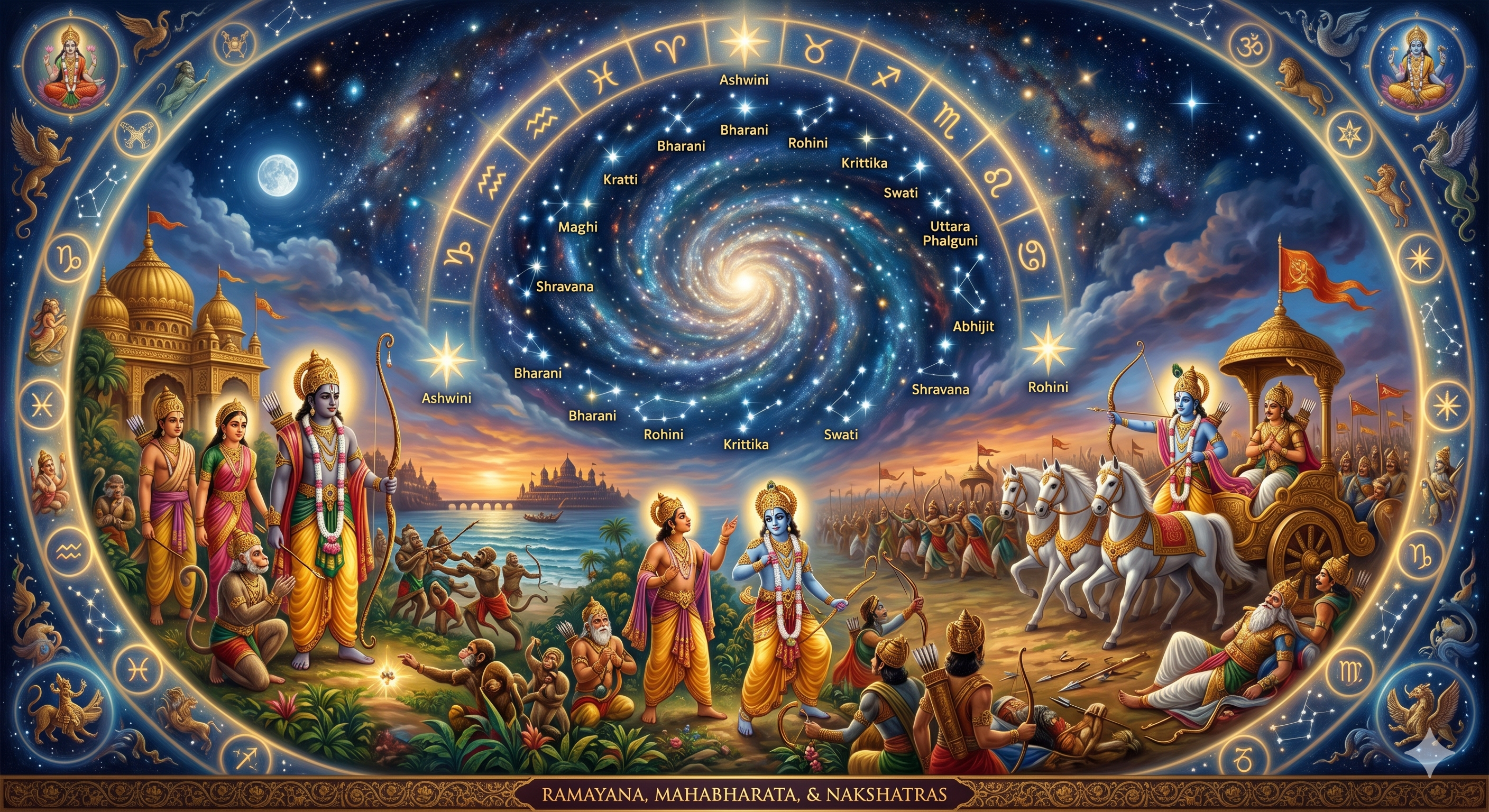
The Nakshatras of Ramayana & Mahabharata Characters —
How ancient birth stars shaped the greatest stories ever told, and what they teach us today
☽ 27 Nakshatras
⚔ Mahabharata
🏹 Ramayana
✦ Vedic Astrology
What is a Nakshatra? In Vedic astrology (Jyotish Shastra), the Moon travels through 27 lunar mansions — called
Nakshatras — as it orbits Earth. The nakshatra the Moon occupies at the exact moment of your birth is your
Janma Nakshatra (birth star). It is considered your soul’s inner compass, shaping your personality, emotional responses, and life patterns far more precisely than a Sun sign alone. The ancient rishis encoded this system over 5,000 years ago — and they also encoded it into the very characters of the Ramayana and Mahabharata.
Methodology note: The nakshatras of Rama, Sita, and Hanuman are sourced from classical scriptural texts (Valmiki Ramayana and traditional commentaries). For other characters, assignments draw from Vedic astrological tradition, character-trait analysis, and scholarly commentary — which is honestly noted below for each character.
| Character |
Epic |
Nakshatra |
Ruling Planet |
Deity |
Key Trait |
| Rama |
RAMAYANA |
Punarvasu |
Jupiter |
Aditi |
Renewal & dharma |
| Sita |
RAMAYANA |
Pushya |
Saturn |
Brihaspati |
Nourishment & endurance |
| Hanuman |
RAMAYANA |
Moola |
Ketu |
Nirriti |
Dormant power & devotion |
| Lakshmana |
RAMAYANA |
Ashlesha |
Mercury |
Naga serpents |
Fierce protective loyalty |
| Ravana |
RAMAYANA |
Vishakha |
Jupiter |
Indra & Agni |
Brilliance corrupted by ego |
| Bharata |
RAMAYANA |
Pushya |
Saturn |
Brihaspati |
Selfless stewardship |
| Vibhishana |
RAMAYANA |
Anuradha |
Saturn |
Mitra |
Dharma over kinship |
| Krishna |
MAHABHARATA |
Rohini |
Moon |
Prajapati Brahma |
Magnetic charm & fixed truth |
| Arjuna |
MAHABHARATA |
Uttara Phalguni |
Sun |
Aryaman |
Sacred leadership & duty |
| Karna |
MAHABHARATA |
Krittika |
Sun |
Agni |
Blazing generosity & pride |
| Yudhishthira |
MAHABHARATA |
Bharani |
Venus |
Yama |
Dharma & fatal weakness |
| Bhishma |
MAHABHARATA |
Dhanishtha |
Mars |
Eight Vasus |
Warrior discipline & tragic loyalty |
| Draupadi |
MAHABHARATA |
Purva Phalguni |
Venus |
Bhaga |
Righteous fire & honour |
| Duryodhana |
MAHABHARATA |
Jyeshtha |
Mercury |
Indra |
Entitlement & cunning |
| Bhima |
MAHABHARATA |
Magha |
Ketu |
Pitris (ancestors) |
Raw power & ancestral pride |
🪐 Ruling Planet: Jupiter
🌟 Deity: Aditi (mother of gods)
♋ Sign: Cancer Lagna
🏹 Symbol: Quiver of arrows
About this Nakshatra
Punarvasu — meaning “return of light” or “becoming good again” — spans 20°00′ Gemini to 3°20′ Cancer. Its symbol is a quiver of arrows, signifying focused purpose and restoration. Valmiki Ramayana explicitly states (Bala Kanda, Shloka 1.18.8–9) that Rama was born on Chaitra Shukla Navami under Punarvasu nakshatra, with five planets in exaltation. This makes Punarvasu Rama’s nakshatra beyond scholarly doubt — it is scripture, not inference.
How these traits played out in the Ramayana
Punarvasu’s core theme is the journey away from home and the triumphant, purposeful return — this is the Ramayana’s plot in a single nakshatra. Fourteen years of exile, wandering through forests, losing his wife, waging a cosmic war — and then returning to Ayodhya to restore dharma. Jupiter’s influence gave Rama his unshakeable moral compass, his wisdom in statecraft, and his compassion even for enemies. He wept for Ravana’s death. He honoured Vali despite their conflict. His bow and arrow — the quiver symbol — was his divine instrument of dharma.
✦ Life Lesson from Rama’s Nakshatra
When life displaces you — through job loss, a broken relationship, or exile from a life you knew — treat it as your Punarvasu time. Use the wandering purposefully. Develop skills, build wisdom, forge alliances. The return home is always richer than the departure. Displacement is not punishment; it is preparation.
🪐 Ruling Planet: Saturn
🌟 Deity: Brihaspati (Jupiter god)
♋ Sign: Cancer
🐄 Symbol: Cow’s udder (nourishment)
About this Nakshatra
Pushya — “the nourisher” — spans 3°20′ to 16°40′ Cancer. Its symbol is the milk-yielding udder of a cow, embodying unconditional nourishment and protection. Indastro.com and multiple Vedic astrology sources explicitly state: “It stands for nourishment and is the birth star of goddess Sita.” Pushya is considered one of the most auspicious nakshatras, yet Saturn’s rulership gives its natives an extraordinary capacity to endure delay, hardship, and tests of patience before receiving their due.
How these traits played out in the Ramayana
Sita nourished everything around her — Rama’s spirit through 14 years of exile, the ashoka grove in Lanka through her dignified presence, the very earth through her devotion. Saturn gave her the patience to endure captivity under Ravana without breaking. Yet Pushya has an inviolable limit: it nourishes generously until the purpose of its nourishment is complete, then it returns to its source. When Rama questioned her character a second time after she had already passed the fire trial, Sita did not protest. She simply chose finality — liberation into the Earth. The nourisher had given everything. The account was closed.
✦ Life Lesson from Sita’s Nakshatra
Nourish others generously — your family, your team, your community. But maintain an inviolable boundary for your own dignity. Sita’s tragedy arose not from her weakness but from others failing to honour that boundary. Know your limit before others reach it, and communicate it clearly. Endless giving without self-respect is not virtue — it is self-erasure.
🪐 Ruling Planet: Ketu
🌟 Deity: Nirriti (dissolution goddess)
♐ Sign: Sagittarius
🌱 Symbol: Roots tied together
About this Nakshatra
Moola — “the root” — spans 0° to 13°20′ Sagittarius. Its symbol is a bunch of roots tied together, representing penetration to the very source of things. Astrojyoti.com states this nakshatra is “the birth star of Lord Hanuman and Goddess Saraswati.” Moola has the shakti (power) to destroy the very roots of problems — but Ketu, the ruling planet, is the planet of detachment, ego dissolution, and mystical forgetting. This paradox — enormous power held by an ego-less being — is the nakshatra’s highest expression.
How these traits played out in the Ramayana
Hanuman didn’t merely defeat demons — he burned Lanka’s entire infrastructure to its foundations (destroying the root of Ravana’s power). This is Moola’s destructive shakti at its most literal. Yet Ketu’s most famous gift to Hanuman was the forgetting of his own limitless power. He had to be reminded by Jambavan that he could cross the ocean — and only then did he leap. This is the deepest Ketu-Moola truth: the most powerful souls often do not recognize their own strength until called upon. His complete ego dissolution (he asked only for Rama’s name, never personal glory) made him invincible.
✦ Life Lesson from Hanuman’s Nakshatra
Your greatest strength may lie dormant inside you, unrecognized. Like Hanuman who forgot he could fly, we frequently underestimate our own capacity. Seek mentors and allies who see your potential before you do — and be willing to believe them. Also: ego dissolution is not weakness. Hanuman’s power was amplified, not diminished, by his complete surrender to purpose over personal glory.
🪐 Ruling Planet: Mercury
🌟 Deity: Naga serpent deities
♋ Sign: Cancer (end degrees)
🐍 Symbol: Coiled serpent
About this Nakshatra
Ashlesha — “the entwiner” — spans 16°40′ to 30° Cancer. Its symbol is a coiled serpent, representing fierce protective instinct, total encirclement of what one loves, hypnotic focus, and quick, decisive action when threatened. Ashlesha natives form intense, almost consuming bonds with a primary person or cause, and are capable of remarkable endurance in service of that bond. Mercury gives them swift intelligence; the Naga deities give them a dangerous edge when their protection is crossed.
How these traits played out in the Ramayana
Lakshmana abandoned his wife Urmila and slept standing guard — literally without rest — for all 14 years of exile. That is Ashlesha’s serpentine total absorption in a primary bond taken to cosmic extremes. His speed in conflict is legendary: the nose of Shurpanakha severed in an instant; the immediate challenge to Parashurama when Rama needed a diplomatic moment to resolve the confrontation. Mercury’s wit made him verbally sharp and sometimes cutting. And like a coiled serpent, he was perfectly still until the moment of strike — then absolute.
✦ Life Lesson from Lakshmana’s Nakshatra
Fierce loyalty is one of the most precious qualities a person can have. But ensure your absolute devotion doesn’t render invisible the needs of others you’ve also pledged to protect. Lakshmana’s singular focus on Rama meant Urmila’s silent 14-year sacrifice went largely unacknowledged. Balance the depth of your primary devotion with awareness of the concentric circles of people who depend on you.
🪐 Ruling Planet: Jupiter
🌟 Deity: Indra & Agni (dual)
♏ Sign: Libra/Scorpio
🌿 Symbol: Forked branch / Triumphal arch
About this Nakshatra
Vishakha — “the forked one” — spans 20° Libra to 3°20′ Scorpio. Its symbol is a forked branch or triumphal arch, perfectly capturing the pivotal choice between two paths. The dual deity of Indra and Agni gives Vishakha natives extraordinary ambition, intelligence, political cunning, and the drive to acquire. Jupiter’s rulership should give wisdom — but in Vishakha’s shadow, Jupiter’s confidence becomes entitlement, and the expansive drive becomes unchecked desire. The nakshatra’s core lesson is the fork: which branch do you choose when desire and dharma diverge?
How these traits played out in the Ramayana
Ravana was not a simple villain. He was a brilliant Brahmin scholar, a master of the Vedas, a gifted musician, an effective king who brought prosperity to Lanka, and a genuine devotee of Shiva. These are Vishakha’s extraordinary high-side gifts. But he stood at the fork — his own minister Maricha warned him explicitly that taking Sita would destroy him. He knew. He proceeded. The dual deity Indra-Agni gave him the ability to see both paths clearly and the burning desire to take the wrong one. His son Narantak, born under the destructive Moola nakshatra, was set adrift in the ocean at birth — even celestial signs warned the family of coming ruin.
✦ Life Lesson from Ravana’s Nakshatra
Intelligence without humility is the most dangerous combination in existence. Ravana knew everything — Vedas, statecraft, omens, consequences — except the one thing that mattered: when to stop and submit his ego to a higher truth. When you face your own fork in the road, the question is not which path you are capable of taking, but which path you can live with having taken. Cultivate the wisdom to recognize your ego’s voice and distinguish it from your conscience’s.
🪐 Ruling Planet: Saturn
🌟 Deity: Brihaspati
🐄 Symbol: Nourishing udder
How these traits played out in the Ramayana
Bharata refused the kingdom that his mother’s scheming had won for him. He placed Rama’s sandals on the throne and governed Ayodhya as regent, living in austerity (matted hair, bark clothing) for 14 years — refusing every comfort of kingship while wielding its full responsibility. This is Pushya at its highest expression: nourishing an entire kingdom without claiming the fruit. Saturn gave him the patience and discipline to sustain this 14-year sacrifice without bitterness or self-pity. He is one of history’s most underrated figures of moral greatness.
✦ Life Lesson from Bharata’s Nakshatra
True leadership is stewardship, not ownership. Bharata shows us that the highest role is often to hold power in trust — to serve without seizing, to govern without glory-seeking. If you are ever in a position of delegated authority, Bharata’s example asks: are you protecting the institution, or using it?
🪐 Ruling Planet: Saturn
🌟 Deity: Mitra (god of friendship & covenant)
♏ Sign: Scorpio
🪷 Symbol: Lotus / Staff
How these traits played out in the Ramayana
Anuradha natives are deeply principled and will, when pushed to the limit, choose dharma over blood. Vibhishana counselled Ravana repeatedly to return Sita, even when doing so invited ridicule and fury in Ravana’s court. When exiled by his own brother, he crossed to Rama’s side — not as a traitor, but as a man whose loyalty to truth superseded his loyalty to family. Mitra’s energy of sacred covenant made this not betrayal but fulfillment: he had made an inner covenant with righteousness long before. Saturn’s eventual reward: kingship of Lanka.
✦ Life Lesson from Vibhishana’s Nakshatra
Courage is not always charging into battle. Sometimes the most courageous act is quiet dissent within your own group — speaking truth to family, colleagues, or leaders who have chosen wrongly. Vibhishana chose lonely righteousness over comfortable complicity. History, and Rama, vindicated him completely.
🌙 Ruling Planet: Moon (exalted)
🌟 Deity: Prajapati Brahma
♉ Sign: Taurus
🛕 Symbol: Chariot (ox-cart)
About this Nakshatra
Rohini — “the red one” — spans 10° to 23°20′ Taurus. The brightest star is Aldebaran. The Moon is exalted in Taurus, and Rohini is the Moon’s own favourite nakshatra — making it the most creatively and emotionally potent lunar position in the entire zodiac. Wikipedia’s Rohini article explicitly states: “Lord Krishna’s birth star is Rohini and it is believed there exists a significance in his choice to be born under the influence of this star.” Rohini is a Dhruva (fixed) nakshatra, meaning its natives hold their convictions with immovable certainty. Symbol: a chariot.
How these traits played out in the Mahabharata
Krishna’s Rohini traits are almost shockingly literal. His magnetic beauty captivated every gopi, his charm disarmed kings, his music enchanted the cosmos — all Moon-in-Rohini gifts of creative magnetism. But the symbol of the chariot is extraordinary: Krishna’s defining role in the Mahabharata is as Arjuna’s charioteer. The most powerful being in the universe chose to drive a chariot, and that chariot-driving became the vehicle for the Bhagavad Gita. Rohini’s fixed quality meant his convictions were absolute — he had decided the Pandavas must win, and he never wavered. He also upheld women’s right to choose their partners (supporting Rukmini, teaching Subhadra’s abduction plan) — a fixed, dhruva principle.
✦ Life Lesson from Krishna’s Nakshatra
Develop genuine magnetism through authenticity, not performance. Krishna’s charm arose from complete self-alignment — he was fully himself in every situation, from playing the flute to managing geopolitics to driving a chariot. When your inner and outer worlds are consistent, people are drawn to you naturally. Also: identify your highest-leverage role in every situation — it may not be the most visible one. Krishna chose to drive.
☀️ Ruling Planet: Sun
🌟 Deity: Aryaman (guardian of unions & nobility)
♍ Sign: Virgo/Leo
🐂 Symbol: Bed’s rear legs / Fig tree
About this Nakshatra
Uttara Phalguni — “the latter reddish one” — spans 26°40′ Leo to 10° Virgo. Sun-ruled, with deity Aryaman governing sacred contracts, noble agreements, and social leadership. Uttara Phalguni natives are placed on a public platform — made visible, called to leadership, and tasked with upholding agreements that transcend personal comfort. Astrologyayurveda.com notes: “Connected to the Sun, Uttara Phalguni naturally puts individuals on a platform — making them visible, respected, and often called to leadership roles.”
How these traits played out in the Mahabharata
The Bhagavad Gita begins with Arjuna’s crisis — frozen at the most sacred duty-crossroads in world literature. His breakdown on the battlefield of Kurukshetra was quintessentially Uttara Phalguni: a conflict between personal loyalty (to family) and his sacred public duty (to dharma). Aryaman made him the axis of every alliance in the war. His peerless archery skill was the Sun’s precision given martial form. In the Gita, Krishna does not simply command Arjuna — he reasons with him, honouring Uttara Phalguni’s need for principled justification before action.
✦ Life Lesson from Arjuna’s Nakshatra
When duty and emotion clash — and they will — seek your Gita moment. Find a trusted guide who can help you see beyond immediate pain to the larger purpose. Arjuna’s greatness was not in having no doubts, but in being willing to sit with those doubts long enough to hear an answer that transcended them. Ask better questions when you are in crisis; the answers may reshape your entire understanding of what you are doing and why.
☀️ Ruling Planet: Sun
🌟 Deity: Agni (fire god)
♈ Sign: Aries/Taurus
🔪 Symbol: Flame / Razor blade
About this Nakshatra
Krittika — “the cutter” — spans 26°40′ Aries to 10° Taurus. Its symbol is a flame or razor. Deity Agni, the fire god, gives Krittika natives blazing generosity, purifying courage, and a tendency to be cut by their own sharpness — the razor that cuts others can cut the wielder. Karna was the son of Surya (Sun) and was born with his divine Kavacha-Kundala (armour and golden earrings) — a solar-fire motif that perfectly embodies Krittika’s Agni essence.
How these traits played out in the Mahabharata
Karna was arguably the greatest donor in all of world literature. He gave so freely that he earned the title Daanveer. And when Indra (disguised as a Brahmin) came to beg for his divine armour and earrings — knowing this would cost Karna his life in battle — Karna gave them away anyway. That is Agni-Krittika generosity: burning, absolute, self-consuming. But Krittika’s shadow is pride that cannot yield. When Krishna offered Karna the Pandava kingship on the eve of war, Karna refused. His loyalty to Duryodhana, and his pride about having been acknowledged by Duryodhana when the world rejected him, were unbreakable. He told Krishna he knew the Pandavas would win. He went to war anyway. He was cut by his own sharpness.
✦ Life Lesson from Karna’s Nakshatra
Generosity is one of the most divine qualities — practise it without reservation. But examine whether your loyalty and pride serve the people you love, or merely your own image of yourself as loyal and proud. Karna’s tragedy was that his nobility became a prison. Sometimes the most generous act is to change sides for truth — even when loyalty has defined your identity.
♀️ Ruling Planet: Venus
🌟 Deity: Yama (dharma & death)
♈ Sign: Aries
🌀 Symbol: Yoni (womb of consequences)
About this Nakshatra
Bharani — “the bearer” — spans 13°20′ to 26°40′ Aries. Symbol is the yoni (womb), representing the bearing of karmic consequences and the restraint that comes with moral weight. Deity Yama — the god of dharma and death — is Yudhishthira’s divine father in the epic, making this one of the most literally resonant nakshatra-character alignments in the texts. Aaps.space explicitly connects Bharani with Yudhishthira’s dharmic and karmic journey.
How these traits played out in the Mahabharata
Bharani natives bear the weight of karma with extraordinary resilience but can suffer catastrophic failures through unchecked impulse — especially Venus-ruled excess. Yudhishthira’s gambling addiction — staking his kingdom, his brothers, and ultimately Draupadi in a dice game — is Bharani’s shadow rendered in perfect narrative form. He knew gambling was wrong, said so himself, and kept playing. The womb-symbol means Bharani births consequences that cannot be unborn. Yet in his final acceptance of all karma without complaint — walking to heaven with a dog by his side, refusing to abandon the faithful — he reached Bharani’s highest expression.
✦ Life Lesson from Yudhishthira’s Nakshatra
Know your one fatal weakness and guard it with structural barriers, not willpower alone. Yudhishthira had plenty of willpower — it failed him anyway at the dice table. Build systems that protect you from your own vulnerabilities. Tell your trusted people about your weakness before it creates consequences. Self-knowledge without structures is incomplete wisdom.
♂️ Ruling Planet: Mars
🌟 Deity: Eight Vasus (elemental gods)
♑ Sign: Capricorn/Aquarius
🥁 Symbol: Mridanga drum
About this Nakshatra
Dhanishtha — “the wealthiest” — spans 23°20′ Capricorn to 6°40′ Aquarius. Symbol is a drum (mridanga), representing rhythm, courage, and divine timing. Ivaindia.com states: “In ancient history known as Mahabharata, Pitamah Bhishma was an incarnation of Vasu known as Dyu” — and Dhanishtha’s ruling deities are the eight Vasus. Rudrakshahub.com directly names Bhishma as a famous Dhanishtha native. This is one of the most mythologically grounded nakshatra-character linkages in the Mahabharata.
How these traits played out in the Mahabharata
Dhanishtha natives are fierce Mars-warriors with the power to purify — to transform what others discard into something precious. Bhishma mastered death itself (Ichcha Mrityu — choosing one’s moment of death) and fought for a side he privately believed was wrong, fulfilling an oath that had become its own prison. His teachings from the bed of arrows (Shanti Parva and Anushasana Parva) — where he lay dying for 58 days, instructing Yudhishthira on dharma — are among the most extensive discourses on governance, ethics, and spirituality in all ancient literature. He knew how to fight, and he knew how to teach. The drum symbol: he set the rhythm for an entire civilization even in death.
✦ Life Lesson from Bhishma’s Nakshatra
Institutional loyalty can become its own prison. Before you make an irreversible commitment — an oath, a contract, an unconditional promise — ask yourself: what injustice might this commitment someday prevent me from stopping? Bhishma’s tragedy was not his vow but his inability to see that some oaths must yield to a higher truth when the institution they were sworn to protect betrays its own purpose.
♀️ Ruling Planet: Venus
🌟 Deity: Bhaga (god of love, fortune & honour)
♌ Sign: Leo
🛏 Symbol: Front legs of a bed
How these traits played out in the Mahabharata
Purva Phalguni gives great beauty, fierce personal honour, creative power, and the inability to forget or forgive a debt of honour. Draupadi’s humiliation in the Kaurava court — dragged by her hair before a full assembly while her husbands sat silently — ignited a fury that burned for 18 years and did not extinguish until the war ended and the debt was paid in blood. Bhaga’s energy governs what is rightfully owed, and Draupadi never let anyone forget what was owed to her. Yet she also loved five husbands with remarkable equanimity and managed that impossible life with extraordinary grace. She was simultaneously the most wronged and the most dignified figure in the epic.
✦ Life Lesson from Draupadi’s Nakshatra
Never silence legitimate righteous anger. Draupadi’s refusal to quietly accept injustice was the moral engine that drove an entire civilization toward accountability. Channel your anger into sustained, purposeful action — not explosive reaction. When you have been wronged, document it, remember it clearly, and pursue justice through every appropriate channel. The war that she helped ignite ultimately restored dharma to the world.
🪐 Ruling Planet: Mercury
🌟 Deity: Indra (king of gods)
♏ Sign: Scorpio
☂️ Symbol: Circular amulet / Umbrella
About this Nakshatra
Jyeshtha — “the eldest” — spans 16°40′ to 30° Scorpio. Symbol is a circular amulet, earring, or umbrella — all symbols of authority and chief status. Indra as deity gives Jyeshtha natives enormous ambition, a keen sense of entitlement to primacy, commanding presence, and ferocious sensitivity to any challenge to their status. Mercury’s shadow in this nakshatra is cunning deployed in service of ego — intelligence weaponized rather than enlightened.
How these traits played out in the Mahabharata
Duryodhana was genuinely gifted — a formidable warrior, an intensely loyal friend to Karna (his greatest virtue), and a capable ruler. These are Jyeshtha’s real strengths. But Mercury’s cunning deployed through Shakuni produced the dice game, the wax palace assassination attempt, and Draupadi’s public humiliation — all calculated schemes to eliminate the threat to his primacy. His inability to tolerate the Pandavas’ success, even when offered a peaceful partition of the kingdom, was Jyeshtha’s fatal shadow: the belief that others flourishing diminishes the self.
✦ Life Lesson from Duryodhana’s Nakshatra
Entitlement is a silent poison that corrodes everything it touches. Duryodhana had every advantage — birth, training, friendship, ability — and destroyed it all because he could not tolerate others flourishing. Cultivate the inner security to celebrate others’ victories without feeling diminished by them. Success shared is success multiplied. Success hoarded is success eventually lost.
🪐 Ruling Planet: Ketu
🌟 Deity: Pitris (ancestral gods)
♌ Sign: Leo
👑 Symbol: Throne / Palanquin
How these traits played out in the Mahabharata
Magha — “the mighty one” — gives immense physical power, ancestral pride, and the drive to avenge insults to family honour at whatever cost. Bhima’s two great vows — to drink Dushasana’s blood and to break Duryodhana’s thigh — were fulfilled literally and without apology. These are quintessential Magha: ancestral honour demanding satisfaction. He was the most emotionally transparent of the Pandavas — openly wept, openly raged, openly loved. Ketu gave him a reckless quality about personal consequences when family was threatened. He was the Pandavas’ hammer; others provided the aim.
✦ Life Lesson from Bhima’s Nakshatra
Raw strength — physical, emotional, or moral — needs the container of wisdom and strategy to be truly effective. Bhima’s power was extraordinary, but it was Yudhishthira’s dharma and Krishna’s strategy that gave it direction and purpose. Pair your strongest gifts with people whose strengths complement yours — and be honest about where your strengths end and theirs begin.
✦ The Cosmic Patterns That Will Astonish You
🛕
Rama’s nakshatra IS the Ramayana’s plot. Punarvasu means “return of light.” The entire Ramayana is Punarvasu: a 14-year wandering and a triumphant return home. The universe encoded the story in the birth star.
🛻
Krishna’s nakshatra symbol is a chariot. Rohini’s symbol is an ox-cart / chariot. Krishna’s defining role in the Mahabharata is as Arjuna’s charioteer. He was the most powerful being alive — and he chose to drive.
🌊
Hanuman forgot he could fly — because Ketu rules forgetting. Moola is ruled by Ketu, the planet of ego dissolution and mystical forgetting. The most powerful figure in the Ramayana had to be reminded of his own strength. This is not myth; it is nakshatra psychology.
⚡
Bhishma was literally an avatar of the Vasus — who rule Dhanishtha. The Mahabharata itself confirms Bhishma was the incarnation of Dyu, one of the eight Vasus. Dhanishtha’s ruling deities are the eight Vasus. The epic and the nakshatra are the same sentence in two languages.
💔
Karna read the nakshatras and knew he would die. Before the war, Karna told Krishna that Saturn was afflicting Rohini nakshatra (a catastrophic omen) and that the planetary alignments foretold Pandava victory. He was a nakshatra scholar who understood his own doom through the stars — and went to war anyway. This is perhaps the most heartbreaking fact in all of Indian literature.
Honest methodology note: The birth nakshatras of Rama (Punarvasu), Sita (Pushya), and Hanuman (Moola) are confirmed in classical scriptures and multiple authoritative Vedic astrology sources. For characters like Arjuna, Karna, Yudhishthira, Draupadi, and Duryodhana, the nakshatra assignments come from astrological tradition, character-trait analysis, and published Vedic astrology commentaries. Bhishma’s Dhanishtha nakshatra is supported by Mahabharata mythological context (his Vasu identity) and direct citation in published nakshatra literature. Where assignments are traditional rather than scriptural, this is noted in each character’s entry.
References & Sources
Valmiki Ramayana, Bala Kanda (Shloka 1.18.8–9) — Rama’s birth nakshatra explicitly stated as Punarvasu
Indastro.com — Pushya Nakshatra article: “It stands for nourishment and is the birth star of goddess Sita”
Indastro.com — Rohini Nakshatra: “Krishna was born in Rohini nakshatra, a favorite of all Gopis”
Wikipedia — Rohini (nakshatra): “Lord Krishna’s birth star is Rohini and it is believed there exists a significance in his choice to be born under the influence of this star”
Subhayogam.com — Moola Nakshatra: “Lord Hanuman is believed to have been born in Moola Nakshatra”
Astrojyoti.com — Moola Nakshatra scripture compilation: “birth star of Lord Hanuman and Goddess Saraswati”
Aaps.space — Bharani Nakshatra: Yudhishthira and the Dharma connection in Mahabharata context
Aaps.space — Mula Nakshatra: “Ravana’s example in the Hindu epic of Ramayana” as classic Moola-Ketu ego-vanity manifestation
Rudrakshahub.com — Dhanishtha Nakshatra: “Bhishma Pitamah, the grandfather of Duryodhan… Dhanishtha born”
IVAIndia.com — Dhanishtha Nakshatra: “Pitamah Bhishma was an incarnation of Vasu known as Dyu”
Vedadhara.com — “Lord Rama’s Horoscope: A Divine Configuration” — planetary analysis from Valmiki Ramayana
Astroanuradha.com — “Krishna and Arjuna: Mahabharat through the Nakshatras”
Asksatishlifeguide.com — “Karna and the Astrology Connection” — Karna as nakshatra scholar citing planetary afflictions to Krishna
Rahasyavedicastrology.com — Jyeshtha, Vishakha, Moola, Uttara Phalguni, Rohini nakshatra mythology articles
Hinduismschool.com — “27 Nakshatras in Vedic Astrology: A Complete Guide”
Wikipedia — List of Nakshatras, Bhishma, Lakshmana, Rama, Rohini (nakshatra) articles
Renukaastrology.com — “The Ultimate Guide to Nakshatras and the 27 Stars”
Astrologyayurveda.com — Uttara Phalguni Nakshatra: deity Aryaman and leadership qualities
Leave a Reply