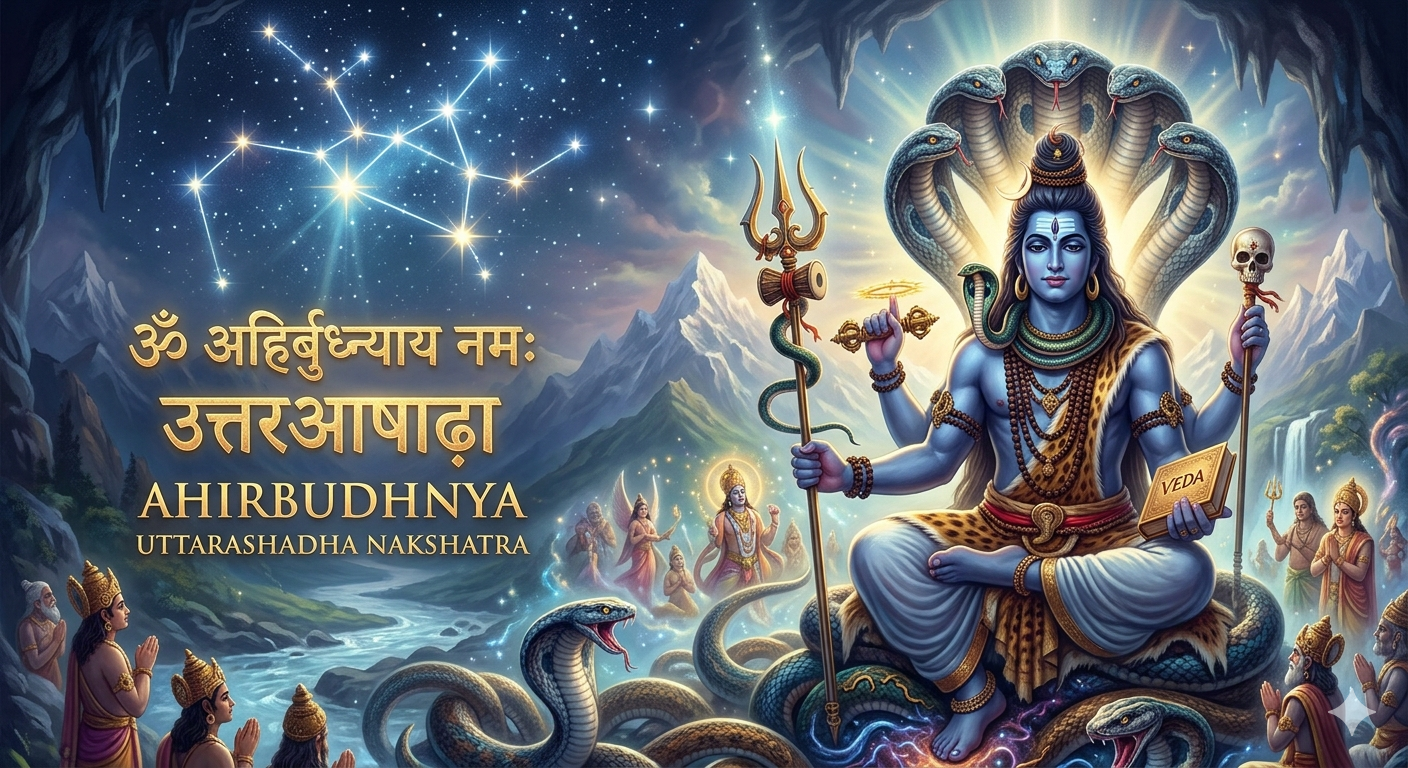
Pancharatra Agama · Vaishnava Scripture · Complete Deep-Dive Guide
Ahirbudhnya Samhita
अहिर्बुध्न्यसंहिता
The Serpent-of-the-Depths Compendium — a profound Vaishnava tantric scripture on cosmic creation, Sudarshana’s power, yoga, mantra, and the path of total surrender. Practically extinct. Profoundly relevant.
~3,880 Verses
c. 200–700 CE
Pancharatra Agama
Kashmir Origin
The Foundation
What is the Ahirbudhnya Samhita?
The Ahirbudhnya Samhita is among the most philosophically sophisticated texts in all of Hindu scriptural literature — a tantric Vaishnava compendium belonging to the Pancharatra Agama, the ancient tradition that forms the theological backbone of South Indian temple worship and Sri Vaishnavism today.
The text is structured as a dialogue between two sages, Bharadvaja and Durvasa, during which Durvasa reveals the teachings that Ahirbudhnya originally gave to the sage Narada. The original scripture was said to contain 240 chapters — what survives is a condensed version of 60 chapters and 3,880 verses.
Transmission Chain
→
→
→
→
→
The Four Domains of Knowledge
What the Samhita Covers
Like all major Agamic texts, the Ahirbudhnya Samhita organises its teachings across four interconnected domains — called jnana, yoga, kriya, and carya. Every chapter falls into at least one of these.
The nature of Brahman, the theory of five forms of Vishnu, the four cosmic Vyuhas, Shakti, creation from pure matter, the soul’s bondage and liberation. Chapters 1–14 form the philosophical bedrock — described as reaching “unparalleled heights of sophistication” in all Pancharatra literature.
Kundalini yoga, pranayama, nadi purification, nyasa (body mapping with mantras), prapatti (total surrender), and meditation on the Vyuhas. The Ahirbudhnya contains one of the earliest pre-Yogasutra discussions of yogic practice — the opening line of Patanjali’s Yogasutra appears in the Sashtitantra section here.
Mantra construction, yantra worship (especially the Sudarshana Yantra), mahabhisheka (great ablution ceremony), diksha (initiation), disease-curing rituals, festival ceremonies, and the Panchakala (five daily observances). Chapters 15–50 are primarily kriya.
Daily ethics, the ideal qualities of a spiritual officiant, the doctrine of Prapatti (surrender), Sharanagati (seeking refuge), and the Mahashanti Karman — the great peace-making rite for communities. The moral architecture beneath all practice.
Core Philosophy
The Five Forms of Vishnu (Pancha-Rupa)
The Ahirbudhnya Samhita’s most important philosophical contribution is its systematic mapping of how the Absolute descends through five successive forms — from pure transcendence to intimate inner presence. Understanding this is the key to every practice.
The Absolute. Pure, beyond all qualities. The eternal divine abode — Vaikuntham.
Four cosmic forms: Vasudeva, Samkarshana, Pradyumna, Aniruddha — managing creation, preservation, dissolution.
39 manifestations listed in this text — avatars who descend for specific cosmic and human purposes.
The indwelling God within every being’s heart. Through His impulse we act. Every action can be worship.
The consecrated icon — accessible, intimate, responsive. As fully present as any other form.
The Four Vyuhas in Detail (AhS Chapter 5)
Sattva dominant. Pure consciousness, fountainhead of all emanations. Rules jnana (knowledge) and aishvarya (lordship).
Sattva-Tamas. Rules jiva (souls) and kala (time). Presides over bala (strength). Associated with dissolution.
Sattva-Rajas. Rules the mind and sense organs. Presides over aishvarya and virya. Associated with creation.
Mixed gunas. Rules ahankara (ego) and gross elements. Most accessible Vyuha — the gateway to practice.
Content Architecture
Complete Map of All 60 Chapters
The 60 chapters fall into four natural parts. This is the most comprehensive English chapter-map of the Ahirbudhnya Samhita available online.
Part I — Philosophical Cosmology
Chapters 1–14 · Jnana Pada · Foundation of all practice
Bharadvaja asks Durvasa about Sudarshana’s mystery. The revelatory dialogue frame is established.
God is eternal, nityodita (ever-manifest), all-pervading, beyond conceptual measurement (AhS 2/22–26).
Kriyashakti (creative energy = Sudarshana) and Bhutishakti (material energy = Lakshmi). Inseparable from the Lord yet distinct.
Sudarshana is the Lord’s Kriyashakti — the Divine Idea that actuates all creation. Not merely a weapon.
Detailed exposition of the four cosmic emanations — their gunas, functions, and attributes (AhS 5).
The impure creation (shudhetara-srishti) that proceeds from the Vyuhas and the two movements of Shakti.
The self is beginning-less, brahma-maya, ever-present. Those who receive Shaktipata are liberated.
How the soul becomes bound through samskaras. Liberation is only by God’s grace — not effort alone.
Para, Vyuha, Vibhava, Antaryamin, and Arca described in detail with the reversibility principle.
The philosophical bridge to Samkhya. Brahman as ultimate principle. Opening line of Yogasutra appears here.
39 manifestations of Vishnu enumerated — each avatar’s three purposes: companionship, protection, dharma.
Reference to 10 principal Samhitas — Bhagavat, Vidya, Karma Samhitas and seven others now extinct.
Unique survey: Vedas, Samkhya, Yoga, Pancharatra, and Pashupata — positioning Pancharatra as most complete.
Summary of jnana teachings. The transition from knowing to doing — cosmology must become embodied practice.
Part II — Mantra, Ethics, Yoga & Nyasa
Chapters 15–32 · Yoga & Carya Pada · The practitioner’s core
Who is authorized to practice. Ideal qualities of a spiritual officiant. Household ethics: satya, ahimsa, daya.
Three occult alphabets of the Ahirbudhnya. Letters as cosmic vibrations — the seed-forms of all mantras.
How the Taraka Mantra and Narasimhanustubha are built from bija syllables. The six angas of mantra practice.
The importance of receiving mantra through a qualified teacher. How initiation frees from all past wrongs.
Sacred geography of practice: which directions to face for different worship types in yantra construction.
The nadi system: Sushumna, Ida, Pingala. Pranayama for redirecting prana upward. Detailed breath instruction.
One of the earliest systematic descriptions of Kundalini yoga. Chakras as seats of the Vyuhas.
Placing mantras on specific body parts to sanctify the body as a cosmic temple — a living yantra.
Detailed Vyuha visualizations. Vasudeva in east, Samkarshana south, Pradyumna west, Aniruddha north.
Five components of Prapatti: faith, resolve, trust, appeal, absolute humility before God. The supreme path.
Abhigamana, Upadana, Ijya, Svadhyaya, Yoga — the complete Pancharatra daily discipline framework.
Preparation and consecration of a yantra. Birch-bark reference locating text in Kashmir (AhS 26/75).
Sharanagati as equivalent to all tapas and pilgrimages combined. Salvation “without any other method.”
Specific mantras for protection, healing, prosperity, obstacle removal, and cosmic consciousness attainment.
Part III — Sudarshana: The Disc of Pure Will
Chapters 33–50 · Kriya Pada · The ritual heart of the text
Sudarshana as Ayudhapurusha — a deity in his own right. Radiant as lightning, surrounded by sixteen flames.
Geometry of the Yantra — hexagram, sixteen petals, three encircling squares. Consecration and daily worship.
Sudarshana rituals for healing. Initiates shed karma “like the sun freed from obstruction by snow” (AhS 39/28).
The six-syllable Sudarshana mantra. Astra-mantras for protection. The Taraka Mantra source text.
The Great Ablution ceremony — sacred bathing of the deity with 108 substances, each with its mantra.
Sacred festivals, chariot procession, music and dance, cosmic symbolism of seasonal celebration.
King Muktapida of Kashmir (c. 750 CE) — the only historical figure. Through Sudarshana worship he attained Chakravartin status.
Political theology: a king who worships Sudarshana attains universal sovereignty. Spiritual power and legitimate authority.
Part IV — Liberation, Mantras & Conclusion
Chapters 51–60 · Liberation Pada · The culmination
Full exposition of the cosmic hymn and hymn to Lakshmi as interpreted through Pancharatra theology.
Complete treatment of the Varaha mantra and Narasimhanustubha — two of the most potent protection mantras.
The “glory-wheel of deities” — a mandala of 39 vibhava forms arranged in a cosmic diagram. Unique to this text.
The Great Peace-Making Rite — collective healing, resolving social conflict, establishing community harmony.
The ultimate teaching: the identity and non-difference among all Vyuhas and Shakti and Vishnu. One reality, multiple faces.
Summary (anukramanika) and teaching on scripture as authoritative guide — without it, practice is blind.
The Central Deity
Sudarshana — The Disc of Pure Will
No other Pancharatra text gives Sudarshana this level of attention. In the Ahirbudhnya Samhita, Sudarshana is elevated from a weapon to a cosmic principle — the active, creative face of the divine.
The Sudarshana Yantra is the sacred geometric representation of Sudarshana’s cosmic presence. Each element encodes a dimension of reality:
The Five Daily Observances
Panchakala — The Core Daily Discipline (AhS Ch. 25)
The Pancharatra tradition prescribes five daily observances as the complete framework for a spiritually integrated life. These are the architecture of each day.
Ritual purification of body and mind at dawn — bathing, wearing clean clothes, clearing the sacred space. The physical preparation signals to the whole nervous system that the sacred has begun.
The deliberate gathering of what will be offered — flowers, water, food, incense, light. The act of collection itself is meditative: each object is seen as already sacred, belonging to the divine.
The heart of the practice — offering gathered materials to the divine form with mantras and devotion. This is where the Sudarshana mantras, Purusha Sukta, and Sri Sukta (AhS Ch. 51–55) are used.
Daily reading of scripture (AhS Ch. 60 emphasises this). Not passive reading — contemplative engagement that reframes one’s worldview. Knowledge without study decays into mere belief.
Withdrawing senses inward, pranayama, nyasa, and deep meditation on the Vyuhas or Sudarshana. The “reversal” practice: moving from arca (outer form) through progressively subtler levels toward Para (the Absolute).
Practical Implementation
Daily Rituals from the Ahirbudhnya Samhita
Each practice below is directly grounded in specific chapters. Sources are linked. The text itself is not online in English translation; the best accessible edition is the 1916 Schrader edition (Archive.org).
🔗 Hindupedia Overview
The Ahirbudhnya Samhita’s first daily observance — Abhigamana (“going toward God”) — transforms the morning routine into a sacred approach. The practitioner themselves is the primary instrument of worship.
“Om. Salutation to Narayana.” — The Ashtakshara (eight-syllable) mantra, foundational to the Pancharatra tradition throughout the Ahirbudhnya Samhita. Repeat 108 times or a multiple of 8.
- Wake before or at sunrise. Before speaking to anyone, take three slow breaths. This is the mental abhigamana — the inner turning toward the sacred.
- Bathe or wash face and hands thoroughly. As water touches you, mentally: “I am purifying this vessel.” This physical act is the outer abhigamana prescribed in AhS Ch. 25.
- Wear clean clothes — not yesterday’s. Fresh clothing signals the start of sacred time to the body’s nervous system.
- Go to your altar or a designated spot facing East. Light a lamp or candle. AhS Ch. 23 associates Vasudeva (primary Vyuha) with the East direction.
- Sit quietly for 3 minutes, palms upward in your lap. The goal is presence, not performance.
- Recite the Ashtakshara mantra 8 or 108 times — silently or in a whisper. This is the seed-mantra around which all the text’s practices are built.
Sacred Intention
Emotional Regulation
Circadian Rhythm
🔗 Wikipedia Overview
Chapter 20 offers one of the earliest nadi-pranayama descriptions in any text. Ida (left, lunar, cooling) and Pingala (right, solar, heating) are the two rivers of prana, with Sushumna as the royal channel. Kundalini (Ch. 21) is both blockage and liberating force.
- Sit upright after Abhigamana. Close your eyes. Right hand in Vishnu Mudra (index and middle fingers folded).
- Close right nostril with thumb. Inhale slowly through the left nostril (Ida channel) for a count of 4. Feel cool, lunar energy entering.
- Close both nostrils. Hold breath for count of 8. During retention, mentally descend the Ashtakshara mantra syllable by syllable from crown to base of spine.
- Release right nostril. Exhale slowly through the right nostril (Pingala) for count of 8. Feel warmth and release.
- Inhale through right nostril (count 4). Hold (count 8, same mantra visualization). Exhale through left (count 8). This is one complete round.
- Complete 8 rounds. Sit silently for 2–3 minutes. Notice the stillness — the “gateway” state the Ahirbudhnya describes as preparatory for Vyuha meditation.
Respiratory Health
Prana Alignment
Anxiety Reduction
🔗 WisdomLib Reference
AhS Ch. 33–35 describes Sudarshana as having the brilliance of assembled lightning, surrounded by sixteen flames. Meditating on Sudarshana eliminates fears, diseases, and hostile forces — through alignment of the practitioner’s will with the cosmic creative will (Kriyashakti) that Sudarshana represents.
“Om. We contemplate Sudarshana, we meditate upon the great flame. May that Discus inspire and illumine us.” — The Sudarshana Gayatri, based on AhS Chapters 36–38. Repeat 11 or 108 times.
- After pranayama, sit still. Close your eyes and visualize a luminous spinning disc of golden-white light at your heart center.
- Visualize it as described in AhS Ch. 33: brilliant as lightning, surrounded by 16 flames, spinning clockwise. It is the concentrated will of the divine to create and protect.
- Recite the Sudarshana Gayatri 11 times slowly. With each repetition, feel the disc at your heart spinning more steadily.
- After the mantra recitation, sit in silence with the image. Do not force anything. This is sudarshana-samapatti — absorption in the divine creative will.
- After 5 minutes: slowly open your eyes. Place right palm over heart. Carry this awareness into your day as a subtle background presence.
Decisive Will
Fear Reduction
Healing Intention
Nyasa — “placing” — is the practice of ritually assigning divine presences to specific body parts. In AhS Ch. 22, it transforms the ordinary body into a consecrated yantra. The practitioner becomes not a person who worships the divine, but a living form through which the divine worships itself.
- Sit upright. Bring hands together in anjali (prayer gesture) for three breaths. Set the intention: “I am not preparing my body for worship. I am recognizing my body as already a temple.”
- Touch the top of your head with three fingers of the right hand. Mentally: “Vasudeva” — placing the first Vyuha at the crown, seat of pure consciousness. Hold one breath.
- Touch the throat. Mentally: “Samkarshana” — the Vyuha of time, speech, and dissolution at the throat center. Hold one breath.
- Touch the heart center with open palm. Mentally: “Pradyumna” — the Vyuha of the mind and senses at the heart. Hold two breaths. The heart is where Pradyumna most fully operates.
- Touch the navel. Mentally: “Aniruddha” — the most accessible Vyuha, closest to ordinary human experience, at the solar plexus. Hold one breath.
- Bring both palms together. Mentally: “Sudarshana” — the divine will at the whole body simultaneously. Three full breaths feeling the body as consecrated space. Begin meditation from this state.
Focused Attention
Groundedness
Self-Compassion
🔗 Hindupedia — Detailed Summary
AhS Chapter 27 states explicitly: the person who takes to Prapatti attains the fruits of all tapas, sacrifices, and pilgrimages — without resorting to any other methods. This is not passive resignation. It has five active components.
अहं त्वा सर्वपापेभ्यो मोक्षयिष्यामि मा शुचः॥
“Abandoning all forms of dharma, take refuge in Me alone. I shall liberate you from all sins; do not grieve.” — Bhagavad Gita 18:66, cited in Pancharatra theology as the essence of the Ahirbudhnya Samhita’s Prapatti teaching (AhS Ch. 24–27).
- Anukulya-sankalpa (Resolve toward what God wills): Sit quietly. Review your day. For each action aligned with your highest values, say silently: “This was offered.”
- Pratikulya-varjana (Release of what opposes the divine): Recall one action or thought you regret. Without self-punishment: “I release this. It is offered.” The Samhita is explicit that prapatti dissolves past karma — with genuine release, not suppression.
- Mahavisvasa (Great trust): Both hands open on knees, palms upward. Three slow breaths. Say: “I trust that I am held. I trust that I do not need to control what I cannot control.” Sit with this for 2 minutes.
- Goptrtva-varana (Choosing divine protection): “I choose to be under the protection of the highest Good. Not as passive helplessness, but as the highest form of active surrender.”
- Karpanya (Absolute humility): End with a bow — physical or mental. “I am not the author of my best outcomes. I am a participant in something larger.” Sit in silence for 2 minutes.
Stress Release
Grief Processing
Humility
Sleep Quality
AhS Chapter 60 closes with an explicit statement on the importance of shastra as authoritative guide — without it, all practice lacks direction. Svadhyaya is contemplative engagement until the text’s meaning lives in you.
- Choose a fixed time and place. Regularity matters more than duration — 15 minutes daily beats 2 hours once a week.
- Begin with 3 breaths. Say or think: “I am reading not to accumulate information but to be transformed.”
- Read slowly — one to three paragraphs. When a sentence genuinely stops you, close the book. Sit with it for 1–2 minutes.
- Ask: “Where is this true in my life right now?” Find one specific, concrete application. The Ahirbudhnya’s four domains (jnana, yoga, kriya, carya) are inseparable — knowledge must become practice.
- Write one sentence in a journal about what you read. This compression forces real understanding. Over time this becomes a living commentary of your own transformation.
Wisdom Integration
Perspective
Putting It Together
A Complete AhS-Inspired Daily Schedule
Total active practice time: approximately 50 minutes. Minimum viable version: 20 minutes (Abhigamana + Sudarshana Dhyana + Prapatti).
Bathing, clean clothes, lamp, 8× Ashtakshara mantra. (AhS Ch. 25)
8 rounds alternate nostril breathing with mantra visualization. (AhS Ch. 20–21)
Place the four Vyuhas and Sudarshana at five body centers. (AhS Ch. 22)
Luminous spinning disc visualization, Sudarshana Gayatri 11×. (AhS Ch. 33–38)
One passage read contemplatively. One sentence journaled. (AhS Ch. 60)
Five-component surrender. Review, release, trust, bow. (AhS Ch. 24, 27)
Intellectual Context
Where This Text Sits in Indian Philosophy
Chapter 13 of the Ahirbudhnya Samhita contains a rare survey of five philosophical systems, positioning Pancharatra as the most complete synthesis.
AhS explicitly affirms Vedic authority while extending it — especially through the Purusha Sukta (Ch. 51–53). Pancharatra is the esoteric fulfilment of Vedic outer form.
The Sashtitantra section closely parallels Samkhya. But AhS theises Samkhya: Brahman becomes personal (Narayana) and Shakti becomes devotional (Lakshmi-Sudarshana).
The opening line of Patanjali’s Yogasutra appears in AhS’s Sashtitantra. The AhS adds devotional context: pranayama and nyasa are theistic practices, not merely technical ones.
The Shiva-Vishnu synthesis: Ahirbudhnya (Shiva as Rudra) is the teacher. This ecumenical move absorbed Shaiva practitioners into the Vaishnava fold through respect rather than rejection.
The text places Buddhist Anagamins and Sakrdagamins as descendants of the Pradyumna Vyuha — acknowledging Buddhist soteriological attainment within its own framework.
AhS takes Vedic authority, Samkhya cosmology, Yogic technique, Shaiva ecumenism, and theistic devotion and integrates them into one complete system: jnana + yoga + kriya + carya.
Common Questions
Deep Questions About the Ahirbudhnya Samhita
Go Deeper
Sources & Further Reading
The definitive 2-volume Sanskrit edition by M.D. Ramanujacharya, 1916. Primary source for all scholarship.
Best English-language entry point. Detailed chapter-by-chapter analysis of the Ahirbudhnya Samhita.
705-page edition with Hindi commentary. Most accessible for Hindi-reading practitioners.
The Hindu Encyclopedia’s well-sourced, accurate article on the Ahirbudhnya Samhita.
Surendranath Dasgupta’s analysis from History of Indian Philosophy, Vol. III.
Overview of the full Pancharatra canon and how AhS fits into the larger tradition.
Leave a Reply