All about Bharini Nakshatra

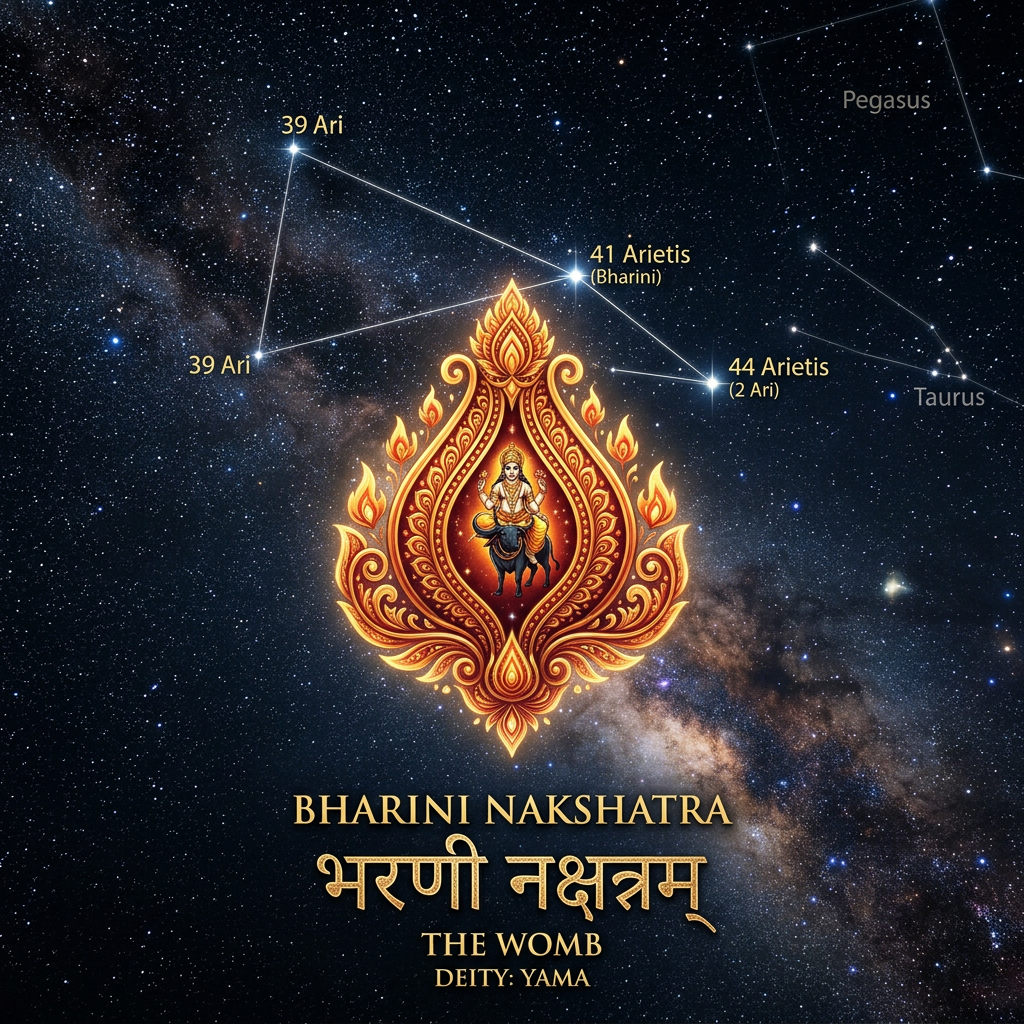
Bharini Nakshatra constellation with stars 39 Ari, 41 Arietis, and 44 Arietis labeled, along with deity Yama symbol

भरणी

Bharani Nakshatra

The Second Lunar Mansion  ·  The Star of Restraint  ·  The Bearer

Where the womb of creation and the hand of death are one. A nakshatra of fire, Venus, desire, transformation, and karmic reckoning — ruled by Yamaraj himself.

13°20′ – 26°40′ Aries
Venus (Shukra) Ruled
Deity: Yamaraj
Symbol: Yoni · Clay Pot
4 Padas

2nd
Nakshatra of 27
4
Padas (Quarters)
3
Stars (35,39,41 Arietis)
Ugra
Nature: Fierce / Active
Artha
Motivation (Life Goal)

Foundation

What is Bharani Nakshatra?

Bharani (भरणी) — meaning “the bearer” or “she who carries” — is the second of the 27 lunar mansions in Vedic astrology. It spans from 13°20′ to 26°40′ of Aries (Mesha Rashi) and corresponds to the three stars 35, 39, and 41 Arietis, forming a triangle in the night sky — the celestial triangle of the cosmic womb.

Bharani stands on the knife-edge between creation and destruction, birth and death, desire and restraint. Its planetary lord is Venus — planet of love, beauty, and life-force. Its divine ruler is Yamaraj — the god of death, justice, and karmic reckoning. This paradox is the very soul of Bharani.

Key Facts at a Glance

♀
Ruling Planet
Shukra (Venus)
☸
Presiding Deity
Yamaraj — King of Dharma
🐘
Animal Totem
Male Elephant
🦅
Bird
Crow (Ancestor’s Messenger)
🜂
Element / Dosha
Fire / Pitta
🌊
Shakti (Power)
Apabharani Shakti — power to take things away
🔡
Name Syllables
Li · Lu · Le · Lo
♂
Gana / Nature
Manushya / Ugra (Fierce)

The Core Paradox: Venus governs beauty, love, pleasure, and art. Yama governs death, karma, and austere justice. Their union in one Nakshatra creates a personality of extraordinary complexity — sensual yet disciplined, creative yet ruthless when crossed, deeply loving yet capable of absolute detachment. The Vedic texts teach: “Even in the yoni — the womb of creation — is the seed of dissolution.”

41 Arietis 39 Arietis 35 Arietis ♀ BHARANI · भरणी

The Four Quarters

Bharani Nakshatra — All Four Padas in Detail

Each Nakshatra divides into four Padas (quarters) of 3°20′ each, corresponding to four Navamsha signs. The Navamsha reveals the soul’s deeper motivation and the flavour through which Bharani’s intense energy is expressed.

First Pada  ·  13°20′ – 16°40′ Aries  ·  Leo Navamsha

Surya Pada — The Leader

Navamsha Lord Sun (Surya)
Key Syllable Li (ली)
Special Note Sun in own Navamsha = full solar power
Saturn here Debilitation zone begins

The most regal and outwardly powerful Pada. Sun in his own Navamsha (Leo) gives the Yama-Venus energy a solar spine — producing unmistakable authority, public distinction, and creative charisma at maximum voltage.

Notable examples: William Shakespeare, Catherine the Great, Uma Thurman, Jessica Alba, Penelope Cruz, Saddam Hussein. Common theme: larger-than-life public figures who bear enormous creative or authoritative power and leave an immortal mark — sometimes at great moral cost.

Second Pada  ·  16°40′ – 20°00′ Aries  ·  Virgo Navamsha

Budha Pada — The Analyst

Navamsha Lord Mercury (Budha)
Key Syllable Lu (लू)
Special Zone Visha (Poison) Nadi: 18°40′–19°33′
Saturn debilitation Exact at 20°00′ Aries

The most analytical and service-oriented Pada. Mercury grounds Bharani’s fire in logic and practical detail. These individuals carry others’ burdens through concrete service. Brilliant at research, medicine, finance, and psychology.

Notable examples: Carl Gustav Jung (spent his life mapping the underworld of the unconscious — Yama’s domain — through systematic Mercury-Virgo analysis). James A. Garfield. The shadow: perfectionism, over-service until depleted.

Third Pada  ·  20°00′ – 23°20′ Aries  ·  Libra Navamsha  ·  ✦ Pushkara (Most Auspicious)

Shukra Pada — The Artist

Navamsha Lord Venus (Shukra)
Key Syllable Le (ले)
Pushkara Bhaga 21°00′ Aries — peak auspice
Special Power Venus doubles (Nakshatra + Navamsha lord)

The most fortunate and artistically gifted Pada. Venus rules both the Nakshatra and the Navamsha — a powerful amplification of creative force. Pushkara Navamsha ensures desires find fulfilment. Rare ability to harmonize life/death, beauty/grief, sensuality/justice.

Notable examples: Elton John (55+ years of enduring music, AIDS activism, survival — creativity through Yama’s shadow). Imelda Marcos. Diana Ross. Theme: extraordinary creative expression combined with complex, turbulent personal transformation.

Fourth Pada  ·  23°20′ – 26°40′ Aries  ·  Scorpio Navamsha  ·  Most Fierce

Mangala Pada — The Transformer

Navamsha Lord Mars (Mangala)
Key Syllable Lo (लो)
Amrita Nadi 24°00′–24°53′ (nectar current)
Yogatara (brightest star) 24°20′ — falls HERE

The most intense and transformative Pada. Mars + Yama + Venus at maximum voltage. The Amrita Nadi runs through this Pada — great suffering leading to great wisdom. The Yogatara (brightest star of Bharani) falls here.

Notable examples: Demi Moore (Moon in Bharani P4 — taboo-breaking roles, public crises survived, memoir of raw truth). These natives descend completely, survive completely. Risk-takers and transformers who go where others fear.

Saturn’s Debilitation in Bharani: Saturn is exactly debilitated at 20°00′ Aries — the boundary of Pada 2 and Pada 3. Saturn (Shani), the half-brother of Yama, is weakened in the domain of his own brother. Saturn’s cold, systematic energy cannot operate in Bharani’s hot, passionate, Venusian fire. Bharani natives often struggle with Saturnian themes — delays, authority, conventional rules — until they learn to transcend them. The tradition teaches: Bharani natives reach their full power only after 33–36 years (a Saturn-related milestone).

The Bharani Personality

Detailed Personality Traits — The Full Portrait

Brihat Jataka of Varahamihira states: “One born in Bharani will be successful at work, truthful, free from disease, capable and free from grief, determined, healthy, skilful and happy.” The full portrait is richer and more complex than any single description can capture.

👁️
The Bearer’s Eyes

Bharani natives have strikingly expressive, large, slightly downward-gazing eyes (adho-mukha gaze). Their look carries both the tenderness of Venus and the weight of Yama’s awareness — magnetic, searching, never entirely at rest. Immediately recognizable.

⚖️
Uncompromising Truth

These natives are constitutionally incapable of comfortable lies. Yama — lord of dharma and justice — instils a deep commitment to truth even when it is socially painful. They will say the uncomfortable thing. This makes them revered by some and alienating to others.

🔥
Extraordinary Endurance

The name Bharani literally means “the bearer.” Their life is often marked by enormous burdens — physical, emotional, karmic. But they carry these with the steadiness of the male elephant, their animal totem, which carries heavy loads without complaint. They suffer greatly but rarely break.

🎨
Raw Creative Power

Venus in Aries gives Bharani an aggressive, urgent creativity. They do not dabble. Their creative work is intense, pioneering, and often taboo-breaking — attracted to subjects others avoid: sexuality, death, power, transgression. Their art carries genuine weight and transformative intent.

🐘
The Elephant’s Memory

Bharani natives never forget what was said or done to them — for good or ill. Slights are remembered for decades; kindnesses are repaid with extraordinary loyalty. This fierce memory serves them in research, law, and any field requiring long-term pattern recognition.

💀
Comfort with Endings

Unlike most people, Bharani natives are not constitutionally terrified of death, endings, or loss. Yama’s influence makes them familiar with the necessary end of things. This gives them unusual courage in crisis situations, and a natural aptitude for medicine, hospice, law enforcement, and forensics.

🌊
Intense Desires

Venus in Aries produces desire that is direct, urgent, and unapologetic. Bharani natives want what they want — fully and without ambivalence. This same intensity drives their ambition, love affairs, creative work, and spiritual seeking. The key challenge is channelling, not being consumed by, this fire.

⛓️
The Shadow: Harsh Judgment

The shadow side of Yama’s energy is harsh judgment — of self and others. Bharani natives can become moralistic, punishing, or rigidly rule-bound. The tradition teaches: Yama himself must be approached with reverence precisely to transform this — justice without compassion becomes cruelty.

Light & Shadow — The Full Spectrum

✦ Light Qualities

Fierce courage and endurance under pressure

Radical honesty — even when it costs them

Transformative creative power

Deep loyalty and long, faithful memory

Natural authority and razor-sharp sense of justice

Pioneer spirit — goes where others dare not

Deep spiritual and ancestral awareness

✦ Shadow Qualities

Ruthless judgment of self and others

Excessive indulgence when Venus runs unchecked

Pride and arrogance (especially Pada 1)

Difficulty accepting Saturn’s delays and rules

Compulsive sexuality or its complete repression

Step-motherly treatment themes in family life

Tendency to extremes — no comfortable middle ground

The Presiding Deity

Yamaraj — Lord of Death, Justice & Karma

Yama (यम) is among the oldest deities in the Vedic pantheon. Son of Surya (the Sun) and Sanjna, twin brother of Yami (Yamuna river), and half-brother of Saturn (Shani) — Yama is the first mortal who chose to die, thereby discovering and revealing the path to the afterlife for all beings that followed.

The Name Yama: The word Yama (यम) derives from the root yam — “to control, to restrain, to bind.” This is also the first of Patanjali’s eight limbs of yoga. Yama is not only the god of death — he is the god of self-restraint, the very foundation of ethical and spiritual discipline. The Vedas reveal him as both the King of the Dead and the Teacher of the Living.

⚖️
Dharmaraj — King of Dharma

Upholds cosmic law with absolute impartiality — no affection or fear can alter his judgment. Chitragupta, his divine accountant, records every deed of every being across every lifetime.

🕯️
Pitripati — Lord of the Ancestors

Rules the South direction and presides over the Pitru realm. All ancestral worship (Shraddha, Pitru Tarpan) is directly connected to Bharani’s energy and Yama’s domain over departed souls.

⏱️
Kala — Time Itself

Yama embodies Kala — time in its consuming, inevitable aspect. He is the nose-carrier, the binder, the finisher. All things existing within time must ultimately surrender to him.

🐂
Appearance & Attributes

Dark green / black complexion. Rides a black buffalo. Carries a staff (danda) and noose (pasha). His two four-eyed dogs — offspring of Sarama — guard the path of the dead and can restore health to the living.

Sacred Texts — Complete Hymn Survey

Vedic Hymns Concerning Yama — All Four Vedas

Every major Vedic hymn dedicated to or significantly involving Yama — the presiding deity of Bharani Nakshatra. Sources are cited precisely with links to public-domain translations.

📖  Rig Veda (Rigveda Samhita)

📜 Rig Veda 10.10 — Yama-Yami Samvada

The Dialogue of Yama and Yami — The First Moral Boundary

“I will not fold mine arms about thy body: they call it sin when one comes near his sister. Not me — prepare thy pleasures with another: thy brother seeks not this from thee, O fair one.”
— RV 10.10.12 (Griffith translation, 1896)

This 14-verse dramatic dialogue is one of the most famous hymns in the entire Rigveda. Yami — Yama’s twin sister, identified with the sacred Yamuna river — urges her brother to join with her and produce offspring for humanity. Yama refuses absolutely, citing cosmic law (rita), the bonds of kinship, and divine order. This hymn encodes the founding moment of Dharma itself: the subjugation of desire to principle.

For Bharani natives, this is their core myth — the battle between Venus (Yami’s urgent desire) and Yama (the imposition of restraint). Scholars note that Yama and Yami may represent Time (Yama) and Space/manifestation (Yami) — their union would collapse the distinction between them, ending creation. Yama’s refusal is therefore cosmically necessary.

📜 Rig Veda 10.14 — The Great Funerary Hymn

Yama as First Ancestor and Path-Finder

“Honour the King with thine oblations, Yama, Vivasvān’s Son, who gathers men together, who travelled to the lofty heights above us, who searches out and shows the path to many.”
— RV 10.14.1 (Griffith)

The central funerary hymn of the Rig Veda — 16 verses recited at the cremation ceremony. Verse 2 establishes Yama as the one who “first found for us a place to dwell in” — he pioneered the path of death so all subsequent mortals would have a road to follow. Yama is not a tyrant but an explorer — the first being willing to undergo death and return as guide.

Verse 14 contains a prayer still resonant today: “Offer to Yama holy gifts enriched with butter… so may he grant that we may live long days of life among the Gods.” Death’s deity is petitioned for long life — Bharani’s paradox in perfect miniature.

📜 Rig Veda 10.135 — Yama’s Tree & the Child

The Pleasant Face of Yama’s Realm

“In the tree clothed with goodly leaves where Yama drinketh with the Gods… Here is the seat where Yama dwells, that which is called the Home of Gods: here minstrels blow the flute for him, here he is glorified with songs.”
— RV 10.135.1, 7 (Griffith)

This 7-verse hymn reveals the pleasant side of Yama’s realm — not a house of horrors but a divine abode where Yama drinks Soma with the gods, ancestors are tended with love, and minstrels play. Death here is “regarded with great sadness but without terror, and life on earth is preciously clung to, but heaven is regarded as a gentle place.” (Wendy Doniger, The Rig Veda.) This hymn contains possibly the earliest reference to the Nachiketa story.

🌿  Atharva Veda (Atharvaveda Samhita)

📜 Atharva Veda 18.1–18.4 — The Four Great Funeral Hymns

The Complete Funeral Canon — Yama as Lord of the Ancestors

“Yama yielded up his own dear body.” — AV 18.3.41    “Let Yama make thee an abiding-place.” — AV 18.3.52    “Worship with sacrificial gift King Yama, Vivasvān’s son who gathers men together, Yama who was the first to die of mortals.” — AV 18.3.13
— Atharva Veda Book 18 (Griffith, 1895)

Book 18 of the Atharva Veda is the most elaborate funerary text in all four Vedas — four long hymns used in the complete cremation ceremony. AV 18.3.41 reveals that Yama’s role as death god required him to personally sacrifice his own existence, making death purposeful and redemptive rather than arbitrary.

AV 18.2 contains the famous instruction to the soul: “Run and outspeed the two dogs, Sarama’s offspring, brindled, four-eyed, upon thy happy pathway. Then go unto the beneficent Fathers, who revel in common revelry with Yama.” The four hymns of Book 18 together reveal Yama not as a monster but as the compassionate King who ensures no soul is lost between worlds.

📜 Atharva Veda 12.2 — Deprecation of the Corpse-Fire

Erecting the Boundary Between Life and Death

“Go onward, Death, pursue thy special pathway apart from that which Gods are wont to travel. Here I erect this rampart for the living: let none of these, none other, reach this limit.”
— AV 12.2.21, 23 (Griffith)

This hymn is recited at the cremation to clearly separate the realm of death from the realm of the living. It uses Yama’s impartial justice as a protective force for survivors. For Bharani natives, this hymn encodes their core gift: the ability to erect boundaries between what must end and what must continue — a natural aptitude for medicine, surgery, law enforcement, and funeral services.

🕉  Yajur Veda — Krishna Yajurveda (Katha Upanishad)

📜 Katha Upanishad — Nachiketa & Yama (Krishna Yajurveda)

The Greatest Teaching — Death Reveals the Immortal Self

“The joy of the Atman ever abides, but not what seems pleasant to the senses. All is well for those who choose the joy of the Atman, but they miss the goal of life who prefer the pleasant.”
— Katha Upanishad 1.2.1 (Easwaran translation)

Embedded in the Katha school of the Krishna Yajurveda, this is the most comprehensive Vedic text on Yama — 6 sections, 2 chapters, 120+ verses. Young Nachiketa is sent by his father to Yama’s abode, waits three days without food. Yama offers him all earthly pleasures to abandon his question. Nachiketa refuses everything. Yama reveals the philosophy of the immortal Atman and the chariot metaphor: Self as rider, body as chariot, mind as reins, senses as horses.

This is the teaching at the heart of Bharani’s energy: the choice between desire (Venus/Yami) and wisdom (Yama). The Katha Upanishad is essentially the complete philosophical manual for Bharani Nakshatra — every theme it explores maps directly onto Bharani’s core mythology.

Cosmic Sibling Conflict

Yama & Saturn — Brothers, Rivals, and Mirrors

The relationship between Yama and Shani (Saturn) is one of the most cosmically significant mythological narratives in the Vedic tradition — and it is directly encoded in Bharani Nakshatra’s energy.

☀️

The Origin Story — Two Sons of the Sun
Skanda Purana, Vishnu Purana, Markandeya Purana

Surya (the Sun God) was married to Sanjna — daughter of Vishwakarma, the divine architect. Unable to bear her husband’s intense radiance, Sanjna secretly left the household, created a perfect shadow-double of herself called Chhaya (“Shadow”), and retreated to the forest as a mare.

Sanjna and Surya’s real children: Shraddhadeva Manu, Yama, and Yami (Yamuna river). Chhaya bore Surya three children including Shani (Saturn). Chhaya naturally gave more love to her own children, subtly neglecting Sanjna’s children — especially Yama. This is the mythological root of the “step-motherly treatment” theme running through Bharani’s energy.

The breaking point came when Yama noticed the unfair treatment and confronted Chhaya — in rage he raised his foot to strike her. Her secret was revealed. Yama was cursed for this act of violence, resulting in his foot being afflicted. Shani, learning he was the son of a shadow-woman, experienced existential shock, burned with rage at his illegitimacy, rejected his father Surya, and in some versions even attacked him.

⚡

The Sibling Dynamic — Justice During Life vs. After Death
Brahma Purana · Vedic astrology tradition · Shani Mantra texts

The tradition divided the administration of karma between the half-brothers:

⚖️ SHANI (Saturn)

Punishes the living for bad karma during their lifetime. Cold, slow, systematic — delivers consequences over years and decades. Operates through delay, difficulty, and discipline.

☸ YAMA

Judges the dead — determines the soul’s next destination. Swift, final, complete. Delivers karmic reckoning at the moment of death, not gradually over a lifetime.

The Shani Mantra itself confirms the sibling bond: “Nilanjana Samabhasam, Ravi Putram, Yamagrajam…” — calling Shani “Yamagrajam” meaning elder brother of Yama. Some traditions make Shani the elder, others make Yama the elder — the ambiguity reflects their complex, contested relationship.

Shani’s limp: “Shani is sometimes shown as lame or with a limp, a result of fighting with his brother Yama as a child.” (LearnReligions.com, citing Hindu tradition.)

The Bharani implication: Because Saturn is debilitated at exactly 20°00′ Aries — within Bharani’s boundaries — the mythological conflict is literally mapped into the sky. Shani cannot function well in the domain of his half-brother Yama. For Bharani natives: Saturnian systems (hierarchy, patience, delay, convention) create friction rather than support. They must consciously cultivate these qualities, or life imposes them through difficult trials.

For the Bharani Native: The Yama-Saturn dynamic plays out as a lifelong tension between the urgent, passionate, justice-now energy of Yama (their deity) and the slow, patient, work-within-systems energy of Saturn (their half-sibling). Most Bharani natives spend their 20s fighting this tension — and their 40s integrating it. The tradition teaches: Bharani natives typically reach their full power only after 33–36 years (a Saturn-related milestone). Before that, the fire burns too hot. After that, it illuminates.

The Bharani Gallery

Famous Persons Born in Bharani — By Pada

Common theme across all padas: people who carry enormous weight, transform their field, often court controversy, and leave an indelible mark on the world.

Pada 1 · Leo Navamsha · Sun
William Shakespeare
c. April 1564 · Poet & Playwright

The quintessential Pada 1 archetype: a figure who earns immortal distinction through creative genius. Shakespeare explored death (Hamlet), desire (Othello), and justice (Merchant of Venice) — the three pillars of Bharani’s divine triangle — more profoundly than any other writer in history. His work bears the full weight of human experience.

Pada 1 · Leo Navamsha · Sun
Catherine the Great
May 2, 1729 · Russian Empress

Sun in his own Navamsha — royal authority at maximum. Catherine seized power through a coup, ruled 34 years, expanded Russia by 200,000 sq. miles, and pursued passionate relationships throughout. Classic Bharani Pada 1: immense creative will, unapologetic desire, and iron discipline in one person. She carried the weight of an empire.

Pada 2 · Virgo Navamsha · Mercury
Carl Gustav Jung
July 26, 1875 · Psychiatrist & Philosopher

The most Bharani career imaginable: Jung spent his life excavating the human shadow (Yama’s domain), systematically (Mercury/Virgo) mapping the underworld of the unconscious. His concepts — the shadow, archetypes of death and rebirth — are essentially Vedic Bharani psychology in Western dress. He also studied alchemy, astrology, and the I Ching.

Pada 3 · Libra Navamsha · Venus (Pushkara)
Elton John
March 25, 1947 · Musician

Pushkara Navamsha Pada 3 — Venus doubled — at its most artistically magnificent. Elton’s career spans 55+ years. His personal life embodied Bharani’s full spectrum: addiction, excess, profound love, AIDS crisis activism (Yama’s domain), and ultimate survival and transformation. He carries the grief of a generation in his music.

Pada 3 · Libra Navamsha · Venus (Pushkara)
Diana Ross
March 26, 1944 · Singer

Moon in Bharani — those iconic downward-gazing eyes that carry a whole world of feeling. Diana Ross transformed Motown, broke racial barriers, and created a solo career of mythic proportion after leaving The Supremes. Her creative resilience over seven decades, her willingness to go where others wouldn’t, is quintessential Bharani Pada 3.

Pada 4 · Scorpio Navamsha · Mars
Demi Moore
November 11, 1962 · Actress

Moon in Bharani Pada 4. Moore’s career is defined by taboo-breaking roles (Ghost — literally about death and love; Indecent Proposal; Striptease), public crises endured with extraordinary resilience, and reinvention. Her memoir Inside Out is a Bharani document — raw truth-telling about addiction, trauma, and rebirth. Descend completely; survive completely.

The Common Thread: Every Bharani notable carries a version of the same story — enormous weight voluntarily borne, transformation through extremity, the willingness to touch what others fear (death, sexuality, power, taboo), and a life that matters beyond personal comfort. Bharani does not produce comfortable people. It produces necessary ones.

Remedies & Practices

Working with Bharani’s Energy

🙏
Yama Mantra

Om Yamaya Namah — 108 repetitions. Invokes Yama’s protective and justice-giving aspect. Best on Saturdays (Shani’s day, brother of Yama) or Amavasya (New Moon).

♀
Venus Beej Mantra

Om Dram Dreem Droum Sah Shukraya Namah — strengthens the Nakshatra lord. Offer white flowers, white sweets, and perfume on Fridays.

💧
Pitru Tarpan

Offering water to ancestors — directly addresses Bharani’s Yama-Pitru connection. Most powerful on Amavasya, eclipses, and during Pitru Paksha (16-day ancestor period).

🌊
Apabharani Shakti Practice

Regularly release what has run its course — declutter, end dead relationships, complete unfinished business. Working with Bharani’s core power rather than against it.

🕯️
Yama Gayatri

Om Suryaputraya Vidmahe Mahakalaaya Dhimahi Tanno Yamah Prachodayat — protection from untimely endings. Useful during Mars or Saturn planetary periods.

🐦
Crow Feeding

The crow is Bharani’s bird — messenger of the Pitrus. Offering food to crows on Saturdays and Amavasya honors both Shani (brother of Yama) and Yama simultaneously. Sesame seeds are especially auspicious.

Sources & References

All Sources Cited — Honest Research Attribution

📖
Rig Veda 10.10, 10.14, 10.135
Sacred Texts Archive · Griffith Translation 1896

sacred-texts.com →

🌿
Atharva Veda 18.1–18.4, 12.2
Sacred Texts Archive · Griffith Translation 1895

sacred-texts.com →

🕉
Katha Upanishad (Krishna Yajurveda)
Wikipedia · Easwaran Translation · veda.wikidot.com

Wikipedia →

⭐
Brihat Jataka — Varahamihira
astrojyoti.com — Authentic scriptural Nakshatra descriptions

astrojyoti.com →

🪐
The Nakshatras — Bharani Analysis
thenakshatras.com — Shakti, Pada & deity analysis

thenakshatras.com →

🌙
Bharani Pada Celebrity Research
mikessleepingdog.com — published birth chart analyses

mikessleepingdog.com →

☀️
Surya-Shani-Yama Family Mythology
tanjavedicastrology.com · dollsofindia.com · learnreligions.com

tanjavedicastrology.com →

📚
Bharani Karma & Mythology
astrologyayurveda.com · rahasyavedicastrology.com

astrologyayurveda.com →

Research Honesty Note: “Karam Bipaak Samhita” as a specific named text is referenced in oral Vedic tradition and regional astrological practice (particularly Nepal and Bengal). While no single canonical published edition under this exact title was locatable for direct citation, the concept of Karma Vipaka (karma ripening) is extensively treated in the Garuda Purana (the most detailed Puranic text on Yama’s court and karma accounting). All Vedic hymn translations cited here are from the public-domain Griffith translations (1895–1896) available at sacred-texts.com — the gold standard public-domain Vedic translation archive.

भरणी ☸ भरणी

Bharani Nakshatra  ·  13°20′ – 26°40′ Aries  ·  Ruled by Venus  ·  Deity: Yamaraj

All Vedic hymns: Griffith translation, public domain (1895–96), sacred-texts.com. Nakshatra data: traditional Jyotish sources. Mythological material: Skanda Purana, Vishnu Purana, Markandeya Purana, Katha Upanishad (public domain).


Discover more from Mokshatrikona

Subscribe to get the latest posts sent to your email.

Leave a Reply

Discover more from Mokshatrikona

Subscribe now to keep reading and get access to the full archive.

Continue reading

Discover more from Mokshatrikona

Subscribe now to keep reading and get access to the full archive.

Continue reading