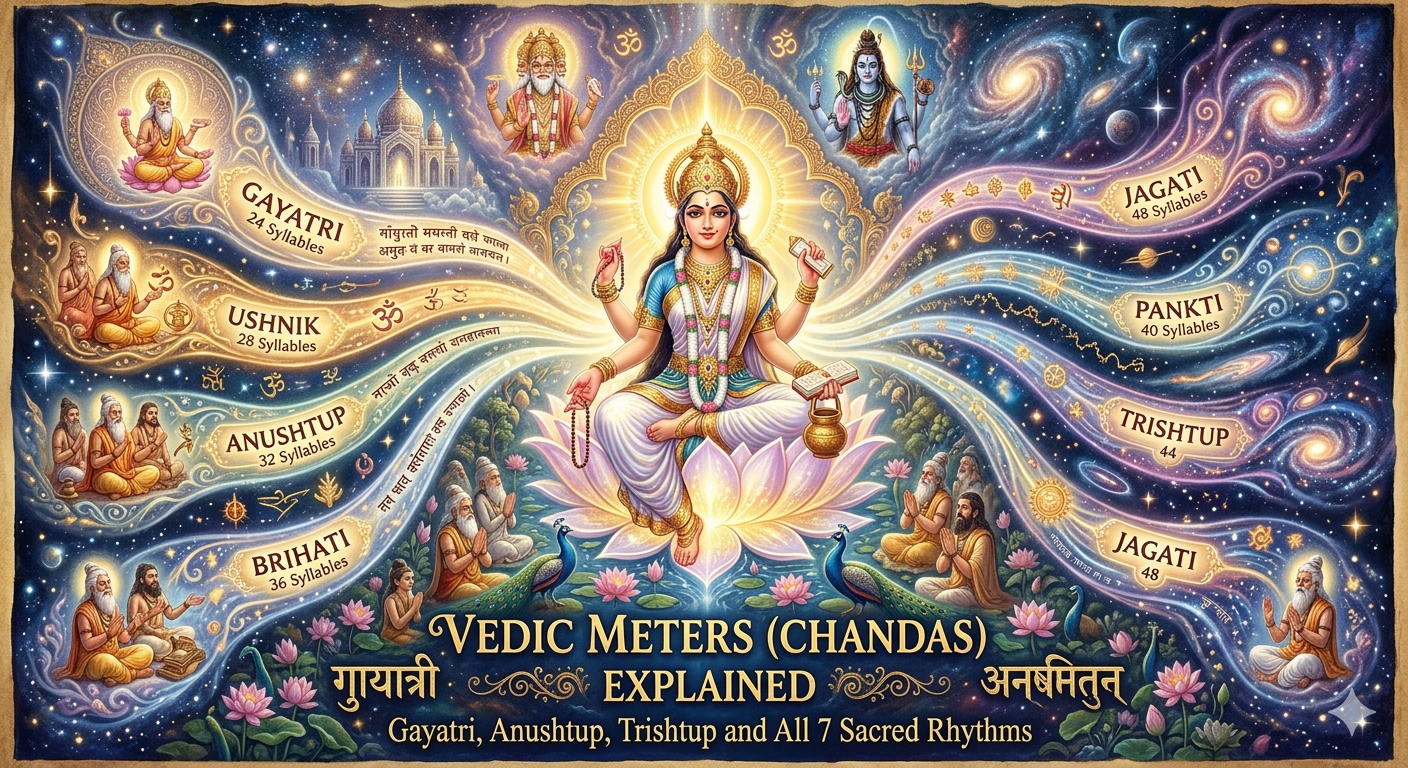
Vedic Knowledge Series
Vedic Chandas
The Sacred Meters of the Vedas — A Complete Encyclopedia
From the primordial syllable Om to the thundering verses of the Rigveda — a definitive exploration of how the ancient Rishis encoded the cosmos into sound, rhythm, and metre.
Complete Reference
“छन्दांसि यज्ञस्य शीर्षाणि” — Chandas are the very heads of the Yajnas. Without knowing the Chanda of a mantra, its recitation is incomplete. The metre is the life-breath; it is through rhythm that the divine word carries its full potency.
— Taittiriya Samhita & Chandas Vedanga tradition
Table of Contents
I. What is Chandas? — The Vedanga of Metre
The word Chandas (Sanskrit: छन्दस्) derives from the root chad, meaning “to please, to delight, to nourish.” It refers simultaneously to the science of Vedic prosody and to the individual metres themselves. Chandas is one of the six Vedangas — the limbs of the Vedas — without which the Vedas cannot be properly understood or recited. Just as the nose controls the breath of life, Chandas is said to control the life-breath of the mantra.
The Natya Shastra proclaims: “There is no word without Chandas, and no Chandas without a word.” Every Vedic mantra possesses three essential attributes: a Rishi (the seer to whom it was revealed), a Devata (the presiding deity), and a Chandas (the metre that gives it form). Before reciting any mantra, the practitioner traditionally touches their nose while naming the Chandas — because the metre is the very nose, the breathing apparatus, of the sacred syllable.
Panini’s grammar treatise makes a crucial distinction: Chandas refers exclusively to the verses that compose the Vedas, while Bhasha is ordinary spoken Sanskrit. This marks the metre as something set apart — divine, precise, inviolable. Even a single syllable added or removed corrupts the spiritual potency of the verse.
“`
The Six Vedangas (Limbs of the Vedas)
| Shiksha — Phonetics & Pronunciation | Chandas — Metre & Prosody | Vyakarana — Grammar |
| Nirukta — Etymology | Jyotisha — Astronomy & Astrology | Kalpa — Ritual Science |
Chandas is called the “feet” of the Vedas — just as feet enable a body to walk, metres enable the Vedas to move through time intact.
“`
II. How Vedic Metres Were Developed
“`
The Primordial Origin: Shruti Revelation
The Vedic metres were not “invented” by human intellect — they were heard. The Vedas are Apaurusheya, not of human authorship. The Rishis in states of deep samadhi perceived the eternal vibrations of cosmic sound (Shabda Brahman). The metres are described as the rhythmic forms through which the infinite organises itself into expressible, chantable verse. In the Rigveda’s own cosmology, Gayatri the metre flew as a bird to the celestial realm to bring back the Soma — the divine nectar of wisdom.
The Shatapatha Brahmana records that Prajapati first breathed out the Vedas, and from those breaths arose the metres — Gayatri from the morning chants, Trishtubh from the noon, and Jagati from the evening recitations. Each metre thus carries within it a time of day, a cosmic plane, and a class of deity.
Pingala and the Science of Chandas (~3rd century BCE)
The systematic codification of Vedic metres belongs to Acharya Pingala, whose monumental Chandahshastra (also called Chandahsutra) is the oldest surviving Sanskrit prosody treatise, dated between 600–200 BCE. In eight chapters written in terse Sutra style, Pingala catalogued, classified, and mathematically described every known metre.
Pingala’s genius lay in recognising that all metres reduce to sequences of two units: Laghu (light/short syllable, symbolised l) and Guru (heavy/long syllable, symbolised g). In solving how many combinations of n syllables exist, he inadvertently pioneered the binary number system, the Fibonacci sequence, and Pascal’s triangle — 1,500 years before their Western “discovery.” Medieval commentaries by Halayudha (10th century CE) and Kedara Bhatta’s Vrittaratnakara (8th century CE) later expanded the classical corpus to describe over 850 distinct metres.
Timeline of Chandas Knowledge
| c. 1500–1200 BCE | Rigveda composed; seven primary metres already in active use by the Rishis in oral tradition |
| c. 900–700 BCE | Brahmana texts fully articulate the cosmic symbolism of each Chanda — Gayatri = Vasus, Trishtubh = Rudras, Jagati = Adityas |
| c. 600–200 BCE | Pingala writes Chandahshastra; binary-combinatorial analysis of metres; discovers the meru-prastara (Pascal’s triangle) |
| c. 4th century BCE | Panini’s Ashtadhyayi distinguishes Chandas (Vedic sacred verse) from Bhasha (everyday speech) |
| c. 8th century CE | Kedara Bhatta’s Vrittaratnakara systematises post-Vedic classical metres; Sragdhara, Vasantatilaka, Mandakranta defined |
| c. 10th century CE | Halayudha’s commentary on Pingala unpacks the Meru Prastara, independently describing Pascal’s triangle and Fibonacci sequences |
“`
III. Structural Principles: Guru, Laghu & Gana
Every Vedic metre rests on two fundamental phonetic atoms. A Laghu (light) syllable has one mora (unit of time) — it is short, quick, like a heartbeat. A Guru (heavy) syllable has two morae — it is long, sustained, like a held breath. Pingala notated these as l and g (or in traditional notation, ᴗ and —). Metres are then built by organising syllables into Padas (feet/lines) and Padas into verses.
Pingala grouped syllables into Ganas — triplets of syllables whose arrangement (LLL, LLG, LGL, LGG, GLL, GLG, GGL, GGG) he named with mnemonic letters: ya, ra, ta, bha, ja, sa, ma, na. This system allowed any metre to be described compactly as an acronym — a revolutionary data-compression of rhythmic information. The total number of syllables per verse-foot determines which of the 26 Chandas categories a metre belongs to, from Ukta (1 syllable) all the way to Utkriti (26 syllables).
“`
The Eight Ganas of Pingala
| Gana Name | Pattern (L=light, G=heavy) | Symbol Pattern | Rhythm Feel |
| Ya-gana | L G G | ᴗ — — | Rising, ascending |
| Ra-gana | G L G | — ᴗ — | Imperial, stately |
| Ta-gana | G G L | — — ᴗ | Weighty, receding |
| Bha-gana | G L L | — ᴗ ᴗ | Flowing, dactyl |
| Ja-gana | L G L | ᴗ — ᴗ | Amphibrach, balanced |
| Sa-gana | L L G | ᴗ ᴗ — | Anapest, surging |
| Ma-gana | G G G | — — — | Molossus, thunderous |
| Na-gana | L L L | ᴗ ᴗ ᴗ | Tribrach, rapid |
“`
IV. The Seven Primary Chandas of the Vedas
The “Sapta Chanda” — Seven Sacred Metres, called the “Seven Birds” or “Seven Mouths of Brihaspati”
“`
1. Gāyatrī Chandas — गायत्री छन्द
The Queen of All Metres · 24 Syllables · 3 Padas of 8
| Total Syllables 24 |
Structure 3 padas × 8 syllables |
Mantras in Rigveda 2,456 |
Associated Deity Savitar / Agni / Solar deities |
The Gāyatrī is the most sacred and celebrated of all Vedic metres — so revered that Lord Krishna in the Bhagavad Gita (10.35) declares: “Gāyatrī chandasām aham” — “Among metres, I am the Gāyatrī.” It is uniquely tri-pada (three-footed) rather than the customary four-footed verse structure. Its unusual three-pada form encodes the three worlds (Bhur-Bhuvah-Svah), three times of day, and the trinitarian structure of Vedic cosmology.
Comprising approximately 25% of the entire Rigveda, the Gayatri’s predominance is remarkable. The metre is associated with the 8 Vasus — the cosmic powers of stability and dwelling. When a Brahmin boy undergoes Upanayana (sacred thread ceremony), it is specifically the Savitri Gayatri that is whispered into his ear by the Guru.
Canonical Example Mantra (RV 3.62.10)
तत् सवितुर् वरेण्यं भर्गो देवस्य धीमहि ।
धियो यो नः प्रचोदयात् ॥
Tat savitur vareṇyam bhargo devasya dhīmahi | dhiyo yo naḥ pracodayāt ||
“We meditate upon the glorious light of the divine Savitar; may that light illuminate our intellect.”
Spiritual Benefits: Illumination of the intellect, solar blessings, inner purification, enhanced meditation, removal of ignorance, bestowing of wisdom, atonement (prayaschitta), awakening of the heart chakra, attainment of fame and long life. Scriptures state: the Gayatri metre confers yashas (glory), ayus (longevity), prajā (progeny), and pashu (prosperity).
2. Ushnik / Ushnih Chandas — उष्णिक् छन्द
The Warm Metre · 28 Syllables · 4 Padas of 7
| Total Syllables 28 |
Structure 4 padas × 7 syllables |
Mantras in Rigveda 398 |
Associated Deity Saraswati · Indra · Mitra |
The name Ushnik derives from ushna (warmth/heat), reflecting the metre’s intimate association with Agni’s warmth and the nourishing quality of sacred fire. It is a mixed-type metre — its most characteristic variant has the pattern 8-8-12 syllables across its three main parts (some traditions count it as 4 padas of 7). Ushnik carries a sense of gentle urgency, the quality of dawn prayers offered as the sun warms the sky.
Example Mantra — RV 8.2.1 (Ushnik metre)
सोमं राजानम् अभि वत्स गायत ।
इन्द्रस्य वज्रं नर्यम् ॥
Somam rājānam abhi vatsa gāyata | indrasya vajram naryam ||
“Sing forth, O young ones, of King Soma; of Indra’s heroic thunderbolt.”
Spiritual Benefits: Warmth of devotion, kindling of inner fire, auspiciousness in morning rituals, purification through Agni, enhancement of speech and poetic expression. The Ushnik metre is associated with vitality, radiance, and the nourishment of life-forces. Its 28 syllables are said to correspond to the 28 lunar mansions (Nakshatras).
3. Anushtubh Chandas — अनुष्टुभ् छन्द
The Universal Metre · 32 Syllables · 4 Padas of 8 · Mother of the Shloka
| Total Syllables 32 |
Structure 4 padas × 8 syllables |
Mantras in Rigveda 850 |
Associated Deity Vishnu · Narayana · all deities |
The Anushtubh is arguably the most widely employed metre in all of Sanskrit literature. Its name means “that which follows and praises” (anu = following; stubh = to praise). The Anushtubh is the direct parent of the classical Shloka — the verse form of the Mahabharata, the Ramayana, the Bhagavad Gita, the Puranas, and countless stotras. All 700 verses of the Gita are in Anushtubh/Shloka form, and nearly the entire Mahabharata (approximately 100,000 shlokas) employs it.
Tradition holds that the first Shloka was born from grief: the sage Valmiki, witnessing a hunter kill a Krauncha bird, spontaneously cried out a verse of mourning — and that cry took the form of Anushtubh. Lord Brahma then appeared and blessed this metre as the vehicle for the Ramayana. Scripturally, the Taittiriya Upanishad declares: “Anushtubbho vā imāni bhūtāni jāyante” — from Anushtubh all beings are born, sustained, and dissolved.
Example Mantra — Bhagavad Gita 4.7 (Shloka form, Anushtubh)
यदा यदा हि धर्मस्य ग्लानिर्भवति भारत ।
अभ्युत्थानमधर्मस्य तदात्मानं सृजाम्यहम् ॥
Yadā yadā hi dharmasya glānir bhavati bhārata | abhyutthānam adharmasya tadātmānaṁ sṛjāmy aham ||
“Whenever there is a decline of righteousness and rise of unrighteousness, O Bharata, then I manifest myself.” — Bhagavad Gita 4.7
Spiritual Benefits: Universally auspicious for all purposes. Its balanced four-fold structure is said to represent the four aims of life (Purusharthas). Recitation grants liberation from karma, establishes righteousness, invokes the all-pervading nature of Vishnu. The Anushtubh is the metre of completeness — it is the cosmos singing to itself.
4. Brihati Chandas — बृहती छन्द
The Great Expansive Metre · 36 Syllables · Mixed Pada Structure (8+8+12+8)
| Total Syllables 36 |
Structure Padas: 8+8+12+8 |
Mantras in Rigveda 427 |
Associated Deity Brihaspati · Indra · the infinite |
Brihati means “great, vast, expansive” — and this metre lives up to its name. Its distinctive third pada of 12 syllables (longer than the surrounding 8-syllable padas) creates a characteristic swelling, like a breath drawn long and deep before release. The Shatapatha Brahmana states that the Brihati sound is so vast that ordinary humans cannot fully comprehend its technical details. It belongs to the cosmic register of the expansive sky.
Example Mantra — RV 6.16.13 (Brihati metre)
त्वं हि क्षैतवत्समग्न इत् कवे ।
दिवश्च गा उप एहि नः ॥
Tvaṁ hi kṣaitavatsam agna it kave | divaś ca gā upa ehi naḥ ||
“O Agni, O wise one, come to us along with the cows of heaven.”
Spiritual Benefits: Expansion of consciousness, accessing the infinite expanse of the divine mind (Brihaspati as guru of the gods), attaining higher knowledge, glory in the three worlds. The Brihati’s expansion mid-verse is said to represent the soul’s expansion toward Brahman. Especially used in Soma rituals and in Vedic fire ceremonies for greatness.
5. Pankti Chandas — पङ्क्ति छन्द
The Row / Rank Metre · 40 Syllables · 5 Padas of 8 (or 4×10)
| Total Syllables 40 |
Structure 5 padas × 8 (or 4×10) |
Mantras in Rigveda 499 |
Associated Deity Vishvedevas · all cosmic forces |
Pankti means “row, line, series” — suggesting ordered procession, the marching of stars across heaven, or the disciplined movement of the seasons. Also called Virat, this metre is uniquely five-footed (pentapada), unlike the three- or four-footed metres that dominate Vedic poetry. The Srimad Bhagavatam notes that the seven horses of the sun god’s chariot are the seven chandas — and Pankti represents the full span of cosmic order. It is associated with all five elements and all five pranas simultaneously.
Example Mantra — RV 10.90 (Purusha Sukta, Pankti metre)
सहस्रशीर्षा पुरुषः सहस्राक्षः सहस्रपात् ।
स भूमिं विश्वतो वृत्वा अत्यतिष्ठद्दशाङ्गुलम् ॥
Sahasra-śīrṣā puruṣaḥ sahasrākṣaḥ sahasra-pāt | sa bhūmiṁ viśvato vṛtvā atyatiṣṭhad daśāṅgulam ||
“The cosmic Person has a thousand heads, a thousand eyes, a thousand feet; enveloping the earth on all sides, he stands beyond it by ten fingers.” — Purusha Sukta 10.90.1
Spiritual Benefits: Harmony and balance of all five elements within the body and cosmos, cosmic vision, attainment of the Virat form of Brahman, success in grand collective rituals, comprehension of the totality of creation. Pankti is also associated with food and abundance — its 40 syllables relate to the 40-day purification cycles in Vedic tradition.
6. Trishtubh Chandas — त्रिष्टुभ् छन्द
The Warrior King of Metres · 44 Syllables · 4 Padas of 11 · Most Used in Rigveda
| Total Syllables 44 |
Structure 4 padas × 11 syllables |
Mantras in Rigveda 4,258 (Most used!) |
Associated Deity Indra · the 11 Rudras · kings |
Remarkably, despite Gayatri’s fame, Trishtubh is actually the most frequently occurring metre in the Rigveda, with 4,258 mantras — nearly double the count of Gayatri. Its name means “that which praises with three” (tri = three; stubh = praise), though the metre itself has four padas. It carries the energy of the noon sun — forceful, blazing, decisive. The 11 syllables per pada correspond to the 11 Rudras, and Trishtubh’s domain is Kshatriya energy: sovereignty, conquest, and fierce protection.
Indra is pre-eminently the deity of Trishtubh. The vast Indra hymns of the Rigveda — the Vritra-slaying battles, the release of the cosmic rivers, the thunder-wielding exploits — are cast in this martial metre. In the Upanayana ceremony, the Kshatriya boy receives a verse in Trishtubh metre, appropriate to his warrior nature.
Example Mantra — RV 1.32.1 (Indra-Vritra hymn, Trishtubh)
इन्द्रस्य नु वीर्याणि प्र वोचं यानि चकार प्रथमानि वज्री ।
अहन्नहिमन्वपस्ततर्द प्र वक्षणा अभिनत् पर्वतानाम् ॥
Indrasya nu vīryāṇi pra vocam yāni cakāra prathamāni vajrī | ahan ahim anvapas tatarda pra vakṣaṇā abhinat parvatānām ||
“Now I will declare the heroic deeds of Indra, the first great feats of the thunderbolt-wielder: he slew the dragon, released the waters, and cleft the belly of the mountains.” — RV 1.32.1
Spiritual Benefits: Courage, victory over adversaries, leadership qualities, strength of will, protection from enemies and disease, embodiment of Kshatriya dharma, awakening of the thunderbolt-nature within the practitioner. Used in Rajasuya (royal consecration), Ashvamedha (horse sacrifice), and all rites connected with sovereignty. The Trishtubh metre, like Indra’s vajra, destroys all obstacles.
7. Jagati Chandas — जगती छन्द
The World-Pervading Metre · 48 Syllables · 4 Padas of 12
| Total Syllables 48 |
Structure 4 padas × 12 syllables |
Mantras in Rigveda 1,353 |
Associated Deity The 12 Adityas · Varuna · Mitra |
Jagati derives from jagat — “the moving world, the universe that breathes and goes.” It is the largest of the seven primary metres, its 12-syllable padas rolling forth like ocean waves. The 12 syllables per pada correspond to the 12 Adityas — the 12 solar deities who govern the 12 months of the year, the 12 aspects of cosmic time. Jagati is the metre of the evening, of the fullness of experience, of the world at its most complete.
In the Upanayana ceremony, the Vaishya boy receives a verse in Jagati metre — connecting commerce and agriculture to the sustaining rhythms of the cosmic year. Varuna, the god of cosmic order and the celestial waters, is particularly propitiated through Jagati hymns.
Example Mantra — RV 1.25.1 (Varuna hymn, Jagati)
यच्चिद्धि ते विशो यथा प्र देव वरुण व्रतम् ।
मिनीमसि द्यवि द्यवि ॥
Yac cid dhi te viśo yathā pra deva varuṇa vratam | minīmasi dyavi dyavi ||
“O divine Varuna, whatever vow of yours we violate day by day, like the people — forgive us.” — RV 1.25.1
Spiritual Benefits: Universal expansion, connection with the rhythms of cosmic time, purification of karmic debts, blessings of the 12 Adityas and the fullness of the solar year. Jagati mantras govern abundance, harvest, water, and the sustaining power of Rta (cosmic law). Chanting Jagati verse calms the ego and aligns the practitioner with the great turning of the world.
“`
V. The Extended & Minor Chandas
Beyond the seven primary metres, Vedic and classical Sanskrit prosody recognise an extensive taxonomy of 26 total Chandas categories (by syllable count per pada), plus a further set of classical varna-vrittas used in epic and devotional poetry. The full system in Pingala’s Chandahshastra lists metres from Ukta (1 syllable) up to Utkriti (26 syllables per pada). Any metre beyond 26 syllables per pada is called Dandaka — the extreme metres used in highly ornate, sophisticated compositions.
“`
| Chandas Name | Syllables per Pada | Total Syllables (4 padas) | Notable Usage |
| Atijagati | 13 | 52 | Later Vedic hymns, 17 variants known |
| Shakwari (Shakvari) | 14 | 56 | 19 variants; Vasantatilaka metre belongs here |
| Atishakwari | 15 | 60 | 10 variants in Vedic literature |
| Ashti | 16 | 64 | 7 Vedic variants |
| Atyashti | 17 | 68 | 82 known variants; Shikharini metre belongs here |
| Dhriti | 18 | 72 | Steadiness; 2 Vedic variants |
| Atidhriti | 19 | 76 | 76 known variants; Mandakranta here |
| Kriti | 20 | 80 | Sacred creative action |
| Prakriti | 21 | 84 | Sragdhara (21 syllables) — Shankaracharya’s hymns |
| Akriti through Utkriti | 22–26 | 88–104 | Increasingly rare; used in highly complex devotional hymns |
| Dandaka | 27+ | Variable | Extreme metres; used in sophisticated kavya poetry |
Notable Classical Varna-Vrittas (Post-Vedic)
The Vedic metres gave birth to an entire flowering of classical Sanskrit metres used in epic poetry, kavya, and stotra literature. These metres follow fixed guru-laghu patterns rather than merely syllable count:
| Classical Metre | Parent Chandas | Famous Usage |
| Indravajra (11 syllables) | Trishtubh | Vedic and classical hymns to Indra |
| Upendravajra (11 syllables) | Trishtubh | Classical Sanskrit verse |
| Upajati (mixed 11-syllable) | Trishtubh | Kalidasa’s Kumara Sambhava |
| Vasantatilaka (14 syllables) | Shakwari | Kalidasa; Shankara’s stotras |
| Mandakranta (17 syllables) | Atidhriti | Kalidasa’s Meghaduta (Cloud Messenger) |
| Shikharini (17 syllables) | Atyashti | Devotional poetry, Shiva hymns |
| Sragdhara (21 syllables) | Prakriti | Shankaracharya’s Keshaadi stotra |
| Bhujangaprayata (12 syllables) | Jagati-family | Snake-like flow; taught by Adishesha |
| Arya (matra-based) | Matra-vritta | Muka Pancashati; Goddess hymns |
“`
VI. Master Comparison Table of the Seven Chandas
| Chandas | Syllables | Pada Structure | RV Count | Deity Class | Cosmic Plane | Sacred Number |
| Gāyatrī | 24 | 3 × 8 | 2,456 | 8 Vasus | Earth (Bhur) | 8 (per pada) |
| Ushnik | 28 | 4 × 7 | 398 | Maruts | Atmosphere | 28 Nakshatras |
| Anushtubh | 32 | 4 × 8 | 850 | All Devas | All three worlds | 32 (completeness) |
| Brihati | 36 | 8+8+12+8 | 427 | Brihaspati | Expanding cosmos | 36 (fullness) |
| Pankti | 40 | 5 × 8 | 499 | Vishvedevas | Five elements | 5 Pranas / 40 |
| Trishtubh | 44 | 4 × 11 | 4,258 | 11 Rudras | Mid-sky / noon | 11 Rudras |
| Jagati | 48 | 4 × 12 | 1,353 | 12 Adityas | Heaven / cosmic | 12 months |
VII. Cosmic & Ritual Significance of Chandas
“`
The Seven Chandas as Seven Horses of the Sun
The Srimad Bhagavatam (5.21.16) declares that the seven horses drawing the chariot of Surya (the Sun God) are the seven primary metres: Gayatri, Brihati, Ushnik, Jagati, Trishtubh, Anushtubh, and Pankti. This is not mere metaphor — in Vedic cosmology, the sound-rhythms of the metres are the actual vibrational energies that carry the solar light through the cosmos. Each chanting of a Vedic hymn in its proper metre is a participation in this cosmic conveyance.
Chandas and the Deities: A Vibrational Map
The Krishna Yajurveda (Taittiriya Samhita 3.3.3) explicitly maps the three primary metres to the three classes of Vedic gods: “Vasavas tvā pravrihantu gāyatreṇa chandasaḥ. Rudrās tvā pravrihantu traiṣṭubhena chandasaḥ. Ādityās tvā pravrihantu jāgatena chandasaḥ.” — “May the Vasus draw you forth with the Gayatri metre; may the Rudras draw you forth with the Trishtubh metre; may the Adityas draw you forth with the Jagati metre.” Each pada of 8 syllables embodies the 8 Vasus; each of 11 embodies the 11 Rudras; each of 12 embodies the 12 Adityas. Thus in total, Gayatri (3×8=24), Trishtubh (4×11=44), and Jagati (4×12=48) together encode 31 of the 33 primary Vedic deities.
“Knowledge of Chandas results in Yashas (fame), Ayu (long life), Prajā (progeny), Pashu (prosperity), and Brahman-varchasa (spiritual radiance).”
— Rikpratishakhya (Vedic Phonetics Treatise)
Chandas in Ritual: The Living Body of the Yajna
In Vedic yajna (fire ritual), the choice of metre for each mantra is not arbitrary — it is a precise science. The Shatapatha Brahmana elaborates: the Gayatri is the morning pressing (of Soma), the Trishtubh the midday pressing, and the Jagati the evening pressing. A priest who chants a mantra in the wrong metre has, in effect, misdirected the sacrifice — the gods will not receive it properly. This is why every performer of Vedic ritual must master Chandas as a prerequisite: it is the body of the mantra; without the body, the soul of the sacrifice cannot dwell.
“`
VIII. Video Resources & Further Study
The following YouTube lectures and tutorials provide audio-visual instruction in Vedic chandas. Hearing the metres chanted is essential — no written description fully captures the living rhythm.
“`
|
All Chandas Overview Chandas — The Vedic Metres Dr. Shreehari Gokarnakar · OLA Lecture Series · Covers all 7 major chandas with examples |
Anushtubh Chandas Anushtup — Definition & Rules Sanskrit Made Easy · Full explanation of Anushtubh with syllable counting, rules & examples |
|
Anushtup + Trishtup Variations Anushtup & Trishtup Chandas Variations Dr. Vasantalakshmi · Academic lecture on both metres with detailed Sanskrit textual analysis |
Trishtup Chandas Sanskrit Shlokas in Trishtup Chhand Classical Sanskrit recitation of Trishtup metre shlokas — hear the 11-syllable rhythm live |
|
Chandas in Samskruta SamskRuta Chandas Tutorial — Part 3 Dr. R. Ganesh · Lecture on AnuShTup Chandas in SamskRuta — deeply scholarly and accessible |
Bhagavad Gita & Anushtup Gita Shloka 1 — Anushtup Chandas Rule Practical guide: learn the Anushtup rule as applied to all 646 verses of the Bhagavad Gita |
|
Anushtup in Simple Sanskrit Chandas in Simple Sanskrit (Ep. 20) Dr. Sowmya · sanskritfromhome.in · Structured e-learning series; highly recommended for beginners |
Ayurveda & Vedanga Chandas Anushtup Chandas — Vedanga for Graduates Dr. Nandeesh J · Vedanga Chandas for Ayurveda graduates; explains rhythmic recitation of Ayurvedic shlokas |
“`
IX. Sources & References
“`
1. Wikipedia — Vedic Metre. https://en.wikipedia.org/wiki/Vedic_metre
2. Wikipedia — Sanskrit Prosody / Chandas. https://en.wikipedia.org/wiki/Sanskrit_prosody
3. Wikipedia — Gayatri Mantra. https://en.wikipedia.org/wiki/Gayatri_Mantra
4. Wikipedia — Pingala. https://en.wikipedia.org/wiki/Pingala
5. Ramanujacharya.org — Chandas article (Bhakti List Archives). https://ramanuja.org/sri/BhaktiListArchives/Article?p=oct2001/0122.html
6. Ramanisblog — Chandas Vedic Meters Details. https://ramanisblog.in/2014/04/06/chandas-vedic-meters-details/
7. TemplePurohit — Chandas (PDF). https://www.templepurohit.com/wp-content/uploads/2022/08/Chandas.pdf
8. knramesh.blogspot.com — The Chandas-Metres (detailed Vedic exposition). http://knramesh.blogspot.com/2010/12/chandas-metres.html
9. P. Gopalakrishnan’s Blog — Chhandas: India’s Ancient Science of Writing Verse. https://pgopalak.wordpress.com/2018/01/22/chhandas-indias-ancient-science-of-writing-verse/
10. Sanskrit Hindu Dharma — Some Metrical Forms, Chapter “Chandas”. https://www.kamakoti.org/hindudharma/part8/chap5.htm
11. Samskrita Google Group — What is the Chandas for Pranava Mantra? (Community scholarly discussion with R.L. Kashyap citations). https://groups.google.com/g/samskrita/c/JrYC-m0V2fY
12. Medium — Meters of Gita: Anushtup and Tristup by Sujatha Ratnala. https://myriadpatterns.medium.com/anushtup-chandas-eeafebb712f9
13. Radio Platonic — Pingala’s Chandas Shastra. https://radioplatonic.com/pingalas-chandas-shastra-text-on-prosody/
14. Cuemath — Acharya Pingala the Mathematician. https://www.cuemath.com/learn/pingala-mathematician/
15. arXiv (math) — Recursion and Combinatorial Mathematics in Chandashaastra. https://arxiv.org/pdf/math/0703658
16. Rita Trust — Mantra Raag: Ancient Sanskrit Mantras in Traditional Raags. https://www.ritatrust.org/2014/08/25/mantra-raag-ancient-sanskrit-mantras-composed-in-traditional-raags/
17. Kashyap, R.L. — Essentials of Rig Veda. Sri Aurobindo Kapali Shastry Institute of Vedic Culture, Bangalore.
18. True Ayurveda Blog — What Effect Does Your Music and Sound Have on You? (Mantra & Chandas). https://trueayurveda.wordpress.com/2015/03/21/what-effect-does-your-music-and-sound-have-on-you-more-on-mantra/
“`
Hindu Mythology & Vedic Spirituality
All content is original research compiled from publicly available scholarly, textual, and Vedic traditional sources.
Chandas Vedanga — One of the Six Limbs of the Vedas · Article produced 2026
Leave a Reply