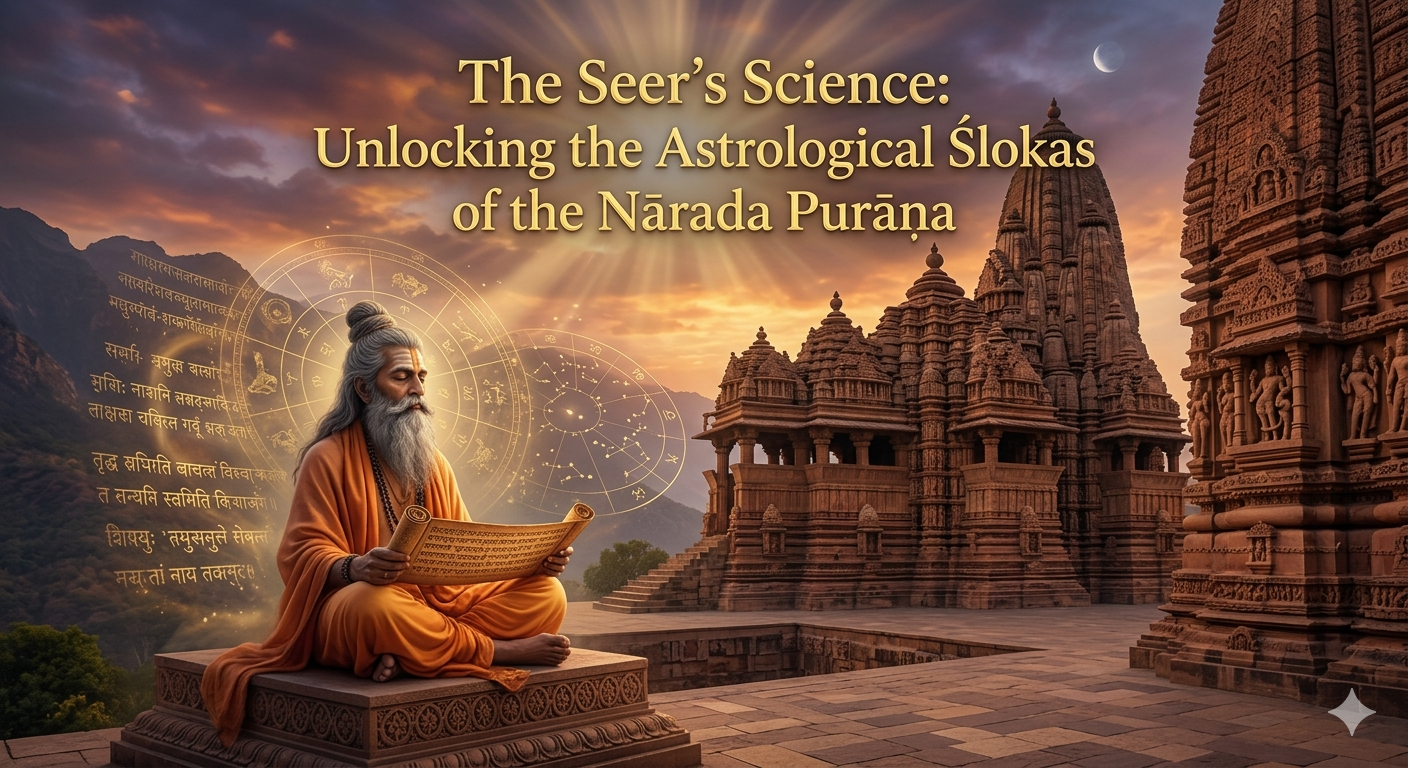
नारद पुराण & ज्योतिष
Nārada Purāṇa and the Science of Jyotiṣa
A complete scholarly extraction of all astrology-related ślokas, their summaries, cosmological framework,
and distilled predictive principles — from the Purāṇa that devoted the greatest space to Jyotiṣa among all eighteen Mahāpurāṇas.
|
I. The Purāṇa’s Unique Place in Jyotiṣa Literature
II. The Tri-Skandha Framework (Ch. 54, v.2) III. Gaṇita Skandha — Mathematical Astronomy (Ch. 54) IV. Jātaka Skandha — Natal Horoscopy (Ch. 55) |
V. Saṃhitā Skandha — Natural Astrology (Ch. 56)
VI. The Kālapuruṣa Doctrine — Cosmic Body & Zodiac VII. The Narada Samhitā Connection VIII. Predictive Principles for the Modern Jyotiṣī |
The Purāṇa’s Unique Place in Jyotiṣa Literature
Among the eighteen Mahāpurāṇas, the Nārada Purāṇa (also called Nāradīya Purāṇa) holds a singular distinction:
it is the only Purāṇa that devoted the greatest space to Jyotiṣa and treated it with scientific exhaustiveness.
The Hindupedia records explicitly state: “Nārada Purāṇa devoted greatest space to Jyotiṣa.”
The Nārada Purāṇa contains 22,000 ślokas in total. Of these,
Chapters 53–57 of the Pūrva-bhāga, Dvitīya-pāda constitute the complete Jyotiṣa block —
spanning over 1,000 ślokas across Gaṇita, Jātaka, and Saṃhitā.
Critically, 186 verses of the astronomical section (Gaṇita) are
shared with or parallel to the Sūrya Siddhānta — the canonical authority on Vedic astronomy —
suggesting both texts draw from a common primordial source rather than one being derivative of the other.
For comparison, while the Agni Purāṇa (Ch. 121 onward) and Garuḍa Purāṇa (Ch. 58–62) also treat Jyotiṣa,
their treatment is thematic rather than systematic. The Nārada Purāṇa uniquely presents all three skandhas
of classical Jyotiṣa in sequence, making it the only Purāṇa to function as a standalone Jyotiṣa compendium.
Classical texts enumerate 18 foundational rishis of Jyotiṣa: Yavana, Vasiṣṭha, Parāśara, Romasa, Sūrya, Vyāsa,
Śaunaka, Kaśyapa, Bhṛgu, Nārada, Atri, Mārīci, Cyavana, Manu, Brahmā, Garga, and Aṅgiras.
Nārada’s placement in this list (rank 10) confirms his recognised authority. The collective output of these sages
is said to total 4,50,000 ślokas — of which only ~20,000 survive in accessible form today.
The Nārada Purāṇa preserves the most coherent surviving body of Nāradīya Jyotiṣa thought.
The Tri-Skandha Framework
गणितं जातकं विप्र संहिता स्कन्धसंज्ञितम्॥
falls into three sections (tri-skandha) — Gaṇita (mathematics and astronomy), Jātaka (horoscopy),
and Saṃhitā (natural astrology).”
This single verse is arguably the most important metatextual shloka in the entire Vedic astrological canon.
The Nārada Purāṇa here provides the official taxonomy of Jyotiṣa — one that all subsequent classical texts
(Varāhamihira’s Bṛhat Saṃhitā, BPHS, Saravalī) follow without deviation.
It is cited explicitly in modern treatises referencing the source as NP II.50.2 (Gitapress numbering)
or NP II.54.2 (Veṅkateśvara Press numbering).
|
गणित
GAṆITA SKANDHA
Mathematical astronomy. Planetary revolutions, mean/true positions, eclipses, gnomonic shadows, NP Chapter 54 |
जातक
JĀTAKA SKANDHA
Individual natal horoscopy. Rāśis, grahas, Lagna, bhavas, yogas, daśās, longevity, profession, NP Chapter 55 |
संहिता
SAṂHITĀ SKANDHA
Mundane astrology & electional timing. Planetary transits, nakṣatra quality, tithi, vāra, muhūrta, NP Chapter 56 |
येन ज्ञानमात्रेण धर्मसिद्धिर्भवेन्नृणाम्॥
“I shall now set out the Vedāṅga called Jyotiṣa, which was enunciated by Brahmā in days of yore —
through the mere knowledge of which men can attain the fulfilment of their ordained duties (dharmasiddhi).”
The Nārada Purāṇa places Jyotiṣa within the six Vedāṅgas: Śikṣā (nose/phonetics), Kalpa (hands/ritual),
Vyākaraṇa (mouth/grammar), Nirukta (ears/etymology), Chandas (feet/metre), and
Jyotiṣa — the eyes (cakṣus) of the Veda.
This metaphor — the Veda sees through Jyotiṣa — is the philosophical basis for astrology’s place
in Vedic knowledge: it is not peripheral but visionary, revealing what the texts alone cannot show.
The NP encodes this at Chapter 54, v.1 and the broader Vedāṅga section spanning Ch. 50–53.
Gaṇita Skandha — Mathematical Astronomy
The Gaṇita chapter of the Nārada Purāṇa is the most mathematically rigorous astronomical text embedded in any Purāṇa.
The translator G.V. Tagare notes that its arithmetical operations are identical to those in Bhāskarācārya’s celebrated
Līlāvatī. The following are the major shloka-clusters with their predictive and cosmological relevance.
Planetary Revolution Numbers — Bhagaṇa (v. 65–69)
“The number of eastward revolutions (bhagaṇa) of the Sun, Mercury and Venus in a Mahāyuga is 43,20,000.
The Moon completes 5,77,53,336 revolutions; Mars 22,96,832 revolutions…”
Summary: The NP gives precise revolution counts for all seven classical planets within a
Caturyuga (Mahāyuga = 43,20,000 solar years). These are essential inputs for computing mean longitudes —
the mathematical foundation of any horoscope. The figures align with those in Sūrya Siddhānta Ch.1.
Predictive Relevance: The very concept of daśā periods being linked to
planetary orbital geometry — Moon’s 9-year Viṃśottarī period, for instance — is grounded in these revolution ratios.
Understanding bhagaṇa explains why Viṃśottarī uses 120 years and assigns specific years to each graha.
Vyatīpāta — The Malign Aspect of Sun and Moon (v. 174–187)
“The two Vyatīpātas — called Lāṭa and Vaidhṛta — occur when the sum of the longitudes of
Sun and Moon equals 180° and 360° respectively. These moments are highly inauspicious (vi-ati-pāta).”
Summary: Vyatīpāta refers to a special astronomical moment when solar and lunar
longitudes sum to 180° (Lāṭa-vyatīpāta) or 360° (Vaidhṛta-vyatīpāta). The Purāṇa classifies these as
highly inauspicious (vi-ati-pāta = extreme inauspiciousness) windows not to be used for any sacred or
auspicious undertaking.
Predictive Principle: The Vyatīpāta yoga (distinct from the 27 regular yogas)
remains a factor in muhūrta analysis to this day. When Moon and Sun reach these geometric relationships,
the pañcāṅga yoga for that day is classified as Vyatīpāta — avoided for marriages, surgeries, major undertakings.
The Nine Measures of Time — Kālamāna (Ch. 56.11, v.109–113)
“Measures of time are nine: Brahma, Deva, Manu, Pitṛya, Śaura, Sāvana, Cāndra, Ākṣa and Guru.
Of these, practical reckoning is done through five only.”
“`
| Kālamāna Type | Astrological Application per NP |
| Śaura (Solar) | Motion of the planets — all graha calculations use solar measure |
| Sāvana (Civil) | Rains and pregnancy — sunrise to sunrise count |
| Nakṣatra (Sidereal) | Rainfall prediction and pregnancy of clouds |
| Cāndra (Lunar) | Marriage, pilgrimage, fasts, tonsure, house-building — all muhūrta |
| Guru (Jovian) | Saṃvatsara (year-name cycle) — each of 60 years named by Jupiter |
Predictive Relevance: This doctrine explains why the Indian pañcāṅga uses
lunar tithis for events but solar months for planetary calculations — not confusion or inconsistency,
but deliberate multi-layered precision. The NP is the Purāṇic locus of this taxonomy.
“`
Jātaka Skandha — Natal Horoscopy
Chapter 55 of the Nārada Purāṇa is, according to G.V. Tagare, practically identical in contents to
Varāhamihira’s Bṛhaj Jātaka — though not textually identical verse-for-verse. This means the Nārada Purāṇa
independently preserves the same body of horoscopic knowledge as the most authoritative classical Jyotiṣa text,
confirming their common origin in primordial astrological tradition.
Kālapuruṣa and the 12 Signs — (v.1–2)
“The twelve limbs of Kālapuruṣa — head, face, arms, heart, breast, entrails, pelvis, genitals,
thighs, knees, shanks, and feet — are represented by the twelve Signs of the Zodiac:
Meṣa through Mīna respectively.”
Summary: The Nārada Purāṇa opens its horoscopy chapter with the
Kālapuruṣa doctrine — the Cosmic Being whose body IS the zodiac. This is the fundamental
ontological statement: Jyotiṣa is not merely symbolic but describes the actual anatomy of time itself.
The 12 Rāśis are thus anatomical — Meṣa/Aries rules the head (hence brain, skull injuries in Meṣa afflictions);
Mīna/Pisces rules the feet.
Sign Lordships per NP v.2: The lord of the 12 signs beginning with Meṣa in order:
Mars, Venus, Mercury, Moon, Sun, Mercury, Venus, Mars, Jupiter, Saturn, Saturn, Jupiter.
This is the classical Jyotiṣa scheme, confirmed without any deviation.
Divisional Charts (Varga) — Horā, Drekkāṇa, Navāṃśa, Dvādaśāṃśa, Triṃśāṃśa (v.3–5)
The NP systematically establishes the six primary sub-divisional charts (ṣaḍvarga) at v.3–5:
| Varga | Division | NP Rule |
| Horā | 1/2 (15°) | Odd signs: first Horā = Sun, second = Moon. Even signs: reversed. |
| Drekkāṇa | 1/3 (10°) | Lords: same sign, 5th from it, 9th from it — the trines of the trine. |
| Navāṃśa | 1/9 (3°20′) | Fire signs start from Meṣa; Earth from Makara; Air from Tulā; Water from Karkaṭa. |
| Dvādaśāṃśa | 1/12 (2°30′) | Lords of the 12 signs starting with the same sign. |
| Triṃśāṃśa | 1/30 (1°) | Odd signs: Mars 5°, Saturn 5°, Jupiter 8°, Mercury 7°, Venus 5°. Reversed in even. |
Vargottama (v.9): A planet in the same sign in both D1 and Navāṃśa (D9) is in
Vargottama — a state of exceptional strength. The NP specifies the Vargottama navāṃśas: first navāṃśa for movable signs,
5th for fixed signs, and last (9th) for dual signs.
Ucca, Nīca & Mūlatrikoṇa — Planetary Dignities (v.8–10)
“The exaltation (ucca) signs of the seven planets headed by the Sun are in order:
Meṣa, Vṛṣabha, Makara, Kanyā, Karkaṭa, Mīna, and Tulā.
The debilitation (nīca) is the 7th from the exaltation sign.”
| Planet | Ucca (Exaltation) | Nīca (Debilitation) | Mūlatrikoṇa (v.10) |
| Sun | Meṣa (10°) | Tulā | Siṃha |
| Moon | Vṛṣabha (3°) | Vṛścika | Vṛṣabha |
| Mars | Makara (28°) | Karkaṭa | Meṣa |
| Mercury | Kanyā (15°) | Mīna | Kanyā |
| Jupiter | Karkaṭa (5°) | Makara | Dhanus |
| Venus | Mīna (27°) | Kanyā | Tulā |
| Saturn | Tulā (20°) | Meṣa | Kumbha |
Special Planetary Aspects — Viśeṣa Dṛṣṭi (v.23)
“Saturn aspects fully the 3rd and 10th houses; Jupiter aspects the 5th and 9th;
Mars aspects the 4th and 8th houses from the one they occupy.
All planets cast their full aspect (pūrṇa dṛṣṭi) on the 7th house.”
Summary: This single shloka encodes the entire doctrine of graha dṛṣṭi
(planetary aspects) that distinguishes Vedic from Western astrology. Beyond the universal 7th house aspect,
Saturn’s 3rd and 10th house aspects make it uniquely powerful in career (10th) and effort/courage (3rd) matters;
Jupiter’s 5th and 9th aspects link it to progeny and fortune; Mars’s 4th and 8th aspects link it to home,
mother (4th) and death/surgery/hidden matters (8th).
Planetary Friendships — Naisargika Maitri (v.25–26)
“Friends of a planet are the lords of the 2nd, 4th, 5th, 8th, 9th and 12th Rāśis
counted from its Mūlatrikoṇa Rāśi.”
Resultant Friendship Matrix (v.26):
| Planet | Friends | Enemies |
| Sun | Jupiter (only) | All others (enemies/neutrals) |
| Moon | Jupiter, Mercury | Sun excluded (neutral) |
| Moon | All except Sun | — |
| Mercury | Venus, Mercury (self) | — |
| Jupiter | All except Mars | Mars |
| Venus | All except Sun, Moon | Sun, Moon |
| Saturn | All except Sun, Moon, Mars | Sun, Moon, Mars |
House Classification — Kendras, Trikoṇas, Trika (v.11)
“The triad of inauspicious houses (Trika) consists of the 6th, 8th and 12th from the Lagna.
The Kendra (Angular) houses are the 1st, 4th, 7th and 10th.
The Trikoṇa houses are the 5th and 9th.”
This shloka establishes the hierarchical architecture of the twelve bhavas.
In predictive Jyotiṣa: Kendras are the pillars of life (body, home, spouse, career);
Trikoṇas are the wealth/fortune and intelligence/merit axes; Trika (6-8-12) are the axes of disease,
death, and loss respectively. The interplay of lords across these three groups governs the vast majority
of yogic combinations in classical astrology.
Daśā System and Sub-Period Computation (v.141–144)
“The sub-divisions of a Daśā are Vidaśās and Upadaśās. When the lord of the sub-period happens
to be an Adhimitra (fast friend) or is posited in the former’s house, exaltation or in the Lagna,
the period should be increased in order by 1, 4, 1 or 7 years.
A benefic occupying a house increases its prospects if aspected by another in a contributory house.”
Summary: The NP here describes the qualitative modification of daśā results
based on the sub-lord’s relationship to the main-lord. This is the Purāṇic basis for what BPHS calls
daśā phala viveka — discernment of period results. The modification factors (1, 4, 1, 7 years for
friend/own house/exaltation/lagna placement) are unique NP contributions.
The Principle at v.144:
“Whatever substances are allotted to a planet — all that should be mentioned as occurring in the Daśā of that planet
by its occupation, aspect and conjunction.” This verse is the foundation of Daśā-phala by Kārakatva
— each planet’s daśā delivers results of its natural significations and those of the houses it occupies/aspects.
Circumstances of Birth — Place, Clandestinity, Water (v.74–79)
“Birth takes place on water when the full Moon in Gemini or Virgo aspects the Lagna,
or is in the Lagna, 2nd or 4th house.
Delivery is clandestine if Saturn in the 12th from Lagna or Moon is aspected by a malefic.
Birth in a pit or dungeon: Saturn in Cancer or Scorpio Lagna, or aspecting the Lagna or Moon.”
These verses demonstrate the NP’s use of Jyotiṣa for garbha-lakṣaṇa (birth circumstances).
While seemingly obscure, they encode crucial Parasharī principles: Saturn’s 12th house position bringing
hidden/secret circumstances; watery Moon and Lagna connections bringing birth near or in water.
These are used in rectification work — matching birth conditions to chart configurations to confirm Lagna.
Pravrajya / Ascetic Yoga (v.214–215)
“One becomes an ascetic (pravrajita) when: the Lagna lord, unaspected by any planet, aspects Saturn;
or when Saturn aspects the eclipsed Lagna lord; or when Saturn, Sun and Lagna lord are in the
aṃśa of Mars or Sun; or when Moon is aspected by Saturn.”
The NP gives four specific combinations for renunciation/asceticism — all involving Saturn’s influence
on the Lagna, Lagna lord, or Moon. The Sun’s involvement brings the ego-dissolution that enables true renunciation.
This cluster of yogas is used in charts of monks, sannyāsīs, and spiritual leaders — cross-checked against
the Pañcamahāpuruṣa scheme and the 4th/9th house configurations.
Narada’s Unique Maraka Yoga for Marriage (Cited in Prasna Lagna texts)
विवाहानन्तरं भर्तात्वष्टवर्षं न जीवति॥
“If Moon is in the Lagna and Mars is in the 7th from it (the Lagna),
the husband will not survive more than 8 years after marriage.”
This is a famous Nāradīya shloka preserved independently from the Nārada Saṃhitā (not the Purāṇa),
quoted by later commentators on Praśna Lagna. It is notable because Nārada differs from other classical
authors here — specifying Mars in the 7th as the triggering maraka factor for the husband.
This shloka is a landmark in the study of female horoscopy and spouse longevity.
Saṃhitā Skandha — Mundane & Electional Astrology
Chapter 56 of the Nārada Purāṇa is its most expansive astrological section — approximately 755 verses
covering mundane astrology, muhūrta, planetary transit omens, Nakṣatra qualities, Tithi, Vāra, Saṃkrānti,
Gocara, marriage electional astrology, and portents. G.V. Tagare confirms that about 300 of these 755 verses
are direct quotations from the Nārada Saṃhitā — confirming the Purāṇa as the largest surviving vessel of
Nārada’s astrological teaching.
Planetary Transit Omens — Grahabhramaṇa Phala (v.1–108)
The first 108 verses of Chapter 56 describe the effects of each of the seven planets transiting through
each of the twelve signs. This is the Gocara Saṃhitā embedded within the Purāṇa.
Key principles from the Scribd source (NP Ch. 56 doc) include:
| Planet/Phenomenon | NP’s Transit Principles |
| Sun’s Appearance | Sunspots, beams, colour changes — each is a portent for crop, rainfall, war, king’s fate. Lord and commander of the year determined by Sun’s ingress position. |
| Moon’s Position | Auspicious/inauspicious based on zodiac position and proximity to nakṣatras. Moon’s color and halo predict seasonal outcomes. |
| Mars Retrograde | Retrograde Mars and its sign position carry specific implications — wars, fires, political upheaval. Its positioning relative to Sun and Moon determines severity. |
| Mercury Transits | Mercury’s transits are outlined with specific outcomes for trade, communication, education, the merchant class. Combustion of Mercury near the Sun is a prominent concern. |
Abdalakṣaṇa — Characteristics of the Year (v.109–133)
“The lord, commander (sena-pati), and lord of vegetation (dhanya-pati) for each year
are determined based on the day of the week on which the year begins and the positioning of the Sun.”
The Abdalakṣaṇa (year-portent) section is the foundation of what we call Varṣapravéśa or
Solar Return astrology in its Vedic form. The lord of the year (who rules it), the sena-pati
(military/executive leader of the year’s energy), and the dhanya-pati (food/grain lord)
each govern different domains of collective experience. These are Mundane Jyotiṣa essentials
used for annual predictions for kingdoms, crops, and collective welfare.
Nakṣatra Phala — Lunar Mansion Effects (v.167–211)
Nearly 45 verses describe the qualities, auspiciousness, and effects of the 27 Nakṣatras for muhūrta purposes.
This is among the most practically applied sections of the entire Purāṇa in daily Jyotiṣa consultation.
The section covers:
| Nakṣatra Category | Muhūrta Application per NP |
| Dhruva (Fixed) Nakṣatras Rohiṇī, U.Phāl, U.Āṣāḍhā, U.Bhādra |
Temple construction, planting, marriage, permanent undertakings — things meant to last |
| Cāra (Movable) Nakṣatras Punarvasu, Svāti, Śravaṇa, Dhanisthā, Śatabhiṣā |
Travel, learning horsemanship, trading journeys, anything involving movement |
| Tikṣṇa (Sharp/Fierce) Nakṣatras Jyeṣṭhā, Āśleṣā, Mūla, Ardrā |
Invoking spirits, separations, fire-related work, surgery, confrontation |
| Mṛdu (Soft) Nakṣatras Mṛgaśīrṣā, Citrā, Anurādhā, Revatī |
Music, arts, fine clothing, pleasurable activities, romance, friendship |
Tithi-Vāra-Nakṣatra — The Pañcāṅga Muhūrta System (v.133–223)
“Times for pilgrimage, marriage, fasts, tonsure — all are fixed through the lunar measure (Cāndramāna):
the Tithi, Nakṣatra, Yoga, and Karaṇa of the day.”
This extensive section covers the complete pañcāṅga (five-limbed almanac) system:
Tithi (v.133–156): The 30 lunar days are classified as auspicious and inauspicious for specific activities.
The 4th, 8th, 12th tithis (Rikta tithis) and the 14th (Caturdaśī) are broadly avoided for auspicious work.
The 5th, 10th, 15th are Pūrṇa tithis — favorable for fullness and completion.
Vāra (v.156–167): Each day of the week has a planetary lord and carries its quality.
Sunday (Sun), Monday (Moon), Tuesday (Mars), Wednesday (Mercury), Thursday (Jupiter),
Friday (Venus), Saturday (Saturn). The NP encodes the effects of specific Vāra-Nakṣatra combinations.
Yoga (v.211–219): The 27 Yogas formed by adding solar and lunar longitudes,
divided by 800′. Vishkambha through Vaidhṛti — some auspicious (Śiva, Siddha, Amṛta, Pūrṇa),
some highly inauspicious (Vyatīpāta, Parigha, Vaidhṛti).
Karaṇa (v.219–223): Half a Tithi. The 11 Karaṇas (4 fixed + 7 movable).
Viṣṭi (Bhadra) Karaṇa is the most avoided in muhūrta — especially for beginning journeys or auspicious events.
Gocara — Current Planetary Transit System (v.271–282)
The Gocara section encodes transit results counted from the natal Moon sign (Janma Rāśi).
This is the standard Gocara system used pan-India for transit prediction:
| Planet | Favorable Houses from Moon | Notes |
| Sun | 3, 6, 10, 11 | 4, 5, 8 most difficult |
| Moon | 1, 3, 6, 7, 10, 11 | Used with Aṣṭakavarga confirmation |
| Mars | 3, 6, 11 | 8th transit of Mars critically harmful |
| Jupiter | 2, 5, 7, 9, 11 | 12-year Jupiter cycle foundational to timing |
| Saturn | 3, 6, 11 | Sāḍe-sātī (12, 1, 2) most noted transit cycle |
Vivāha — Marriage Electional Astrology (v.394–523)
The marriage section is the longest single muhūrta topic in the Saṃhitā chapter —
nearly 130 verses (394–523) — reflecting its supreme social importance.
Key principles encoded:
▸ Forbidden Marriage Tithis: Rikta tithis (4, 9, 14), Amāvāsyā (New Moon),
and Pūrṇimā are avoided. The 5th, 7th, 10th, 11th, 13th are generally favorable.
▸ Favorable Nakṣatras for Marriage: Rohiṇī, Mṛgaśīrṣā, Maghā, U. Phālgunī,
Hastā, Svāti, Anurādhā, Mūla, U. Āṣāḍhā, U. Bhādrapadā, and Revatī.
▸ Forbidden Months: Caitra, Āṣāḍha, Bhādrapada, and Pauṣa are traditionally
avoided for marriage (Adhika māsa / malefic months).
▸ Lagna Requirements: The marriage Lagna should be a fixed or dual sign,
with the 7th free from malefics and the Lagna free from Saturn.
Jupiter or Venus should aspect the Lagna or the 7th house.
The Kālapuruṣa Doctrine
The Nārada Purāṇa’s opening shloka of Chapter 55 establishes what may be the most profound cosmological-astrological statement
in all Purāṇic literature: the Kālapuruṣa Doctrine. Kāla means both “Time” and the “Black One” (Death),
and also refers to the Supreme Being in His aspect as the all-devouring principle. The zodiac is His body.
|
ZODIAC AS COSMIC ANATOMY
|
|
Source: NP II.2.55.1 (Tagare translation, Motilal Banarsidass) | The body of the Cosmic Being = the zodiacal belt
Predictive Application: This doctrine is the basis of medical astrology (Āyurvedic Jyotiṣa).
When a malefic planet transits or natally afflicts a sign, it afflicts the corresponding body part.
Mars in Aries = head injuries; Saturn in Capricorn = knee problems; Rāhu in Scorpio = genital/reproductive diseases.
This principle, stated first in the NP, is systematically developed in BPHS’s chapter on disease.
The Nārada Saṃhitā Connection
Beyond the Purāṇa itself, there exists a separate text called the Nārada Saṃhitā
(or Nāradīya Jyotiṣa Saṃhitā) — a standalone astrological treatise attributed to the Devarṣi Nārada.
This text, available in manuscript form and with a Hindi translation by Paṇḍita Vasati-rāma Śarmā
(published by Śrī Kṛṣṇadāsa Press, Bombay, ca. 1906 CE, Vikram Saṃvat 1967), is the direct source
from which the NP Saṃhitā section draws approximately 300 of its 755 verses.
“The Saṃhitā portion in the Nārada Purāṇa is a digest of the Nārada Saṃhitā, and the fact that
in the 755 verses of the NP we find about 300 quotations from the Nārada Saṃhitā shows how the
Nārada Purāṇa is indebted to the Nārada Saṃhitā, though the possibility of a common source cannot be ruled out.”
This means: if you find a principle in the NP’s Saṃhitā section, its fuller elaboration is likely
in the Nārada Saṃhitā. The two texts must be read together for complete Nāradīya astrological doctrine.
The Nārada Saṃhitā is available on Archive.org (Internet Archive, uploaded 2015) for direct Sanskrit study.
Predictive Principles Distilled from the Nārada Purāṇa
What follows is the distilled predictive architecture of the Nārada Purāṇa’s Jyotiṣa, arranged in
hierarchical order from foundation to application — each principle sourced to a specific NP section.
Every prediction requires cross-validation across all three Skandhas.
Gaṇita gives the precise astronomical positions (the raw data). Jātaka gives the natal interpretation (the karmic blueprint).
Saṃhitā gives the transit/muhūrta trigger (the timing mechanism). A prediction made using only one layer is incomplete.
When Gaṇita (transit), Jātaka (natal yoga), and Saṃhitā (muhūrta quality) all agree, a result can be declared with confidence.
The afflicted sign reveals the afflicted body part — not just the afflicted house.
When diagnosing health matters: examine the sign occupied by the 6th lord, the 8th lord, and any malefic planet.
The sign (by Kālapuruṣa mapping) reveals the anatomical site. The planet reveals the nature of affliction
(Saturn = chronic/degenerative, Mars = acute/inflammatory, Rāhu = mysterious/unusual, Sun = vitality drain).
The house (from Lagna) reveals the life-domain impact.
A planet’s dignity (ucca/svakṣetra/mūlatrikoṇa) amplifies both benefic and malefic results.
NP confirms: exalted benefics give their best results; but exalted malefics give their worst results even more powerfully.
An exalted Saturn as 12th lord gives greater loss; an exalted Mars as 8th lord gives more acute danger.
Dignity is not inherently positive — it is an amplifier. Evaluate dignity in conjunction with
house lordship and context.
A Vargottama planet is exceptionally powerful — it holds its strength across the most scrutinized divisional lens.
The NP specifies: movable signs — first Navāṃśa is Vargottama; fixed signs — middle (5th) Navāṃśa; dual signs — last (9th).
A planet in Vargottama carries the same sign-energy in both D1 and D9.
Predictively: its results in its daśā are cleaner, more pronounced, less diluted by conflicting sub-lord influences.
A Vargottama Lagna lord is among the strongest possible placements for overall life quality.
The 6th-8th-12th axis (Trika) is the primary axis of karma to be resolved in this lifetime.
NP explicitly names these as the “inauspicious triad.” In predictive practice: planets in Trika houses
work hardest but produce the most growth (the 6th gives enemies but also the strength to overcome;
the 8th gives death and rebirth; the 12th gives loss but also liberation). A strong Trika house
planet with a benefic aspecting it transforms struggle into transformation.
A malefic in the Trika without relief creates the classical Ariṣṭa (misfortune).
Saturn’s 3/10 aspect, Jupiter’s 5/9 aspect, and Mars’s 4/8 aspect are karmic channels — not just geometrical beams.
Saturn’s 10th house aspect makes it the permanent karaka of career even when not the 10th lord.
Jupiter’s 9th aspect makes it the eternal guru and dharma-giver in any chart.
Mars’s 8th aspect makes it eternally linked to hidden matters, secrets, surgery, and transformation.
Use special aspects to understand which planet has additional jurisdiction over a house
beyond simple sign-lordship.
Naisargika (natural) friendship is derived from Mūlatrikoṇa relationships — not arbitrary tradition.
NP provides the algorithm: a planet’s friends are lords of 2nd, 4th, 5th, 8th, 9th, 12th from its Mūlatrikoṇa.
This means friendship has a mathematical basis in angular relationships.
Combined with temporal friendship (Tātkālika maitri from chart positions),
this gives the composite (pancadhā maitri) that determines the planet’s effective strength
in any specific chart — the correct basis for shadbala assessment.
The relationship between Mahādaśā lord and Antardaśā lord determines the period’s quality — not merely their individual nature.
NP states: when the Antardaśā lord is an Adhimitra (fast friend) of the Mahādaśā lord, or occupies the latter’s
house/exaltation/Lagna, the period yields enhanced results.
Conversely, when the Antardaśā lord is an enemy of the Mahādaśā lord, results are strained and conflicted.
Two malefics as Mahādaśā/Antardaśā lords who are friends (e.g., Saturn-Mercury for certain Lagnas)
can give surprisingly productive periods; two benefics who are enemies give internally contradictory results.
In a planet’s daśā: expect results of its natural significations AND the houses it occupies/aspects.
“Whatever substances are allotted to a planet” — the NP’s formulation.
In Mercury daśā expect: communication, trade, siblings, learning (naisargika), PLUS whatever Mercury is lord of
and wherever it sits (bhava phala). These two streams of results (kārakatva + bhāva-phala) are always operating
simultaneously. A planet strong in both dimensions gives great results in its daśā;
weak in both gives the worst; strong in one gives mixed results.
Vyatīpāta days mark cosmic discontinuity — initiations, contracts, and actions begun here carry unresolved energy.
When Sun + Moon longitudes sum to 180° or 360°, the pañcāṅga Yoga becomes Vyatīpāta or Vaidhṛta respectively.
The NP calls these vi-ati-pāta — extreme inauspiciousness. In modern practice:
check the Yoga column of the pañcāṅga before scheduling surgery, weddings, business incorporations, or legal filings.
These are also powerful days for spiritual practices aimed at dissolving karma
(the same energy that breaks ordinary patterns can also break karmic knots when intentionally channelled).
Use the correct time-measure for each astrological calculation — mixing them creates systematic errors.
NP’s taxonomy: Śaura (solar) for planetary positions, Cāndra (lunar) for muhūrta/events,
Nākṣatra (sidereal) for weather, Sāvana (civil) for physiological events, Guru (Jovian) for annual cycles.
Practical implication: when calculating a Viṃśottarī daśā start date, use the Śaura longitude of the Moon’s nakṣatra
(sidereal position from birth). When selecting muhūrta, use Cāndra tithi and Nakṣatra.
Confusing these creates the systematic errors that give astrology a bad reputation.
Any strong Saturn influence on the Lagna, Lagna lord, or Moon indicates spiritual orientation or renunciation potential.
NP gives four specific formulations for asceticism. Common thread: Saturn’s dominance over personal identity (Lagna/Lagna lord)
or mental orientation (Moon). In natal readings: when this pattern appears — especially in dasas of Saturn or associated planets —
expect deepening spiritual commitment, withdrawal from worldly pursuits, or actual renunciation.
Combined with 12th house strength and Jupiter’s involvement, this becomes the pattern of a genuine spiritual seeker.
The conditions of birth — place, mode, secrecy, environment — are astrologically deterministic and can confirm Lagna.
NP gives specific birth-environment combinations. Practical use: when a client is uncertain about their birth time
(common in India, especially for older generations), ask about birth circumstances.
Birth in hospital vs. home, in water, in a vehicle, during the day vs. night,
during public or private circumstances — each corresponds to specific planetary configurations.
Match these conditions to the candidate Lagnas and the one that fits is confirmed.
The type of Nakṣatra (Fixed, Movable, Sharp, Soft) determines what category of activity is supported — not just which is “good.”
There is no universally “good” or “bad” Nakṣatra — each is suited to its type of action.
Ardra (Sharp) is terrible for a wedding but excellent for confronting enemies or surgery.
Rohiṇī (Fixed) is wonderful for planting or marriage but not ideal for travel or change.
Mṛgaśīrṣā (Soft) is perfect for arts but not for construction.
Matching Nakṣatra type to activity type is the correct muhūrta method per the NP.
All Gocara (transit) results are counted from the Janma Rāśi (natal Moon sign) — not from the Lagna.
This is Nārada’s explicit teaching, confirmed by the NP. The Moon represents the mind and the accumulated
saṃskāra of the native — it is the experiential baseline. Transiting planets are experienced through this
baseline. Jupiter in the 5th from Moon brings wisdom and children regardless of where the natal 5th house falls.
However, this is modified by: (a) Aṣṭakavarga bindus of the transiting planet in the transited sign,
and (b) concurrent daśā-antardaśā quality. All three must agree for strong transit results.
A retrograde planet in transit changes the nature of its signification — what it brings forward is internalized, not external.
NP’s Saṃhitā section treats retrograde motion of Mars (and other planets) as carrying specific implications
distinct from direct motion. In predictive practice: retrograde transits bring past matters to the surface,
reconsideration, delays, and internalization of the planet’s themes.
A retrograde Jupiter transit over the 2nd house may bring reflection on wealth rather than its direct increase.
This NP principle aligns with and pre-dates Varāhamihira’s retrograde transit observations in the Bṛhat Saṃhitā.
The Horā chart (D2) gives the fundamental Sun/Moon polarization of wealth and vitality — check it before all other vargas for material questions.
NP specifies: odd signs → first Horā = Sun’s, second = Moon’s; even signs → reversed.
A planet in Sun’s Horā gives results through willpower, authority, and masculine energy;
in Moon’s Horā — through nurturing, intuition, public support, and feminine energy.
For financial predictions: planets in the Sun’s Horā in the 2nd or 11th houses of the D2 are wealth-giving;
those in Moon’s Horā in the D2 10th indicate wealth through public/nurturing professions.
The Triṃśāṃśa (D30) chart reveals the nature of trials and misfortunes — not their quantity but their type.
NP specifies the Triṃśāṃśa rulerships: Mars (5°), Saturn (5°), Jupiter (8°), Mercury (7°), Venus (5°) in odd signs;
reversed in even. The planet ruling the Triṃśāṃśa of the Lagna lord (or of afflicted planets) reveals
the type of karma playing out: Mars Triṃśāṃśa = violence/conflict-related trials;
Saturn = chronic burden/disease/loss; Jupiter = misjudgment/excess; Mercury = deception/confusion;
Venus = passion/relationship-related trials. Use D30 to understand the karmic texture of difficulty.
Time in Jyotiṣa is fractal — the same cyclical mathematics operate at the level of Mahāyuga, year, month, and day.
NP states: computation can begin from Brahmā’s creation or any chosen yuga’s start.
This establishes the fractal nature of time in Vedic cosmology.
The same cyclical patterns manifest at multiple scales. A Viṃśottarī daśā is a microcosm
of the planetary Mahāyuga cycles. The quality of a planet in the larger cycle (natal chart)
determines its quality in the smaller cycle (daśā).
This is why BPHS says “as above, so below” — the natal chart is the entire cosmos seen through one birth.
Mars in the 7th from the Moon (or Lagna) at a Marriage Praśna indicates danger to the husband within 8 years.
Nārada’s famous maraka-marriage shloka (preserved in the Nārada Saṃhitā and cited in Praśna Lagna commentaries):
Moon in Lagna + Mars in 7th → husband’s life endangered within 8 years of marriage.
In natal horoscopy: this is a version of the broader Maṅgalī (Kuja doṣa) doctrine.
Mars in the 7th house creates marital friction and is the strongest form of Maṅgalī.
Nārada’s contribution is the quantification (8 years) and the Moon-Lagna condition
that makes the combination critical.
The Varṣa-lord (lord of the year) determines the collective dominant energy — apply it to mundane and personal Varṣapravéśa simultaneously.
NP’s Abdalakṣaṇa section establishes the lord of each year based on solar ingress conditions.
In practice: know the current year’s lord and sena-pati. The year lord sets the dominant planetary
quality for collective events; the sena-pati determines where conflict and decisive action falls.
A Saturn year lord indicates retrenchment, responsibility, delay, and structural reckoning at national scale.
In a personal Varṣapravéśa: the same planet’s strength in the solar return chart is amplified
by its being the year lord.
Planets are stronger in their natural environment — diurnal planets in diurnal signs, nocturnal planets in nocturnal signs.
NP specifies nocturnal signs (rising with hind part first): Meṣa, Vṛṣabha, Mithuna, Karkaṭa, Dhanus, Makara.
Remaining are diurnal. This principle matters in Śadbala calculation (Nathonnatha Bala)
and also in birth-time quality assessment.
A natally strong Sun placed in a diurnal sign during daytime birth is in full Nathonnatha dignity.
Conversely, a nocturnal planet like Moon is strengthened in nocturnal signs and nighttime births.
The Lagna’s triplicity (movable/fixed/dual) is the first indicator of a native’s fundamental life pattern.
NP v.7: three signs in each quality — movable (Cara: Meṣa, Karkaṭa, Tulā, Makara), fixed (Sthira: Vṛṣabha, Siṃha, Vṛścika, Kumbha),
dual (Dvi-svabhāva: Mithuna, Kanyā, Dhanus, Mīna).
Movable Lagna natives initiate and change; Fixed Lagna natives persist and consolidate; Dual Lagna natives mediate and synthesize.
This is the first filter in any reading — before planetary combinations are considered,
understand the baseline orientation of the Lagna.
Each Saṃkrānti (solar ingress into a sign) marks a new collective energy phase — predict the next 30 days from it.
NP’s Saṃkrānti section (v.250–270) gives the collective effects of the Sun entering each sign.
The day of the week on which a Saṃkrānti falls, the Nakṣatra of that ingress, and the Lagna at the moment of ingress
all combine to determine the flavour of that solar month.
In mundane Jyotiṣa: Meṣa Saṃkrānti (Vedic New Year) is the most important —
it resets the Abda (year) and all its officers. A Saṃkrānti into a malefic-occupied sign
predicts distress for that region of collective life ruled by that sign.
The purpose of Jyotiṣa is Dharmasiddhi — the fulfilment of one’s ordained duty — not fatalistic prediction.
This is the meta-principle above all others, stated in the very first verse of the NP’s Jyotiṣa section.
Jyotiṣa does not exist to tell someone “this will happen to you.” It exists to reveal the cosmic timing
of opportunities and challenges so that the native can act in accordance with their dharma.
The astrologer’s role is not to predict doom but to provide dik darśana — directional clarity.
Every prediction given without this intention falls short of the tradition’s own stated purpose.
Brahmā enunciated this knowledge so that humans can attain dharmasiddhi — not so they can despair at fate.
|
Primary Texts
1. Nārada Purāṇa (Sanskrit) — Pūrva-bhāga, Dvitīya-pāda, Ch. 53–57. 2. Nārada Purāṇa (English Translation by G.V. Tagare, 1950). 3. Nārada Saṃhitā (Jyotiṣa-grantha) with Hindi Translation. 4. Astrology in Nārada Purāṇa (Hindi). |
Scholarly Sources & Cross-References
5. WisdomLib.org — Nārada Purāṇa (English) full text with footnotes by G.V. Tagare. 6. Hindupedia.com — “Astrology” article. Confirms NP as devoting greatest space to Jyotiṣa among Purāṇas. 7. Parashar Hora by Om Prakash Paliwal et al. — cites NP II.50.2 for the tri-skandha taxonomy. 8. Saptarishi Astrology — Iranganti Rangacharya, “Specialty of Prasna Lagna” — 9. Planets in Signs and Houses (blog) — cites NP II.50.2 for the 4-lakh-verse declaration |
॥ ज्योतिषं चक्षुषी च ॥ — Jyotiṣa is the Eye of the Veda.
This research compendium is compiled from primary Sanskrit sources and academic translations.
All predictive principles are sourced to specific NP chapter and verse references.
For research and study purposes. Not a substitute for direct study of the primary texts.
Leave a Reply