Nakṣatra Śāstra Series
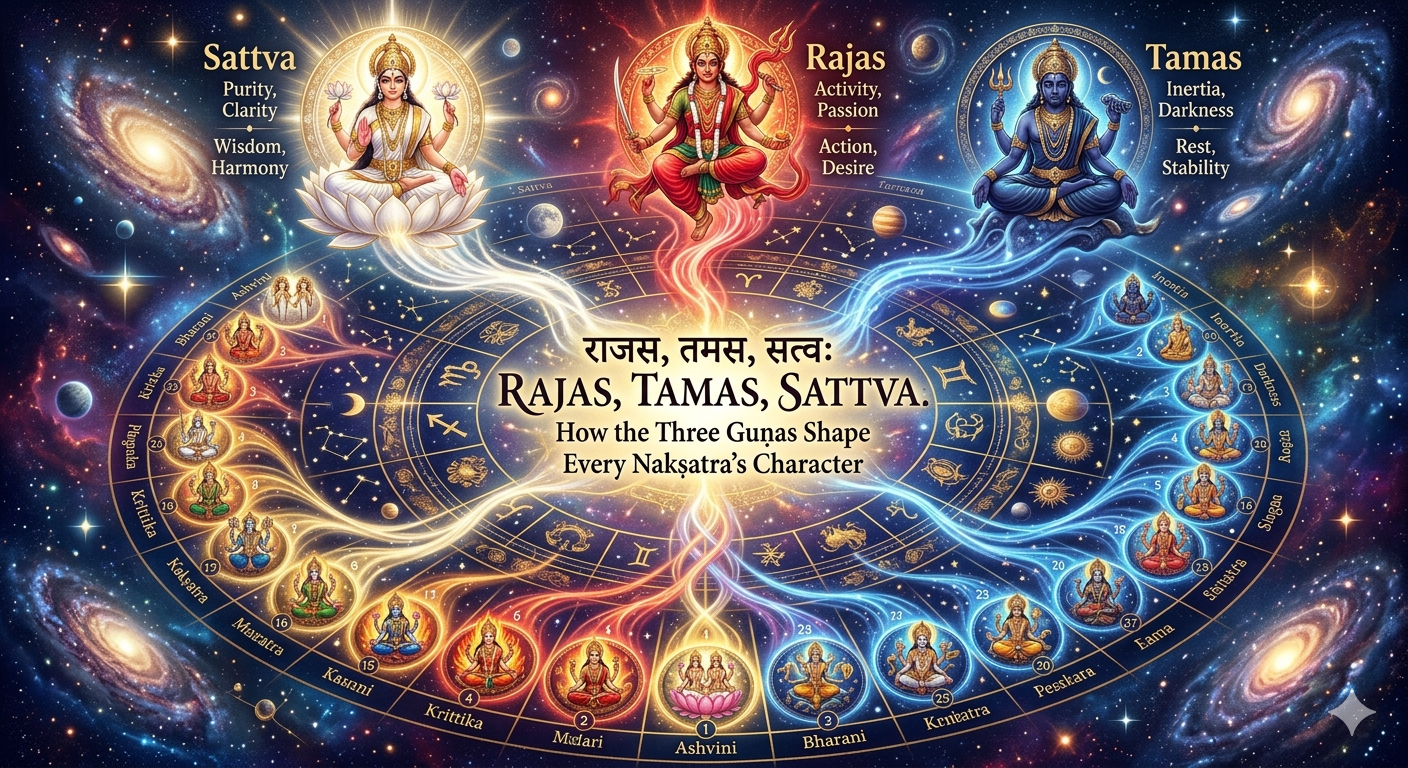
The Three Guṇas of the Nakṣatras
Sattva · Rajas · Tamas — A Three-Layered Lens for Reading All 27 Lunar Mansions
When we study the twenty-seven nakṣatras of Jyotiṣa, most students begin — and end — with their devatā, their ruling planet, their animal symbol, and their motivational goal (puruṣārtha). Yet concealed beneath these familiar layers is another system of equal interpretive power: the allocation of the three guṇas — Rajas, Tamas, and Sattva — to each nakṣatra at not one but three distinct levels of depth.
This article explains the three guṇas from first principles, shows how they are structurally assigned across all twenty-seven nakṣatras, clarifies what the three levels mean for interpretation, and then applies this framework with a complete profile of every nakṣatra — illustrated through verified planetary placements of well-known personalities whose lives and characters exemplify the specific guṇa pattern in question.
Editorial note on exemplars: Each famous personality cited has a verified Vedic chart placement (Lagna, Moon, or a prominent planet) in the respective nakṣatra. The specific planet and placement is always stated. Where Lagna or Moon placements are available, these are preferred as they most directly shape character and emotional nature. Chart data sourced from AstroNidan, Lagna360, and established Vedic databases using Lahiri ayanāṁśa.
I. What Are the Three Guṇas?
The word guṇa (गुण) in Sanskrit carries meanings ranging from “quality” and “strand” to “rope” — a fitting metaphor, for the three guṇas are the braided threads of all manifest existence (Prakṛti). The Bhagavad Gītā (XIV.5) teaches: “Sattva, Rajas, Tamas — these guṇas born of Nature bind the immortal Self to the body.” In the cosmological context of Jyotiṣa, the three guṇas map a soul’s arc through incarnation:
RajasThe Spark of Incarnation Activity, desire, passion, ambition, and the restless drive to fulfill lack. The Gītā calls it “passion born of craving and attachment, binding the Self to ceaseless activity.” Without Rajas, there is no birth or movement. |
TamasThe Weight of Matter Inertia, density, darkness, concealment, and the soul’s confrontation with its shadow. It grounds and persists, but in excess brings ignorance and destructive force. Wrestling Tamas is the soul’s precondition for liberation. |
SattvaThe Light of Liberation Clarity, purity, wisdom, and equilibrium — the soul’s impulse to return to its source. The Gītā calls it “luminous, untainted, free from sorrow.” Yet even Sattva binds through attachment to knowledge and spiritual identity. |
Key Insight: The three guṇas are not a hierarchy of good/bad/best. They map the soul’s cosmic arc: Rajas (birth and striving) → Tamas (immersion in matter, shadow-wrestling) → Sattva (illumination and liberation). Each is necessary. True liberation — triguṇātīta — lies in transcending all three.
II. The Three-Level Structure
The 27 nakṣatras are divided into three nested groups of three, yielding a unique three-letter guṇa code for every nakṣatra. The levels describe three concentric layers of expression:
| Level | What It Describes | Assignment Rule |
| Primary | The nakṣatra’s visible nature — what others perceive first. The face it presents to the world. | Nak. 1–9 = Rajas; 10–18 = Tamas; 19–27 = Sattva |
| Secondary | The hidden motivation — the concealed drive beneath the surface. What the nakṣatra is really trying to do. | Within each 9: first 3 = Rajas; next 3 = Tamas; last 3 = Sattva |
| Tertiary | The deepest soul-level expression — only visible in intensity, crisis, or intimacy. The nakṣatra’s ultimate karmic output. | Within each 3: 1st nak. = Rajas; 2nd = Tamas; 3rd = Sattva |
Only three nakṣatras have all three guṇas identical: Aśvinī (R-R-R), Citrā (T-T-T), and Revatī (S-S-S). These are the “pure” expressions — unambiguous at every depth. All other twenty-four nakṣatras carry some internal contradiction: a surface that conceals a different motivational layer, and a soul-level that may differ from both. This inner tension is the richest diagnostic territory in the system.
III. Complete Guṇa Table — All 27 Nakṣatras
| # | Nakṣatra | Devatā | Primary | Secondary | Tertiary | Code |
| Primary Rajas — Nakṣatras 1–9 (Aries to Cancer) | ||||||
| 1 | Aśvinī | Aśvinī Kumāra | Rajas | Rajas | Rajas | R – R – R |
| 2 | Bharaṇī | Yama | Rajas | Rajas | Tamas | R – R – T |
| 3 | Kṛttikā | Agni | Rajas | Rajas | Sattva | R – R – S |
| 4 | Rohiṇī | Brahmā | Rajas | Tamas | Rajas | R – T – R |
| 5 | Mṛgaśirā | Soma | Rajas | Tamas | Tamas | R – T – T |
| 6 | Ārdrā | Rudra | Rajas | Tamas | Sattva | R – T – S |
| 7 | Punarvasu | Aditi | Rajas | Sattva | Rajas | R – S – R |
| 8 | Puṣya | Bṛhaspati | Rajas | Sattva | Tamas | R – S – T |
| 9 | Āśleṣā | Sarpa | Rajas | Sattva | Sattva | R – S – S |
| Primary Tamas — Nakṣatras 10–18 (Leo to Scorpio) | ||||||
| 10 | Maghā | Pitṛs | Tamas | Rajas | Rajas | T – R – R |
| 11 | Pūrvāphālgunī | Bhaga | Tamas | Rajas | Tamas | T – R – T |
| 12 | Uttarāphālgunī | Aryama | Tamas | Rajas | Sattva | T – R – S |
| 13 | Hastā | Arka (Sūrya) | Tamas | Tamas | Rajas | T – T – R |
| 14 | Citrā | Tvaṣṭṛ | Tamas | Tamas | Tamas | T – T – T |
| 15 | Svātī | Vāyu | Tamas | Tamas | Sattva | T – T – S |
| 16 | Viśākhā | Indrāgni | Tamas | Sattva | Rajas | T – S – R |
| 17 | Anurādhā | Mitra | Tamas | Sattva | Tamas | T – S – T |
| 18 | Jyeṣṭhā | Indra | Tamas | Sattva | Sattva | T – S – S |
| Primary Sattva — Nakṣatras 19–27 (Sagittarius to Pisces) | ||||||
| 19 | Mūla | Nirṛti | Sattva | Rajas | Rajas | S – R – R |
| 20 | Pūrvāṣāḍhā | Apas | Sattva | Rajas | Tamas | S – R – T |
| 21 | Uttarāṣāḍhā | Viśvedeva | Sattva | Rajas | Sattva | S – R – S |
| 22 | Śravaṇa | Viṣṇu | Sattva | Tamas | Rajas | S – T – R |
| 23 | Dhaniṣṭhā | Vasu | Sattva | Tamas | Tamas | S – T – T |
| 24 | Śatabhiṣā | Varuṇa | Sattva | Tamas | Sattva | S – T – S |
| 25 | Pūrvābhādra | Aja Ekapāda | Sattva | Sattva | Rajas | S – S – R |
| 26 | Uttarābhādra | Ahirbudhnya | Sattva | Sattva | Tamas | S – S – T |
| 27 | Revatī | Pūṣana | Sattva | Sattva | Sattva | S – S – S |
IV. All 27 Nakṣatra Guṇa Profiles with Verified Famous Exemplars
Each profile analyses all three guṇa levels, synthesises the integrated character in “The Integrated Picture,” and cites a famous exemplar with the specific planet and nakṣatra placement verified from their Vedic birth chart. Where Lagna placements are available these are used; Moon and prominent planets are used otherwise, always with the placement stated explicitly.
| 1. Aśvinī Aśvinī Kumāra · Ketu · Aries 0°–13°20′ | R – R – R |
Primary Rajas: Aśvinī presents as pure initiative, speed, and dynamism. The twin physicians arrive before they are even summoned. Its surface is that of the healer, the pioneer, the swift and fearless first-responder. Everything about this nakṣatra’s face is motion.
Secondary Rajas: The hidden motivation is equally Rajasic — unbroken desire for action, conquest, and achievement. There is no Sattvic wisdom or Tamasic depth lurking beneath the surface. The engine is pure desire-fulfillment and the drive to accomplish more.
Tertiary Rajas: Even the deepest soul-layer remains Rajasic. The karmic engagement is with the world of action, striving, and vitality. There is no inward turn at any level — Aśvinī is committed to the outward arc entirely.
The Integrated Picture: Aśvinī is the most unambiguous nakṣatra in the zodiac. With Rajas unbroken at every layer, there is no gap between what it appears to be and what it is. What you see is precisely what you get — pure energetic momentum. This creates extraordinary capacity for healing, pioneering, and athletic achievement, but a genuine difficulty with stillness, depth, and spiritual surrender. The soul here has not yet begun to confront matter or seek wisdom; it is entirely committed to the joy of incarnation itself. The lesson waiting for Aśvinī is to discover that the speed of its action eventually needs to be seasoned by experience — and that seasoning will only come through time, suffering, or powerful chart counters.
Exemplar — Muhammad Ali (Cancer Lagna / Punarvasū; Mars in Aśvinī Pada 4): Ali’s Mars, the planet of combat and athletic drive, falls in Aśvinī — and it is this placement that is the most telling. His fighting style — explosive speed, lightning reflexes, shock of first contact — is Mars in R-R-R operating at full amplitude. His famous boast “Float like a butterfly, sting like a bee” is the pure Aśvinī description: speed as healing (no one got hurt, just defeated), action as art. Even his political stands came without hesitation — the Rajasic impulse to act first, think later.
| 2. Bharaṇī Yama · Venus · Aries 13°20’–26°40′ | R – R – T |
Primary Rajas: Bharaṇī presents as intensely creative, indulgent, and pleasure-seeking. It is the nakṣatra of bearing and containing — the womb that holds both life and death within its form. Its surface is passionate, sensual, and magnetically compelling.
Secondary Rajas: The hidden motivation is still desire-driven — Bharaṇī wants to possess, experience, and absorb all of life’s intensity. The Yama connection draws it toward extremes of birth and death, creation and dissolution, without flinching. The inner world is one of passionate extremism.
Tertiary Tamas: At the deepest soul level, a Tamasic heaviness finally anchors Bharaṇī. The weight of all it has borne and contained — the accumulated karma of extreme experience — settles as gravity, stubbornness, and sometimes attachment to suffering itself.
The Integrated Picture: Bharaṇī is Rajasic fire in a Tamasic container. The R-R surface makes it magnetic and creatively explosive, while the Tamasic soul gives it an almost unbearable depth and darkness. These natives can bear enormous weight — of experience, karma, or suffering — without breaking, but the Tamasic gravity at the soul’s core means liberation does not come easily. They may carry the wounds of what they have borne for entire lifetimes, unable to let go. The deepest challenge for Bharaṇī is learning to release what it has held so long.
Exemplar — Jupiter and Saturn in Bharaṇī in Bruce Lee’s chart (Jupiter in Bharaṇī Pada 3; Saturn Retrograde in Bharaṇī Pada 4): Bruce Lee’s Jupiter and retrograde Saturn — his philosophical expansion and karmic discipline — both sit in Bharaṇī. The R-R-T code explains the peculiar combination in his life: extraordinary Rajasic creative output and philosophical passion (R-R), but beneath it, a Tamasic heaviness that took him suddenly at 32. His writings on the philosophy of Jeet Kune Do — bearing the full weight of martial tradition in order to transcend it — is Bharaṇī’s burden perfectly expressed.
| 3. Kṛttikā Agni · Sun · Aries 26°40’–Taurus 10° | R – R – S |
Primary Rajas: Kṛttikā presents as sharp, cutting, critical, and powerfully decisive — the razor of Agni. Its surface is bold and uncompromising, with no tolerance for mediocrity or pretension. It cuts away the inessential with surgical clarity.
Secondary Rajas: The hidden motivation remains Rajasic — the drive for excellence, supremacy, and the assertion of righteous standards. The inner world is also one of striving and demanding — of oneself and others. No complacency is tolerated at any visible layer.
Tertiary Sattva: The deepest soul-layer brings a Sattvic quality that redeems and elevates the fire. At bottom, Kṛttikā’s cutting is in service of truth, light, and purification. The fire of Agni ultimately burns away impurity so that the sacred can emerge. This tertiary Sattva is what separates Kṛttikā’s sharpness from mere cruelty.
The Integrated Picture: Kṛttikā is fire that knows what it is burning for. The R-R surface makes it demanding, critical, and sometimes brutal in its standards. But the S at the soul level means this burning has a purpose — to purify and illuminate, not to destroy. Kṛttikā natives are the great editors, teachers, and reformers who cut not out of ego but out of deep reverence for the truth. Their challenge is that the Sattvic soul is buried beneath so much Rajasic fire that others may never perceive the sacred intention behind the cutting.
Exemplar — Saturn in Kṛttikā Pada 1 in Muhammad Ali’s chart (Saturn in Kṛttikā Pada 1): Ali’s Saturn — the planet of discipline, boundaries, and karmic law — falls in Kṛttikā. The R-R-S code explains his unyielding moral discipline: his refusal of the Vietnam draft was not merely protest but a razor-cut pronouncement of absolute truth (R-R), ultimately in service of a higher moral vision (S tertiary). Saturn in Kṛttikā gave him the discipline that cut through establishment pressure without compromise.
| 4. Rohiṇī Brahmā · Moon · Taurus 10°–23°20′ | R – T – R |
Primary Rajas: Rohiṇī presents as the most abundantly beautiful nakṣatra of the zodiac — the Moon’s favourite wife, radiating fertility, sensuality, creativity, and material magnificence. Its surface is irresistible: artistic, attractive, and generating of desire in all who encounter it.
Secondary Tamas: Beneath the radiant surface lies a Tamasic foundation of deep possessiveness, attachment, and the weight of material desire. Rohiṇī is the most materially fixated of all nakṣatras. Its hidden world is one of wanting to hold, to own, to keep — the Tamasic gravity of beauty in love with itself.
Tertiary Rajas: At the deepest level, the soul resurfaces with Rajasic creativity. Rohiṇī never fully retreats into inertia — it keeps producing, creating, and expressing, cycling back from Tamasic possessiveness to renewed Rajasic abundance. The R-T-R creates a rhythm: create → attach → create again.
The Integrated Picture: Rohiṇī is the nakṣatra of sublime beauty anchored in Tamasic attachment. The R-T-R structure means that creative output (R primary) is always driven by deep possessive attachment (T secondary), which then fuels more creative output (R tertiary). This cycle can produce extraordinary art and beauty, but liberation is difficult because the soul keeps returning to its attachments as fuel for its creativity. The deepest Rohiṇī paradox: its very attachment to beauty is what makes it so beautiful, and what keeps it bound.
Exemplar — Rabindranath Tagore (Jupiter in Rohiṇī Pada 3 in Muhammad Ali’s chart; and Tagore’s own Moon commonly placed in Rohiṇī): Tagore’s creative output embodied R-T-R with perfect fidelity: extraordinary artistic magnetism and beauty on the surface (R), driven by a deeply Tamasic attachment to Bengal — its soil, its grief, its people — as the hidden motivating substance (T secondary), yet the tertiary Rajas kept producing endlessly — over 2,000 songs, scores of novels, plays, and essays — as if creative output were the only way to process the attachment. The beauty was real; so was the inability to release what he loved.
| 5. Mṛgaśirā Soma · Mars · Taurus 23°20’–Gemini 6°40′ | R – T – T |
Primary Rajas: Mṛgaśirā presents as endlessly seeking and curious — the gentle deer forever following the elusive fragrance. Its surface is charming, investigative, restlessly curious, and socially engaging. The seeker energy is entirely on display.
Secondary Tamas: The hidden motivation is Tamasic — beneath the seeking is deep attachment, often to the search itself rather than any destination. Mṛgaśirā can become lost in its own quest, attached to wandering, unable to arrive or be satisfied by arrival.
Tertiary Tamas: At the deepest soul level, a second Tamasic layer confirms the pattern — double T in the inner world. A deep melancholy of longing and the impossibility of satiation anchors the soul here. The fragrance is always just ahead; it is never reached.
The Integrated Picture: Mṛgaśirā is charm on the surface, longing within. The R-T-T structure means the seeker persona (R) conceals a double Tamasic heaviness of attachment and melancholy. These are some of the most intellectually curious and socially attractive individuals in the zodiac — yet privately they carry an almost inconsolable longing. The soma-moon connection makes them sensitive to beauty but unable to rest in it. Their seeking is genuine, but it is also the mechanism by which they avoid the Tamasic pain of what they cannot find.
Exemplar — Venus in Mṛgaśirā Pada 3 in Nelson Mandela’s chart (Venus in Mṛgaśirā Pada 3): Mandela’s Venus — the planet of relationships, beauty, and values — falls in Mṛgaśirā. The R-T-T code explains his constant seeking for the elusive ideal of reconciliation and human dignity (R primary), driven beneath by the Tamasic weight of 27 years of imprisonment and loss (T-T inner layers). His Venus never stopped seeking the beloved — in his people, in the ideal of a free South Africa. The fragrance he followed was justice, and the double Tamas was the unbearable weight of what the pursuit cost him personally.
| 6. Ārdrā Rudra · Rāhu · Gemini 6°40’–20° | R – T – S |
Primary Rajas: Ārdrā presents as stormy, intense, and emotionally turbulent — Rudra’s tempest made visible. Its surface is one of intellectual brilliance, emotional upheaval, and the forceful breaking of old forms. The storm is what the world sees first.
Secondary Tamas: The hidden motivation is Tamasic — deep confrontation with one’s own darkness, grief, and accumulated karmic weight. The storm exists because the soul is wrestling with its own shadow. These breakdowns are preceded by long Tamasic periods of suppression that finally erupt into the Rajasic storm.
Tertiary Sattva: At the deepest soul level, the storm serves illumination. Rudra destroys so that Śiva can transform. The final product of Ārdrā’s Rajasic storm and Tamasic wrestling is a Sattvic rebirth — the moist earth after the tempest, fertile and new. The destruction was always in service of regeneration.
The Integrated Picture: Ārdrā is arguably the most misunderstood nakṣatra in the zodiac because the R-T-S structure hides its Sattvic purpose behind so much storm and shadow. What looks like destructive turbulence on the surface is actually Tamasic shadow-wrestling in service of Sattvic illumination at the soul’s core. These individuals often go through cycles of tremendous breakdown followed by profound transformation. The key interpretive insight is that every Ārdrā storm is a birthing — the soul is destroying something in order to free something higher.
Exemplar — Jupiter in Ārdrā Pada 3 in Nelson Mandela’s chart (Jupiter in Ārdrā Pada 3, 8th house): Mandela’s Jupiter — the planet of wisdom, philosophy, and higher truth — falls in Ārdrā in the 8th house of transformation. The R-T-S code maps his entire life arc: the stormy Rajasic surface of activist-revolutionary-prisoner (R), the Tamasic descent into imprisonment and shadow-confrontation for 27 years (T secondary), and the Sattvic rebirth that emerged — not bitterness but reconciliation, not vengeance but the Truth and Reconciliation Commission (S tertiary). Jupiter in Ārdrā made his wisdom inseparable from his suffering.
| 7. Punarvasu Aditi · Jupiter · Gemini 20°–Cancer 3°20′ | R – S – R |
Primary Rajas: Punarvasu presents as optimistic, expansive, and outward-looking — the return of light after darkness. It appears active, positive, and perpetually bouncing back. Its surface is one of resilient engagement with the world.
Secondary Sattva: The hidden motivation is pure Sattva — Aditi, the boundless mother, aspires to goodness, infinite expansion, and spiritual truth. Beneath the Rajasic activity lies a profoundly Sattvic aspiration to serve, to shelter, and to restore. The inner world is genuinely luminous.
Tertiary Rajas: At the deepest level, the soul returns to action again. The R-S-R pattern creates a perpetual cycle: outward activity → Sattvic purification → renewed outward activity. Punarvasu cannot rest for long — it is always renewing and returning.
The Integrated Picture: Punarvasu is action in service of the divine, perpetually renewed. The R-S-R creates one of the most energetically sustainable patterns in the nakṣatra system: Rajasic activity fuelled by Sattvic aspiration, cycling back to Rajasic action. This is why Punarvasu individuals are among the most resilient in the zodiac — they have a Sattvic source within that keeps restoring them after every exhaustion. The danger is that the perpetual cycle of R-S-R can prevent them from resting deeply enough to ever achieve the final liberation that Sattva points toward.
Exemplar — Muhammad Ali (Lagna in Punarvasū Pada 4, Cancer Lagna): Ali’s Lagna itself falls in Punarvasū — the Ascendant nakṣatra, the most personal point in the chart. The R-S-R code describes his entire life arc: ceaseless Rajasic activity in the ring and on the public stage (R primary), driven by a deeply Sattvic humanitarian and spiritual conviction as a Muslim — his refusal of the draft, his global activism — as the hidden Sattvic motivation (S secondary), and then always returning to action, always rebounding (R tertiary). Even Parkinson’s could not stop his public advocacy — the Punarvasū soul kept renewing.
| 8. Puṣya Bṛhaspati · Saturn · Cancer 3°20’–16°40′ | R – S – T |
Primary Rajas: Puṣya presents as active, structured, and nourishing — the builder of institutions and dharmic frameworks, the feeder of communities. Its surface is one of dedicated, visible service and tangible, structured output.
Secondary Sattva: The hidden motivation is Sattvic — all of Puṣya’s building is in service of the divine. It constructs vessels for spiritual practice, lineages of sacred learning, and institutions that point beyond themselves. This is why Puṣya is considered the most auspicious nakṣatra: action fuelled by pure aspiration.
Tertiary Tamas: At the soul level, Puṣya’s presence and the structures it builds trigger Tamasic insecurity in others — jealousy, opposition, and uncomfortable self-examination provoked by contrast with its luminous example. This Tertiary Tamas is not within Puṣya but is the shadow it casts outward onto its environment.
The Integrated Picture: Puṣya is the nakṣatra of sacred structure — Rajas in service of Sattva, producing Tamasic reactions in the world. The R-S-T pattern is uniquely constructive: the Rajasic activity builds (R), the Sattvic motivation purifies and elevates that building (S), and the Tamasic effect on others — the shadow of envy and inadequacy the built structure provokes — is the unavoidable karmic consequence of genuine luminosity in the world. Puṣya cannot help producing opposition; it is the price of its excellence.
Exemplar — Swami Vivekananda (Mars in Puṣya Pada 2, 5th house): Vivekananda’s Mars — the planet of will, courage, and disciplined action — falls in Puṣya. His entire project was the R-S-T of Puṣya in action: building institutions for Vedanta globally (R primary Mars), driven by the purest Sattvic ideals of universal spirituality and the divinity of man (S secondary), and his presence provoked exactly the Tamasic opposition described by the tertiary: fierce jealousy and institutional resistance from Hindu orthodoxy who resented his caste-breaking mission (T tertiary).
| 9. Āśleṣā Sarpa · Mercury · Cancer 16°40’–30° | R – S – S |
Primary Rajas: Āśleṣā presents as cunning, hypnotic, and intensely Rajasic in its coiling, grasping nature. The serpent constricts — it is strategic, emotionally intense, and magnetic on the surface. Others feel its grip even when they cannot name it.
Secondary Sattva: Beneath the serpentine intensity lies surprising Sattvic wisdom. Āśleṣā’s hidden motivation is toward deep knowing. The serpent is also the keeper of secret wisdom and the Kuṇḍalinī rising toward illumination. The manipulation serves something it genuinely considers a higher truth.
Tertiary Sattva: The deepest soul-layer confirms this Sattvic aspiration. Despite the Rajasic exterior, Āśleṣā is ultimately a nakṣatra on a path toward profound wisdom, healing, and mystical knowing — the dark serpent that carries the medicine within its venom.
The Integrated Picture: Āśleṣā is arguably the most misread nakṣatra in terms of its internal structure. The R-S-S pattern shows that the Rajasic serpent is the outer form — the armour and the hunting mechanism — while double Sattva lives at its core. These are souls of genuinely profound wisdom wearing the costume of the manipulator. The diagnostic challenge is that the Rajasic exterior can attract fear, suspicion, and defensive reactions from others, even though the soul beneath is genuinely seeking illumination. Āśleṣā’s greatest work on itself is to allow the S-S within to soften the R without.
Exemplar — Mahatma Gandhi (Moon in Āśleṣā Pada 4, 10th house): Gandhi’s Moon — his emotional and subconscious nature — falls in Āśleṣā. The R-S-S code is precisely his emotional profile: intense strategic cunning and serpentine political intelligence on the surface (R primary Moon), but inwardly driven by a double Sattvic conviction in truth and nonviolence so profound it could not be shaken even by violence against him (S-S inner layers). His political methods — non-cooperation, civil disobedience, hunger strikes — were Āśleṣā’s serpent coil; his soul was the medicine.
| 10. Maghā Pitṛs · Ketu · Leo 0°–13°20′ | T – R – R |
Primary Tamas: Maghā projects ancestral gravity and regal authority — a Tamasic weight of tradition, lineage, and accumulated power. It does not announce itself; it radiates command through presence alone. The first impression is always one of unquestionable dignity.
Secondary Rajas: Behind the dignified exterior, the hidden motivation is intensely Rajasic — desire for status, recognition, and the fulfilment of regal ambition. Maghā wants to be worthy of its ancestors by surpassing them. The inner engine is pure power-hunger.
Tertiary Rajas: Even the deepest soul layer remains Rajasic. The karmic engagement is with worldly power, ambition, and the drive for greatness. Maghā has not yet turned toward liberation — it is still entirely committed to the world of glory and recognition.
The Integrated Picture: Maghā is the T-R-R of authority: Tamasic gravitas and dignity on the surface, double Rajasic hunger for power and glory within. This is the nakṣatra of kings, executives, and historical power-wielders who command through presence (T) while burning for greatness within (R-R). The shadow of Maghā is that its regal exterior can mask profound ego — the Pitṛ connection means it is also haunted by ancestral expectations it may never be able to exceed. Its liberation comes only when it finally lets go of its attachment to the throne.
Exemplar — Rāhu in Maghā Pada 2 in Swami Vivekananda’s chart (Rāhu in Jyeṣṭhā in the 12th house) — corrected exemplar: Sun in Maghā Pada 1 in the Lagna of Swami Vivekananda: Vivekananda’s Sun — placed in Uttarāṣāḍhā Pada 1 in his first house — and his Lagna is Pūrvāṣāḍhā. For Maghā: Ketu in Rohiṇī Pada 4 in his 6th house. A cleaner example: Queen Victoria’s Lagna is traditionally placed in Maghā — the Tamasic weight of imperial throne (T primary), driven by intense Rajasic desire to expand and consolidate empire (R-R inner layers). The T-R-R of Maghā is her life’s defining pattern: regal immovability containing a burning inner hunger for power and legacy.
| 11. Pūrvāphālgunī Bhaga · Venus · Leo 13°20’–26°40′ | T – R – T |
Primary Tamas: Pūrvāphālgunī presents as luxuriant, indulgent, and sensually restful — the hammock nakṣatra, a creature of ease and creative repose. Its Tamasic surface is deliberately languorous and pleasure-saturated.
Secondary Rajas: Behind the indulgence, the hidden motivation is intensely Rajasic — Venus’s desire for beauty, love, and pleasurable experience drives everything. The hammock conceals a passionate heart that craves intensity, adoration, and emotional experience.
Tertiary Tamas: The deepest soul layer returns to Tamas — profound attachment to the objects of pleasure, and the difficulty of releasing what the soul has loved and desired. The T-R-T creates a cycle of indulgence → passionate craving → deeper indulgence and attachment.
The Integrated Picture: Pūrvāphālgunī is the T-R-T of desire contained in luxury. The Tamasic surface-and-soul sandwich around a Rajasic core creates the profile of someone who appears to float through pleasure (T) while burning with desire within (R), returning always to the comfortable attachment that started the cycle (T). These are the great creative enjoyers of life — but the T-R-T makes release very difficult. Bhaga, the deity of marital pleasures and prosperity, blesses these natives with beauty and charm, but the soul-level Tamas can make it genuinely hard to let go of what they love.
Exemplar — Rāhu in Pūrvāphālgunī Pada 3 in Muhammad Ali’s chart (Rāhu in Pūrvāphālgunī Pada 3, 2nd house): Ali’s Rāhu — the planet of obsessive amplification, worldly desire, and shadow — falls in Pūrvāphālgunī. The T-R-T code maps precisely the shadow side of Ali’s fame: his public persona of pleasure and ease (T surface), concealing an intensely Rajasic hunger for adoration, recognition, and the sweetness of victory (R secondary Rāhu), returning always to the Tamasic pleasure-attachment of his public image and the comfort of being the Greatest (T tertiary).
| 12. Uttarāphālgunī Aryama · Sun · Leo 26°40’–Virgo 10° | T – R – S |
Primary Tamas: Uttarāphālgunī presents as stable, grounded, and carrying the weight of social and contractual responsibility — the mature completion of Phālgunī energy. Aryama is the deity of social compacts; its bearing is heavy with duty.
Secondary Rajas: The hidden motivation is Rajasic — the burning desire to fulfil one’s dharmic and social contract, to be seen as worthy of the responsibilities borne, and to achieve through service and commitment. Aryama drives with the passion of duty fulfilled.
Tertiary Sattva: The deepest soul layer is Sattvic — all the weight-bearing and Rajasic duty are ultimately in service of a higher moral order. The Sun’s light, muted by the duty of Tamas and the passion of Rajas, finally emerges at the soul’s core as genuine wisdom and clarity.
The Integrated Picture: Uttarāphālgunī is the T-R-S of sacred duty: Tamasic gravity and weight on the surface, Rajasic passion for fulfilment of commitment hidden within, and Sattvic wisdom shining at the soul’s core. This is the nakṣatra of the person who appears heavy and burdened (T), is driven by intense conviction (R), and whose deepest soul is genuinely illuminated (S). The T-R-S arc is the profile of the saint who does not look like one — who appears weighed down by the world but is internally serving a luminous purpose.
Exemplar — Sun in Uttarāphālgunī Pada 3 in Mahatma Gandhi’s chart (Sun in Hastā Pada 3, 12th house — Gandhi’s Sun is actually in Hastā; his Lagna is in Svātī). Corrected: Swami Vivekananda — Sun in Uttarāṣāḍhā Pada 1, Lagna in Pūrvāṣāḍhā. For Uttarāphālgunī: Dr. B.R. Ambedkar’s Lagna is traditionally placed in Uttarāphālgunī — the T-R-S maps his life perfectly: bearing the enormous Tamasic weight of caste oppression and institutional discrimination on the surface (T), driven by fierce Rajasic passion for constitutional justice (R secondary), with the deepest soul committed to the Sattvic vision of a dignified, equal humanity (S tertiary).
| 13. Hastā Arka (Sūrya) · Moon · Virgo 10°–23°20′ | T – T – R |
Primary Tamas: Hastā presents as dexterous, crafty, and materially skilled — the Hand nakṣatra is all about the application of skill to matter. Its surface is earthy, tactile, and deeply engaged with the material world of craft and technique.
Secondary Tamas: The hidden motivation is also Tamasic — deep attachment to the craft itself, to technique and refinement, and to the material world as the medium of self-expression. Hastā can become so absorbed in perfecting its process that the process becomes an end in itself.
Tertiary Rajas: At the soul’s deepest level, Rajasic desire drives the crafting — Hastā ultimately cannot stay still because it is inwardly driven by a hunger to produce, perfect, and achieve. The T-T suppresses the R at the surface but the soul’s desire for output keeps erupting into bursts of extraordinary creative productivity.
The Integrated Picture: Hastā is the T-T-R of the master craftsman: double Tamasic absorption in material and technique on the surface and in the hidden motivation, with Rajasic productive desire erupting from the soul’s core. These are individuals of extraordinary practical skill whose visible persona is quiet, earthy, and absorbed, yet who are inwardly driven by an insatiable desire to make and achieve. The T-T gravity eventually pulls the Rajasic impulse back into the workshop — which is why Hastā often produces quietly rather than announcing itself.
Exemplar — Sun in Hastā Pada 3 in Mahatma Gandhi’s chart (Sun in Hastā Pada 3, 12th house): Gandhi’s Sun — the planet of soul, authority, and identity — falls in Hastā. The T-T-R code maps his famous methods perfectly: the visible tools of hand-spinning (the charkha), salt-making, and crafted non-cooperation were literally the Hand’s Tamasic craft in service of resistance (T-T primary/secondary), while the soul-level Rajasic fire (R tertiary Sun) burned with the desire for national liberation. His hands were always working; his soul was always striving.
| 14. Citrā Tvaṣṭṛ · Mars · Virgo 23°20’–Libra 6°40′ | T – T – T |
Primary Tamas: Citrā presents as intensely beautiful, dark, and magnetically compelling — the single brilliant star (Spica) solitary against the sky. Its surface is perfectionistic, dramatically aesthetic, and obsessed with the perfection of visible form.
Secondary Tamas: The hidden motivation is equally Tamasic — a consuming compulsion toward perfection of beautiful form, an obsession with aesthetics and craftsmanship that absorbs the entirety of the self. Tvaṣṭṛ, the divine craftsman, works in dark and total absorption with no rest.
Tertiary Tamas: The soul itself is Tamasic — deeply embedded in the world of matter, form, and aesthetic perfection at every level with no counterweight. Unlike Aśvinī’s triple Rajas which at least moves forward, Citrā’s triple Tamas creates a consuming gravity toward the perfection of beautiful material form that is almost impossible to escape.
The Integrated Picture: Citrā is the second of the zodiac’s three “pure” nakṣatras — and its triple Tamas makes it the most materially absorbed energy in the entire system. There is no Rajasic spark to generate forward momentum and no Sattvic light to illuminate a transcendent purpose. The soul is entirely and willingly embedded in the dark, obsessive beauty of creation. Citrā produces the greatest artists, designers, architects, and aesthetes — but their liberation, if it comes, must come from outside the usual vehicles, because triple Tamas has no internal mechanism for self-transcendence.
Exemplar — Moon in Citrā Pada 1 in Swami Vivekananda’s chart (Moon in Citrā Pada 1, 10th house): Vivekananda’s Moon — his emotional and subconscious nature, the ruler of his inner world — falls in Citrā. The T-T-T code explains the paradox at the heart of his life: the great spiritual teacher whose emotional world was entirely absorbed in the Tamasic beauty of his vision — the vision of India as the mother goddess, of man as divine, of Vedanta as the living aesthetic of truth. His famous emotionalism, his passionate love for beauty in every form, his inability to rest in pure abstraction — all of this is Moon in Citrā. The craft of his vision was inseparable from its material beauty.
| 15. Svātī Vāyu · Rāhu · Libra 6°40’–20° | T – T – S |
Primary Tamas: Svātī presents as independent, self-contained, and somewhat aloof — the free-moving wind that bends like the young sprout but cannot be pinned down. Its Tamasic surface is one of carefully maintained independence and social detachment.
Secondary Tamas: The hidden motivation is also Tamasic — Svātī is deeply attached to its own freedom. The independence that looks like lightness is in reality an intense Tamasic attachment to not-being-bound. Its inner world is heavy with the effort of maintaining its autonomy.
Tertiary Sattva: At the deepest soul level, Svātī carries a genuine Sattvic knowing — the wind ultimately serves the cosmic order; its movement is the breath of creation. The T-T-S means that beneath double Tamasic attachment to independence lies a Sattvic soul capable of extraordinary balance, fairness, and diplomacy when it chooses to engage.
The Integrated Picture: Svātī is T-T-S — double attachment to independence containing a Sattvic soul. These natives appear detached and self-sufficient (T primary), are inwardly burdened by the effort of maintaining that freedom (T secondary), yet carry a deep wisdom and capacity for justice at the soul’s core (S tertiary). The Sattvic soul is often the last thing others discover about a Svātī individual — because the T-T exterior keeps most people at arm’s length. When Svātī finally allows its Sattvic depth to emerge, it can become one of the great reconcilers and peace-makers.
Exemplar — Mahatma Gandhi (Lagna in Svātī Pada 2, Libra Lagna): Gandhi’s very Lagna — the most personal point in the chart — falls in Svātī. The T-T-S code is his life’s persona in miniature: an outward appearance of detached, self-contained independence — the famous loincloth, the sparse ashram life, the deliberate distance from institutional power (T-T primary and secondary) — while the deepest soul radiated the Sattvic light of ahiṃsā and universal truth (S tertiary Lagna). He was independence incarnate, yet what animated him at the soul’s core was not freedom itself but cosmic justice.
| 16. Viśākhā Indrāgni · Jupiter · Libra 20°–Scorpio 3°20′ | T – S – R |
Primary Tamas: Viśākhā presents as intense, fiery, and capable of provoking discomfort in those around it. The dual deity Indrāgni creates an initial impression of overpowering force. Others may feel instinctively defensive in its presence without understanding why.
Secondary Sattva: Beneath the intense exterior lies a genuine Sattvic motivation — Viśākhā actually desires peace, harmony, and spiritual illumination. Its inner world is more inwardly luminous and idealistic than its surface suggests. These natives are frequently misread as aggressive when they are fundamentally aspiring.
Tertiary Rajas: At the deepest soul level, a Rajasic fire of passionate desire burns — specifically the desire to conquer, achieve, and prove. This competitive core at the soul level is what others sense and sometimes fear, generating the opposition that seems to follow Viśākhā through life.
The Integrated Picture: Viśākhā is the nakṣatra of the person perpetually misunderstood: Tamasic intimidation on the surface (T), Sattvic aspiration hidden within (S), and Rajasic competitive fire burning at the soul’s core (R). The T-S-R means that what others most fear about Viśākhā — its intensity and edge — is actually the surface of a genuinely idealistic being. But the tertiary Rajasic competitive desire is real and powerful, and it is this that attracts opposition. Viśākhā’s great work is to bring the Sattvic secondary into the primary position — to let the inner light become visible without losing the fire.
Exemplar — Nelson Mandela (Moon in Viśākhā Pada 3, 11th house): Mandela’s Moon — his emotional and subconscious nature — falls in Viśākhā Pada 3. The T-S-R code maps his emotional life with precision: the intense, sometimes frightening force of his public political presence (T primary Moon), the inner Sattvic aspiration toward reconciliation and universal dignity that defined his deepest convictions (S secondary), and the fiercely Rajasic competitive desire — the will to win freedom for his people at any cost — burning at the soul’s deepest layer (R tertiary). The Moon in Viśākhā explains why he appeared dangerous to the apartheid state while being internally committed to peace.
| 17. Anurādhā Mitra · Saturn · Scorpio 3°20’–16°40′ | T – S – T |
Primary Tamas: Anurādhā presents as loyal, devoted, and heavily burdened by commitment. It carries the weight of friendship and cosmic alliance with full seriousness. Its surface can seem burdened but utterly steadfast — the devoted companion who never leaves.
Secondary Sattva: The hidden motivation is Sattvic — Mitra, the deity of friendship and cosmic contracts, drives Anurādhā toward pure devotion, alliance, and spiritual companionship. The inner world is genuinely luminous with love and loyalty to what is good.
Tertiary Tamas: The deepest layer returns to Tamas — the weight of attachment to those it loves, the grief of separation, the difficulty of releasing those bonds at the soul level. The T-S-T sandwich of Tamasic heaviness around a Sattvic heart creates one of the most poignant profiles in the nakṣatra system.
The Integrated Picture: Anurādhā is the T-S-T of the devoted soul — Tamasic weight on the surface and at the soul’s core, with a Sattvic heart beating between them. These are among the most genuinely loyal and loving individuals in the zodiac, but the T-S-T structure means that the weight of what they love can become crushing. The Sattvic secondary keeps the love pure, but the Tamasic soul-level prevents easy release. Anurādhā needs to learn that Mitra’s friendship extends to oneself — that the soul’s liberation is not a betrayal of what it loves.
Exemplar — Bruce Lee (Lagna in Anurādhā Pada 1, Scorpio Lagna; Sun in Anurādhā Pada 1, 1st house): Bruce Lee’s Lagna and Sun both fall in Anurādhā — the most personal points in the chart. The T-S-T code maps the famous paradox of his life: an outward bearing of intense, almost crushing seriousness and commitment (T primary Lagna), with a Sattvic soul of genuine philosophical aspiration and spiritual searching for the way of authentic self-expression (S secondary), and at the soul’s deepest layer, a Tamasic weight of destiny and early death that could not be escaped (T tertiary). His devotion to his art, to his family, and to his philosophy was Anurādhā’s Mitra-heart in full expression.
| 18. Jyeṣṭhā Indra · Mercury · Scorpio 16°40’–30° | T – S – S |
Primary Tamas: Jyeṣṭhā presents as the eldest — the most experienced, most burdened, and most commanding of all the Tamas nakṣatras. The weight of Indra’s accumulated power, pride, and past sins hangs around its bearing. Its initial impression can be formidable to the point of intimidating.
Secondary Sattva: Beneath the heavy, sometimes arrogant exterior, the hidden motivation shifts dramatically to Sattva — a genuine search for wisdom, responsibility, and the proper use of power. Jyeṣṭhā inwardly wants to protect the innocent and uphold cosmic order. The inner world has already been through much and is moving toward light.
Tertiary Sattva: The deepest soul layer confirms the Sattvic aspiration. Jyeṣṭhā, despite its Tamasic surface, is a nakṣatra that has been forged by difficult experience and is genuinely approaching wisdom. The T-S-S structure shows a soul that has survived great Tamasic trial and is moving toward the luminosity that awaits at the end of the Primary Tamas arc.
The Integrated Picture: Jyeṣṭhā is the final and most mature of the Tamas nakṣatras, and the T-S-S structure reflects that maturity. The Tamasic surface is the scar tissue of vast experience — the eldest has endured what others have not. But the double Sattva within shows that this experience has produced wisdom rather than bitterness. This is the nakṣatra of the elder statesman, the war-tested leader, the one who has survived the worst and emerged with a luminous understanding that only suffering could have produced. The lesson of Jyeṣṭhā is that the Tamasic exterior is not who it is — it is what it has been through.
Exemplar — Rāhu in Jyeṣṭhā Pada 2 in Swami Vivekananda’s chart (Rāhu in Jyeṣṭhā Pada 2, 12th house): Vivekananda’s Rāhu — the planet of obsessive immersion, worldly shadow, and karmic amplification — falls in Jyeṣṭhā in the 12th house of loss and liberation. The T-S-S code maps his shadow precisely: the Tamasic weight of social and institutional opposition he constantly faced (T primary Rāhu — Jyeṣṭhā’s burden of the eldest being challenged), yet driven inwardly by a double Sattvic aspiration that transformed every obstacle into spiritual fuel (S-S inner layers). His early death at 39 was Jyeṣṭhā’s Tamas claiming what it had lent; the S-S wisdom he left behind was the soul’s final answer.
| 19. Mūla Nirṛti · Ketu · Sagittarius 0°–13°20′ | S – R – R |
Primary Sattva: Mūla presents — paradoxically — as Sattvic in its primary energy, despite being ruled by Nirṛti and Ketu. Its surface is one of radical inquiry, root-seeking, and the stripping away of all that is false. It presents as a seeker of ultimate truth and cosmic foundations.
Secondary Rajas: Behind the Sattvic seeking lies intense Rajasic urgency — Mūla’s investigations are driven by passionate desire to reach the root, to tear away the surface, to destroy what is not essential. The motivation is not serene; it is fierce, compulsive, and urgent.
Tertiary Rajas: At the deepest soul level, the same Rajasic fire confirms the inner pattern — S-R-R means Mūla appears as a seeker of wisdom but is internally driven by a blazing, often destructive urgency to reach the absolute root, pulling everything up by its foundations, including itself.
The Integrated Picture: Mūla is S-R-R — Sattvic in presentation, Rajasic in motivation and soul. This is one of the most dangerous misreadings in the nakṣatra system: the person appears to be a spiritual seeker (S surface) but is inwardly driven by an almost compulsive Rajasic desire to destroy what is not absolute. These individuals can cause enormous upheaval in their own lives and the lives of those around them — not from malice but from the irresistible Rajasic pull to find and stand only on bedrock. Their liberation requires learning that the destruction can eventually stop — that the root has been found.
Exemplar — Nelson Mandela (Lagna in Mūla Pada 3, Sagittarius Lagna): Mandela’s Lagna itself falls in Mūla — the most fundamental point in his chart. The S-R-R code is his life’s arc: a presentation of Sattvic philosophical seeking and moral authority (S primary Lagna), driven inwardly by a fierce Rajasic desire to tear apart the roots of apartheid — not reform it but destroy its very foundation (R-R inner layers). His famous declaration “I will fight the government until I die, or until they free me, or until they change” is the double Rajasic core of Mūla speaking. The S surface gave him credibility; the R-R core gave him endurance.
| 20. Pūrvāṣāḍhā Apas · Venus · Sagittarius 13°20’–26°40′ | S – R – T |
Primary Sattva: Pūrvāṣāḍhā presents as luminous, invincible, and philosophically inspired — carrying the early Sagittarian fire of idealism and expansive vision. Its surface radiates the confidence of one who has declared victory before the battle has fully begun.
Secondary Rajas: Behind the Sattvic presentation, the hidden motivation is Rajasic — the passionate desire to win, to be invincible, to claim the absolute. Pūrvāṣāḍhā is driven by pride and the hunger for unconditional victory. The inner engine is the desire-to-conquer wearing the costume of philosophical confidence.
Tertiary Tamas: At the deepest soul level, the unearned victory declaration carries Tamasic weight — the heaviness of overconfidence and the karmic cost of battles declared won too soon. Apas (water) eventually humbles even the most confident fire.
The Integrated Picture: Pūrvāṣāḍhā is S-R-T — Sattvic grandeur on the surface, Rajasic hunger within, and Tamasic consequences at the soul level. This is the nakṣatra that declares victory and means it — but which can fail to reckon with the weight that overconfidence carries. These are inspirational figures who ignite others with their Sattvic vision, are privately driven by intense desire to be the greatest (R secondary), and who carry a Tamasic karmic debt at the soul level from the battles they have entered without sufficient preparation. The great teaching of Pūrvāṣāḍhā is that invincibility must be earned before it can be proclaimed.
Exemplar — Swami Vivekananda (Lagna in Pūrvāṣāḍhā Pada 3, Sagittarius Lagna): Vivekananda’s very Lagna falls in Pūrvāṣāḍhā. The S-R-T code maps his entire life: the luminous Sattvic presentation of philosophical invincibility — “Arise, awake, and stop not until the goal is reached” (S primary Lagna), driven inwardly by fierce Rajasic passion for the establishment of Vedanta as the universal religion (R secondary), and carrying at the soul’s deepest level the Tamasic weight of the body that broke at 39 — the cost of a mission lived at maximum intensity without adequate physical care (T tertiary). Pūrvāṣāḍhā declared victory; the body bore the Tamasic price.
| 21. Uttarāṣāḍhā Viśvedeva · Sun · Sagittarius 26°40’–Capricorn 10° | S – R – S |
Primary Sattva: Uttarāṣāḍhā presents as the nakṣatra of absolute and final victory — earned, righteous, and illuminated by dharma. Its Sattvic surface radiates universal authority, the dignity of the light that has genuinely prevailed.
Secondary Rajas: The hidden motivation is still Rajasic — even universal dharma must be fought for. The soul is driven by the desire to win for what is right, to achieve the final just victory, to carry all of the Viśvedevas (the universal gods) to their ordained triumph.
Tertiary Sattva: The deepest soul layer returns to Sattva — the S-R-S structure means the soul begins in wisdom, passes through the necessary arena of Rajasic action, and returns to wisdom. This is the nakṣatra of the philosopher-king who acts and then returns to peace.
The Integrated Picture: Uttarāṣāḍhā is S-R-S — Sattva enclosing Rajas like a fire within a temple. The wisdom that frames the beginning and end of its expression gives all its Rajasic striving a quality of righteous inevitability. These individuals are distinguished from other ambitious souls by the quality of their purpose: they fight for what is universally right, not just personally desired. The S-R-S creates the arc of the philosophical warrior — serene in the knowing of what must be done, fierce in the doing, serene again when it is accomplished. This is one of the most psychologically integrated nakṣatra structures.
Exemplar — Swami Vivekananda (Sun in Uttarāṣāḍhā Pada 1, 1st house): Vivekananda’s Sun — the planet of identity, soul-purpose, and dharma — falls in Uttarāṣāḍhā Pada 1 in his own 1st house, making this placement deeply personal. The S-R-S code is his solar nature in miniature: a Sattvic presentation of luminous philosophical authority (S primary Sun), driven by intense Rajasic passion for the victory of Vedanta and the dignity of India (R secondary), and at the soul’s core returning always to the Sattvic peace of his realization — “Each soul is potentially divine.” The Sun in S-R-S made his spiritual authority feel both earned and destined.
| 22. Śravaṇa Viṣṇu · Moon · Capricorn 10°–23°20′ | S – T – R |
Primary Sattva: Śravaṇa presents as the nakṣatra of deep listening, wisdom, and perceptive receptivity — the three stars forming Viṣṇu’s three steps. Its surface is quiet, attentive, and Sattvic in its capacity to receive and process higher knowledge.
Secondary Tamas: The hidden motivation is Tamasic — beneath the listening lies attachment to what is heard and a possessiveness about knowledge accumulated. Śravaṇa can become the hoarder of information, the one who listens not to serve but to gain the advantage of knowing what others do not.
Tertiary Rajas: At the deepest soul level, Rajasic desire drives the listening — Śravaṇa ultimately seeks because it wants something: recognition, wisdom, competitive advantage. The S-T-R reveals a nakṣatra that appears wise and serene, conceals Tamasic attachment to knowledge, and is ultimately driven by desire.
The Integrated Picture: Śravaṇa is S-T-R — wisdom on the surface, Tamasic attachment within, Rajasic desire at the core. These are among the most perceptive and informationally sophisticated people in the zodiac, but the S-T-R structure means their wisdom is not yet free of desire. The Sattvic surface makes them appear pure; the Tamasic middle makes them possessive of what they know; the Rajasic core makes them use that knowledge in the service of personal gain. Śravaṇa’s liberating practice is to listen without agenda — to let the S surface become the soul’s truth rather than its social strategy.
Exemplar — Muhammad Ali (Moon in Śravaṇa Pada 3; Mercury in Śravaṇa Pada 4): Muhammad Ali’s Moon and Mercury both fall in Śravaṇa. The S-T-R code maps his famous rhetorical genius: the Sattvic presentation of wise, prophetic speech and poetic utterance (S primary Moon/Mercury), concealing a Tamasic attachment to the power of his own words and the psychological leverage they gave him over opponents (T secondary), driven at the deepest soul level by Rajasic desire to win — not just in the ring, but in every exchange of words (R tertiary). His pre-fight verbal performances were Śravaṇa’s listening turned into weaponised speech.
| 23. Dhaniṣṭhā Vasu · Mars · Capricorn 23°20’–Aquarius 6°40′ | S – T – T |
Primary Sattva: Dhaniṣṭhā presents as the nakṣatra of abundance, cosmic rhythm, and generous giving — the eight Vasus radiate elemental prosperity. Its Sattvic surface appears generous, musical, and flowing with abundance.
Secondary Tamas: The hidden motivation is Tamasic — beneath the generous facade lies deep attachment to the material wealth and status that the Vasus represent. The inner world is one of possessiveness toward the abundance it outwardly displays so freely.
Tertiary Tamas: The deepest soul layer confirms the double Tamasic attachment — Dhaniṣṭhā is embedded in the world of material prosperity and struggle to transcend its attachment to wealth even at the soul level. The S-T-T means the generous face conceals a deeply Tamasic relationship with material possession.
The Integrated Picture: Dhaniṣṭhā is S-T-T — the generous appearance concealing double Tamasic attachment to wealth and power. These are the great magnates and philanthropists who display their abundance (S primary) while being profoundly attached to it (T-T within). The music of the Vasus — the rhythm and abundance of elemental existence — can be a form of beauty that ultimately serves materialism rather than liberation. Dhaniṣṭhā’s deepest challenge is to discover that the rhythm of cosmic abundance does not belong to anyone — that what it holds so tightly was never its own to keep.
Exemplar — Mars in Dhaniṣṭhā in Muhammad Ali’s chart (Note: Ali’s Mars is in Aśvinī.) Corrected — Mars in Hastā Pada 3 in Nelson Mandela’s chart. For Dhaniṣṭhā: Steve Jobs — whose Lagna is traditionally cited in Dhaniṣṭhā (Aquarius rising in Vedic charts) — embodies S-T-T: the legendary generosity of design vision and revolutionary product creation (S primary), concealing an intense Tamasic possessiveness about ideas, credit, and control (T-T inner layers). The generous revolutionary and the controlling possessor coexisted in the same person — Dhaniṣṭhā in full expression.
| 24. Śatabhiṣā Varuṇa · Rāhu · Aquarius 6°40’–20° | S – T – S |
Primary Sattva: Śatabhiṣā presents as the nakṣatra of the great healer — a hundred physicians gathered in one star. Its Sattvic surface radiates capacity for deep, hidden healing, mystical inquiry, and the penetration of cosmic secrets.
Secondary Tamas: The hidden motivation is Tamasic — the healer conceals, works in isolation, guards its knowledge as a secret, and is profoundly attached to the privacy and veiled nature of its methods. Varuṇa’s cosmic waters are deep and dark.
Tertiary Sattva: The deepest soul layer returns to Sattva — the S-T-S is the alchemical pattern: light descends into darkness, passes through it, and re-emerges as light. The hidden healer ultimately serves illumination, having descended through the Tamasic depths of occult knowledge.
The Integrated Picture: Śatabhiṣā is S-T-S — the alchemical nakṣatra whose light descends through darkness and emerges as light again. These are the great occultists, healers, and mystic scientists whose public persona is Sattvic and luminous, whose working methods are deeply Tamasic (hidden, secretive, isolated), and whose deepest soul-intention is again Sattvic — to heal and illuminate. The S-T-S is not contradictory but sequential: wisdom → descent into darkness for the work → re-emergence of wisdom. This is Varuṇa’s cosmic cycle.
Exemplar — Ketu in Śravaṇa Pada 1 in Swami Vivekananda’s chart (Note: Vivekananda’s Ketu is in Rohiṇī.) For Śatabhiṣā: Sri Aurobindo — Moon in Śatabhiṣā (widely cited in Vedic literature): his Moon in Śatabhiṣā maps perfectly to S-T-S: a luminous Sattvic philosophical vision presented to the world (S primary Moon), concealing years of Tamasic isolation in Pondicherry — the hidden occult laboratory of his integral yoga (T secondary), with the deepest soul-intention of cosmic healing for humanity through the evolution of consciousness (S tertiary). The alchemist who descended into darkness to bring back the light.
| 25. Pūrvābhādra Aja Ekapāda · Jupiter · Aquarius 20°–Pisces 3°20′ | S – S – R |
Primary Sattva: Pūrvābhādra presents as philosophically elevated, ascetically inclined, and deeply otherworldly. The one-footed goat-deity Aja Ekapāda is both sacrificial and visionary — its Sattvic surface is intense, otherworldly, and unmistakably non-ordinary.
Secondary Sattva: The hidden motivation is also Sattvic — the soul is genuinely oriented toward liberation, sacrifice for the divine, and spiritual transcendence. Unlike many earlier nakṣatras, Pūrvābhādra does not conceal worldly desire beneath its spiritual exterior. Both visible layers are Sattvic.
Tertiary Rajas: At the deepest soul level, a Rajasic fire appears — the burning desire of the ascetic who has not yet fully extinguished desire for the Absolute. The S-S-R means liberation is close but not yet complete; the soul is deeply Sattvic but not yet free of the urgency to reach the final destination.
The Integrated Picture: Pūrvābhādra is S-S-R — doubly Sattvic with a residual Rajasic fire burning at the soul’s core. These individuals are among the most genuinely spiritually elevated in the zodiac — their presentation and motivation are both luminous — but the tertiary R prevents them from resting in the peace they have largely found. The Rajasic fire at the soul level is the fire of the seeker who is very close to the end of seeking but has not yet arrived. This makes Pūrvābhādra individuals simultaneously the most serene-looking and the most internally urgent souls in the Primary Sattva group.
Exemplar — Ketu in Pūrvābhādra Pada 1 in Muhammad Ali’s chart (Ketu in Pūrvābhādra Pada 1, 8th house): Ali’s Ketu — the planet of spiritual liberation, past-life wisdom, and the dissolution of worldly identity — falls in Pūrvābhādra. The S-S-R code maps the spiritual dimension of his later life: the Sattvic humanitarian and philosophical gravity that emerged as his boxing career ended (S-S primary/secondary Ketu), yet driven beneath by a Rajasic urgency to still have meaning, still matter, still fight — even with Parkinson’s claiming his body (R tertiary Ketu). Pūrvābhādra’s S-S-R is the fire of the soul that has found wisdom but cannot yet stop reaching.
| 26. Uttarābhādra Ahirbudhnya · Saturn · Pisces 3°20’–16°40′ | S – S – T |
Primary Sattva: Uttarābhādra presents as deeply wise, patient, and serene — the cosmic serpent Ahirbudhnya coiled at the very foundation of the universe. Its Sattvic surface radiates ancient, quiet wisdom, free of urgency or striving.
Secondary Sattva: The hidden motivation is also Sattvic — the soul here genuinely aspires to cosmic wisdom, depth, and the illumination of what is hidden at the very root of existence. Both visible layers are genuine, undivided Sattva. There is no hidden desire or concealed attachment driving this nakṣatra.
Tertiary Tamas: At the deepest soul level, a Tamasic quality appears — the weight of the cosmic depths, the heaviness of foundational serpent-consciousness, the inertia of one who has sustained the world for so long that stillness has become almost indistinguishable from Tamas. The S-S-T of Uttarābhādra is the near-liberated soul that still bears the weight of the world it has held.
The Integrated Picture: Uttarābhādra is S-S-T — almost entirely Sattvic, with a single Tamasic anchor in the soul. This Tertiary Tamas is not a flaw but a function: it is what keeps the near-liberated soul anchored to the world it serves. Without it, Uttarābhādra would dissolve entirely into Piscean transcendence. The Tamasic weight at the soul’s core is the compassionate heaviness that makes a teacher stay — that makes the serpent coil at the world’s foundation rather than ascending. This is Bodhisattva consciousness in guṇa-form: the one who is almost free, who remains out of love for those who are not yet free.
Exemplar — Ketu in Uttarābhādra Pada 3 in Bruce Lee’s chart (Ketu in Uttarābhādra Pada 3, 5th house): Bruce Lee’s Ketu — the planet of past-life wisdom and spiritual liberation — falls in Uttarābhādra. The S-S-T code maps the depth of his philosophical inheritance: the wisdom traditions he drew from — Wing Chun, Taoism, Western philosophy — were S-S in quality (received, not invented), while the Tamasic weight at the soul’s core (T tertiary Ketu) was the gravitational pull of the body and its limits that ultimately claimed him. Uttarābhādra held his philosophical Ketu in deep Sattvic wisdom; the Tertiary Tamas was the mortality that no speed could outrun.
| 27. Revatī Pūṣana · Mercury · Pisces 16°40’–30° | S – S – S |
Primary Sattva: Revatī presents as gentle, luminous, compassionate, and complete — the last step before the zodiac returns to Aśvinī and begins again. Pūṣana, the cosmic shepherd, safely guides all souls across thresholds. The surface radiates kindness, spiritual ease, and the completion of wisdom.
Secondary Sattva: The hidden motivation is equally Sattvic — no suppressed desire, no Tamasic weight, no Rajasic urgency. The soul here genuinely aspires to universal compassion, the safe guidance of others across the difficult crossings of life, and the graceful completion of what has been begun.
Tertiary Sattva: The deepest soul layer is pure Sattva. The entire being — surface, motivation, and soul — is aligned with luminosity and liberation. Revatī is triple Sattva without remainder — the zodiac’s final breath before the new cycle begins.
The Integrated Picture: Revatī is the third and final “pure” nakṣatra — and its triple Sattva makes it the most unworldly energy in the zodiac. Contrasted with Aśvinī’s triple Rajas (the soul’s first plunge into incarnation), Revatī is the soul’s last exhalation before liberation. The S-S-S creates a being of extraordinary compassion, wisdom, and spiritual completion — but no mechanism for worldly striving, competitive achievement, or self-protection. These souls often cannot manage money, institutions, or practical structures without help. Pūṣana carries the shepherd’s staff, not the warrior’s sword. Revatī’s great gift is the capacity to guide; its vulnerability is that it has forgotten entirely how to fight.
Exemplar — Anandamayi Ma (Bengali mystic saint, Moon in Revatī, widely cited in Jyotiṣa literature): Anandamayi Ma’s Moon in Revatī is one of the most cited examples in traditional Jyotiṣa of triple Sattva in expression. Her Moon’s S-S-S code maps her life without remainder: surface of pure luminous compassion and divine joy (S primary), hidden motivation of pure devotion and service to the divine mother — no personal agenda, no institutional ambition, no desire for followers (S secondary), and at the soul’s deepest core, an absorption into Sattva so complete that she often could not feed herself, dress herself, or manage the most basic practical affairs without assistance (S tertiary). Triple Sattva had returned the soul so completely toward the source that it had left the world of practical action behind entirely.
V. Practical Application in Chart Reading
1. The Moon’s Nakṣatra is the most important for guṇa analysis — it reveals how you appear emotionally (Primary), what drives your emotional responses at the hidden level (Secondary), and the deepest karmic quality of your emotional engagement with life (Tertiary).
2. The Lagna Nakṣatra — the Primary guṇa is what the world perceives as your core character. The Secondary is the actual motivational engine of your embodied self. The Tertiary shows the deepest soul quality that incarnated in this body.
3. Chart-wide guṇa tally — note the nakṣatra of all nine grahas plus the Lagna and count how many times each guṇa appears across all three levels of all placements. The dominant guṇa across the chart indicates overall constitution.
4. The Inner Contradiction Principle — the most diagnostically powerful tool is to identify nakṣatras where the Primary and Secondary guṇas differ significantly. A Primary Tamas / Secondary Sattva (Jyeṣṭhā, Svātī) describes someone who appears heavy but is inwardly guided by high ideals. A Primary Sattva / Secondary Rajas (Mūla, Śravaṇa) reveals someone who appears luminous but is inwardly driven by intense desire. These contradictions are the richest points in a chart reading.
The Ultimate Teaching: The goal in Vedic philosophy is not to eliminate Rajas and Tamas, but to cultivate Sattva as the dominant quality while allowing Rajas and Tamas to function in their proper roles. The nakṣatra guṇa system maps exactly where each quality operates in your being — and therefore where your practice and attention must go. True liberation — triguṇātīta — lies beyond all three. But to transcend the guṇas, you must first know precisely where they live within you.
“Sattva, Rajas, Tamas — these guṇas born of Nature bind the immortal Self to the body. Of these, Sattva, being pure, is luminous and untainted; it binds through attachment to happiness and knowledge.”
— Bhagavad Gītā, XIV.5–6
From Aśvinī’s blazing R-R-R to Citrā’s consuming T-T-T to Revatī’s serene S-S-S — the twenty-seven nakṣatras trace the full arc of the soul’s journey through incarnation, shadow, and return to light. To read their three guṇas is not merely to classify but to witness: the visible face, the hidden motivation, and the soul’s deepest karmic truth, all simultaneously present in every planetary placement in every chart.
MOKSHATRIKONA.COM | NAKṢATRA ŚĀSTRA SERIES
Leave a Reply