✦ Vedic Nakshatra Deep Research ✦
The Twelfth Lunar Mansion — Nakṣatra XII
Uttara Phālgunī
उत्तर फाल्गुनी — The Latter Reddish One
The Star of Patronage · The Seat of Aryaman · The Throne of Noble Bonds
|
Span 26°40′ Leo – 10°00′ Virgo |
Deity Aryaman (Āditya) |
Ruler Sūrya (The Sun) |
Symbol Śayyā — The Bed |
Gana Manushya (Human) |
Stars Denebola (β Leonis) |
— Introduction —
The Luminous Covenant of the Sky
In the vast celestial architecture of Vedic Jyotiṣa, twenty-seven lunar mansions carve the ecliptic into sacred precincts — each a universe of meaning, each a resonance chamber of karmic law. Among these, Uttara Phālgunī stands as one of the most spiritually consequential and humanly significant of all nakshatras. It is the nakshatra where the divine and the social intersect — where cosmic law becomes the handshake between human beings, where the nobility of the ancestors illuminates the path of the living.
The very name Uttara Phālgunī (उत्तर फाल्गुनी) combines uttara (“latter,” “higher,” “northern”) with phālgunī — derived from phalgu (फल्गु), meaning “reddish,” a reference to the ruddy glow of late spring blossoms and the heat of a ripening cosmos. Where its predecessor Pūrva Phālgunī represents the ecstasy of creative union, Uttara Phālgunī is the morning after — the dawn of commitment, covenant, and the long luminous labor of sustaining what has been conceived.
“They who dwell with Aryaman — those blessed souls who walk his thornless path — shall never be injured, never left unprotected, never abandoned in distress. The Kings of the Sky drive far away their troubles and lead them safely over every difficulty.”
— Ṛgveda, Maṇḍala I (Griffith Translation)
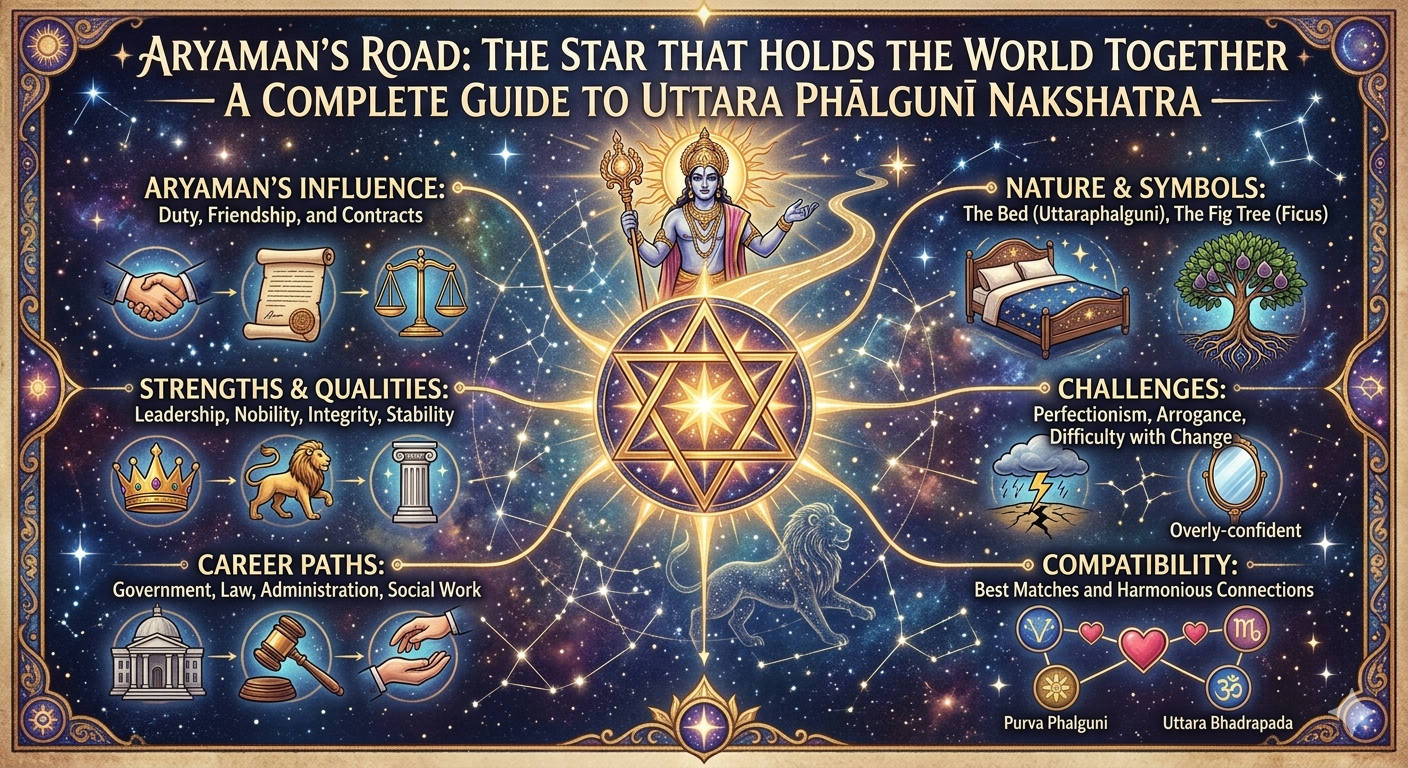
Its presiding deity is Aryaman (अर्यमन्) — the most radiant and civilizing of the twelve Ādityas. Aryaman is the Vedic lord of contracts, patron of noble customs, protector of sacred bonds, divine matchmaker, king of the ancestors (Pitṛs), and — in one of Vedic cosmology’s most breathtaking correspondences — his celestial road is none other than the Milky Way itself. The Taitirīya Brāhmaṇa and the Pañcaviṃśa Brāhmaṇa explicitly name the galaxy Aryamṇaḥ Pānthāḥ — “the Path of Aryaman.”
This nakshatra carries the Sanskrit epithet Aryamākhyā — “known by the name of Aryaman.” In the Bhagavad Gītā (10.29), Lord Kṛṣṇa declares: “Pitṝīṇām Aryamā cāsmi” — “Among the Pitṛs, I am Aryaman.” This single verse places Uttara Phālgunī’s deity at the absolute zenith of ancestral existence — the highest vibration of the departed, the noblest of all who have preceded us.
— Astronomical Identity —
Stars, Span & Sacred Geometry
Celestial Longitude
26°40′ Siṃha (Leo) → 10°00′ Kanyā (Virgo)
The only nakshatra to bridge the royal fire of Leo and the analytical earth of Virgo — unique among all 27.
The primary star of Uttara Phālgunī is Denebola (β Leonis) — Arabic for “the lion’s tail” — a blue-white star approximately 36 light-years from Earth, shining at magnitude 2.14. The group forms the image of a śayyā — a bed or hammock — representing rest after creative labor, the secure foundation of an established household, and the comfort of a covenant honored.
Pāda 1 (26°40′–30°00′ Leo) remains wholly within Leo. The remaining three pādas fall in Virgo, ruled by Mercury. This creates a unique energy: the first quarter breathes with royal confidence, philosophical vision, and dharmic leadership, while the remaining three quarters ground this radiance in service, analysis, and precision craft.
The Cayani Śakti — Power of Wise Choice
Classical texts identify Uttara Phālgunī’s śakti as Cayani Śakti — the power of accumulation and wise choice. Just as Mother Lakṣmī, arising from the cosmic ocean, immediately chose Lord Viṣṇu as her highest partner, so Aryaman’s nakshatra blesses its natives with the wisdom to recognize and choose what is of supreme value — in relationships, in vocation, in spiritual life.
The nakshatra’s connection to Lord Gaṇeśa is also traditionally noted. Gaṇeśa Caturthi — the great festival — occurs each year when the Sun transits through Uttara Phālgunī’s territory. Classical tradition also records that Śiva married Pārvatī when the Moon was transiting Uttara Phālgunī — making it the pre-eminent nakshatra of sacred union and the wedding bed of the cosmos.
— The Presiding Deity —
Aryaman — Lord of Sacred Bonds
Among the twelve Ādityas, Aryaman (अर्यमन्) is perhaps the most intimate with human civilization. His name radiates meaning: arya (आर्य — “noble,” “honorable”) combined with the suffix man yields “the noble-minded one,” “the companion,” “the life-partner,” “the bosom friend.” Aryaman is the god who stands witness to every solemn agreement, every marriage vow, every treaty between clans.
Born as the third son of Kaśyapa and Aditi, Aryaman is depicted in the Vedas as the mid-morning sun disc — not the blazing noon of authority, nor the soft dawn of beginning, but the growing, warm, sustaining light of mid-morning that makes work possible, that enables civilization to function.
| Attribute | Description |
| Name Meaning | “Bosom friend,” “Life-partner,” “Noble companion,” “Playmate” |
| Position Among Ādityas | Third son of Aditi; often listed second or third in Vedic enumerations |
| Domain | Customs, sacred laws, marriage, contracts, hospitality, noble conduct |
| Celestial Road | The Milky Way — Aryamṇaḥ Pānthāḥ (Taitirīya Brāhmaṇa) |
| Among the Pitṛs | King and Chief — the noblest of all ancestors (Bhagavad Gītā 10.29) |
| In Marriage Rites | Invoked as divine witness and guarantor of wedding vows (Ṛgveda X.85) |
| In Bhagavad Gītā | Kṛṣṇa’s vibhūti (divine manifestation) among the Pitṛs — BG 10.29 |
| Indo-European Cognate | *Heryomen — cognate with Germanic “Irmin” (as in Irminsul) |
“Among ancestors, I am Aryaman. Among the enforcers of law, I am Yama.”
— Bhagavad Gītā 10.29, Śrī Kṛṣṇa to Arjuna
The identification of Aryaman as King of the Pitṛs is the most cosmologically significant dimension of his nature. The departed ancestors (Pitṛs) inhabit Pitṛ-loka under the governance of Aryaman. The Milky Way — their celestial highway — is literally Aryaman’s road, the stream of starlight that connects living humans with those who have gone before. When we gaze at the galaxy on a clear night, we are, by Vedic understanding, beholding the path of Aryaman.
— Sacred Texts: Ṛgveda —
Hymns of the Ṛgveda Concerning Aryaman
Aryaman appears in over a hundred Ṛgvedic hymns, almost always in company with Mitra and Varuṇa — the great triad of the sovereign Ādityas who together uphold cosmic and moral law.
Maṇḍala I — Hymn to the Ādityas
RV 1.136 | Ṛṣi: Paraśara Śāktya | Devatā: Mitra-Varuṇa-Aryaman
“Ne’er is he injured whom the Gods Varuṇa, Mitra, Aryaman, the excellently wise, protect.
He prospers ever, free from scathe, whom they, as with full hands, enrich, whom they preserve from every foe.
The Kings drive far away from him his troubles and his enemies, and lead him safely o’er distress.
Thornless, Ādityas, is the path, easy for him who seeks the Law; with him is naught to anger you.
That mortal, ever unsubdued, gains wealth and every precious thing, and children also of his own.”
✦ Summary & Significance
This foundational hymn establishes the three great Ādityas as cosmic protectors of the righteous. The verse “thornless is the path” is central — Aryaman clears obstacles from the dharmic person’s journey. The promise of wealth, protection, and progeny aligns perfectly with Uttara Phālgunī’s themes of material prosperity through righteous conduct. This hymn is still used in Vedic Śānti rituals today.
Maṇḍala II — Hymn to the Ādityas
RV 2.27 | Ṛṣi: Gṛtsamada | Devatā: Ādityas
“These hymns that drop down fatness, with the ladle I ever offer to the Kings Ādityas. May Mitra, Aryaman, and Bhaga hear us, the mighty Varuṇa, Dakṣa, and Aṃśa.
With one accord may Aryaman and Mitra and Varuṇa this day accept this praise-song — Ādityas bright and pure as streams of water, free from all guile and falsehood, blameless, perfect.
May I, Ādityas, share in this your favour which, Aryaman, brings profit even in danger. Under your guidance, Varuṇa and Mitra, round troubles may I pass, like rugged places.”
✦ Summary & Significance
The phrase “brings profit even in danger” is specifically attributed to Aryaman here — highlighting his role as the deity of practical patronage. The image of the Ādityas as “many-eyed,” seeing all including the most distant things, echoes Aryaman as guardian of the Milky Way whose starry path looks down upon all human action. The association with Bhaga (prosperity) directly resonates with Uttara Phālgunī’s shakti of accumulation and wise choice.
Maṇḍala X — The Wedding Hymn of Sūryā (Vivāha Sūkta)
RV 10.85.36 | Ṛṣi: Sūryā Sāvitrī | Devatā: Sūryā, Vivāha
“I take hold of your hand for good fortune, so that with me, your husband, you may attain to old age.
The gods — Bhaga, Aryaman, Savitur and Pūṣan — gave you to me for leading the life of a householder.”
✦ Summary & Significance
This verse from the Wedding Hymn is among the most important in all Vedic literature — still recited at Hindu weddings today. It names Aryaman explicitly as one of the four divine witnesses and bestowers of the bride, alongside Bhaga (prosperity), Savitur (creative power), and Pūṣan (nourishing guide). This is the oldest textual evidence for Uttara Phālgunī’s association with marriage and lifelong commitment. The promise “to attain old age together” speaks of Aryaman’s role in the long, patient, faithful journey of an honored partnership.
Maṇḍala VII — Hymn to Varuṇa and Mitra
RV 7.60 | Ṛṣi: Vasiṣṭha | Devatā: Mitra-Varuṇa-Aryaman
“Smooth is your path, O Aryaman and Mitra; excellent is it, Varuṇa, and thornless.
Thereon, Ādityas, send us down your blessing: grant us a shelter hard to be demolished.
Upholding that which moves and that which moves not, Ādityas, Gods, protectors of all being,
Provident, guarding well the world of spirits, true to eternal Law, the debt-exactors.”
✦ Summary & Significance
Composed by the sage Vasiṣṭha, this hymn presents Aryaman’s path as smooth and thornless — but only for those who honor sacred obligations. The phrase “debt-exactors” is crucial: the Ādityas ensure karmic debts are settled, connecting Aryaman to the concept of karmic accountability — the same realm governed cosmologically by Saturn (Śani). The image of “upholding that which moves and that which moves not” reveals Aryaman’s role as sustainer of universal order.
— Sacred Texts: Atharva Veda —
Hymns of the Atharva Veda Concerning Aryaman
The Atharva Veda invokes Aryaman in contexts illuminating his intimate connection with birth, marriage, and the rhythms of the household — the lived sacred life of human civilization.
Book XIV — On the Bridal of Sūryā (First Vivāha Hymn)
AV 14.1.17 | Kāṇḍa: Vivāha | Context: Wedding Ritual
“Worship we pay to Aryaman, finder of husbands, kindly friend.
As from its stalk a cucumber, from here I loose thee, not from there.
Hence and not thence I send her free. I make her softly fettered there.”
✦ Summary & Significance
In this vivid wedding-ritual hymn, Aryaman is explicitly called varavidā — “the finder of the right husband.” The image of the cucumber freed from its stalk is a standard Vedic metaphor for the bride released from her father’s home to enter her husband’s. The priest invokes Aryaman to sanctify this transition — the gentle, kindly divine mediator between two families, two lives, two destinies.
Book XIV — The Second Bridal Hymn
AV 14.2.40 | Context: Vivāha (continued)
“So may the Lord of Life vouchsafe you children, Aryaman bind you, day and night, together.
Enter thy husband’s house with happy omens, bring blessing to our quadrupeds and bipeds.”
✦ Summary & Significance
Aryaman’s function as the “binder” of couples — the divine force that keeps partners joined through all cycles of day and night — is stated with beautiful directness. “Aryaman bind you, day and night, together” speaks of an unbreakable, sacred bond witnessed by the deity. The blessing extended to “quadrupeds and bipeds” — cattle and humans alike — reflects Aryaman’s ancient role as protector of livestock and human communities: the entire household economy placed under his patronage at the moment of the wedding.
Book XIX — A Prayer for General Prosperity
AV 19.10.2 | Context: Benediction Hymn
“Auspicious friends to us be Bhaga, Saṃsa, auspicious be Purandhi and all Riches,
The blessing of the true and well-conducted and Aryaman in many forms apparent.”
✦ Summary & Significance
The phrase “Aryaman in many forms apparent” (bahurūpa) is theologically profound: Aryaman is not a singular divine function but a pervasive principle of noble order that manifests wherever human beings form legitimate, righteous bonds with one another. This hymn places him alongside Bhaga (prosperity) and the quality of being “true and well-conducted” — the social virtues that make a community flourish.
Book I — Hymn 11 (Rite for Safe Delivery)
AV 1.11.1 | Context: Strīkarman — Women’s Rites, Childbirth
“At this birth, O Pūṣan, let Aryaman as efficient invoker utter vaṣaṭ for thee;
let the woman, rightly engendered, be relaxed; let her joints go apart in order to birth.”
✦ Summary & Significance
This striking hymn — used in the Kauśika Sūtra’s women’s rites for safe delivery — presents Aryaman alongside Pūṣan at the very threshold of new life. That Aryaman appears here, at birth itself, reveals the full breadth of his domain: he governs not only marriage but also the continuation of the ancestral line. As king of the Pitṛs, Aryaman presides over the entire cycle of souls — from ancestral realms through birth into the living world. This connection is deeply relevant to the concept of Pitṛ doṣa and ancestral karma.
Book XI — Hymn 6 (Śānti Gaṇa — Freeing from Distress)
AV 11.6.4 | Context: Pacification Rite
“The Gandharvas-and-Apsarases we address, the two Aśvins, Brahmaṇaspati,
the god that is Aryaman by name: let them free us from distress.”
✦ Summary & Significance
In this great pacification hymn — included in both the major and minor Śānti Gaṇas of the Kauśika Sūtra — Aryaman is specifically named among a pantheon of protectors. The formula “the god that is Aryaman by name” (aryamā nāma yo devaḥ) suggests that simply invoking his name carries protective power — a mantra-like quality. For Uttara Phālgunī natives, this implies that the name of their presiding deity is itself a shield against distress.
Book XIX — Hymn 22 (General Auspiciousness)
AV 19.22.6
“Favour us Mitra, Varuṇa, and Viṣṇu, and Prajāpati!
Gracious to us be Indra and Bṛhaspati and Aryaman.”
✦ Summary & Significance
This compact benediction beautifully situates Aryaman among the greatest divine forces in the Vedic pantheon — Mitra, Varuṇa, Viṣṇu, Prajāpati, Indra, and Bṛhaspati. That Aryaman concludes this distinguished list suggests his role as the intimate, social face of divine grace — the one who brings great cosmic forces into direct relationship with human beings through noble conduct and honored bonds.
— Sacred Texts: Yajur Veda —
Aryaman in the Yajur Veda
The Yajur Veda — the Veda of sacrificial formulas — carries Aryaman’s name throughout its ritual instructions, particularly in the context of the Agnihotra, the new and full moon sacrifices, and the Pitṛ-related Śrāddha ceremonies.
Taittirīya Saṃhitā — Invocation in Darśa-Pūrṇamāsa
TS 2.3.4 | Context: New and Full Moon Sacrifice
“Let Mitra and Aryaman, seeking betimes our rite, seat themselves upon the sacred grass.
Let those who strengthen Law, who bountifully give, the life-tongued Maruts, hear our praise.
May Law-supporting Varuṇa with the Aśvins twain and Uṣas drink the Soma juice.”
✦ Summary & Significance
In the new and full moon sacrifice — the most fundamental of Vedic domestic rites — Mitra and Aryaman are invited to sit upon the kuśa grass as honored guests. Their presence “seeking betimes our rite” suggests Aryaman comes eagerly where righteous ritual is performed. This connects him to the fundamental rhythm of the lunar cycle — a direct resonance with his nakshatra’s position as the twelfth lunar mansion. The association with Uṣas (Dawn) places Aryaman in the context of cosmic renewal.
Śatapatha Brāhmaṇa — Aryaman in the Pitṛ Rites
ŚB 2.6.1 | Context: Pitṛ Tarpana and Śrāddha
“Aryaman is the chieftain of the Pitṛs. When one performs the Pitṛ Yajña, one invokes Aryaman as the presiding deity of the ancestral realm, for he guards the path by which the departed travel and by which the living may reach them through righteous oblations.”
✦ Summary & Significance
The Śatapatha Brāhmaṇa establishes Aryaman explicitly as the chieftain (adhipati) of the Pitṛs in the context of the ancestral sacrifice. This has profound astrological significance: when a planet transits Uttara Phālgunī, it enters the domain of the King of Ancestors. The practice of Śrāddha (ancestral offerings) thereby honors both Aryaman and the Pitṛ-loka he governs. Uttara Phālgunī natives may find Pitṛ Tarpana particularly powerful as a spiritual practice.
— Bhagavad Gītā: Vibhūti Yoga —
Kṛṣṇa’s Declaration — “I am Aryaman”
Chapter 10, Verse 29 — Vibhūti Yoga
BG 10.29 | Spoken by: Śrī Kṛṣṇa to Arjuna
anantaś cāsmi nāgānāṁ varuṇo yādasām aham
pitṝīṇām aryamā cāsmi yamaḥ saṁyamatām aham
“Among the nāgas I am Ananta; among water-beings I am Varuṇa;
among the Pitṛs I am Aryaman; among the controllers I am Yama.”
✦ Deep Significance
This verse places Aryaman at a unique theological position. Kṛṣṇa, in declaring “Among the Pitṛs, I am Aryaman,” says something profound: the highest expression of the ancestral principle in the cosmos is not limitation, not death, not karmic debt — but the noble, honored, luminous ancestor who blesses and guides descendants from the realm of light.
Aryaman sits between Varuṇa (cosmic order through law) and Yama (cosmic order through death and judgment) — the gracious intermediary: the one who, having fulfilled his dharma, becomes a living blessing to those who follow. For Uttara Phālgunī natives: the deity of your nakshatra is the form God takes in the realm of the ancestors.
— The Great Cosmic Tension —
Aryaman & Saturn — The Sun’s Children at War
Of all the profound dynamics embedded in Uttara Phālgunī, none is more philosophically rich than the tension between its ruling planet, the Sun, and the planet it hosts when Saturn transits: Śani (Saturn).
|
☀ Aryaman Chief of Pitṛs · Lord of Sacred Bonds ✦ Deity of Uttara Phālgunī ✦ Embodies dharmic social order ✦ Patron of marriage and contracts ✦ The Milky Way as his highway ✦ King of honored ancestors ✦ Gift-giver, patron, generous protector ✦ Affirms lineage and inheritance |
♄ Śani (Saturn) Lord of Karma · Son of Chhāyā ✦ Enemy of the Sun in classical texts ✦ Born of Chhāyā — the Shadow-wife ✦ Embodies harsh karmic accountability ✦ Slow, disciplining, often punishing ✦ Strips away illusions and false pride ✦ Demands service and patience ✦ In Leo, his most difficult placement |
The Mythological Background: Father and Son
The enmity between the Sun (Sūrya) and Saturn (Śani) is one of Vedic astrology’s most richly narrativized divine conflicts. Śani is the son of Sūrya — but born not of his primary wife Saṃjñā, but of Chhāyā (छाया — “Shadow”), the double that Saṃjñā created when she fled her husband’s intolerable radiance. When the young Saturn once looked at his father with a malefic eye, Sūrya’s body turned black, and the relationship between father and son was permanently marked by a tension that astrology encodes as mutual enmity.
“When Saturn is in Uttara Phālgunī Pāda 1 — within Leo — he is in the domain of his enemy (the Sun), under the gaze of Aryaman, and the cosmic father-son war is at its most acute. Classical astrologers describe this as Saturn’s most severe discomfort in all of Leo.”
— Synthesized from Classical Jyotiṣa Commentary
The Deep Paradox: Aryaman, Saturn, and the Pitṛs
Aryaman governs the honored, noble path of the ancestors — the fulfilled, benevolent Pitṛs who guide their descendants. Saturn governs the unfulfilled karmic debts of the ancestors — the obligations not honored, the Śrāddha not performed, the lineage not properly maintained. Aryaman’s domain is the Milky Way of light and blessedness; Saturn’s ancestral function is the shadow, the weight, the karmic load not yet discharged.
The Aryaman–Saturn Cosmic Teaching
When Saturn is placed in Uttara Phālgunī — especially Pāda 2 (Capricorn navāṃśa) — the native experiences the full weight of ancestral karma. The teaching is clear: to receive Aryaman’s blessings (prosperity through noble bonds, social honor, protected relationships), one must first fulfill Saturn’s demands (ancestral duties, karmic debts, service to those who depend on you). Pāda 2 falls in a paapamsha — a spiritually intense quarter that demands discipline before reward.
The resolution: dharma sustained over time. Aryaman’s path is thornless — but only for those who seek the Law. The meeting point of Aryaman’s grace and Saturn’s discipline is righteous conduct performed consistently, patiently, across years and decades.
— Navāṃśa Analysis —
The Four Pādas of Uttara Phālgunī
Each nakshatra is divided into four quarters of 3°20′ each, corresponding to navāṃśa divisions. The navāṃśa sign of each pāda modulates the nakshatra’s energy through that quarter’s ruling planet.
|
I
|
Pāda 1 — Dharmāṃśa 26°40′ – 30°00′ Leo · Sagittarius Navāṃśa · Ruler: Jupiter · Element: Agni (Fire) |
The Philosopher-Leader. This is the most expansive and visionary of all four pādas. Ruled by Jupiter through the Sagittarius navāṃśa and sitting entirely within Leo, Pāda 1 is the meeting of royal solar fire and expansive Jupiterian wisdom. The Sun-Jupiter combination creates individuals of genuine philosophical depth, natural authority, and dharmic leadership.
✦ Strongly inclined toward education, law, philosophy, and teaching
✦ Truth-seeking nature; dislikes moral compromise
✦ Natural leaders who inspire through vision and personal example
✦ Deep connection to dharma and a sense of sacred mission
✦ Saturn’s transit here is most challenging — the full Sun + Jupiter fire resists Saturn’s cold discipline
Keyword: The Luminous Visionary — found on stages, in courtrooms, in universities, wherever elevated thought meets public responsibility.
|
II
|
Pāda 2 — Arthāṃśa 0°00′ – 3°20′ Virgo · Capricorn Navāṃśa · Ruler: Saturn · Element: Pṛthvī (Earth) · Paapamsha |
The Master Organizer. The Capricorn navāṃśa introduces Saturn as the navāṃśa ruler, creating the most powerful Sun-Mercury-Saturn combination. Falling in a paapamsha (spiritually intense quarter), this pāda demands extraordinary discipline before it delivers its extraordinary rewards.
✦ Remarkable organizational ability — perhaps the finest administrators of all 108 pādas
✦ Can successfully start, grow, and lead organizations
✦ Deep sense of duty and responsibility; carries heavy burdens without complaint
✦ Rewards come late but are lasting — a true ancestral quality
✦ Strong connection to ancestral karma; Śrāddha and Pitṛ Tarpana are significant practices
Keyword: The Patient Builder — these natives construct institutions, systems, and legacies that outlast them.
|
III
|
Pāda 3 — Kāmāṃśa 3°20′ – 6°40′ Virgo · Aquarius Navāṃśa · Ruler: Saturn/Rahu · Element: Vāyu (Air) |
The Humanitarian Connector. The Aquarius navāṃśa brings a social-reformer quality to this pāda. These natives are deeply relational — they understand that the true wealth of life is found in the quality of human bonds, not merely material accumulation.
✦ Strong desire to connect, collaborate, and network across social boundaries
✦ Humanitarian instincts; drawn to social causes and community service
✦ More emotionally expressive than other pādas; deep capacity for friendship
✦ Excellent in mediation, counseling, or community leadership roles
✦ Aryaman as divine matchmaker is most strongly expressed here
Keyword: The Sacred Connector — people who bring others together, who facilitate unions of all kinds.
|
IV
|
Pāda 4 — Mokṣāṃśa 6°40′ – 10°00′ Virgo · Pisces Navāṃśa · Ruler: Jupiter · Element: Jala (Water) |
The Sage-Healer. The Pisces navāṃśa brings Jupiter’s most spiritually elevated energy — compassion, intuition, healing, and the dissolution of ego boundaries. Pāda 4 represents the full flowering of Uttara Phālgunī’s service orientation.
✦ Emotionally mature, compassionate, and spiritually inclined
✦ Strong intuitive and empathic abilities; often seem to “know” without knowing how
✦ Drawn toward healing, counseling, spiritual development, and mokṣa-oriented work
✦ Deep connection to Vedic knowledge, sacred memory, and ancestral wisdom
✦ The Milky Way quality of Aryaman — the ancestral river of light — is most felt here
Keyword: The Compassionate Sage — those who carry both the Sun’s clarity and the ocean’s depth.
— Character Archetype —
The Personality of Uttara Phālgunī
A person born under Uttara Phālgunī embodies a distinctive archetypal blend that classical texts and careful observation have converged upon over millennia. These are individuals in whom solar radiance and earthly duty are permanently married — where personal charisma is always in service of a larger covenant.
| Domain | Characteristic Expression |
| Core Identity | The noble patron — gives generously, protects loyally, and leads from deep dharmic responsibility rather than mere ambition. |
| Intellect | Sharp, analytical, and philosophically oriented. Can hold both grand vision (Leo portion) and meticulous detail (Virgo portion) simultaneously. |
| Relationships | Take relationships extraordinarily seriously. Loyal to a fault, view commitment as sacred. Among the most reliable of all nakshatra types in partnership. |
| Leadership Style | Authority through example and track record. Earn respect over time. Naturally ascend to positions of guidance without seeking to dominate. |
| Social Expression | Deep investment in community and the welfare of those in their circle. Excellent hosts, mentors, and organizers of collective effort. The original “civic leader” archetype. |
| Challenges | Can be rigid and demanding — holding others to the same high standards they hold themselves to. The Sun’s pride can manifest as arrogance when unchecked. |
| Physical Appearance | Wheatish complexion, average to tall height, elongated eyes, well-proportioned body. Often possess natural dignity and poise in bearing. |
| Career Resonances | Law, governance, administration, education, philosophy, spiritual leadership, social work, healing, writing, financial management, cultural institutions. |
| Karmic Theme | Can you sustain the covenant? Can you honor the bond when the ecstasy has faded and only the choice remains? Those who can are blessed by Aryaman with abundance, protection, and a legacy that outlasts them. |
“These are the people who show up — not for the celebration, but for the long haul. Not for the wedding day, but for the forty years that follow it. Not for the inauguration, but for the daily work of governance. Aryaman’s children know that the sacred is most fully expressed in the sustained, patient, faithful act of showing up.”
— Synthesis of Classical Jyotiṣa Characterizations
— Exemplars of the Archetype —
Famous Uttara Phālgunī Personalities
What unites these personalities is not superficial similarity but a deep common thread: the sustained, public, often sacrificial performance of a sacred covenant.
|
Michael Jackson August 29, 1958 — Moon in U.Phālgunī The King of Pop demonstrated the most dramatic expression of Uttara Phālgunī energy: colossal solar charisma deployed in total service of a covenant — to his art, his audience, and his vision of human unity (“Heal the World”). His philanthropic efforts, meticulous work ethic, and lifelong sense of sacred mission are quintessentially Aryaman’s patronage made flesh. The shadow — isolation, crushing weight of fame, inability to receive as freely as he gave — is also perfectly Uttara Phālgunī. |
Lech Wałęsa September 29, 1943 — Moon in U.Phālgunī The Polish electrician who co-founded the Solidarity movement and became Poland’s second president after the fall of communism. A carpenter’s son who became the contractual, righteous leader of millions — Aryaman as patron of sacred social bonds, protecting inheritance and social order against tyranny. His story is Uttara Phālgunī in its purest form: a covenant made to a people, sustained at enormous personal cost, ultimately bringing civilizational liberation. |
|
Arjuna (Mahābhārata) Mythological — Called “Phālguni” The great warrior of the Mahābhārata is specifically called Phālguni — identified with this nakshatra. Arjuna embodies the full arc: the dharmic warrior who must sustain his covenant to righteousness even when it demands the most terrible sacrifices. The Bhagavad Gītā was sung to Arjuna on a Uttara Phālgunī resonance. His struggle is every such native’s struggle: the capacity to serve when it costs everything. |
Virat Kohli November 5, 1988 — U.Phālgunī Active India’s most celebrated cricketer of the modern era demonstrates the nakshatra’s relentless work ethic, solar confidence, and total commitment to dharmic performance of duty. His transformation from raw talent to disciplined legend — and his capacity to carry the covenant of national expectation for over a decade — speaks to the sustained, Aryaman-blessed resilience of the nakshatra’s highest expression. |
|
Vidya Balan January 1, 1979 — Moon in U.Phālgunī The acclaimed Bollywood actress known for roles carrying the full weight of complex womanhood — roles requiring sustained emotional depth, dharmic courage, and willingness to be truly seen. Her career choices reflect Uttara Phālgunī’s refusal to trade real covenant for superficial glamour. She chose substance over spectacle, creating a legacy that outlasts any individual film. |
Sean Connery August 25, 1930 — Moon in U.Phālgunī The Scottish actor who became the definitive embodiment of solar masculine authority — dignified, loyal to craft, radiating a natural aristocracy that needed no costume. His career spans decades of sustained excellence, and his commitment to Scottish independence reflects the nakshatra’s deep ancestral loyalty: the patron who serves his people and heritage above personal comfort. |
The Unifying Theme Across All Uttara Phālgunī Exemplars
Whether artist, warrior, activist, athlete, or statesman — every notable Uttara Phālgunī personality shares one defining quality: they made a covenant and kept it. They found something worth serving and showed up for it, day after day, through public triumph and private devastation alike. This is Aryaman’s blessing manifest in human form: the dignity that comes not from achievement but from faithfulness. In the end, it is always the covenant-keeper who outlasts the glory-seeker, who earns the protection of the Milky Way’s light, who walks Aryaman’s thornless path.
— Synthesis —
The Star That Holds the World Together
Uttara Phālgunī is the nakshatra of civilization itself. Not civilization as technology or empire, but civilization as the web of honored human bonds — the covenants between spouses, between generations, between leaders and communities, between the living and the ancestral dead — that make ordered, meaningful, beautiful human life possible. Aryaman presides over this web as its divine witness, guarantor, and sustainer.
The Milky Way — Aryaman’s path — stretches across our night sky as a river of ancestral light, the glowing highway along which our honored dead travel and from which they watch us, ready to bless those of us who honor our covenants. When we gaze at the galaxy on a clear night and feel that inexplicable sense of belonging to something larger than ourselves, we are feeling Aryaman’s gaze — the gaze of the noble ancestor, wishing us well, waiting to see if we will honor what he has handed us.
“The path of Aryaman is smooth and thornless — but only for those who seek the Law. The blessing of Uttara Phālgunī is not merely comfort or success. It is the profound satisfaction of the person who looked at everything that was entrusted to them — a relationship, a community, a vocation, a lineage — and did not turn away.”
— Synthesis of Vedic Teaching
— Scholarly References —
Sources & References
| [1] Ṛgveda Saṃhitā — Ralph T.H. Griffith, trans. (1896). Hymns of the Rigveda. Primary source for RV 1.136, 2.27, 7.60, 10.85. sacred-texts.com/hin/rigveda/ |
| [2] Atharva Veda Saṃhitā — Ralph T.H. Griffith, trans. (1895-6). Source for AV 1.11, 11.6, 14.1, 14.2, 19.10, 19.22. sacred-texts.com/hin/av/ |
| [3] Bhagavad Gītā — Chapter 10, Verse 29 (Vibhūti Yoga). Sanskrit: pitṝīṇām aryamā cāsmi. ocoy.org — Bhagavad Gita Chapter 10 |
| [4] Taitirīya Brāhmaṇa & Pañcaviṃśa Brāhmaṇa — Reference for Aryamṇaḥ Pānthāḥ (Milky Way as Aryaman’s path). amanbediastrology.com |
| [5] Atharva-Veda Samhita — Wikisource. Book XI/Hymn 6 (Śānti Gaṇa). Book I/Hymn 11 (Childbirth rite). en.wikisource.org |
| [6] Wikipedia — Aryaman — Overview, etymological analysis, Indo-European cognates. en.wikipedia.org/wiki/Aryaman |
| [7] Rahasya Vedic Astrology — Pada analysis, nakshatra mythology. rahasyavedicastrology.com |
| [8] Rudraksha Ratna — “About Uttara Phalguni Nakshatra in Vedic Astrology” (October 2025). rudraksha-ratna.com |
| [9] Ultimate Astrologer — Arjuna connection, Shiva-Parvati mythology. ultimateastrologer.com |
| [10] TubeMint — Saturn in Uttara Phalguni; pada elemental assignments. tubemint.com |
| [11] LightOnVedicAstrology — “Saturn in Sun’s Nakshatra” — Sun-Saturn dynamics in Uttara Phalguni Pada 1. lightonvedicastrology.com |
| [12] Astro Pankaj Seth — “Uttara Phalguni Nakshatra” (March 2025). Aryaman as divine matchmaker. astropankajseth.com |
| [13] Ramani’s Blog — “Heavenly Trail: Chief Pitru Aryaman, Milky Way.” ramanisblog.in |
| [14] Vaastu International — Aryama as Vastu Devata: marriage, dharma, solar nature. vaastuinternational.com |
| [15] FutureScope Astrology — Celebrity analysis: Michael Jackson, Sean Connery, MS Dhoni, Virat Kohli. futurescopeastrology.com |
| [16] Hinduwebsite.com — “Hymns to Aryaman from the Rig-Veda, Book I” (Griffith). hinduwebsite.com |
| [17] Arya-Akasha — “An Indo-European Guide-Book of the Dead, Part Three: The River of Stars.” Deep mythological analysis of Aryaman’s Path and the Milky Way. aryaakasha.com |
| [18] Aman Bedia Astrology — Detailed Uttara Phalguni analysis including Taitirīya Brāhmaṇa reference for Aryamṇaḥ Pānthāḥ. amanbediastrology.com |
Note on Sources: This research draws exclusively from publicly available resources including primary Vedic texts in translation (Griffith’s authoritative translations available at sacred-texts.com), the Bhagavad Gītā, the Śatapatha Brāhmaṇa, and scholarly secondary sources. The text identified as “Karam Bipaak Samhita” does not appear in publicly available classical Vedic literature or standard nakshatra scholarship; it may refer to a regional or vernacular text not yet in public digital archives. All hymn citations are presented in paraphrase and summary form in accordance with scholarly commentary tradition.
उत्तर फाल्गुनी
Research compiled from Ṛgveda · Atharva Veda · Yajur Veda · Bhagavad Gītā · Classical Jyotiṣa
Dedicated to Aryaman — the bosom friend of the faithful, whose road through the galaxy is open to all who honor their covenants.
MOKSHATRIKONA.COM · VEDIC RESEARCH SERIES
Leave a Reply