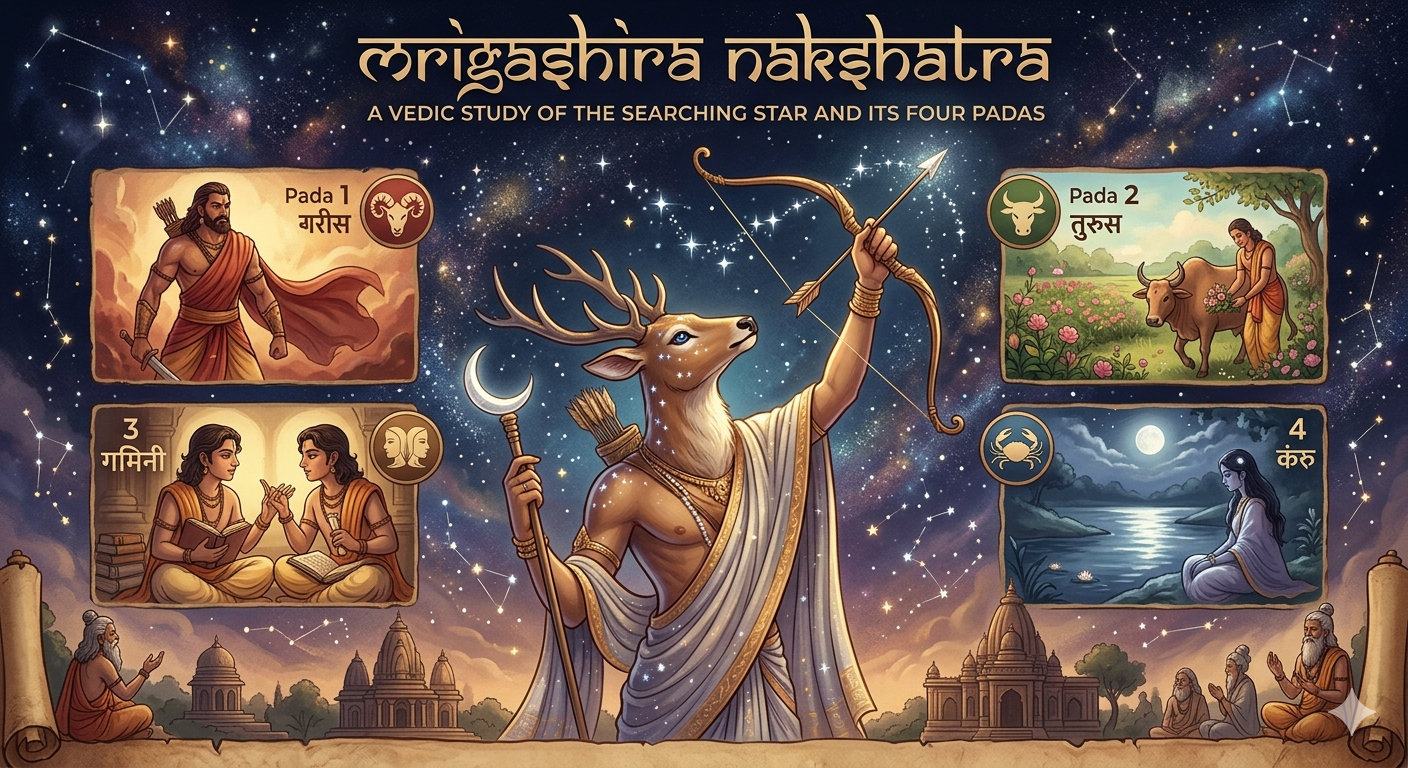
मृगशीर्षा
Mrigashira Nakshatra
“I am Mrigashira — always on search for eternal bliss. I am restless and abundant like the flow of Soma, the Divine Nectar.”
At a Glance: Core Attributes
| Sanskrit Name | मृगशीर्षा (Mṛgaśīrṣā) — “Head of the Deer” |
| Position | 5th of 27 Nakshatras · 23°20′ Taurus to 6°40′ Gemini |
| Presiding Deity (Devata) | Soma — the Moon-God as nectar of immortality and lord of plants |
| Nakshatra Lord | Mars (Mangala / Angaraka) |
| Symbol | Deer’s Head 🦌 · Pot full of Soma · Arched bow |
| Shakti (Power) | Prīṇana Śakti — the power of fulfillment and giving joy (Ananda) |
| Basis Above / Below | Above: Diffusion and extending · Below: Weaving |
| Desire | To gain lordship over all plants |
| Nature (Gana) | Deva (divine / god-like) |
| Quality (Guna) | Mridu (Soft, Mild, Tender) |
| Astronomical Stars | λ Orionis (Lambda Orionis) and surrounding stars in the head of Orion |
| Celestial Lineage (Gotra) | Sage Pulasthya — one of the seven cosmic rishis (Saptarishi) |
| Yoni (Cosmic Animal) | Sarpa (Male Serpent) · Element: Earth · Guna: Tamas |
| Goal (Purushartha) | Moksha (liberation and spiritual transcendence) |
| Seed Syllables (Bīja) | Ve · Vo · Kaa · Kee |
The Sacred Myth: Brahma, Rohini & the Arrow of Rudra
In the beginning, when creation was still taking shape, Lord Brahma — the Great Progenitor — became captivated by the incomparable beauty of his daughter Rohini (herself embodied as the fourth Nakshatra, the Red Doe). Overwhelmed by the nectar-wine of desire, Brahma transformed himself into a great stag (Mriga) and pursued his fleeing daughter across the celestial vault.
The other gods, horrified at this transgression of dharma, cried out to Rudra — the fierce, auspicious destroyer of moral corruption. Without hesitation, Lord Shiva took his bow and shot a single arrow across the heavens. The shaft struck the stag between the antlers, severing the head of Brahma’s deer-form. The head leapt upward and became fixed in the sky as Mrigashira Nakshatra — the Head of the Deer, visible to all creation as a reminder of both the beauty and the danger of unchecked desire.
The three stars of Orion’s Belt correspond to the three-pointed arrow of Rudra (Pashupati), and the star Sirius — blazing nearby — is identified in some traditions as the bowman Mrigavyadha (“the deer slayer”). This cosmic tableau, described in texts such as the Shatapatha Brahmana and referenced in Vedic astronomical lore, establishes Mrigashira as the nakshatra of the eternal seeker: one who pursues the beautiful, the nourishing, the ultimate — yet must be guided by dharmic restraint.
A second mythological current flows from the love-story of the Moon (Soma) himself. Among his 27 wives (the 27 Nakshatras, daughters of Daksha Prajapati), Soma was utterly besotted with Rohini — spending all his nectar and time with her and neglecting the rest. This earned him a curse of wasting — and Mrigashira perpetually seeks what Rohini once embodied for Soma: the perfect object of love, nourishment, and bliss. The restlessness of this nakshatra is thus Soma’s own restlessness made starlight.
✦ Cosmic Geography
In Vedic astronomical cosmology, the region of the Milky Way around 0° Gemini — the heart of Mrigashira — was considered the most auspicious sector of the entire zodiac. Rohini and Mrigashira together mark where the galactic river of light pours through the ecliptic. The opposite point (Jyeshtha/Mula in Scorpio-Sagittarius) was considered the most dangerous. Mrigashira is, literally, born of light.
Soma — The Presiding Deity: Nectar, Moon, and Mind
Soma occupies a stature in the Vedic pantheon second only to Indra and Agni. He is simultaneously a god, a sacred plant-substance, and a celestial body (the Moon). The Sanskrit root su — “to energize, swell, expand, and flow” — gives birth to the word Soma. He is the personification of ananda (bliss), the cosmic principle that is the very origin of creation in Vedic understanding.
As the deity of Mrigashira, Soma governs the fulfilment of desires (prīṇana), the nourishment of body and mind, sovereignty over the plant kingdom, and the gift of immortality. The Vedic seers understood Soma as the nectar (amrita) that descends from the thousand-petal lotus at the crown of the head in deep meditation — the sweet reward of inward search. Soma is called “the lord of plants” because plant life — which heals, nourishes, and transforms — carries this life-giving rasa. Mrigashira natives are thus natural healers, herbalists, chefs, perfumers, and poets: all who work with the rasa of things.
| Soma as Deity | Soma as Substance | Soma as Celestial Body |
| King of the Nakshatras, depicted riding a three-wheeled chariot pulled by 10 white horses; healer-god, lord of plants, bestower of immortality, bringer of joy and Ananda | Sacred pressed juice offered at yajnas; the most important Vedic ritual drink, offered by Udgatar priests; central to the Soma sacrifice described in the Brahmanas | The Moon (Chandra), storehouse of divine nectar; waxing and waning mirrors the filling and consumption of the divine cup; the Moon rules the mind (manas) |
Sacred Hymns to Soma Across the Vedas
No deity in Vedic literature receives more sustained, rapturous, and multi-textual praise than Soma. Across all four Vedas — Rig, Sama, Yajur, and Atharva — Soma hymns form the backbone of the sacrificial tradition. Below is an in-depth synthesis of the most significant hymns, with summaries and their spiritual significance for the Mrigashira native.
Ṛg Veda — The First Praise
Mandala 9 (Soma Maṇḍala): 114 hymns entirely devoted to Soma Pavamāna (“Self-Purifying Soma”), recited by the Udgatar priests during the Soma sacrifice. These constitute the most sacred corpus in the entire Rigveda.
(Griffith trans., sacred-texts.com)
“We have drunk Soma and become immortal; we have attained the light, the Gods discovered. Now what may foeman’s malice do to harm us? What, O Immortal, mortal man’s deception? Absorbed into the heart, be sweet, O Indu, as a kind father to his son, O Soma…” — RV 8.48.3–4
Summary & Significance: This is the most famous Soma hymn in the Rigveda — a 15-verse ecstatic declaration of Soma-consciousness. The rishi describes drinking Soma and feeling immortality course through his veins, his ailments dissolved, his joints strengthened like straps on a chariot. The hymn ends with Soma being invoked as the “life-giver,” the “light-finder,” the “aim of all eyes.” For Mrigashira natives, this hymn maps perfectly onto their inner experience: the sensation of having glimpsed something transcendent — the nectar of existence — and the restless yearning to return to it.
(Griffith trans.)
“The Soma-drops with thousand powers are purified for victory, hymned to become the feast of Gods… Like coursers by their drivers urged, they were poured forth for victory, swift through the woollen straining-cloth…” — RV 9.1 (Griffith)
Summary & Significance: The opening hymns of Mandala 9 establish Soma Pavamana as the self-purifying stream — like golden liquid flowing through a woollen filter — that strengthens the gods, destroys enemies, and brings wealth and heroic sons. The Soma is described as flowing like a great bull, a rushing steed, waves of the cosmic ocean pressing through the filter of ritual. The imagery of purification — the sieve through which Soma flows — corresponds to Mrigashira’s quality of discriminating the true from the false, the immortal from the merely pleasant.
(sacred-texts.com)
“Finder of horses, pour on us horses and wealth in kine and gold, And, Indu, food in boundless store… O Soma, being purified, bring us from all sides, for thou canst, riches and food with hero sons.” — RV 9.61.3, 6
Summary & Significance: This hymn highlights Soma’s role as wealth-giver and fortune-finder — he who knows the hidden paths to abundance. The “finder of horses” epithet resonates with Mrigashira’s deer-like alertness, its nose always following a scent trail toward something better, richer, more fulfilling. Soma here is both the journey and the reward, the seeker and the sought.
(sacred-texts.com)
“This universe, O Pavamana, owns thy sway; thou, Indu, art the first establisher of Law. Thou art the sea, O Sage who bringest all to light: under thy Law are these five regions of the world. Thou reachest out beyond the earth, beyond the heavens: thine are the lights, O Pavamana, thine the Sun.” — RV 9.86.28–29
Summary & Significance: In this grand hymn (86 verses — one of the longest in the Rigveda), Soma is elevated to cosmic sovereign: the first establisher of Ṛta (cosmic law), who encompasses all five regions of the world, who is both the ocean and the sun. The ceaseless streams of Soma with their “hundred streams” singing to the Golden-Hued one — this is the Mrigashira native at their best: connecting everything, flowing everywhere, illuminating what was dark.
(sacred-texts.com)
“For our sage fathers, Soma Pavamana, of old performed, by thee, their sacred duties… As thou didst flow for Manu Life-bestowing, Foe-queller, Comforter, rich in oblations, even thus flow onward now conferring riches…” — RV 9.96.11–12
Summary & Significance: This hymn connects Soma to the ancestral lineage — he who performed the sacred duties of the Vedic fathers and flowed for Manu himself (the progenitor of humanity). Soma is the thread connecting the living to the ancestors, the present to the primordial. For Mrigashira natives — whose gotra sage is Pulasthya, one of the Saptarishis — lineage, heritage, and ancestral wisdom are deeply personal themes.
(one of the oldest myths in the Rigveda)
Summary & Significance: This pair of hymns celebrates one of the earliest recorded Vedic myths: a great eagle (Shyena) steals the Soma from its heavenly guardian on the mountaintop and brings it down to the gods and sages. Soma is described as “a great enjoyment that is won, conquered, bought, or stolen — its procurement does not always come easily.” This myth perfectly captures the Mrigashira archetype: the sacred nourishment exists, it is real — but reaching it requires boldness, cunning, and an eagle’s resolve. The Mrigashira person will search until they find their Soma.
(Griffith trans.)
“Where there is eternal light, in the world where the Sun is placed, in that immortal, imperishable world, place me, O Soma… Where King Vaivasvata rules, where the innermost heaven of the sky is, where the mighty waters are, there make me immortal, O Soma…” — RV 9.113.7–10 (paraphrased from Griffith)
Summary & Significance: In this deeply moving hymn, the rishi does not ask Soma for wealth or victory — he asks to be placed in the realm of immortal light, where there is no more death, no separation. The longing here is the purest expression of Mrigashira’s Moksha orientation: the search is ultimately not for earthly pleasures but for the imperishable. This is the highest Soma — the bliss that lies beyond all seeking.
Sāma Veda — The Song of Soma
The entire Samaveda is essentially the Rigveda reorganized for melodic recitation during the Soma sacrifice. Of its 1875 verses, the overwhelming majority are drawn from Rigveda Mandala 9 and addressed to Soma Pavamana. The Udgatr priests chanted these verses in seven svaras (musical notes) while the Soma was being pressed, filtered, and poured.
“I have tasted, as one who knows its secret, the honeyed drink that charms and relaxes, the drink that all, both Gods and mortals, seek to obtain, calling it nectar… Sing forth, ye men who long for help, to Pavamana, to the Sage, effused to entertain the Gods…”
Summary & Significance: The Samaveda transforms the Soma hymns from spoken mantras into living music. The melodic recitation was itself considered a form of Soma — the sound-rasa that nourished the gods as much as the liquid rasa. For Mrigashira natives, who possess the Mercury-Venus blend of musical intelligence and sensory delight, the Samaveda’s Soma hymns are the most intimate: they represent the moment where knowledge becomes song, and song becomes nectar. The Samaveda was the Vedic scripture most beloved by musical and artistic souls.
Yajur Veda — Soma in Sacrificial Action
The Yajurveda (both Shukla/White and Krishna/Black recensions) contains the ritual prose formulas (yajus) spoken by the Adhvaryu priest during the soma sacrifice. It describes precisely how the plant was to be pressed, filtered, mixed with milk and barley, and offered — grounding the cosmic poetry of the Rigveda in practical, embodied action.
असतो मा सद्गमय । तमसो मा ज्योतिर्गमय । मृत्योर् माऽमृतं गमय ।
“From the unreal lead me to the Real. From darkness lead me to Light. From death lead me to Immortality.”
Summary & Significance: Known as the Pavamana Mantra — named after Pavamana (Soma being purified) — this prayer from the Brhadaranyaka Upanishad of the Yajurveda is perhaps the most universally beloved Vedic prayer. It encapsulates the soul of Mrigashira: the movement from illusion to truth, from ignorance to illumination, from mortal limitation to the immortal Soma-state. The word Pavamana itself (“being purified”) is Soma’s most intimate name. The Mrigashira native is on a lifelong Pavamana journey — always being refined, always seeking the light.
Summary & Significance: The White Yajurveda (Vajasaneyi Samhita) contains dozens of specific ritual formulas addressing Soma during the pressing ceremony. Soma is described as a dark, sour, leafless creeper pressed between stones. The Yajurveda formulas ground the cosmic ecstasy of the Rigveda into earthy practice: the actual labour of grinding, pressing, filtering through wool, mixing with milk, and offering in precisely enumerated vessels. This “embodied Soma” — physical effort leading to divine result — mirrors Mrigashira’s gift of combining sensory intelligence with spiritual aspiration: the body is the laboratory for the soul.
Atharva Veda — Soma as Healer and Plant-King
The Atharvaveda (Knowledge of Sacred Formulas) takes a more medicinal, terrestrial, and magical relationship with Soma — emphasizing him as the Lord of healing plants, protector against disease, and bestower of long life.
“To the five kingdoms of the plants which Soma rules as Lord we speak. Darbha, hemp, barley, mighty power: may these deliver us from woe.” — AV 11.6.15
Summary & Significance: The Atharvaveda asserts Soma’s supremacy over all the plant kingdoms. This connects directly to Mrigashira’s Shakti — Prīṇana, the power of fulfillment through plant nourishment. Soma here is not merely a ritual drink but the living principle within every herb, crop, and forest: the sap of life itself. Mrigashira natives who become botanists, herbalists, Ayurvedic practitioners, farmers, or perfumers are enacting this Atharvavedic dimension of their nakshatra.
“One thinks, when men have brayed the plant, that he hath drunk the Soma’s juice. Of him whom Brāhmans truly know as Soma, no one ever eats.” — AV 14.1 (after Griffith)
Summary & Significance: This cryptic verse from the Atharvaveda points to the esoteric heart of the Soma mystery: the physical ritual drink is a symbol. The “true Soma” that the knowers of Brahman understand — this is never consumed, never destroyed. It is the bliss-principle within consciousness itself. This verse is the Atharvaveda’s bridge to Vedanta: Soma as Ananda, as the sat-chit-ananda of the Self. Mrigashira’s deepest calling is to find this inner Soma — the nectar that the deer is always seeking, which in truth flows from within.
✦ Note on Karma Vipaka Samhita
The Karma Vipaka Samhita is a post-Vedic Sanskrit text primarily dealing with karmic consequences and remedial rituals (pariharas) for various planetary and nakshatra placements. While it references nakshatra-based prescriptions extensively, its specific verses are not separately classified under Mrigashira in the publicly accessible primary literature searchable at this time. Its broader framework aligns with the Atharvavedic tradition of remedial ritual — supporting the view that Mrigashira natives benefit from Soma-related offerings, moonlit meditations, plant-based worship, and charitable acts involving food and water.
The Four Padas: A Journey Through Four Worlds
Mrigashira spans two rashis — Taurus (first two padas) and Gemini (last two padas) — and four Navamsa signs. Each pada distils a unique expression of the seeker-archetype: from Leo’s creative boldness, through Virgo’s analytical precision, to Libra’s aesthetic harmony, and finally Scorpio’s penetrating depth.
| PADA 1 23°20′–26°40′ Taurus Leo Navamsa · Sun |
PADA 2 26°40′–30°00′ Taurus Virgo Navamsa · Mercury |
PADA 3 0°00′–3°20′ Gemini Libra Navamsa · Venus |
PADA 4 3°20′–6°40′ Gemini Scorpio Navamsa · Mars |
| Planetary Blend: Mars (lord) + Sun (navamsa) in fixed Taurus | Shadow: Pride, stubbornness, short temper, excessive concern with recognition |
Character Portrait: The Pada 1 Mrigashira native burns with creative fire. Sun’s Leo energy fused with Mars’s pioneering drive in stable Taurus creates a person of remarkable artistic vision and unwavering determination. They are the most fixed of Mrigashira’s four expressions — once they find their Soma (their passion, their creative path), they pursue it with absolute dedication. They have a natural aesthetic sense, strong imagination, keen interest in beauty, and an innate desire for recognition of their gifts. They tend toward leadership in creative fields, are often blessed with a commanding physical presence, and can attract wealth through artistic or educational endeavours. They need to guard against egoism and the tendency to equate their identity with their output. Their spiritual lesson: the Sun must bow before Soma — personal glory must yield to universal bliss.
| Planetary Blend: Mars (lord) + Mercury (navamsa) in late Taurus | Shadow: Excessive analysis, hypercriticism, sensuality leading to indulgence |
Character Portrait: This pada produces Mrigashira’s most intellectually gifted expression. Mars’s drive plus Mercury’s quicksilver intelligence in careful Virgo creates superb orators, writers, analysts, and communicators. These natives are calculative yet compassionate — they can run a commercial enterprise while composing poetry. They have a strong will, excellent memory, and the patience to master complex bodies of knowledge. They fall in love on journeys — for travel activates their sensory curiosity and opens the heart. They are the natural researchers, journalists, and teachers of Mrigashira: they seek truth methodically, document it precisely, and communicate it compellingly. Their spiritual lesson: Mercury must be stilled long enough for Soma’s wordless bliss to speak.
| Planetary Blend: Mars (lord) + Venus (navamsa) in early Gemini | Shadow: Materialism, indecision in love, restlessness in partnerships |
Character Portrait: Pada 3 is Mrigashira’s most charming, socially gifted, and aesthetically refined expression. Venus in Libra joining Mars’s vitality and Gemini’s airy communicativeness creates a person of natural grace, beautiful speech, diplomatic brilliance, and a refined eye for beauty in all its forms. These natives are naturally attractive, skilled in partnerships and negotiations, and often excel in performing arts, design, and diplomacy. They have a deep desire for intellectual and emotional connection — they seek a partner who is both a mental equal and a soulmate. Their spiritual challenge: Venus’s sweetness can become an end in itself. The Soma they seek must ultimately be found within, not in relationships or luxury, however exquisite.
| Planetary Blend: Mars (lord) + Mars (navamsa) — double Mars in Gemini + Scorpio | Shadow: Secrecy, manipulation, obsessive tendencies, difficulty trusting |
Character Portrait: This is the most intense, penetrating, and potentially transformative of Mrigashira’s four expressions. Double Mars — Mrigashira’s ruling planet doubling as the Navamsa lord — creates a seeker who digs beneath surfaces, who will not rest until they have found the hidden truth. These natives are natural researchers, psychologists, surgeons, astrologers, and investigators. They form deep, intense bonds and experience love as a total merger rather than a pleasant partnership. They are keenly observant, secretive about themselves while curious about others, and can be devastatingly accurate in their analyses. Their greatest gift is depth; their greatest challenge is learning to trust the universe enough to let go. The Soma they seek is nothing less than the immortal essence — the deathless awareness beneath all change.
Personality Traits: The Mrigashira Soul
Mrigashira natives carry within them a perennial paradox: they are simultaneously the most restless and the most blissful of souls — always in search of the nectar, always touching it just long enough to know it exists, then following the next scent further into the forest. Understanding them requires understanding this fundamental duality.
Core Strengths
| Prīṇana — Gift of Joy | They fill their environment with Soma-energy: warmth, wit, sensory delight. People feel better in their presence. They are natural entertainers, hosts, and inspirers. |
| Boundless Curiosity | They want to know everything: how things work, how people think, what lies beyond the horizon. This makes them exceptional learners, researchers, and polymaths. |
| Sensory Intelligence | Like the deer that lifts its head and reads the wind, Mrigashira natives are extraordinarily alert to their environment: the taste of food, the beauty of form, the subtext of conversation. |
| Artistic Mastery | The Venus-Mercury combination within the nakshatra’s sign-lords gives them natural gifts in music, literature, painting, design, and all aesthetic domains. |
| Communicative Brilliance | Whether through argument (Mars), eloquence (Mercury), or charm (Venus), they win people with words. They make excellent debaters, orators, poets, and persuaders. |
| Healing Touch | Soma’s dominion over plants translates to natural gifts in healing — Ayurveda, herbal medicine, nutrition, counselling, and touch therapies. They know how to restore rasa. |
Shadow Patterns
| The Restless Seeker | Like Soma’s Moon ever waxing and waning, they can never fully settle. There is always a better option, a deeper truth, a more beautiful destination. Relationships, careers, and homes may all feel temporary. |
| Fickle Affections | Their presiding deity Soma famously neglected 26 of his 27 wives in favour of Rohini. Mrigashira natives can be intensely devoted to one person or interest while completely ignoring everything else. |
| Suspicious Nature | The deer’s survival depends on reading threats correctly. This translates into hypervigilance — a tendency to suspect motives, read too much into situations, and sometimes project insecurity onto partners. |
| Sensory Overindulgence | Soma intoxicates. The same drive toward pleasure and rasa that makes Mrigashira natives delightful can tip into addiction to sensation — food, romance, substances, or stimulation. |
| Anxiety and Insomnia | The Moon-ruled sensitive mind coupled with Mars’s restless energy frequently produces digestive anxiety, insomnia, and IBS-like symptoms when the native is not living in alignment with their dharma. |
Health & Constitution
Ruled anatomically over the throat, neck, voice, shoulders, and arms (in the Taurus portion) and the lungs, nervous system, and hands (Gemini portion). Mrigashira natives are prone to digestive sensitivity, nervous anxiety, respiratory issues, hormonal imbalance, and throat ailments. Their greatest medicine is Soma itself: plant-based healing, music, nature walks, and the practice of inward stillness.
Career & Dharma
| Artists, musicians, singers, poets, authors, painters, sculptors, dancers, actors, film directors | Researchers, scientists, psychologists, counsellors, astrologers, surgeons, investigative journalists |
| Herbalists, Ayurvedic physicians, botanists, farmers, foresters, perfumers, sommeliers, chefs | Merchants, commercial entrepreneurs, travel industry, real estate developers, land surveyors |
| Philosophers, mathematicians, linguists, teachers, academic researchers | Electronics engineers, interior designers, construction professionals (especially Pada 1) |
Luminaries Born Under Mrigashira
The following figures, born with the Moon or significant chart emphasis in Mrigashira, illustrate the nakshatra’s overarching theme: the relentless seeker who creates lasting beauty, knowledge, or transformation through an insatiable thirst to explore beyond the known.
| Leonardo da Vinci | The supreme polymath of the Renaissance — painter, sculptor, architect, musician, mathematician, engineer, inventor, anatomist. The quintessential Mrigashira: never settled in one domain, always seeking the next dimension of truth and beauty. His restless notebooks (filled with mirror-writing) read like a deer perpetually following new scents into deeper forest. |
| George Frederick Handel | Baroque composer with Moon in Mrigashira. His music has been described as having a distinctly “Mrigashira quality” — flowing, searching, full of yearning that resolves into transcendence. His Messiah is arguably the most famous Soma-experience in Western classical music: an ecstatic flood of joy, grief, and divine light. |
| Dr. Rajendra Prasad | First President of independent India — legal scholar, freedom fighter, philosopher-statesman. Embodies Mrigashira Pada 2 (Virgo navamsa): meticulous, principled, an eloquent communicator who sought the truth of a just nation with the focused dedication of a Vedic rishi. |
| Brooke Shields | Actress and model who has reinvented herself multiple times across decades — illustrating Mrigashira’s adaptive, ever-searching nature. Her public narrative is one of constant redefinition: child star to actress to author to advocate — always seeking a truer expression of self. |
| Salman Rushdie | Author whose literary work embodies Mrigashira’s mythic restlessness: boundary-crossing, searching, willing to follow imagination into dangerous territory regardless of consequence. Midnight’s Children is itself a Soma-intoxicated narrative of India’s searching soul. |
| B.V. Raman | The great 20th-century Jyotishi, through whose tireless research and writing Vedic astrology reached a global audience. Mrigashira’s Pada 4 (Scorpio navamsa) energy — deep research, penetrating insight, the seeker who digs into the hidden laws of time and karma. |
| Shirley Temple Black | Iconic child star turned US diplomat and UN delegate — the Mrigashira duality at its most vivid: radiant Soma-joy in creative expression, then deep service through diplomatic curiosity and intellectual versatility. Always searching for where her gifts could matter most. |
| Walter Mondale | 42nd US Vice President — known for intellectual integrity, progressive civil rights advocacy, and the courage to pursue unpopular truths. The quintessential Mrigashira Pada 3: charming, diplomatic, seeking balance and justice, devoted to partnership in service of a higher ideal. |
The Common Thread: Soma’s Children
Across every field, every century, every culture — Mrigashira luminaries share a single, unmistakable signature: they are seekers who become finders, and what they find — whether it is a new continent of the mind, an immortal melody, a political truth, or a hidden law of the cosmos — they offer back as Soma to the world.
The deer in the forest does not know why it is following the scent — it simply follows. Mrigashira natives rarely can explain why their curiosity takes them where it does. But when they arrive — when da Vinci opens a new sketchbook, when Handel hears the Hallelujah Chorus in his mind, when Rushdie discovers the story he must tell — it is always Soma that greets them. Always the nectar. Always the immortal drink.
The Rigveda tells us: “Having power of finding fulfillment as its shakti, Moon, the mind, is always searching its fulfillment in external things and experiences — forgetting that its own name is Soma, the nectar.” The journey of every Mrigashira native is ultimately the journey from seeking Soma outside themselves to recognizing that they are Soma — that the nectar they have been chasing through every form and experience was flowing from within them all along.
This is why Mrigashira is oriented toward Moksha — not as renunciation but as recognition. The deer stops running not because it is exhausted, but because it finally understands: the scent it was following was always its own essence.
Remedies, Practices & Upaya
| Deity Worship | Worship Soma (the Moon) on Mondays. Offer white flowers, milk, and rice to Chandra. Recite the Chandra Kavacham and the Soma Ashtottara Shatanamavali. |
| Mantra | असतो मा सद्गमय — “Lead me from the unreal to the Real” (Pavamana Mantra, Yajur Veda). Also: ॐ सोमाय नमः (108 times on Mondays). |
| Nature & Plant Practice | Spend time in forests, gardens, and near water. Plant medicinal herbs. Practice Ayurvedic self-care. Offer food to animals (especially deer if accessible). |
| Gems & Metals | Natural pearl (for Moon / Soma energy). Red coral (for Mars, the nakshatra lord). Wear on Monday and Tuesday respectively after astrological consultation. |
| Spiritual Practice | Moonlit meditation — sit outside under the full moon in silence. Practice trataka (gazing) on a flame or the moon. Chanting, music, and silence are equally powerful medicines for the Mrigashira soul. |
References & Sources
All sources used are publicly accessible. No paywalled or restricted content has been cited.
| [1] | Griffith, Ralph T.H. (1896). Hymns of the Rigveda. Vols. 1–4. Available: sacred-texts.com/hin/rigveda/ and en.wikisource.org — Primary source for all Rig Veda Soma hymns cited (RV 8.48, 9.1, 9.61, 9.86, 9.96, 9.113, 4.26–27, 9.101). |
| [2] | Griffith, Ralph T.H. (1895–96). Hymns of the Atharvaveda. sacred-texts.com/hin/av/ — Source for Atharva Veda Soma references including AV 11.6.15 and AV 14.1. |
| [3] | Madhavananda, Swami (trans.). Brhadaranyaka Upanishad. Advaita Ashrama, 1934. — Source for the Pavamana Mantra (BU 1.3.28), part of the Yajurveda tradition. Wikipedia article “Pavamana Mantra” (en.wikipedia.org/wiki/Pavamana_Mantra). |
| [4] | Wisdomlib.org — “Soma in Vedic Mythology and Ritual: Study” (doc627291). Available: wisdomlib.org/hinduism/essay/soma-in-vedic-mythology-and-ritual-study — Used for overview of Mandala 9 and Soma Pavamana corpus. |
| [5] | Frawley, David. “Soma, the Bliss Principle in Vedic Knowledge.” American Institute of Vedic Studies. vedanet.com/soma-the-bliss-principle-in-vedic-knowledge/ — Used for the philosophical interpretation of Soma as Ananda and cosmic principle. |
| [6] | Frawley, David. “The Milky Way and the Cosmic Soma.” American Institute of Vedic Studies. vedanet.com/the-milky-way-and-the-cosmic-soma/ — Source for the mythological/astronomical connection of Mrigashira to Orion, the Milky Way, and the Prajapati-Rohini myth. |
| [7] | Vedicastrologycenter.net — “Mrigashira: Deer/Antelope’s Head.” vedicastrologycenter.net/mrigashira-deer-antelopes-head/ — Used for the esoteric Soma-as-crown-chakra-nectar interpretation and deer symbolism. |
| [8] | Indastro.com — “All About Mrigashira Nakshatra.” indastro.com/nakshatra/mrigashira.html — Pada analysis and general personality traits for all four padas. |
| [9] | Rudraksha-Ratna.com — “Mrigashira Nakshatra 2026.” rudraksha-ratna.com/articles/mrigashira-nakshatra — Personality traits, celebrity examples (Brooke Shields, Walter Mondale, Shirley Temple Black), and Soma philosophical overview. |
| [10] | Vedicfolks.com — “Mrigashira Nakshatra.” vedicfolks.com/life-time-management/karma-predictions/vedic-astrology/mrigashira-nakshatra.html — Pada descriptions, gotra (Sage Pulasthya), and esoteric symbolism (hunted and hunter duality). |
| [11] | Thenakshatras.com — “Mrigashira Nakshatra.” thenakshatras.com/mrigashira-nakshatra/ — Source for Shakti (Prīṇana), Yogatara, Mrityu bhaga, Visha/Amrita nadi degrees, and the “I am Mrigashira” opening quote. |
| [12] | Futurescopeastrology.com — “Mrigasira Nakshatra.” futurescopeastrology.com — Source for Leonardo da Vinci as Mrigashira native and extended celebrity analysis. |
| [13] | Encyclopedia.com — “Soma.” encyclopedia.com/philosophy-and-religion/eastern-religions/hinduism/soma — For the statement that the Ninth Mandala contains 120 hymns to Soma and its role in the Jyotishtoma sacrifice. |
| [14] | BVAshram.org — “Soma: Elixir of the Gods.” bvashram.org/soma-elixir-of-the-gods/ — For the Eagle myth (RV 4.26–27), the Tvastar-and-golden-chalice imagery, and the astronomical moon cycle as Soma vessel. |
| [15] | Griffith, Ralph T.H. (1893). Hymns of the Sāmaveda. cs.kent.edu/~jchitali/history/Vedas/SamaVeda/ — For the Samaveda’s role as the musical Soma corpus and the quote on the Udgatar recitation tradition. |
“It is only when the mind recognizes that its own name is Soma — the nectar — that the searching ceases and the bliss begins.”
© mokshatrikona.com · Research compiled from public Vedic and astrological literature · All Vedic hymns cited from public domain translations
Leave a Reply