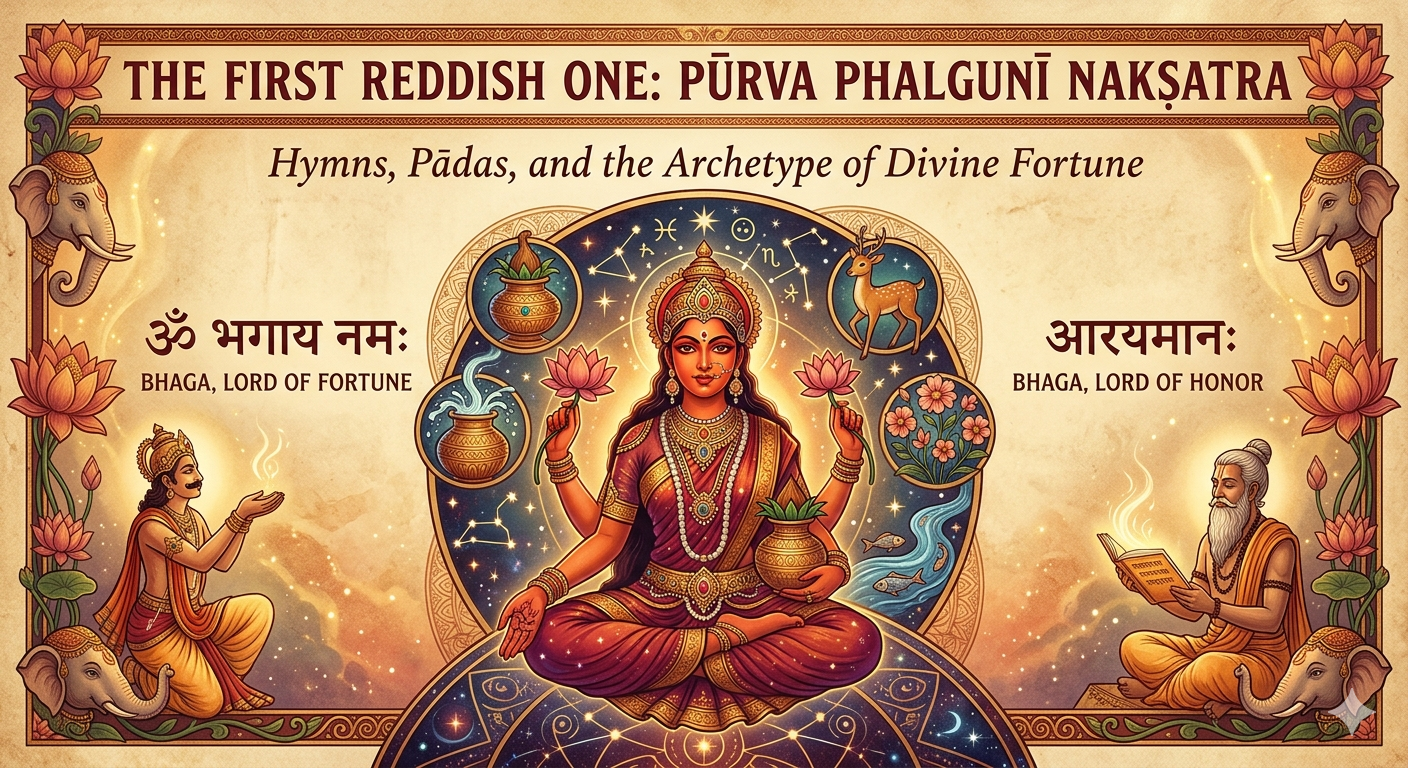
Pūrva Phalgunī Nakṣatra
Personality Archetypes · Celebrated Natives · Classical Text Synthesis
Śayyāsukhapradā devī kāmakrīḍāviśāradā ||”
The goddess grants the comfort of the bed and is most skilled in love’s sacred play.”
I. Introduction — The Reclining Goddess of Fortune
In the grand procession of the twenty-seven Nakṣatras that girdle the celestial sphere, Pūrva Phalgunī occupies the eleventh position — stationed in the heart of the royal sign Siṁha (Leo), spanning from 13°20′ to 26°40′ of the sidereal zodiac. She follows the mighty Maghā, the throne of the Pitṛs, and together with her twin Uttara Phalgunī she forms one of the three celebrated Nakṣatra pairs of the Vedic firmament.
The very name encodes her essence. Pūrva means “the former” or “the earlier one.” Phalgunī derives from the Sanskrit root phalguna — meaning “reddish,” “fruitful,” or “the fruit of the tree.” Together they declare: “The First Reddish One” — radiant as the pre-dawn sky, rich as ripe fruit hanging on the cosmic fig tree that is also her botanical symbol.
Her primary symbol — the front legs of a bed, or a swinging hammock — is not mere indolence. In the Vedic cosmological framework, the śayyā (bed) is the sacred space of union, restoration, dream, and creative gestation. While Maghā sits upon the throne of ancestors, Pūrva Phalgunī reclines upon the bed of living pleasure — the deliberate pause between the king’s duty and the world’s joy.
| Sanskrit Name | पूर्व फाल्गुनी (Pūrva Phalgunī) |
| Number | 11th of the 27 Nakṣatras |
| Zodiacal Span | 13°20′ – 26°40′ Leo (Siṁha Rāśi) |
| Stars (Modern) | δ Leonis (Zosma) & θ Leonis (Chertan) |
| Presiding Deity | Bhaga — Âditya of Fortune & Marital Bliss |
| Ruling Planet | Śukra (Venus) |
| Symbol | Front legs of a bed; Swinging hammock; Fig tree (Udumbara) |
| Guna / Quality | Rajas (Passionate, creative, desire-driven) |
| Caste (Varṇa) | Brāhmaṇa |
| Gender | Female (Strī) |
| Gana | Manuṣya (Human) |
| Animal (Yoni) | Female Rat (Mūṣikā) |
| Motivation (Puruṣārtha) | Kāma (Desire, Love, Aesthetic Fulfilment) |
| Deity in Trimurti | Viṣṇu (the Sustainer) |
| Classical Name | Yoni Nakṣatra; Bhagodaya Nakṣatra |
| Auspicious For | Marriage, arts, celebrations, property, luxury, creative launches |
II. Bhaga — The Luminous Lord of Fortune
The presiding deity of Pūrva Phalgunī is Bhaga — one of the twelve Âdityas, the solar sons of the cosmic mother Aditi. In the Vedic pantheon, Bhaga is the personification of bhāgya — fortune, share, portion, prosperity — and it is from his very name that the Sanskrit language draws its most sacred vocabulary: Bhagavān (the blessed one), bhāgya (fate, fortune), bhaga (divine grace). To name God “Bhagavān” is to invoke Bhaga’s essence — the one who possesses all divine portions.
Bhaga is described in the Nirukta (5th–6th century BCE) as the god of the morning — the divine illuminator who arrives at dawn to dispense fortune to all who wake with pure intention. The Ṛgveda associates him with the Dawn goddess Uṣas as her elder brother (RV 1.123), and his eye — by which he sees all fortune — is adorned with solar rays (RV 1.136). In Purāṇic mythology, Bhaga lost his eyes during Dakṣa’s doomed sacrifice when &346;iva’s fury swept the assembly — an esoteric teaching that divine grace cannot be grasped through ego: it must be received with humble, open eyes.
|
“We will invoke strong, early-conquering Bhaga, the Son of Aditi, the great supporter: Thinking of whom, the poor, yea, even the mighty, even the King himself says, ‘Give me Bhaga.’”
— Ṛgveda 7.41.2 (Bhāgya Sūktam, trans. Griffith)
|
III. The Sacred Hymns — Bhaga in All Four Vedas
Few Vedic deities are so consistently woven through all layers of scriptural transmission as Bhaga. His presence spans the Ṛgvedic morning hymns, the Atharvavedic marriage liturgy, the Yajurvedic ritual invocations, and the Sāmavedic chants. Below is a comprehensive survey of every major hymnic context in which Bhaga appears.
A. The Ṛgveda — The Primary Testimony
|
ṚGVEDA 7.41 — BHĀGYA SŪKTAM (The Hymn of Fortune)
Ṛṣi: Vasiṣṭha Maitrāvaruṇi · Devatā: Bhaga & Dawn deities · Chandas: Mixed
|
|
Verse 1: “Agni at dawn, and Indra we invoke at dawn, and Varuṇa and Mitra, and the Aśvins twain. Bhaga at dawn, Pūṣan, and Brahmaṇaspati, Soma at dawn, Rudra we will invoke at dawn.” Verse 2: “We will invoke strong, early-conquering Bhaga, the Son of Aditi, the great supporter: Thinking of whom, the poor, yea, even the mighty, even the King himself says, Give me Bhaga.” Verse 3: “Bhaga our guide, Bhaga whose gifts are faithful, favour this song, and give us wealth, O Bhaga. Bhaga, augment our store of kine and horses, Bhaga, may we be rich in men and heroes.” Verse 4: “So may felicity be ours at present, and when the day approaches, and at noontide; And may we still, O Bounteous One, at sunset be happy in the Deities’ loving-kindness.” Verse 5: “May Bhaga verily be bliss-bestower, and through him, Gods! may happiness attend us. As such, O Bhaga, all with might invoke thee: as such be thou our Champion here, O Bhaga.” Verse 6: “To this our worship may all Dawns incline them … As strong steeds draw a chariot may they bring us hitherward Bhaga who discovers treasure.” Verse 7: “May blessed Mornings dawn on us for ever, with wealth of kine, of horses, and of heroes, Streaming with all abundance, pouring fatness. Preserve us evermore, ye Gods, with blessings.” |
|
✦ Scholarly Summary
The Bhāgya Sūktam is a morning prayer (Prātaḥ Sūktam) structured as a cascade of invocations at three watch-points of day — dawn, noon, and sunset — mirroring the Nakṣatra’s theme of sustained, graceful enjoyment across life’s arc. The hymn crucially establishes that everyone — from the destitute to the king — ultimately seeks Bhaga’s grace. Verse 5 contains the earliest Vedic occurrence of Bhagavantāḥ — the word later used exclusively for God-in-the-fullest-sense. This Sūktam is also recited as part of Udaka Śānti (water consecration) in South Indian Brahmin ritual.
|
|
ṚGVEDA 2.27 — HYMN TO THE ÂDITYAS (Bhaga among the Solar Council)
Ṛṣi: Gṛtsamada · Devatā: Âdityas · Chandas: Triṣṭubh
|
|
Verse 1: “These hymns that drop down fatness, with the ladle I ever offer to the Kings Âdityas. May Mitra, Aryaman, and Bhaga hear us, the mighty Varuṇa, Dakṣa, and Aṁśa.” Verse 3: “These Gods, Âdityas, vast, profound, and faithful, with many eyes, fain to deceive the wicked, Looking within, behold the good and evil — near to the Kings is even the thing most distant.” Verse 4: “Upholding that which moves and that which moves not, Âdityas, Gods, protectors of all being, Provident, guarding well the world of spirits, true to eternal Law, the debt-exactors.” |
|
✦ Scholarly Summary
Here Bhaga is positioned within the cosmic council of Âdityas. His inclusion alongside Mitra (friendship) and Aryaman (nobility of relationship) is deliberate: these three form the “social Âdityas” who govern the bonds between human beings — exactly the domain over which Pūrva Phalgunī presides. The Âdityas who “behold the good and evil” from afar encodes the ethical dimension: fortune is distributed according to moral alignment with cosmic law.
|
|
ṚGVEDA 10.85 — SŪRYĀ’S WEDDING HYMN (Bhaga as Marriage Consecrator)
Ṛṣi: Sūryā Sāvitrī · Devatā: Sūryā, Soma, Âdityas · Chandas: Triṣṭubh & Anuṣṭubh
|
|
Verse 23: “Straight in direction be the paths, and thornless, whereon our fellows travel to the wooing. Let Aryaman and Bhaga lead us: perfect, O Gods, the union of the wife and husband.” Verse 36: “I take thy hand in mine for happy fortune that thou mayst reach old age with me thy husband. Gods, Aryaman, Bhaga, Savitar, Purandhi — have given thee to be my household’s mistress.” |
|
✦ Scholarly Summary
The Sūryā Vivāha Sūkta is the oldest wedding liturgy in human history. Within this epic hymn — narrating the cosmic marriage of Sūryā (daughter of the Sun) to Soma (Moon) — Bhaga appears as one of the four divine witnesses who give the bride to the groom and sanctify the marital path. Verse 23 is still recited in Vedic Hindu marriages today. Verse 36 — the taking of the bride’s hand (pāṇigrahaṇa) — explicitly cites Bhaga as the divine bestower who arranged the union from above. This is the scriptural root of Pūrva Phalgunī’s role as the supreme Nakṣatra of marriage.
|
|
ṚGVEDA 5.46 & 3.20 — BHAGA AS COSMIC PEER AND PRINCIPLE
|
|
RV 5.46 — The Double Bhaga: The text exhibits deliberate wordplay: “tathā bhaga bhajāmahi” — “Thus, O Bhaga, may we partake of bhaga.” The deity’s name and the common noun for “fortune, share, portion” are identical. The god and his gift are not separate: the mortal who embodies fortune becomes a living avatar of this Âditya. RV 3.20.4: “Agni, like Bhaga, leads the godly people, he who is true to Law and guards the seasons. Ancient, all-knowing, he the Vṛtra-slayer shall bear the singer safe through every trouble.” Also RV 1.123 (Dawn is Bhaga’s sister) and RV 1.136 (Bhaga’s eye adorned with solar rays). |
|
✦ Scholarly Summary
RV 5.46 reveals the non-dual dimension: Bhaga is the very quality of fortune as cosmic principle, not merely a god who gives it. RV 3.20 shows Bhaga is not passive — he leads the righteous, actively guiding those on the path of Ṛta. This active quality explains the Pūrva Phalgunī native’s surprising capacity for leadership behind the apparent ease and luxury.
|
B. The Atharvaveda — Bhaga in Marriage and Life Ritual
|
ATHARVAVEDA 14.1 & 14.2 — THE BRIDAL HYMNS (Kalyāṇārtha Prārthaṇā Sūktam)
Book of Marriage — the most extensive ritual deployment of Bhaga in the entire Vedic corpus
|
|
AV 14.1.20: “Let Bhaga lead thee hence, grasping thy hand; let the Aśvins carry thee forth by chariot; go to the houses, that thou mayest be housewife — thou, having control, shalt speak unto the council.” AV 14.1.50: “I grasp thy hand in order to good-fortune, that with me as husband thou mayest be long-lived; Bhaga, Aryaman, Savitar, Purandhi — the gods have given thee to me in order to housewifeship.” AV 14.2.13: “Propitious hath this woman come to the home; Dhātar appointed this world to her; her let Aryaman, Bhaga, both Aśvins, Prajāpati, increase with progeny.” AV 14.2.15 & 21 (refrain): “O Sinīvālī, let her bear children, and live in Bhaga’s grace.” (Repeated throughout as the wedding blessing.) |
|
✦ Scholarly Summary
The Atharvavedic Bridal Sūktas are hymns actively performed during marriage rites, and Bhaga appears as the divine official who formally hands the bride to the groom, leads her from her father’s house by the hand, and guards the threshold of the new home. The repeated refrain “live in Bhaga’s grace” (Bhaga-subhage) became the prototype for all subsequent South Asian wedding blessings, confirming Pūrva Phalgunī’s supreme position as the Nakṣatra of marriage.
|
|
ATHARVAVEDA 2.36 — FINDING A HUSBAND (Bhāga and the Suitor Hymn)
|
|
AV 2.36.1: “Unto our favor, O Agni, may a wooer come to this girl, along with our fortune (bhāga). Enjoyable is she to suitors, agreeable at festivals; be there quickly good-fortune for her with a husband.” AV 2.36.3: “May this woman, O Agni, find a husband; for king Soma maketh her of good-fortune; giving birth to sons, she shall become chief consort; having gone to a husband, let her, having good-fortune, bear rule.” |
|
✦ Scholarly Summary
This hymn is performed on behalf of an unmarried woman, ritually invoking Bhaga’s grace to attract a worthy husband. Remarkably, it concludes with the blessing that the woman shall “bear rule” — a subtle assertion of feminine sovereignty within the marital home, perfectly resonant with the Pūrva Phalgunī woman’s archetype: charming yet commanding, soft yet self-possessed.
|
C. The Yajurveda — Bhaga in Sacrificial and Sanctification Ritual
|
TAITTIRĪYA BRĀHMAṇA (Krishna Yajurveda) — Udaka Śānti & Nakṣatra Invocations
|
|
The Bhāgya Sūktam (RV 7.41) is formally incorporated into the Taittirīya Brāhmaṇa of the Krishna Yajurveda as part of the Udaka Śānti — the sanctification of water ceremony performed before weddings and festivals. The water itself becomes a vehicle of Bhaga’s fortune, charged by the mantras and distributed to all participants as divine grace made tangible. The Taittirīya Brāhmaṇa (TB 3.1.48) also contains the explicit statement: “the Phalgunīs have Bhaga and Aryaman as their regents” — a formal cosmological annotation anchoring Vedic Nakṣatra science to these deities with direct textual authority. |
|
✦ Scholarly Summary
The Yajurvedic transmission of Bhaga’s hymns into ritual action reflects a profound Vedic theology: fortune is not merely petitioned from a distant deity but is physically transmitted through sanctified substance. The Udaka Śānti, charged with the Bhāgya Sūktam, is poured over the newly married — blessing them literally with Bhaga’s grace made material. This gives the Pūrva Phalgunī native a deep instinct for embodied luxury: beauty, pleasure, and prosperity experienced as sacred, physical gifts.
|
IV. Classical Jyotiṣa Texts — What the Masters Said
| Classical Text | Key Traits Attributed to Pūrva Phalgunī Natives |
| Vasiṣṭha / Vedāṅga Jyotiṣa | Bhaga-presided; auspicious for marriage, creative activity, pleasure-seeking |
| Varāhamihira (Bṛhat Saṁhitā) | Priyavāk (sweet speech), dātā (charitable), dyutimān (resplendent), aṭano (fond of travelling), nṛpa-sevaka (royal servant) |
| Phaladeepikā (Mantreśvara) | Attractive, well-mannered; successful through partnerships and diplomacy; must avoid over-indulgence |
| Horāsāra (Pṛthuyaśas) | Affable speaker, charitable, anxious, high expenditure, obedient servants, famous, dear to the king, shy away from war |
| Hora Ratnam | Dhyutimān (resplendent), aṭano (wanderer), dātā (charitable), nṛtya-śāstra-viśāradā (adept in dance & arts), kārya-akārya-vicārajño (acts after careful evaluation), paṭu (skillful) |
| Saravalī (Kalyāṇavarman) | Intelligent, loving, magnetic personality; drawn to comfort and luxury; seeks pleasure as a natural right |
| BPHS (Parāśara) | Cheerful, kind, affectionate; enjoys luxury, art, music, and sensual pleasures; natural creative inclination |
| Jātaka Pārijāta | Leadership through charm rather than force; gains through royal or governmental patronage; creative arts as livelihood |
V. The Four Pādas — A Journey from Solar Fire to Scorpionic Depth
The four pādas of Pūrva Phalgunī all fall within Leo (Siṁha Rāśi), yet their navāṁśa rulers — Sun, Mercury, Venus, Mars — create a fascinating progression: from pure blazing creative self-expression (Pāda 1) through disciplined artisanship (Pāda 2) to double Venusian sensuality (Pāda 3) and finally to passionate, emotionally complex depth (Pāda 4).
|
PĀDA 1 — 13°20′ to 16°40′ Leo
Navāṁśa: Leo (Siṁha) · Ruler: Sūrya (Sun) · Vargottama Position ✦
This is Pūrva Phalgunī at its most magnificent and undiluted. The sign and navāṁśa both being Leo creates a Vargottama placement — the Leo qualities amplify to their purest expression. The Sun-ruled quarter brings radiant confidence, natural leadership, and an almost theatrical flair for self-presentation. These natives are born performers in the fullest sense — not because they are artificial, but because their authentic self is luminous enough to command an audience. Personality Signature: Regal bearing, warm generosity, fiercely creative, deeply proud. They educate and inspire others, carrying the Sun’s mission of illumination. Shadow: Ego inflation, the need for constant admiration, creative jealousy, difficulty sharing the spotlight. Best Planets Here: Sun (maximum creative authority), Venus (luminous artistry), Jupiter (philosopher-king energy). Mars becomes combative; Saturn feels deeply uncomfortable. |
|
PĀDA 2 — 16°40′ to 20°00′ Leo
Navāṁśa: Virgo (Kanyā) · Ruler: Budha (Mercury)
Venus’s pleasure meets Mercury’s discrimination — the result is refined artisanship. These natives create not from raw impulse but from disciplined craft. Their pleasure comes through getting it right: the perfect melody, the precisely worded phrase, the flawlessly executed performance. Personality Signature: Hardworking, commercially astute, detail-oriented within creative fields. They excel in trade, particularly of beautiful or luxury goods. Shadow: Critical perfectionism that paralyzes action, over-analyzing pleasure away, losing spontaneity in technique. Best Planets Here: Mercury (maximum precision), Venus (discerning artistry), Saturn (disciplined creativity). Moon can become overly critical here. |
|
PĀDA 3 — 20°00′ to 23°20′ Leo
Navāṁśa: Libra (Tulā) · Ruler: Śukra (Venus) · Double Venus Influence
This is Venus squared — the nakṣatra ruler (Venus) and the navāṁśa ruler (Venus) align to create the most intensely Venusian quarter of the entire zodiac. Peace, beauty, partnership, sensory pleasure — all reach their zenith here. These natives possess an almost magical capacity for attracting comfort, beauty, and harmonious relationships. Personality Signature: Supremely charming, relationship-focused, aesthetically gifted, peace-loving. The diplomats of the zodiac — Bhaga’s grace made interpersonal. Shadow: Indolence, excessive attachment to comfort, avoidance of necessary conflict. Best Planets Here: Venus (its strongest possible quarter placement), Moon (emotional beauty), Jupiter (wisdom through relationship). Mars and Saturn feel most restricted here. |
|
PĀDA 4 — 23°20′ to 26°40′ Leo
Navāṁśa: Scorpio (Vṛścika) · Ruler: Maṅgala (Mars)
The final pāda plunges Venus’s pleasures into Scorpio’s underworld — the hammock tilts into emotional depth, passionate intensity, and transformational desire. These natives are the least “relaxed” of the four quarters. Their creative drive is urgent, sometimes obsessive. Artists born here often produce work that is beautiful on the surface but disturbing in its depth. Personality Signature: Intensely emotional, courageous, family-oriented, introspective. Mars gives them the capacity to protect what they love with surprising ferocity. Shadow: Jealousy, possessiveness, emotional turbulence, tendency to transform pleasure into obsession. Best Planets Here: Mars (maximum transformational courage), Ketu (spiritual detachment balances intensity). Sun feels challenged; Venus must navigate Scorpio’s scrutinizing gaze carefully. |
| Quality | Pāda 1 Sun–Leo | Pāda 2 Mercury–Virgo | Pāda 3 Venus–Libra | Pāda 4 Mars–Scorpio |
| Core Drive | Recognition | Perfection | Harmony | Intensity |
| Creative Mode | Performative | Technical craft | Relational beauty | Transformative art |
| Social Style | Centre-stage | Discerning | Diplomatic | Selective, intense |
| Relationship | Generous, proud | Critical, devoted | Romantic, harmonious | Passionate, possessive |
| Vargottama | ✦ YES | No | No | No |
| Career Apex | Entertainment, teaching, leadership | Commerce, fine arts, medicine | Music, dance, diplomacy | Psychology, occult arts |
VI. The Pūrva Phalgunī Personality — A Complete Portrait
At the heart of every Pūrva Phalgunī native pulses a singular truth: they were born to enjoy. But this is not the petty enjoyment of the undeveloped soul — it is the royal enjoyment of one who understands that beauty is a form of dharma, that pleasure — properly received — is a form of worship, and that generosity is the most natural expression of abundance.
Core Strengths
| Trait | Expression |
| Magnetic Charm | Effortlessly draws people, opportunities, and resources — Bhaga’s dispensation made personal |
| Creative Radiance | Deep aesthetic intelligence — arts, music, performance, design, literature; often a natural genius |
| Sweet Speech (Priyavāk) | Gift for words — oratory, poetry, negotiation; the voice that soothes, persuades, and enchants |
| Generosity (Dātā) | Naturally philanthropic — gives freely of time, money, affection, knowledge. Never truly poor in spirit |
| Joie de Vivre | Inherent delight in existence — they make those around them feel that life is fundamentally worth living |
| Partnership Wisdom | Bhaga as marriage-god: deep understanding of relationship dynamics; loyal, romantic, committed |
| Deliberate Action | Hora Ratnam’s kārya-akārya-vicārajño — they evaluate before they act; wisdom beneath the ease |
| Wanderlust | Love of travel, new cultures, sensory variety — the hammock that swings across the world’s geography |
Shadow Tendencies
| Shadow Trait | Discover more from MokshatrikonaSubscribe to get the latest posts sent to your email. |
Leave a Reply