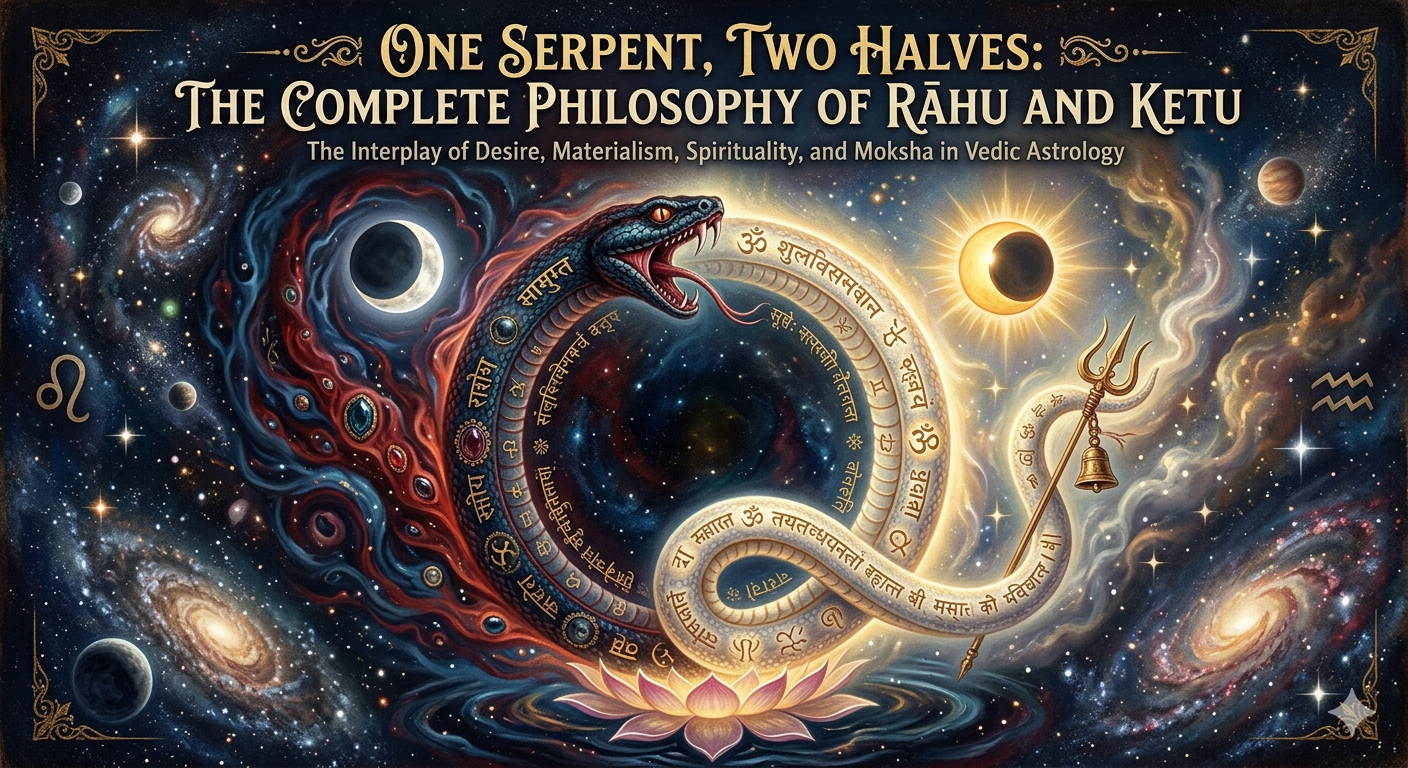
Rāhu & Ketu: The Complete Philosophical Portrait
Distilled from the 108 Sacred Names of Each Node — The Ashtottara Śatanāmāvalī
In the Vedic tradition, the 108 names of a deity are never arbitrary. They constitute a complete philosophical portrait — a 360-degree description of a cosmic principle built from its own essential qualities. Each name is a facet. Taken together, the 108 names of Rāhu and Ketu reveal two of the most misunderstood, most feared, and most transformative forces in all of Jyotiṣa.
What follows is a complete analysis of every name in both Ashtottara Śatanāmāvalīs — what each name means, the philosophy it encodes, and the unified portrait that emerges when all 108 are heard as one voice.
Part One: Rāhu — The 108 Names & Their Philosophy
The 108 names of Rāhu naturally cluster into philosophical groups. Below, each name is given with its Sanskrit meaning and the deeper principle it encodes.
Group 1 — Origin & Primordial Identity (Names 1–9)
| # | Sanskrit Name | Meaning | Philosophical Significance |
|---|---|---|---|
| 1 | Rāhave | The Seizer, the Grasper | From root rah — to catch, to eclipse. He is pure grasping energy in personified form. |
| 2 | Saiṁhikeyāya | Son of Siṁhikā (the demoness) | Born of the lineage of primal, unrefined desire. His mother is the source of his nature. |
| 3 | Vidhuntudāya | He who strikes the Moon | The eternal aggressor against Chandra — the mind. He attacks mental peace by design. |
| 4 | Suraśatrave | Enemy of the Devas | The structural adversary of divine order — not personal malice, but cosmic opposition to the established hierarchy. |
| 5 | Tamasē | Darkness itself — Tamas personified | Not merely associated with darkness — he is the guṇa of inertia and ignorance made conscious. |
| 6 | Phaṇinē | The Serpent, the Hooded One | Snake energy: coiled potential, sudden strike, hypnotic stillness. The Nāga principle. |
| 7 | Gārgyāyaṇāya | Descendant of the Gārgya lineage | Paradoxically linked to the Brahminical Gārgya gotra. The demon carries Ṛṣi bloodlines. |
| 8 | Surāgavē | Who has a form like a Deva | He appears divine. His disguise is his greatest power — he is the principle of illusion within ambition. |
| 9 | Nīlajīmūtasaṅkāśāya | Dark as a rain-cloud | The monsoon cloud: pregnant with transformation, threatening and necessary both. His darkness precedes rain. |
Group 2 — The Armed & Paradoxical Nature (Names 10–27)
| # | Sanskrit Name | Meaning | Philosophical Significance |
|---|---|---|---|
| 10 | Caturbhujāya | Four-armed | Four arms signal cosmic agency — the same iconography as a major deity. Rāhu is no lesser being. |
| 11 | Khaḍgakhēṭakadhāriṇē | Bearer of sword and shield | Aggressive and defensive simultaneously. A complete war-stance: he attacks and protects at once. |
| 12 | Varadāyakahastakāya | Whose hand grants boons | The same hand that seizes also bestows. The grasper is also the giver — Rāhu’s fundamental duality. |
| 17 | Tīkṣṇadaṁṣṭradharāya | Bearer of sharp fangs | His speech and his contact both pierce. What he says cuts; what he touches changes. |
| 18 | Śūrpākārāsanasthāya | Seated on a winnowing basket | The winnowing basket separates grain from chaff. His very seat is the instrument of cosmic discrimination. |
| 21 | Kaśyaparṣinandanāya | Beloved son of Ṛṣi Kaśyapa | Kaśyapa is the primordial progenitor of both Devas and Asuras. Rāhu’s divine parentage is fully confirmed. |
| 25 | Nidhipāya | Guardian of Treasure | Hidden beneath the darkness lies immense wealth. He guards what others cannot see or reach. |
| 27 | Viṣajvalāvṛtāsyāya | Face surrounded by flames of poison | What he speaks and consumes is toxic to ordinary existence. His very breath transforms the environment around him. |
Group 3 — The Half-Body, Shadow & Counter-Movement (Names 28–54)
| # | Sanskrit Name | Meaning | Philosophical Significance |
|---|---|---|---|
| 28 | Ardhaśarīrāya | Of half-body | The most philosophically significant name. He is only a head — eyes to covet, mouth to consume, brain to obsess. No stomach to digest, no heart to feel. Infinite wanting, zero satisfaction. This is the precise metaphysics of worldly desire itself. |
| 31 | Chāyāsvarūpiṇē | Whose form is shadow | Not the object — its shadow. Not the cause — its absence. The chhāyā graha: known only by what he obscures. |
| 43 | Cāṇḍālavarṇāya | Of the complexion of the outcaste (Caṇḍāla) | Most socially transgressive name. He belongs to no varṇa, no lineage, no cosmic order. He is the power of the excluded. History proves repeatedly: transformation arrives from the margins. |
| 48 | Apasavyagatayē | Who moves counter-clockwise | Retrograde. Against the cosmic order. The apasavya direction is anti-Dharmic ritual motion. He perpetually undoes what is done — the evolutionary pressure that prevents stagnation. |
| 52 | Grahaśrēṣṭhāya | Foremost among the planets | Despite being a shadow planet, he is named supreme among the grahas. His intensity exceeds all others. |
| 54 | Kabandhamātradēhāya | Whose existence is the truncated, severed body | His existence is definitionally incomplete. Not accidental — structural. He will always be incomplete, and that incompleteness is his power. |
Group 4 — The Paradoxes & House Results (Names 55–90)
| # | Sanskrit Name | Meaning | Philosophical Significance |
|---|---|---|---|
| 56 | Gōvindavarapātrāya | Recipient of Govinda’s (Viṣṇu’s) boon | Viṣṇu blessed the enemy of the gods. The paradox is complete: the preserver of the cosmos conferred grace on the one who disrupts it. |
| 57 | Dēvajātipraviṣṭakāya | Who entered the race of the Devas | He successfully infiltrated divinity. He sat among the gods and was not detected until it was too late. The master of disguise and assimilation. |
| 63 | Mānē gaṅgāsnānadātrē | Giver of the merit of bathing in the Gaṅgā | In the 3rd house, Rāhu gives the highest purificatory merit. A dark, malefic planet giving sacred purification — the tradition will not let you reduce him to simple malefic. |
| 80 | Ṣaṣṭhē vittadātrē | In the 6th house, giver of wealth | The 6th is his favourite house. He destroys enemies, accumulates resources, and dominates competition when placed here. |
| 84–85 | Ādau yaśaḥ pradātrē / Antē vairapradāyakāya | At the beginning gives fame; at the end gives enmity | The arc of Rāhu’s dasha in two names: rise → accumulation → overreach → enmity. He is the planet whose gift contains its own undoing. |
| 86 | Kālātmanē | Whose soul is Time itself | He is not in time — he is a face of Kāla. His eclipse is not an event in time; it is Time itself asserting its sovereignty over the luminaries. |
Group 5 — The Final Revelation (Names 91–108)
| # | Sanskrit Name | Meaning | Philosophical Significance |
|---|---|---|---|
| 94 | Śāśvatāya | The Eternal One | Rāhu does not die. He drank the amṛta. He is immortal — and immortally unsatisfied. His hunger will never end because he cannot end. |
| 104 | Dēvāya | The God | He is a Deva. His divinity is affirmed at name 104. |
| 105 | Dānavāya | The Demon | He is also a Dānava. Names 104 and 105 are placed back to back intentionally. He is both God and Demon simultaneously — the duality dissolves in him. |
| 106 | Bhaktarakṣāya | Protector of devotees | The terrifier becomes the guardian. Those who worship him are shielded by the very force that terrifies others. |
| 108 | Sarvābhīṣṭaphalapradāya | Giver of all desired fruits | The final name of the entire 108: the dark malefic serpent is the granter of all wishes. Rāhu understands desire better than any cosmic force — because he is desire. Therefore, he can grant it completely. |
✦ The Distilled Essence of Rāhu
Rāhu is the immortal hunger — the principle that desire, when fully inhabited and understood rather than merely indulged or suppressed, becomes the most powerful transformative force in existence. He is the shadow that falls when consciousness meets the material world and forgets itself. He makes you want. He makes you chase. He makes you suffer. And somewhere in that very suffering, if you do not run, you find what you actually are.
Part Two: Ketu — The 108 Names & Their Philosophy
Ketu’s 108 names speak an entirely different language. Where Rāhu’s names are about consuming and desiring, Ketu’s names are about burning and releasing. His key image is not the open mouth — it is the comet-tail burning as it falls through the sky.
Group 1 — Form, Origin & The Fierce Nature (Names 1–25)
| # | Sanskrit Name | Meaning | Philosophical Significance |
|---|---|---|---|
| 1 | Ketave | The Banner, the Comet, the Tail | Ketu means flag, ensign, comet. He marks the sky as a signal — his very name is a warning and a calling simultaneously. |
| 4 | Dhvajākṛtayē | Shaped like a banner/flag | A comet is a banner dragged across the sky. His form is literally that of a comet-tail — a streaming pennant that leaves a mark, then vanishes. |
| 5 | Navagrahayutāya | United with all nine planets | Ketu influences every graha. No planet escapes his karmic imprint. He is the background karmic frequency underlying all planetary manifestation. |
| 8 | Citravarṇāya | Of variegated, spotted colour | Multi-coloured, never uniform. Unlike Rāhu who is consistently dark, Ketu shifts and changes. He cannot be pinned to a single frequency. |
| 13 | Cārunetrāya | Of beautiful eyes | The fearful planet has enchanting eyes. He is beautiful in his terror. This paradox runs through Ketu’s entire namāvalī. |
| 19 | Vaiḍūryābharaṇāya | Adorned with cat’s eye gem (Vaiḍūrya) | His gem glows from within — light caught inside stone, never fully expressed on the surface. His gifts are always interior, always hidden. |
| 25 | Antarvedīśvarāya | Lord of the inner sacred space | Antarvedi is the sacred altar between two rivers. Ketu is lord of the inner sanctum — the innermost altar of consciousness where no external authority has jurisdiction. |
Group 2 — Lineage, The Karmic Record & The Citragupta Soul (Names 26–42)
| # | Sanskrit Name | Meaning | Philosophical Significance |
|---|---|---|---|
| 26 | Jaiminigōtrajāya | Born of the Jaimini gotra | Extraordinary name. The Jaimini gotra is the lineage of the great sage who codified Pūrva Mīmāṁsā — the rigorous philosophical inquiry into karma and ritual action. Ketu is philosophically grounded in the most demanding school of karmic analysis. |
| 27 | Citraguptātmanē | Whose soul is Citragupta | The most revelatory name in the entire Ketu namāvalī. Citragupta is Yama’s celestial accountant — the recorder of every karma ever performed. Ketu’s very soul is the karmic ledger. He brings the precise, exhaustive, inescapable fruits of past action — not arbitrarily but with perfect cosmic accounting. |
| 29 | Mukundavarapātrāya | Recipient of Viṣṇu’s boon | As with Rāhu, Viṣṇu blessed both halves of Svarbhānu. Even the severed body received divine benediction. The Lord did not abandon what he cut. |
| 33 | Mṛtyuputrāya | Son of Death (Mṛtyu) | Born of the death-principle. He does not carry death as a punishment — it is his inheritance. He is the face of transition itself, formalized as lineage. |
| 34 | Utpātarūpadhāriṇē | Who takes the form of calamity | He does not merely cause calamity — he becomes it. The disruption and Ketu are one and the same event. |
| 41 | Analāya | Fire itself | Not like fire — he is fire. Specifically the fire of jñāna: knowledge-fire that burns ignorance. His destruction is always purification at a deeper layer. |
Group 3 — The Liberation Names & The Nirguṇa Revelation (Names 55–72)
| # | Sanskrit Name | Meaning | Philosophical Significance |
|---|---|---|---|
| 55 | Mōkṣadāya | Giver of liberation (Mōkṣa) | His supreme and defining gift: freedom from the cycle of rebirth. This name appears twice in the namāvalī — the tradition emphasises it above all else. |
| 59 | Vairāgyavardhanāya | Increaser of dispassion/renunciation | His primary psychological gift is detachment. Where Rāhu increases wanting, Ketu increases the capacity to let go. They are mirror operations. |
| 63 | Nirguṇāya | Beyond the three guṇas | The philosophical climax of the namāvalī. Nirguṇa — beyond Sattva, Rajas, and Tamas — is the exact term used in Advaita Vedānta for Brahman the Absolute. The planet associated with pain and obscuration shares the name of the Supreme Reality. |
| 64 | Nirvikalpāya | Without differentiation or ideation | Beyond thought-categories. He cannot be conceived through the ordinary mind — only approached through direct experience after the conceptual mind falls silent. |
| 65 | Niranjanāya | Unstained, absolutely spotless | Despite being called a pāpa graha, he is fundamentally unstained. His darkness is not impurity — it is the darkness of transcendence, the darkness beyond light itself. |
| 62 | Tapōmayāya | Consisting entirely of austerity | His body is made of tapas. The decapitation was not merely punishment — it was the ultimate austerity: to be severed from the ego-head, to exist as pure function without agenda. |
Group 4 — Immortality, the Crystal Nature & The Triple Protector (Names 74–108)
| # | Sanskrit Name | Meaning | Philosophical Significance |
|---|---|---|---|
| 51 | Sphāṭikakarāya | Made of/associated with crystal (Sphāṭika) | The crystal revelation. Crystal has no colour of its own — it reflects the light that falls on it. Ketu at his deepest level is pure reflection: he shows you what you have brought from past lives with crystalline accuracy. |
| 74 | Sudhāpāyinē | Drinker of Amṛta (the immortality nectar) | He drank it. The root event. Unlike most beings who never tasted the nectar, Ketu (as half of Svarbhānu) consumed immortality. His protection of devotees is therefore the protection of an immortal being. |
| 75 | Ajitāya | The Unconquered, the Invincible | Viṣṇu’s discus severed him but could not conquer him. He persists, immortal. The decapitation did not defeat him — it transformed him. |
| 70, 76, 85 | Bhaktārakṣakāya (×3) | Protector of devotees | The only name that appears three times in the entire namāvalī. No other attribute of Ketu is emphasised this way. More than his terror, more than his liberation-giving, his protection of those who surrender to him is what the tradition insists you remember above all else. |
| 87 | Vicitraphaladāyinē | Giver of strange, varied fruits | You cannot predict what Ketu will give. His results are vicitra — unique, unexpected, often bizarre — because he operates from beyond the guṇic matrix that governs all other planetary results. |
| 108 | Bhaktābhīṣṭaphalapradāya | Granter of all desired fruits to devotees | The final name: all of his terrifying, unpredictable power is placed entirely at the disposal of his devotees. Unlike Rāhu who grants wishes generally, Ketu grants everything — but only in a state of complete surrender. You cannot grasp results from Ketu. You must release. |
✦ The Distilled Essence of Ketu
Ketu is the sacred fire that burns away what you thought you were in order to reveal what you actually are. He is the immortal remnant — the part of you that has already passed through a thousand deaths and carries the distilled wisdom of every one of them. He gives grief, dissolution, and confusion not out of malice but out of surgical precision: he removes exactly what stands between you and liberation. And for those who let it burn, he gives the only thing worth having — freedom.
Part Three: The Rāhu–Ketu Axis — One Being, Two Halves
They are not two planets. They are two halves of one being — Svarbhānu, the solar-shining demon, cut across the middle by Viṣṇu’s Sudarśana Cakra at the precise moment he tasted immortality. The cut is the most important event in Jyotiṣa mythology.
Before the cut: one being, complete — both desiring and experiencing. After the cut: the desire is separated from the experience. The head (Rāhu) keeps the mouth and the wanting. The body (Ketu) keeps the accumulation and the wisdom. This is the human condition described cosmologically.
The Rāhu–Ketu Philosophical Contrast
| Dimension | Rāhu (The Head) | Ketu (The Body) |
|---|---|---|
| Form | Head only — mouth, eyes, brain. No stomach, no heart, no limbs. | Headless trunk — heart, spine, limbs. No ego-centre, no desiring mechanism. |
| Core Action | Consume, grasp, desire, obsess. Infinite wanting with zero satisfaction. | Burn, dissolve, release, detach. Action without personal agenda. |
| Colour | Dark, cloud-black, storm-blue. The darkness before rain. | Variegated, smoky, comet-coloured. The darkness after all fires go out. |
| Gem | Gomedha (Hessonite) — orange-red, fiery, externally vivid. | Vaiḍūrya (Cat’s Eye) — glows from within, light caught inside stone. |
| Key Alliances | Friend of Śani (karma-suffering) and Śukra (pleasure-desire). | Friend of Śani (karma) and Śukra (desire-release). The same allies, different relationship. |
| Greatest Gift | Sarvābhīṣṭaphalapradāya — all desired fruits. The granter of wishes. | Mōkṣadāya — liberation. Freedom from the cycle entirely. |
| Soul Nature | Kālātmanē — his soul is Time. | Citraguptātmanē — his soul is the Karmic Record. |
| House Direction | Points toward future experience — what you are reaching toward, what you must learn to desire wisely. | Points toward past mastery — where you over-performed in past lives, what you must now release. |
| How to Activate | Courage — step into the unfamiliar experience his house demands, even when it feels foreign and excessive. | Surrender — stop fighting the dissolution his house brings. What burns was already finished. |
| Highest Philosophical Description | Dēvāya / Dānavāya — simultaneously God and Demon. Beyond the duality itself. | Nirguṇa / Nirvikalpa / Nirañjana — beyond the three guṇas, beyond thought, unstained. Named as Brahman. |
✦ The Axis as One Cosmic Teaching ✦
We desire (Rāhu) what our past-life karma (Ketu) has prepared us to desire. We grasp (Rāhu) what we are simultaneously releasing (Ketu). The axis of the nodes runs through every horoscope — always cutting through two opposite houses, always re-enacting the primal severance.
Rāhu’s house is where you hunger, where you overreach — and where, because of that very excess, you receive unprecedented experiences that would never come to a cautious person.
Ketu’s house is where you have already been a thousand times — where things dissolve without your permission, where, if you allow it, the deepest spiritual mastery of your entire existence waits.
Together, Rāhu and Ketu are the Desire that leads to the Death that leads to Liberation.
They are the full arc of consciousness moving through matter —
grasping its way in (Rāhu), burning its way out (Ketu).
And in the space between those two movements: one human lifetime.
Sources: Rāhu Ashtottara Śatanāmāvalī & Ketu Ashtottara Śatanāmāvalī from classical Jyotiṣa tradition. Sanskrit meanings compiled from primary scripture. Philosophical analysis based on the Vedic astrological tradition. Published on mokshatrikona.com.
Leave a Reply