Ashtadasha Yoga
A Chapter-by-Chapter Practice Manual for the Bhagavad Gita
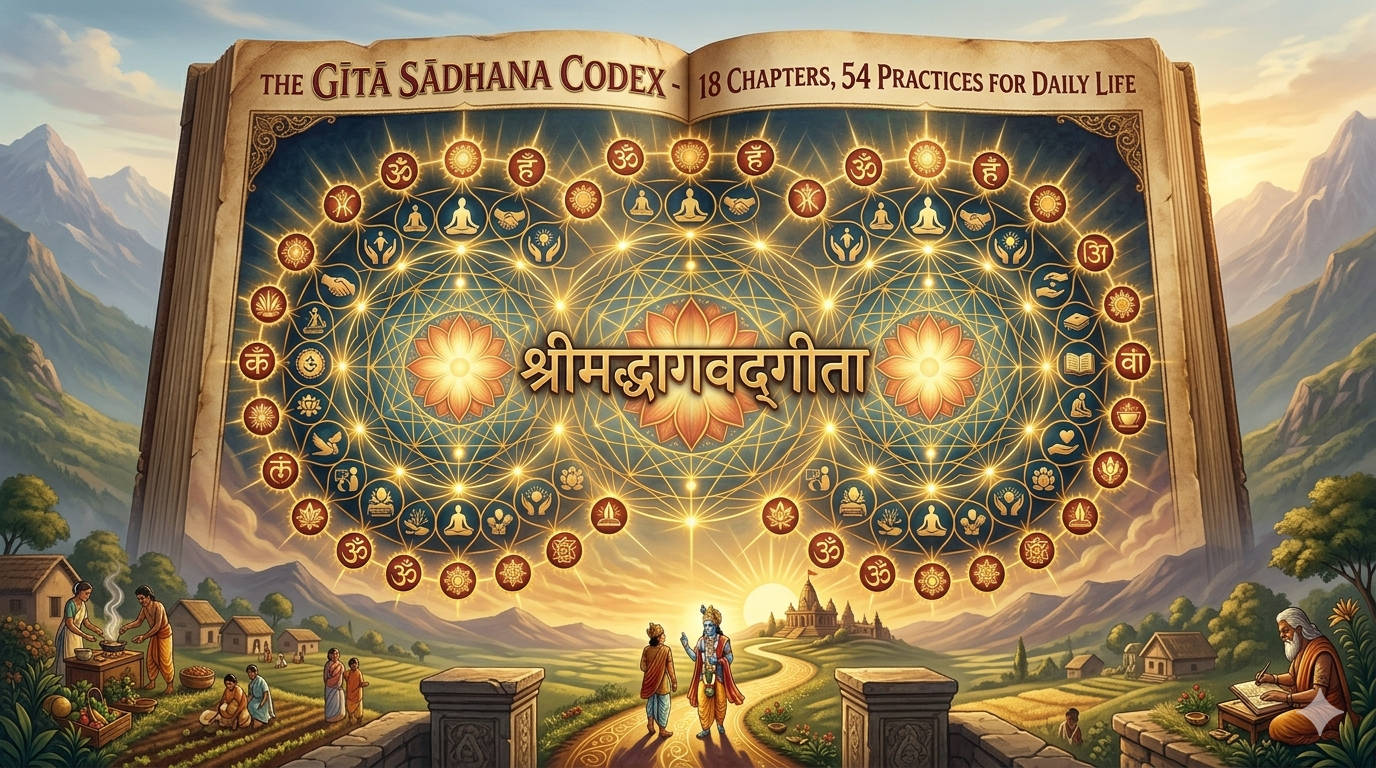
Each of the Gita’s eighteen chapters carries a distinct teaching and a distinct practice. The journey map below traces Arjuna’s emotional arc and Krishna’s teaching arc side by side, chapter by chapter — a single continuous transformation from collapse to resolve. Below that, every chapter is summarized in its essence, followed by three concrete formulas you can implement as daily ritual, self-audit, or remedy.
Contents
The Journey: Arjuna & Krishna Across 18 Chapters
A single continuous arc, read top to bottom — collapse to resolve, silence to surrender.
| # | Chapter | Essence | Arjuna’s Arc | Krishna’s Teaching Arc |
| 1 | Arjuna Vishada Yoga | Despair born of attachment paralyzes a warrior before the choice. | Collapses in grief and refuses to fight; will, weapons, and resolve all fail him. | Remains the silent witness, preparing to respond rather than react. |
| 2 | Sankhya Yoga | The eternal Self cannot grieve; act without claim to results. | Surrenders as a disciple; asks Krishna directly for guidance (2.7). | Teaches the immortal Self and the right to act without attachment to fruit. |
| 3 | Karma Yoga | Action is inescapable — offer it, don’t own it. | Still puzzled — questions why act at all if knowledge is higher. | Resolves the action-vs-knowledge debate; names desire as the real enemy. |
| 4 | Jnana Karma Sanyasa Yoga | Knowledge purifies action; the divine renews dharma across ages. | Questions Krishna’s authority — how could he have taught this “in the beginning”? (4.4) | Reveals his avatara nature, building Arjuna’s trust in his authority. |
| 5 | Karma Sanyasa Yoga | Renunciation and action converge in inner detachment. | Asks for one clear, definitive answer between renunciation and action (5.1). | Synthesizes renunciation and action as one path, not two. |
| 6 | Dhyana Yoga | Meditation steadies the mind through practice and moderation. | Anxious about his own capacity; fears falling short on the path (6.37–39). | Reassures that no effort is wasted; gives the concrete method of meditation. |
| 7 | Jnana Vijnana Yoga | Krishna reveals himself as the essence within all things. | Falls silent and receptive; stops objecting, starts absorbing. | Begins self-revelation — discloses his nature as the source of all. |
| 8 | Akshara Brahma Yoga | Constant remembrance shapes the soul’s destiny at death. | Asks seven precise philosophical questions, fully engaged intellectually (8.1–2). | Answers systematically; introduces remembrance as the mechanism of destiny. |
| 9 | Raja Vidya Raja Guhya Yoga | Devotion is the simplest, most direct path to the divine. | Listens in silence as Krishna opens his most intimate, confidential teaching. | Opens devotion as accessible to all, regardless of past conduct. |
| 10 | Vibhuti Yoga | Krishna’s glory shines through everything excellent in creation. | Wonder builds; explicitly asks to hear more of Krishna’s glories (10.12–18). | Lists his manifestations, intensifying Arjuna’s wonder before the climax. |
| 11 | Vishvarupa Darshana Yoga | The cosmic form reveals Krishna as time itself. | Peak terror and awe — a second collapse; begs Krishna to return to human form (11.45). | Grants cosmic vision, then returns to comfort with the human form. |
| 12 | Bhakti Yoga | Devotion to the personal form is the most livable path. | Composure restored; asks calm, comparative questions about practice. | Grounds the vision into a livable, devotional daily practice. |
| 13 | Kshetra Kshetrajna Vibhaga Yoga | The Self witnesses; the field merely acts. | Quiet, attentive student absorbing increasingly subtle metaphysics without objection. | Teaches the field/knower distinction and equal vision of the Self in all beings. |
| 14 | Gunatraya Vibhaga Yoga | The three gunas bind; devotion alone transcends them. | Practical curiosity returns — asks what marks one beyond the gunas (14.21). | Describes the marks of one who has transcended the gunas. |
| 15 | Purushottama Yoga | Krishna is the Supreme Person beyond perishable and imperishable. | Silent absorption of the final major metaphysical synthesis — no objection recorded. | Declares himself Purushottama, completing the metaphysical hierarchy. |
| 16 | Daivasura Sampad Vibhaga Yoga | Character splits the divine-bound from the self-destructive. | Listens as the teaching turns ethical — implicitly measuring himself against both natures. | Diagnoses character, distinguishing what liberates from what binds. |
| 17 | Shraddhatraya Vibhaga Yoga | Faith, diet, and conduct all reveal one’s inner nature. | Re-engages actively, asking about faith practiced outside scripture (17.1). | Classifies all practice by guna, closing the practical instruction. |
| 18 | Moksha Sanyasa Yoga | Surrender all dharmas; act, but release the outcome. | Delusion destroyed; resolves to act according to Krishna’s word (18.73) — the arc completes. | Calls for total surrender of outcomes (18.66) — the teaching’s culmination. |
Chapter 1 — Arjuna Vishada Yoga
The Yoga of Arjuna’s Dejection
Essence: Despair born of attachment paralyzes a warrior before the choice.
Arjuna surveys the battlefield and sees relatives, teachers, and friends arrayed on both sides. Overwhelmed by grief and moral confusion — compassion entangled with attachment — his body weakens, his bow slips, and he refuses to fight, fearing the destruction of family and dharma (1.28–1.47). The chapter ends with him collapsed, paralyzed by sorrow, not yet taught.
| Name the conflict precisely | Before any hard decision, write out the conflict in full sentences, as Arjuna does — not vague unease. Clarity precedes guidance. |
| Separate compassion from attachment | Ask if your hesitation protects others, or protects your own comfort/identity. They feel identical but aren’t. |
| Don’t act from collapse | If you’re as overwhelmed as Arjuna, that is the signal to seek counsel — not the moment to decide. |
Chapter 2 — Sankhya Yoga
The Yoga of Knowledge
Essence: The eternal Self cannot grieve; act without claim to results.
Krishna’s teaching begins: the soul (atman) is eternal, unborn, undying, distinct from the perishable body (2.12–2.30). Grief over the body is delusion born of misidentification. He introduces the right to action without claim to its fruits (2.47, “karmany evadhikaras te”) and describes the sthitaprajna — one of steady wisdom, undisturbed by pleasure and pain, acting from equanimity (samatvam, 2.55–2.72).
| Work the action, release the fruit | Daily practice: before starting a task, consciously state the effort is yours, the outcome is not (2.47). |
| The “not-this-body” recall | In acute fear or grief, silently recall the self is not the perishable form (2.20) — a perspective reset, not a denial of feeling. |
| Audit your reactivity | Track your swing between praise/blame, gain/loss for a week. The gap between the swings is your sthitaprajna baseline. |
Chapter 3 — Karma Yoga
The Yoga of Action
Essence: Action is inescapable — offer it, don’t own it.
No one is ever actionless — the gunas force constant action (3.5). Action offered as yajna sustains the cosmos; acting purely for oneself is theft from the cycle (3.9–3.16). Even the self-realized act, for lokasangraha — to hold the world together by example (3.17–3.26). Svadharma (one’s own duty), done imperfectly, is safer than another’s perfectly (3.35). The real enemy is kama (desire), which curdles into krodha (anger) and clouds judgment (3.37–3.43).
| Treat tasks as offerings | Before work, ask what it contributes to, not just what you extract from it. |
| Choose svadharma-fit first | Ask “is this mine to do” before “am I good at this” when taking on responsibilities. |
| Catch desire before anger | Intervene at the unmet-desire stage, not the angry-reaction stage (3.37). |
Chapter 4 — Jnana Karma Sanyasa Yoga
The Yoga of Knowledge and Renunciation of Action
Essence: Knowledge purifies action; the divine renews dharma across ages.
Krishna reveals the avatara principle: he descends age after age to protect dharma (4.7–4.8). The wise see action in inaction and inaction in action (4.18) — action performed without desire, “burned by the fire of knowledge,” doesn’t bind (4.19–4.23). Knowledge is the great purifier (4.38), attained by approaching a teacher with humility, inquiry, and service (4.34).
| Spot disguised inaction | Check if “doing nothing” is actually avoidance dressed as detachment (4.18). |
| Actively seek a teacher | Ask, serve, inquire (4.34) in any domain you’re learning — don’t expect knowledge to arrive unsought. |
| Trust the larger order | Act for your part of dharma rather than carrying the burden of fixing everything alone. |
Chapter 5 — Karma Sanyasa Yoga
The Yoga of Renunciation of Action
Essence: Renunciation and action converge in inner detachment.
Krishna resolves Arjuna’s confusion between renunciation and action: both lead to the same end, but karma yoga is easier since it stays active rather than purely intellectual (5.2). True renunciation is internal — releasing the sense of ownership while remaining engaged (5.8–5.10). The wise see the same Self in the learned, the cow, the elephant, the outcaste (5.18). Peace is available here and now, in this very life (5.19, “ihaiva”).
| Renounce internally, not externally | Keep doing the work; mentally release ownership of the result rather than quitting the role. |
| Practice equal regard | Once a day, deliberately extend the same attentiveness to someone you’d normally overlook (5.18). |
| Stop postponing peace | Treat equanimity as achievable today, not a reward deferred to some future state (5.19). |
Chapter 6 — Dhyana Yoga
The Yoga of Meditation
Essence: Meditation steadies the mind through practice and moderation.
A direct technical chapter: a clean place, steady seat, controlled posture, gaze fixed at the nose-tip (6.10–6.13). The mind is friend or enemy depending on whether it’s mastered (6.5–6.6). Yoga is not for one who eats or sleeps too much or too little — moderation in all habits is the precondition (6.16–6.17). The steady mind is like a lamp flame undisturbed by wind (6.19), cultivated through practice (abhyasa) and dispassion (vairagya) (6.35). No sincere effort on this path is ever wasted (6.40–6.45).
| Fix a time and seat | Same place, same time daily, even briefly — consistency over intensity (6.10–6.13). |
| Regulate the basics | Audit food, sleep, work, and recreation for extremes in either direction (6.16–6.17). |
| Return, don’t judge | When the mind wanders in practice, gently bring it back — treat distraction as data, not failure (6.35). |
Chapter 7 — Jnana Vijnana Yoga
The Yoga of Knowledge and Wisdom
Essence: Krishna reveals himself as the essence within all things.
Krishna describes his lower nature (the eightfold material prakriti) and higher nature (the living beings), with everything strung on him like pearls on a thread (7.4–7.7). He is the essence within things — taste in water, light in sun and moon, sound in ether (7.8–7.9). Four types turn to him: the distressed, the seekers of wealth, the seekers of knowledge, and the wise — the wise are dearest, being established in single-minded devotion (7.16–7.19).
| Practice sacred noticing | Once daily, consciously register the essence within an ordinary sensory experience (taste, light, sound) (7.8–7.9). |
| Name your motivation honestly | Identify which of the four drivers (distress, desire, curiosity, wisdom) is behind your current spiritual practice, without judging the answer. |
| Notice maya’s grip | When caught in reactive patterning, name which guna is operating before responding (7.13–7.14). |
Chapter 8 — Akshara Brahma Yoga
The Yoga of the Imperishable Brahman
Essence: Constant remembrance shapes the soul’s destiny at death.
Arjuna asks seven questions on Brahman, the self, karma, and the nature of existence. Krishna answers with a central mechanism: whatever one remembers at the time of death, that state one attains (8.6) — so constant remembrance (abhyasa) throughout life is the real practice, not a deathbed event. Reaching him, there is no return to the cycle of rebirth (8.16, 8.21).
| Build daily remembrance | A fixed japa or smarana practice, repeated until it becomes the mind’s default groove (8.6–8.7). |
| Train for the last moment now | What occupies your mind today is rehearsal for what will occupy it under duress. |
| Revisit the seven questions | Periodically clarify, in your own words, what you mean by self, action, and the ground of being. |
Chapter 9 — Raja Vidya Raja Guhya Yoga
The Yoga of Royal Knowledge and Royal Mystery
Essence: Devotion is the simplest, most direct path to the divine.
Krishna calls this teaching “the king of knowledge, the king of secrets” — most purifying, directly perceivable, easy to practice (9.2). He is impartial to all beings, yet present in devotees as they are in him (9.29). Even a person of poor conduct, if rightly resolved in devotion, should be considered well-directed (9.30–9.31). A leaf, flower, fruit, or water, offered with love, is accepted (9.26).
| Simplify the offering | A small sincere daily act of devotion outweighs an elaborate but distracted one (9.26). |
| Hold universalism and devotion together | Equal regard for all need not dilute the intimacy of personal practice (9.29). |
| Don’t disqualify yourself | Right resolve, even imperfectly executed, is the entry point — not a purity precondition (9.30–9.31). |
Chapter 10 — Vibhuti Yoga
The Yoga of Divine Glories
Essence: Krishna’s glory shines through everything excellent in creation.
Krishna lists his vibhutis — manifestations of excellence across categories: among lights the sun, among rivers the Ganga, among letters “A,” among seasons spring, among speech he is truth (10.20–10.39). The principle generalizes: wherever there is glory, beauty, or might, know it springs from a spark of his splendor (10.41). A single fragment of him sustains the entire universe (10.42).
| Practice vibhuti-spotting | Consciously notice excellence wherever encountered — a skill, a landscape, a piece of music — as a recognition discipline (10.41). |
| Treat the “best” as reverence, not just achievement | When you encounter peak excellence in your own work or life, pause before moving to the next goal. |
| Build your own vibhuti list | Write down where you personally see the divine most clearly; revisit and revise it periodically. |
Chapter 11 — Vishvarupa Darshana Yoga
The Yoga of the Vision of the Universal Form
Essence: The cosmic form reveals Krishna as time itself.
Granted divine sight, Arjuna beholds Krishna’s universal form — countless mouths, eyes, and arms, blazing like a thousand suns, all worlds and warriors being consumed within it (11.10–11.31). Krishna declares, “I am time, the destroyer of worlds” (11.32). Overwhelmed with awe and terror, Arjuna asks Krishna to return to his gentle human form (11.45–11.46), which he does, comforting him.
| Hold awe and intimacy together | The same relationship can contain vastness and approachability — don’t reduce the sacred to only one register. |
| Practice scale-recalibration | Periodically reflect on impermanence and forces beyond your control to right-size ego-driven decisions (11.32). |
| Allow the return to comfort | After confronting something overwhelming, integration and comfort are part of the process, not weakness (11.50). |
Chapter 12 — Bhakti Yoga
The Yoga of Devotion
Essence: Devotion to the personal form is the most livable path.
Asked whether devotion to the personal form or the formless is superior, Krishna says the personal path is easier for embodied beings (12.1–12.5). He lists the qualities of the ideal devotee at length: free from hatred, compassionate, free of possessiveness, equanimous in pleasure and pain, forgiving, content, self-controlled, causing no fear and unafraid of the world (12.13–12.19).
| Choose the sustainable path | If relational/devotional practice is more sustainable for you than abstract philosophy, that’s a valid path, not a lesser one (12.5). |
| Run the devotee-quality checklist | Pick one quality from 12.13–19 each week and deliberately practice it. |
| Practice non-disturbance both ways | Don’t let the world disturb you, and don’t become a source of disturbance to others (12.15). |
Chapter 13 — Kshetra Kshetrajna Vibhaga Yoga
The Yoga of the Field and the Knower of the Field
Essence: The Self witnesses; the field merely acts.
Krishna distinguishes the kshetra (the field — body and matter) from the kshetrajna (the knower — consciousness, ultimately the Supreme witnessing all fields) (13.1–13.3). True knowledge is marked by humility, non-violence, tolerance, and non-attachment (13.7–13.11). The Supreme is described as present everywhere — hands and feet, eyes and faces, on every side (13.13–13.14). Seeing the same Self equally present in all beings is true vision (13.27–13.28).
| Run the field/knower check | Under stress, ask: is this happening to the field (body, mind, circumstance), or to me, the witness? (13.1–13.3) |
| Use the humility audit | Check yourself against the 13.7–11 qualities the way you would the Ch.12 devotee list. |
| Correct unequal seeing | Notice when you grant more worth or reality to certain people or situations, and consciously correct it (13.27–28). |
Chapter 14 — Gunatraya Vibhaga Yoga
The Yoga of the Division of the Three Gunas
Essence: The three gunas bind; devotion alone transcends them.
The three gunas explained in detail: sattva (clarity, binds through attachment to happiness and knowledge), rajas (passion, binds through attachment to action, born of desire), tamas (inertia, binds through delusion, born of negligence) (14.5–14.18). The gunatita — one beyond the gunas — witnesses their activity without disturbance, equal to praise and blame, gold and stone (14.22–14.25). The way beyond is unwavering devotion (14.26).
| Run a nightly guna audit | Identify which guna dominated your day — clarity, agitation, or dullness — using the chapter’s diagnostic signs (14.6–14.18). |
| Practice the witness stance | Observe your guna-fluctuation as passing weather, not identity. |
| Use devotion as the override | When willpower alone fails against a guna, single-pointed focus is the chapter’s stated lever (14.26). |
Chapter 15 — Purushottama Yoga
The Yoga of the Supreme Person
Essence: Krishna is the Supreme Person beyond perishable and imperishable.
Opens with the inverted ashvattha tree — roots above, branches below, representing samsara — to be cut down with the strong axe of detachment (15.1–15.3). The jiva is described as an eternal fragment (amsha) of the Supreme, drawing mind and senses around itself like wind carrying scents (15.7–15.10). Three purushas are distinguished: the perishable (kshara), the imperishable (akshara), and the Supreme beyond both (Purushottama) (15.16–15.18).
| Trace branches to roots | Before changing a habit, trace it back to the underlying value or conditioning that feeds it (15.1–15.3). |
| Apply the axe to one thing at a time | Practice detachment on a single specific attachment, not as vague general renunciation. |
| Use the three-fold map | When self-inquiry gets confusing, locate yourself among the changing self, the witnessing self, and the ultimate ground. |
Chapter 16 — Daivasura Sampad Vibhaga Yoga
The Yoga of the Division Between the Divine and Demoniac Natures
Essence: Character splits the divine-bound from the self-destructive.
Divine qualities listed: fearlessness, purity of heart, charity, self-control, truthfulness, freedom from anger, compassion, gentleness (16.1–16.3). Demoniac qualities: hypocrisy, arrogance, harshness, ignorance, driven by insatiable desire (16.4, 16.7–16.18). Kama (desire), krodha (anger), and lobha (greed) are named the three gates to self-destruction, to be abandoned (16.21).
| Rotate the divine-qualities checklist | Pick one quality from 16.1–3 weekly, as with Ch.12 and Ch.13’s lists. |
| Name the triple gate explicitly | In conflict or temptation, catching kama, krodha, or lobha by name is a meaningful daily win (16.21). |
| Audit without self-condemnation | Check yourself honestly against the demoniac traits (16.4) — this list is diagnostic, not condemnatory. |
Chapter 17 — Shraddhatraya Vibhaga Yoga
The Yoga of the Division of the Threefold Faith
Essence: Faith, diet, and conduct all reveal one’s inner nature.
Faith itself is shown to be of three types, matching one’s guna — “as is a person’s faith, so the person is” (17.2–17.3). Food, sacrifice, austerity (of body, speech, mind), and charity are each classified by guna (17.7–17.22) — for instance, the tapas of speech is truthful, pleasant, beneficial, and non-disturbing (17.15). The mantra “Om Tat Sat” is explained as the threefold designation used to sanctify action (17.23–17.28).
| Audit your faith, not just your beliefs | Notice what you have deep conviction in — it shapes you more than stated beliefs do (17.3). |
| Apply the guna-classification literally | Use it as a practical filter for diet, speech (truthful, pleasant, beneficial — 17.15), and giving. |
| Open important work with right intention | Consciously set intention before significant undertakings rather than starting reactively (17.23–28). |
Chapter 18 — Moksha Sanyasa Yoga
The Yoga of Liberation Through Renunciation
Essence: Surrender all dharmas; act, but release the outcome.
The longest chapter, synthesizing the whole Gita. True renunciation (sanyasa, giving up desire-driven action) is distinguished from tyaga (relinquishing attachment to fruits while still acting) — the latter is recommended (18.2–18.12). Knowledge, action, the doer, and happiness are each reclassified by guna as a final synthesis (18.20–18.39). It’s better to do one’s own duty imperfectly than another’s perfectly (18.47, echoing 3.35). The chapter climaxes in total surrender — “abandon all dharmas and take refuge in me alone” (18.66) — after which Arjuna’s delusion is dispelled and he resolves to act (18.73).
| Practice tyaga over sanyasa | Stay engaged with responsibilities; release grip on outcomes — the Gita’s final practical verdict (18.2–18.12). |
| Acknowledge the five factors of action | Before major decisions, note that forces beyond your control are always one of the five factors (18.14) — this curbs ego-inflation around outcomes. |
| Close each day with surrender | End the day by consciously handing over an unresolved result or anxiety, rather than carrying it forward (18.66). |
“Sarva-dharman parityajya mam ekam sharanam vraja” — Abandon all varieties of dharma and take refuge in me alone (18.66).
Leave a Reply