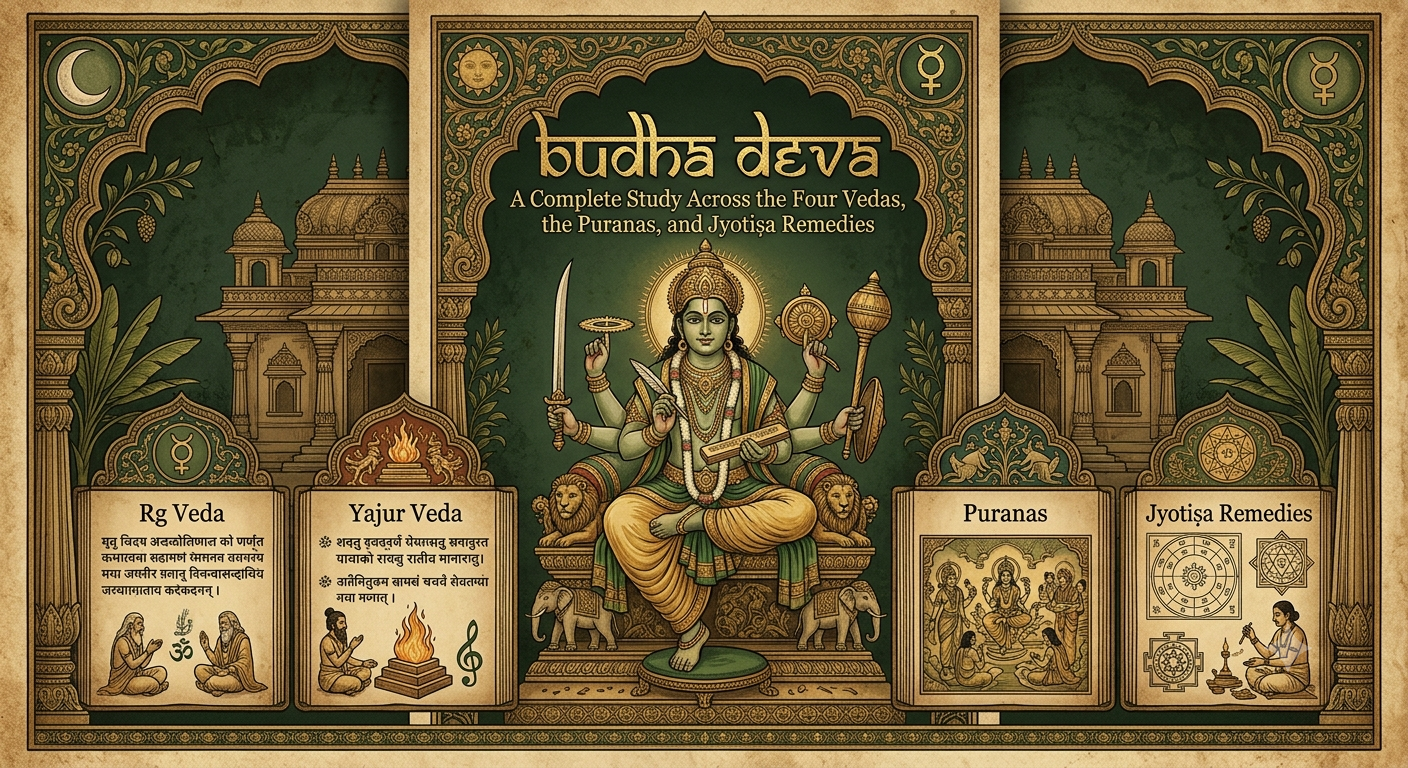
बुध देव — Lord Budha (Mercury)
The Prince of Planets — Deity of Intellect, Speech, and Commerce
1. Who Is Budha?
| Budha is the presiding deity of the planet Mercury and one of the Navagraha, the nine planetary powers of Hindu cosmology. Known as the “Prince among planets,” he governs buddhi (discriminating intellect), speech, logic, mathematics, trade and commerce — where Chandra (the Moon) rules the emotional mind (manas), Budha rules the rational, classifying faculty that turns perception into knowledge. He is depicted as youthful and green-complexioned, four-armed, dressed in yellow, riding a chariot drawn by eight horses or seated on a lion, holding a sword, shield, mace and sometimes a lotus or sceptre. Budha is unique among the Navagraha for being of dual nature — benefic in the company of benefics, malefic in the company of malefics — a chameleon quality that mirrors the ambiguity of his own birth. His presiding day is Wednesday (Budhavāra), his gemstone is emerald (Panna), and his associated deity is Lord Viṣṇu. |
2. Budha in the Four Vedas
Ṛgveda
Budha as a personified planetary deity does not appear by name in the Ṛgveda; the systematic worship of the nine planets (Navagraha) as a group is a later development. However, the Ṛgveda does lay important groundwork: its hymns to Bṛhaspati — the guru of the gods and lord of speech (Vācaspati) — establish the very qualities of eloquence and sacred wisdom that later come to define Budha, and its imagery around Soma (the Moon) and Tārā-related courtship themes prefigure the birth-story later elaborated in the Purāṇas. The root idea of “budh” (to know, to awaken, to perceive) is itself a common Ṛgvedic verbal root, appearing throughout the text in words for awakened insight, long before it crystallised into the name of a planetary deity.
Yajurveda
The Yajurveda, focused on ritual formulae, does not single out Budha for dedicated hymns, but its associated Brāhmaṇa literature develops the mythology of Bṛhaspati and Tārā that later Purāṇic tradition builds upon for Budha’s birth-story. The Yajurveda’s broader concern with correct speech (vāc) and precise ritual utterance — errors in which were believed to bring misfortune — reflects the same domain of language and precision that Budha would come to govern in the fully developed Navagraha system.
Sāmaveda
The Sāmaveda, being a musical recension of Ṛgvedic verses for chanting, has no independent Budha hymns. Its significance to Budha’s later domain is indirect but real: the Sāmaveda is the Veda of refined, patterned sound and melodic precision, and in classical Hindu thought Sarasvatī — goddess of speech, music and learning — is intimately linked with the same intellectual faculties (buddhi, vāc) that define Mercury’s rulership in Jyotiṣa.
Atharvaveda
The Atharvaveda is the first Vedic text where the classical planets, Mercury included, are referenced as astronomical and astrological bodies, generally dated to around 1000 BCE. This places the seed of planetary observation — and by extension the eventual deification of Budha — within the Vedic corpus itself, well before the fully articulated Navagraha system took shape under the later Vedāṅga Jyotiṣa and subsequent Greco-Babylonian and Śaka-era astrological influences absorbed into classical Hindu astrology.
3. The Birth of Budha — Tārākāmayam
|
Tārā was the wife of Bṛhaspati, guru of the gods and lord of Jupiter, but a woman left lonely by a husband absorbed in ritual and study. Chandra, the radiant Moon-god and one of Bṛhaspati’s own disciples, was captivated by her beauty and drew her away. Bṛhaspati’s pleas went unheeded, and the resulting standoff escalated into the celestial conflict known as the Tārakāmaya Yuddha — Śukra (Venus) and the asuras siding with Chandra, the devas siding with Bṛhaspati, until Brahmā himself intervened to end the war and compel Tārā’s return.
By then Tārā was already pregnant. When the radiant child was born, both Chandra and Bṛhaspati claimed him as their own, and Tārā’s silence deepened the dispute — until, in some tellings, the child himself asked his mother to name his true father, and she confirmed that Chandra had fathered him. Brahmā ruled that although Chandra was the biological father, the child would legally belong to Tārā’s husband Bṛhaspati. Enraged at being made to raise his rival’s son, Bṛhaspati cursed the infant to be born napuṃsaka — of neither fixed gender — a curse later softened into Mercury’s astrological classification as neuter/dual in nature. The child, named Budha (“the awakened, the wise one”), was raised in Chandraloka under the care of Chandra’s wife Rohiṇī. This ambivalent parentage is precisely why classical Jyotiṣa treats Mercury as taking on the nature of whichever planet it is closest to or conjunct with — benefic among benefics, malefic among malefics. Sources: the Viṣṇu Purāṇa (H. H. Wilson translation, Book IV, Chapter 6) gives the fullest classical account of the Tārakāmaya war and Budha’s birth; the Bhāgavata Purāṇa (Skandha 9, Chapter 14, verses 13–16) narrates Tārā’s confirmation of Chandra’s fatherhood; the Padma Purāṇa gives a simpler version in which Chandra directly takes and blesses the child without the legal dispute; the Devī Bhāgavata Purāṇa also treats Tārā and Budha’s parentage, alongside her later son Kaca born to Bṛhaspati. |
4. Budha, Ilā, and the Founding of the Lunar Dynasty
| Episode | Summary |
| Growing up estranged | Raised amid the shadow of his contested birth, Budha grew resentful of Chandra for the humiliation surrounding his origin, and in later astrological symbolism gravitates instead toward Śukra and Śani — a dynamic reflected in classical planetary friendships, where Mercury is treated as neutral toward the Moon rather than fully friendly. |
| Meeting with Ilā / Sudyumna | Ilā was the child of King Manu, born through a sacrifice performed incorrectly, resulting in a being who alternated month by month between male (Sudyumna) and female (Ilā) form — in some tellings due to trespassing into a grove sacred to Śiva and Pārvatī where all who entered were transformed. As a woman, Ilā met and married Budha; as a man, Sudyumna served as Budha’s disciple. This union of two beings each marked by gender fluidity is read by commentators as a deep symbolic pairing. |
| Birth of Purūravas | From Budha and Ilā was born Purūravas, who became the founding king of the Chandravaṃśa, the Lunar Dynasty — the royal line that eventually produces Yayāti, Śantanu, and, through many generations, the Kauravas and Pāṇḍavas of the Mahābhārata. Budha is thus, despite the irregularity of his own birth, the mythological progenitor of one of the two great royal lineages of Hindu epic literature (the other being the Solar Dynasty, or Sūryavaṃśa, of Rāma). |
5. Budha Across the Purāṇas
Beyond the core birth narrative, the Purāṇas describe Budha in several further contexts:
- Matsya Purāṇa & Viṣṇudharmottara Purāṇa: lay out Budha’s iconography for temple and image worship — green-bodied, four-armed, seated upon a lion or a chariot of eight horses, holding sword, shield, and club, an essential reference for Navagraha temple sculpture such as at the Sūrya and Navagraha shrines of Tamil Nadu (e.g., Thiruvenkadu).
- Regional Purāṇic/temple tradition (associated with Skanda Purāṇa material): describes Budha undertaking severe tapas to Lord Viṣṇu at Saravaṇavana in the Himālayas to atone for the “sin” of his contested birth; pleased with his austerity, Viṣṇu appears and grants Budha mastery of the Vedas and all arts and sciences, formally establishing him among the Navagraha.
- Bṛhat Parāśara Horā Śāstra (the foundational classical text of Vedic astrology, attributed to the sage Parāśara): systematises Budha’s rulership of Mithuna (Gemini) and Kanyā (Virgo), his exaltation in Kanyā and debilitation in Mīna (Pisces), his rulership of the nakṣatras Aśleṣā, Jyeṣṭhā and Revatī, and his classification as a dual-natured, mutable, earth-element graha — the technical astrological scaffolding built directly on top of his Puranic mythology.
- Agni Purāṇa (chapters 121–150, the astronomy/astrology section): includes Budha among the nine grahas whose worship, mantras, and iconographic proportions are prescribed as part of Navagraha pūjā and praśna (horary) calculation.
6. Budha in Jyotiṣa — Key Significations
| Attribute | Detail |
| Rules | Mithuna (Gemini) and Kanyā (Virgo) |
| Exaltation / Debilitation | Exalted at 15° Kanyā (own sign of exaltation); debilitated in Mīna (Pisces) |
| Nakṣatras ruled | Aśleṣā, Jyeṣṭhā, Revatī |
| Nature | Soumya (gentle); dual/neuter — benefic with benefics, malefic with malefics |
| Mahādaśā | 17 years in the Vimśottarī Daśā system |
| Governs | Intellect, speech, logic, memory, mathematics, trade, writing, education, nervous system, skin |
| Special Yoga | Bhadra Mahāpuruṣa Yoga — Mercury in own sign or exaltation in a kendra, producing orators, writers, and exceptional analytical minds (classically described in the Phaladīpikā) |
7. Remedies for a Weak or Afflicted Mercury
Signs of an afflicted Budha include difficulty with clear speech or public expression, poor memory or scattered concentration, setbacks in education, losses or confusion in trade and business, and nervous-system or skin complaints. Traditional remedies (Budha Graha Śānti) include:
| Remedy | Practice |
| Mantra Japa | Beej mantra “Oṃ Bram Brīṃ Brauṃ Saḥ Budhāya Namaḥ,” or the simpler “Oṃ Budhāya Namaḥ,” ideally 108 times daily or on Wednesdays, for 21, 40 or 108 days. The Budha Gāyatrī — “Oṃ Gajadhvajāya Vidmahe, Śuka Hastāya Dhīmahi, Tanno Budhaḥ Pracodayāt” — is also widely used. |
| Gemstone | Emerald (Panna), worn set in gold or silver on the little finger of the working hand, traditionally on a Wednesday during Mercury’s hora — only after proper astrological consultation, since an unsuitable gemstone can aggravate rather than help. |
| Fasting | Observing a fast on Wednesdays (light meals or fruit only), sometimes combined with Ekādaśī fasting, is a classical Mercury-pacifying practice. |
| Dāna (Donation) | Donating green items on Wednesdays — moong dal (green gram), green vegetables, green cloth — as well as books, stationery, or support for students, since Mercury governs both the colour green and learning. |
| Worship | Worship of Lord Viṣṇu (Budha’s presiding deity) and Lord Gaṇeśa (remover of obstacles to intellect); reciting the Viṣṇu Sahasranāma is considered especially calming for an overactive or afflicted Mercury. |
| Yantra | The Budha Yantra, a geometric diagram inscribed on copper or bhojpatra, worn or placed at home or workspace as a substitute or supplement to gemstone therapy. |
| Lifestyle | Wearing green on Wednesdays; practising Throat Chakra (Viśuddha) meditation and prāṇāyāma for clearer speech; engaging daily in reading, writing or other intellectually engaging activity to actively exercise Mercury’s faculties; showing respect and kindness toward one’s sisters, since afflicted Mercury is classically tied to strained relations with female siblings. |
| Āyurveda | Herbs traditionally associated with strengthening the nervous system and cognition — such as Brāhmī and Aśvagandhā — are commonly recommended alongside astrological remedies for a weak Mercury. |
As with any planetary remedy, gemstone and yantra recommendations should ideally be confirmed against the specific birth chart by a qualified astrologer before undertaking them, since a planet’s remedy depends on its house lordship and placement, not on affliction alone.
Compiled from the Ṛgveda, Yajurveda, Sāmaveda, Atharvaveda, the Viṣṇu Purāṇa, Bhāgavata Purāṇa, Padma Purāṇa, Devī Bhāgavata Purāṇa, Agni Purāṇa, and the Bṛhat Parāśara Horā Śāstra.
H
Leave a Reply