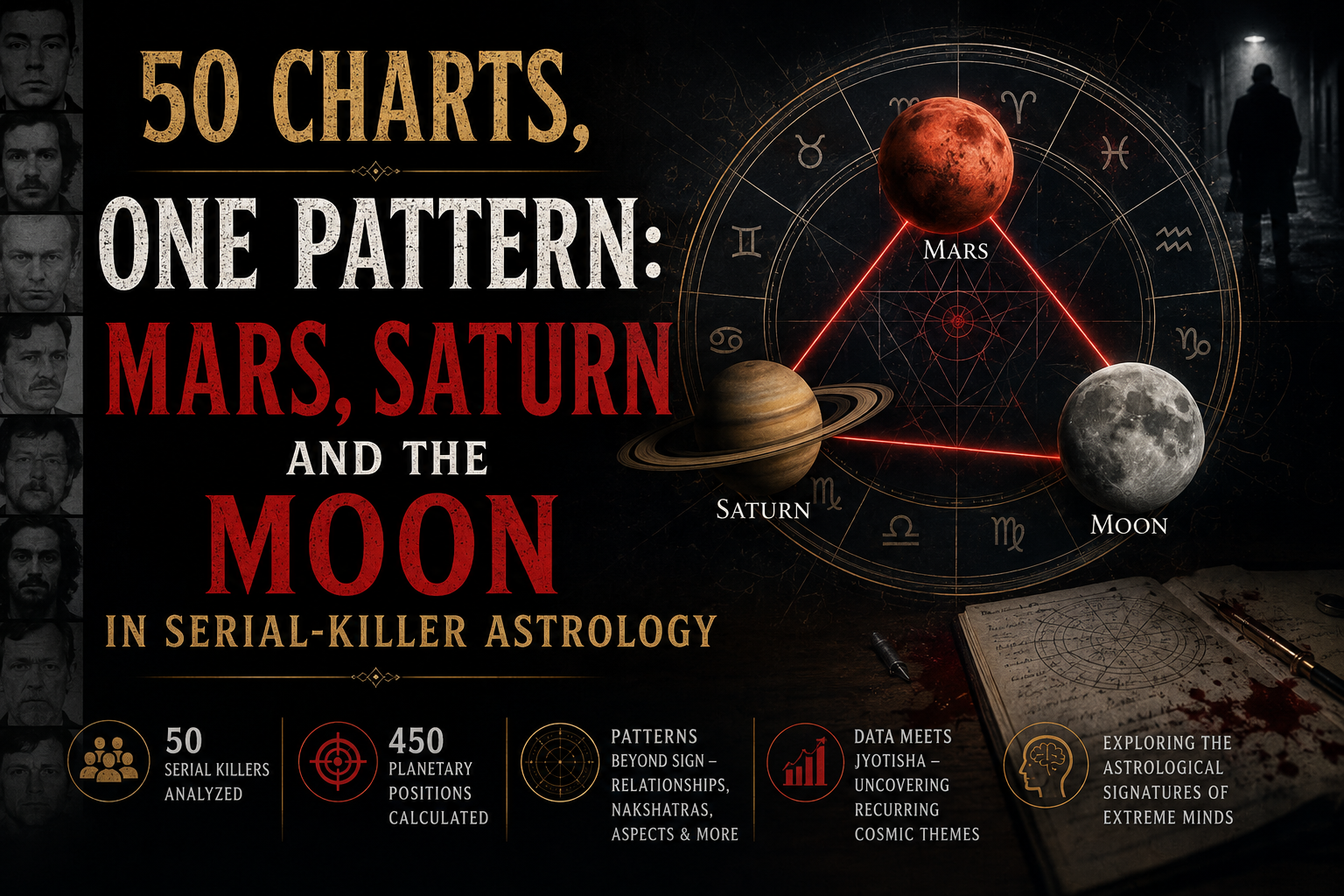

Astrological Pattern Research Across 50 Serial-Killer Birth Charts
A descriptive Vedic astrology study of planetary signs, conjunctions, nodal relationships, retrogrades, nakshatras, stelliums and dispositor patterns
Research Intent
The purpose of this research was simple: to examine whether recurring planetary patterns could be found across the birth data of 50 widely known serial killers from different countries and historical periods.
The study was not designed to calculate ascendants, houses, divisional charts or exact house lordships for every person. Instead, the focus was on the planetary zodiacal positions themselves:
- Sun sign
- Moon sign
- Mars sign
- Mercury sign
- Jupiter sign
- Venus sign
- Saturn sign
- Rahu and Ketu signs
- Nakshatras and padas
- Retrograde status
- Conjunctions, oppositions, squares and trines
- Vedic special aspects
- Stelliums
- Dispositor chains
In other words, the research question was not, “What was this person’s ascendant?” It was, “Across this dataset, how often do certain planets occupy the same signs, form close angular relationships, fall in particular nakshatras or repeatedly connect with the Moon, Mars, Saturn and the lunar nodes?”
Birth-Time Assumption and Why Noon Was Used
Where a documented birth time was available, that time was used.
Where a reliable birth time could not be established, 12:00 PM EST was used as a standard placeholder.
This was done because the research was interested primarily in planetary positions by sign and degree, not in ascendants or houses. The Sun, Mercury, Venus, Mars, Jupiter, Saturn, Rahu and Ketu do not change signs within a few hours under normal circumstances. The Moon moves faster and is therefore the most time-sensitive planet in the dataset.
Using noon does not make the data suitable for ascendant, house, bhava, divisional-chart or exact house-lord analysis. It is a practical compromise for studying planetary sign placements and broad angular relationships.
For technical consistency, the calculations used the Lahiri sidereal zodiac and the mean lunar node.
Who Was Included
The dataset covered 50 well-known serial killers. The names included:
| Ted Bundy | Nannie Doss |
| Jeffrey Dahmer | Belle Gunness |
| Edmund Kemper | H. H. Holmes |
| Dennis Rader (BTK) | Albert Fish |
| Edward Gein | Carl Panzram |
| Fritz Haarmann | Joseph James DeAngelo |
| Joseph Vacher | Wayne Williams |
| John Wayne Gacy | Joel Rifkin |
| Richard Ramirez | Arthur Shawcross |
| Aileen Wuornos | Israel Keyes |
| Gary Ridgway | Dennis Nilsen |
| David Berkowitz | Peter Sutcliffe |
| Samuel Little | Harold Shipman |
| Henry Lee Lucas | Fred West |
| Ottis Toole | Rose West |
| Dean Corll | Myra Hindley |
| Donald Harvey | Ian Brady |
| Robert Hansen | Peter Kürten |
| Randy Steven Kraft | Andrei Chikatilo |
| Rodney Alcala | Anatoly Onoprienko |
| Kenneth Bianchi | Alexander Pichushkin |
| Angelo Buono Jr. | Luis Garavito |
| Richard Chase | Pedro López |
| Herbert Mullin | Tsutomu Miyazaki |
| Dorothea Puente | Moses Sithole |
The dataset is broad but not exhaustive. It includes figures from the United States, United Kingdom, continental Europe, Russia and the former Soviet Union, Latin America, Japan and South Africa.
Data Calculated
For each person, the following values were calculated:
| Category | What Was Calculated |
|---|---|
| Planetary position | Sidereal longitude, sign, degree, minute and second |
| Nakshatra | Nakshatra and pada for each graha |
| Motion | Direct or retrograde status |
| Planetary relationships | Same-sign placement and close conjunction, opposition, square, trine and sextile |
| Vedic aspects | Mars, Jupiter, Saturn, Rahu and Ketu special aspects by sign distance |
| Chart concentration | Stelliums of three or more classical planets in one sign |
| Dispositor analysis | Chains beginning from Moon, Mars, Saturn, Rahu and Ketu |
| Group-level patterns | Sign frequencies, nakshatra frequencies, element balance, modality balance and retrograde frequency |
Major Findings
1. Mars-Saturn Tension Was One of the Strongest Nontrivial Patterns
Among the 50 charts:
- Mars conjunct Saturn within 8°: 5 charts
- Mars opposite Saturn within 8°: 5 charts
That means 10 of 50 charts, or 20%, contained a close Mars-Saturn conjunction or opposition.
Astrologically, Mars represents force, aggression, impulse, assertion and action. Saturn represents restriction, pressure, fear, inhibition, frustration and delayed release. When these planets form a tight conjunction or opposition, the symbolic pattern is one of pressure meeting force.
Possible shadow expressions include:
- blocked aggression
- suppressed rage
- cold or controlled violence
- repeated frustration
- oscillation between paralysis and eruption
- endurance applied to destructive intent
This does not make Mars-Saturn a criminal combination. It does, however, make it one of the most important relationships found in this dataset.
2. The Moon Was Frequently Connected to the Nodal Axis
The Moon was conjunct Ketu within 8° in 6 charts. Because Rahu is always opposite Ketu, these same charts generally showed Moon opposite Rahu.
Thus, about 12% of the sample had the Moon closely aligned with the Rahu-Ketu axis.
In Vedic astrology, this may suggest unusual emotional processing, detachment, obsession, compulsion, dissociation, emotional discontinuity or difficulty integrating instinct with conscious feeling.
This was one of the most psychologically meaningful patterns found, but it also requires the most caution because the Moon is the planet most affected by an assumed birth time.
3. Stelliums Were Very Common
There were 21 classical-planet stelliums across 21 different individuals.
That means 42% of the sample had at least three classical planets concentrated in one sign.
A stellium does not indicate violence. Its significance is concentration. Several psychological and behavioral functions become routed through one sign, one dispositor or one narrow symbolic agenda.
In difficult charts, such concentration may reduce flexibility and amplify repetition, fixation, compulsion or over-identification with one mode of operating.
Planet-by-Planet Sign Trends
Sun
| Sun Sign | Count | Percentage |
|---|---|---|
| Taurus | 11 | 22% |
| Aquarius | 6 | 12% |
| Libra | 5 | 10% |
Taurus was the most frequent sidereal Sun sign in the dataset. In shadow form, Taurus can become rigid, possessive, repetitive, sensually fixated or resistant to release. However, a Sun-sign count by itself is not a meaningful criminal indicator.
Moon
| Moon Sign | Count | Percentage |
|---|---|---|
| Sagittarius | 8 | 16% |
| Pisces | 7 | 14% |
| Scorpio | 6 | 12% |
Together, Sagittarius, Pisces and Scorpio contained 21 of the 50 Moons, or 42% of the sample.
These signs can symbolically point toward belief systems, private psychological worlds, secrecy, emotional permeability, extremity and hidden intensity. Yet Moon-sign interpretation must remain cautious where birth times were assumed.
Mars
| Mars Sign | Count | Percentage |
|---|---|---|
| Gemini | 7 | 14% |
| Cancer | 7 | 14% |
| Aries | 5 | 10% |
Mars in Gemini may connect action with thought, speech, strategy and duality. Mars in Cancer is debilitated in classical Jyotisha and may express anger defensively, indirectly or emotionally. Mars in Aries is direct, instinctive and forceful.
The presence of Mars in Cancer in 14% of the dataset deserves special attention, especially when connected with Moon, Saturn or the nodes.
Saturn
| Saturn Sign | Count | Percentage |
|---|---|---|
| Leo | 8 | 16% |
| Sagittarius | 7 | 14% |
| Gemini | 7 | 14% |
Saturn in Leo may create tension between recognition and inadequacy, authority and humiliation, expression and suppression. Saturn in Sagittarius may harden beliefs. Saturn in Gemini may create repetitive, anxious, compartmentalized or highly structured thought.
Rahu
| Rahu Sign | Count | Percentage |
|---|---|---|
| Gemini | 8 | 16% |
| Taurus | 6 | 12% |
| Virgo | 5 | 10% |
Rahu appeared in Mercury-ruled signs Gemini and Virgo in 13 charts, or 26% of the dataset.
This may suggest a recurring Mercury-Rahu theme involving:
- strategic thinking
- compartmentalization
- mental restlessness
- manipulation of information
- multiple narratives or identities
- obsessive attention to detail
- rationalization
Nakshatra Findings
Moon Nakshatras
| Nakshatra | Count |
|---|---|
| Uttara Ashadha | 6 |
| Rohini | 6 |
| Mula | 5 |
These three nakshatras accounted for 17 of the 50 Moon placements.
Possible shadow symbolism:
- Uttara Ashadha: rigid certainty, uncompromising victory, insistence on being right
- Rohini: attachment, possession, appetite, desire and fixation
- Mula: uprooting, destruction, penetration to the root and dismantling
Mars Nakshatras
| Nakshatra | Count |
|---|---|
| Mrigashira | 5 |
| Pushya | 4 |
| Krittika | 4 |
Mrigashira searches and pursues. Krittika cuts and separates. Pushya structures, contains and nourishes. These meanings are symbolic and should never be converted into literal predictions of behavior.
Saturn Nakshatras
| Nakshatra | Count |
|---|---|
| Magha | 6 |
| Mula | 5 |
| Punarvasu | 4 |
Magha and Mula are both ruled by Ketu. Together, they contained 11 of the 50 Saturn placements.
This creates an interesting Saturn-Ketu symbolic theme involving detachment, severance, ancestral burdens, authority, isolation and unresolved past patterns.
Rahu Nakshatras
| Nakshatra | Count |
|---|---|
| Rohini | 4 |
| Chitra | 4 |
| Punarvasu | 3 |
Rahu in Rohini may intensify appetite and possession. Rahu in Chitra can intensify image, construction, technical skill or fascination with how things are assembled.
Most Common Same-Sign Relationships
| Planetary Pair | Charts | Percentage |
|---|---|---|
| Sun-Mercury | 20 | 40% |
| Mercury-Venus | 12 | 24% |
| Sun-Venus | 9 | 18% |
| Sun-Mars | 8 | 16% |
| Mars-Mercury | 8 | 16% |
| Moon-Mars | 7 | 14% |
| Moon-Venus | 7 | 14% |
| Saturn-Rahu | 7 | 14% |
| Sun-Moon | 6 | 12% |
| Moon-Mercury | 6 | 12% |
Sun-Mercury is astronomically common because Mercury never travels far from the Sun. More interesting relationships in this dataset include Saturn-Rahu, Moon-Mars, Mars-Mercury and Sun-Mars.
Saturn-Rahu
Saturn and Rahu sharing a sign may intensify fear, obsession, control, concealment, resentment, long-term compulsion and conflict with rules.
Moon-Mars
Moon-Mars can connect feeling directly with action. In difficult expressions, it can produce emotionalized aggression, irritability, rapid reaction and heightened survival responses.
Mars-Mercury
Mars-Mercury can connect thought with action, language with aggression, planning with force and analysis with tactical execution.
Close-Degree Conjunctions
| Conjunction | Charts |
|---|---|
| Mercury-Venus | 8 |
| Sun-Mercury | 7 |
| Moon-Ketu | 6 |
| Mars-Saturn | 5 |
| Sun-Venus | 4 |
| Moon-Mars | 4 |
| Moon-Venus | 4 |
| Moon-Saturn | 4 |
| Mars-Venus | 4 |
| Saturn-Ketu | 4 |
The combinations most deserving of deeper case-by-case study are Mars-Saturn, Moon-Ketu, Moon-Saturn, Moon-Mars, Saturn-Ketu and Saturn-Rahu.
Retrograde Frequency
| Planet | Retrograde Charts | Percentage |
|---|---|---|
| Saturn | 23 | 46% |
| Jupiter | 15 | 30% |
| Mercury | 7 | 14% |
| Mars | 6 | 12% |
| Venus | 3 | 6% |
Saturn retrograde was the most frequent, but Saturn is retrograde for a substantial part of every year. Therefore, retrograde status becomes more meaningful when combined with planetary relationships, especially contacts with Moon, Mars, Rahu and Ketu.
Element and Modality Balance
Elements
| Element | Placements | Percentage |
|---|---|---|
| Fire | 122 | 27.1% |
| Air | 111 | 24.7% |
| Earth | 109 | 24.2% |
| Water | 108 | 24.0% |
The elements were broadly balanced, with only a mild excess of Fire.
Modalities
| Modality | Placements | Percentage |
|---|---|---|
| Fixed | 162 | 36.0% |
| Mutable | 158 | 35.1% |
| Cardinal | 130 | 28.9% |
The clearest modality pattern was a relative reduction in Cardinal placements and greater concentration in Fixed and Mutable signs.
Symbolically, Fixed signs preserve, repeat and resist change. Mutable signs adapt, divide and shift between states. The combined Fixed-Mutable dominance may suggest repetition combined with adaptation, although that conclusion remains speculative without a matched control group.
Overall Astrological Synthesis
The clearest recurring pattern was not one isolated “serial-killer placement.” It was a network involving Moon, Mars, Saturn and the Rahu-Ketu axis.
The most notable repeated relationships were:
- Mars-Saturn conjunction or opposition in 20%
- Moon closely aligned with the nodal axis in 12%
- Saturn-Rahu in the same sign in 14%
- Moon-Mars in the same sign in 14%
- Moon-Saturn close conjunction in 8%
- Saturn-Ketu close conjunction in 8%
- Stelliums in 42%
The working hypothesis emerging from this dataset is:
Extreme behavior, where present, may be less associated with one debilitated planet and more associated with concentrated charts in which emotional processing represented by the Moon becomes strongly linked with aggression represented by Mars, suppression represented by Saturn, and compulsion or detachment represented by the lunar nodes.
Reliability and Research Limitations
The calculations in this study were internally consistent, but the underlying birth data are not equally reliable in every case.
- Some birth dates and places are strongly documented.
- Some birth times are supported by birth records.
- Many birth times are unknown and were standardized to noon.
- The Moon may shift noticeably across a day and, near a sign boundary, can change signs.
- Ascendants and houses cannot be trusted where birth time is unknown.
- No matched control group was used.
- Historical generations create natural clustering in slow-moving planets.
Therefore, the strongest conclusions are descriptive rather than causal. The study identifies patterns present in this sample. It does not establish that these patterns are unique to serial killers or absent from the general population.
Conclusion
This research produced a structured dataset of 50 charts and examined planetary signs, nakshatras, angular relationships, retrogrades, stelliums, special aspects and dispositors.
The most interesting result was the repeated involvement of Moon, Mars, Saturn and the nodal axis. Mars-Saturn tension, Moon-node alignment, Saturn-Rahu connections and a high incidence of stelliums formed the central pattern of the study.
The next scientifically stronger step would be to compare these same calculations with a control population matched by decade, geography and gender. That would help distinguish genuinely unusual patterns from ordinary astrological frequencies.
Method note: Calculations used the Lahiri sidereal zodiac and mean lunar node. Unknown birth times were assigned 12:00 PM EST solely to permit standardized planetary-position analysis. This assumption should not be used for ascendant, house or divisional-chart interpretation.
Leave a Reply