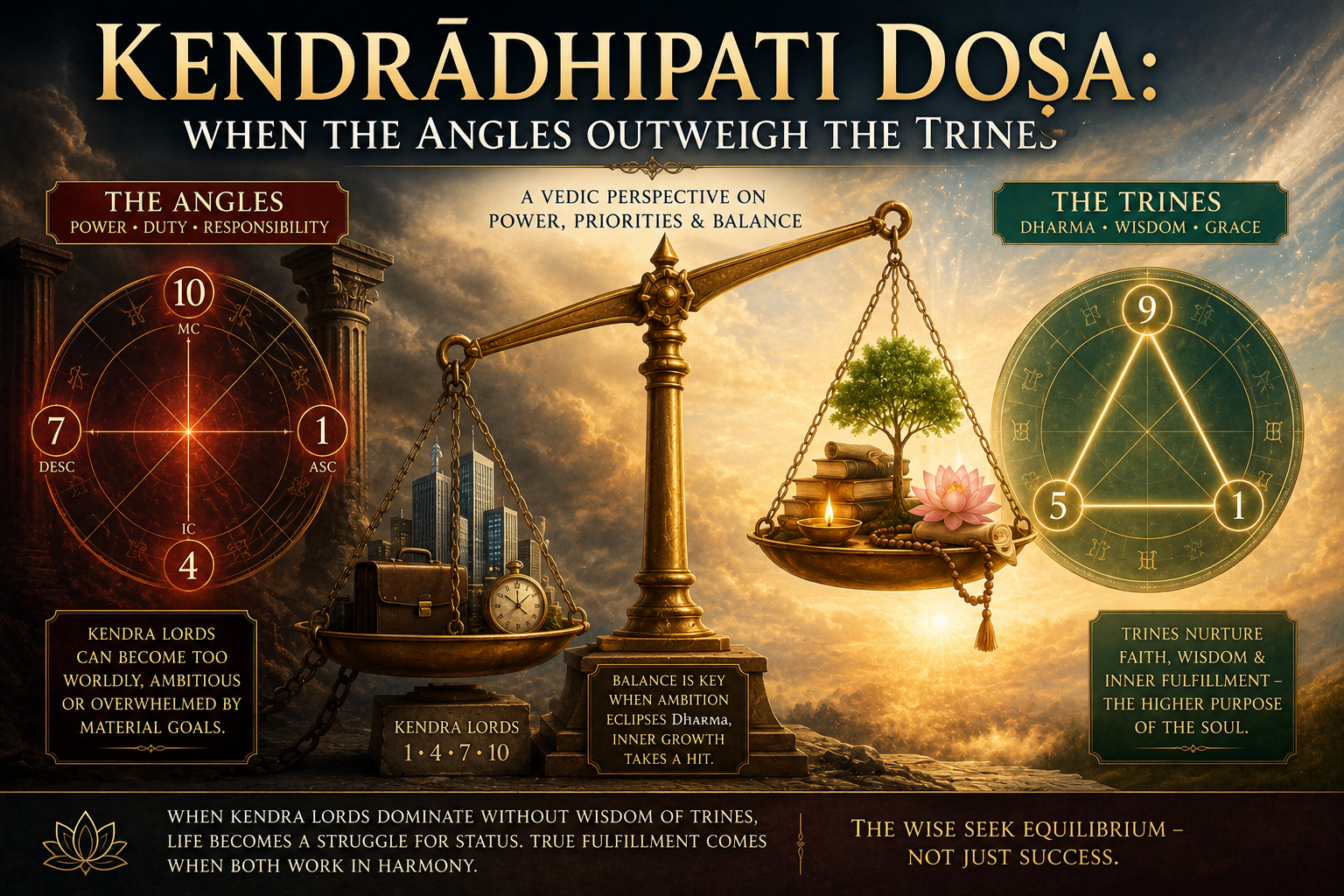
Kendrādhipati Doṣa: When the Angles Outweigh the Trines
Why a benefic planet can lose its sweetness simply by ruling the “wrong” kind of house — and why lordship, not placement, is what actually matters.
1. What the Doṣa Actually Is
Kendra = the four angular houses: 1, 4, 7, 10 — the pillars of the chart, ruling self, home, relationships, and career. They represent artha, the domain of material structure and worldly power.
Adhipati = lord/ruler.
Doṣa = flaw, affliction.
Parāśara’s teaching (Bṛhat Parāśara Horā Śāstra) holds that the four naisargika śubha grahas — natural benefics — Jupiter, Venus, Mercury, and the waxing Moon — are diminished when their only function in a chart is to rule kendra houses. A planet whose whole portfolio is “material world administration” with no stake in trikona (houses 1, 5, 9 — the houses of dharma, fortune, and merit) loses some of its purity. It still gives results, but with more mixed, harder-edged, sometimes even mildly adverse flavor to the affairs of the houses it rules — quite unlike the smooth, protective benevolence these planets normally offer.
2. Why This Happens — Kendra vs Trikona
Trikona houses are considered inherently pure and auspicious — no natural malefic can fully spoil them, and any planet ruling one carries a whiff of puṇya (merit) regardless of its natural temperament. Kendras carry no such immunity; they are neutral ground, governed by karma and material necessity, not grace. A benefic confined only to kendra lordship is, so to speak, “forced to work” without the cushioning of a trikona portfolio — hence the doṣa. This is precisely why malefics are unaffected by this rule, and in fact often improve when they rule a kendra: a malefic ruling both a kendra and a trikona becomes a Yogakāraka — one of the most powerful placements in the chart (classic examples: Mars for Cancer/Leo, Saturn for Taurus/Libra, Venus for Capricorn/Aquarius).
3. The Critical Exception: Simultaneous Trikona Ownership
This is the exception that resolves the trickiest cases. The 1st house (lagna) is unique — it is both a kendra and a trikona simultaneously. So when a benefic rules the lagna and a kendra (4th, 7th, or 10th) together, it is not a pure kendra-only lord — its trikona credential (via the 1st) tempers or cancels the doṣa. This combination is generally read as favorable, even strong, not afflicted.
The doṣa bites hardest when a benefic owns kendras only, with zero trikona ownership anywhere — not even via the lagna.
4. Worked Examples
| Ascendant | Planet & Houses Owned | Verdict |
|---|---|---|
| Gemini | Mercury rules 1st (Gemini) + 4th (Virgo) | No real doṣa — 1st house lordship is also trikona, so this is protected. Often praised as a strong lagna lord. |
| Virgo | Mercury rules 1st (Virgo) + 10th (Gemini) | No real doṣa — same logic; lagna lordship cancels it, despite 10th being a “pure” kendra. |
| Sagittarius | Mercury rules 7th (Gemini) + 10th (Virgo) | Full doṣa — no trikona ownership anywhere. Textbook Kendrādhipati Doṣa case. |
| Pisces | Mercury rules 4th (Gemini) + 7th (Virgo) | Full doṣa — both houses are pure kendras, nothing trikona to redeem it. |
| Virgo | Jupiter rules 4th (Sagittarius) + 7th (Pisces) | Full doṣa — classic example; Jupiter here often behaves more neutrally than its natural benefic self. |
5. Lordship Versus Placement: Which One Actually Decides the Doṣa?
Here is the key distinction to lock in: Kendrādhipati Doṣa is entirely a function of rulership (which houses a planet owns from the ascendant) — not of where that planet physically sits in the chart.
A few common scenarios clarify this further:
- Does it apply if the benefic owns a kendra but isn’t sitting there? Yes — the doṣa is triggered by ownership, full stop. A planet doesn’t need to occupy the kendra it rules for the affliction to exist.
- Does sitting in a trikona house (by placement) cancel it? No — that’s a different mechanism. Occupying a trikona by transit-position gives some mild dignity/comfort to the planet, but it does not cancel Kendrādhipati Doṣa. Only owning a trikona (as in the Mercury/Gemini or Mercury/Virgo cases above) cancels it. Placement can soften how the doṣa manifests; it cannot erase the doṣa itself.
- What does placement actually change, then? Severity and flavor. If a kendra-only benefic (say Mercury for Sagittarius or Pisces lagna) sits exalted, in its own sign, or well-aspected, the doṣa’s edge is considerably blunted — the planet still gives functional, workable results. If instead it’s placed in a duṣṭhāna (6th, 8th, 12th) or afflicted by malefic conjunction/aspect, the doṣa compounds — the native may see obstruction, disappointment, or even health/relationship difficulty specifically in the matters of the houses that planet owns.
6. Real-Life Manifestations
A doṣa in a textbook is abstract. In an actual life, it shows up as a specific, recognizable friction in the affairs of the houses involved. Two of the clearest examples:
Jupiter for Virgo Ascendant (rules 4th and 7th — both pure kendras)
Jupiter here governs home/mother/inner contentment (4th) and marriage/partnership (7th) — but with no trikona backing it, its usual gift of “blessing” is thinned out to just “function.” In practice this often reads as: a marriage that arrives on schedule and looks materially sound on paper, but feels transactional or emotionally under-nourished; a comfortable home that never quite feels like a sanctuary; a spouse who may be older, foreign, in a teaching/advisory/legal profession, or otherwise “appropriate” rather than deeply compatible. Domestic peace can feel like something the native has to manage rather than something that simply exists.
Jupiter placed in one of its own signs — Sagittarius (the 4th house itself) or Pisces (the 7th house itself) — keeps the doṣa mild: it still delivers real domestic comfort and a stable marriage, even without the deeper emotional fulfillment Jupiter usually promises. Jupiter placed in a duṣṭhāna — the 6th, 8th, or 12th — sharpens the doṣa considerably: recurring marital friction or separation, disputes over property or inheritance, weight/liver-related health patterns, or a mother’s health and the native’s domestic peace both under repeated strain.
Mercury for Sagittarius Ascendant (rules 7th and 10th — both pure kendras)
Mercury here governs partnership (7th) and career/public standing (10th), again with no trikona anchor. This commonly shows up as a marriage or business partnership that runs on negotiation and communication rather than warmth — contracts, terms, and constant re-discussion rather than settled trust; a spouse who may function almost like a business partner. In career, it tends to produce restlessness and reinvention — frequent job or field changes, income tied to trade, writing, media, consulting, or brokering rather than one stable seat of authority — along with a reputation that can swing on the strength of the native’s last piece of communication rather than resting on a fixed foundation.
Mercury in its own sign (Gemini or Virgo) or exalted (Virgo) keeps this workable — genuine business acumen, sharp negotiation skill, real career mobility. Mercury afflicted or placed in the 6th, 8th, or 12th intensifies it: contractual disputes, partnership breakdowns, scandal or misinformation damaging professional standing, or a marriage that dissolves into legal/technical wrangling.
7. Quick Summary Rule
A natural benefic (Jupiter, Venus, Mercury, waxing Moon) suffers Kendrādhipati Doṣa only when its entire house-ownership portfolio is kendra houses with zero trikona stake — including no lagna lordship, since lagna itself counts as trikona. Where it sits, and how strong it is there, shapes how the doṣa plays out — but the doṣa’s presence or absence is decided by ownership alone.
Note: this is the classical Parāśarī framework (BPHS). Jaimini and some later schools (e.g., Uttara Kalāmṛta) add nuance and some disagreement on exact severity — worth a separate piece if you want to go deeper into the cross-school debate.
Leave a Reply