|
Jyotisha Study Reference
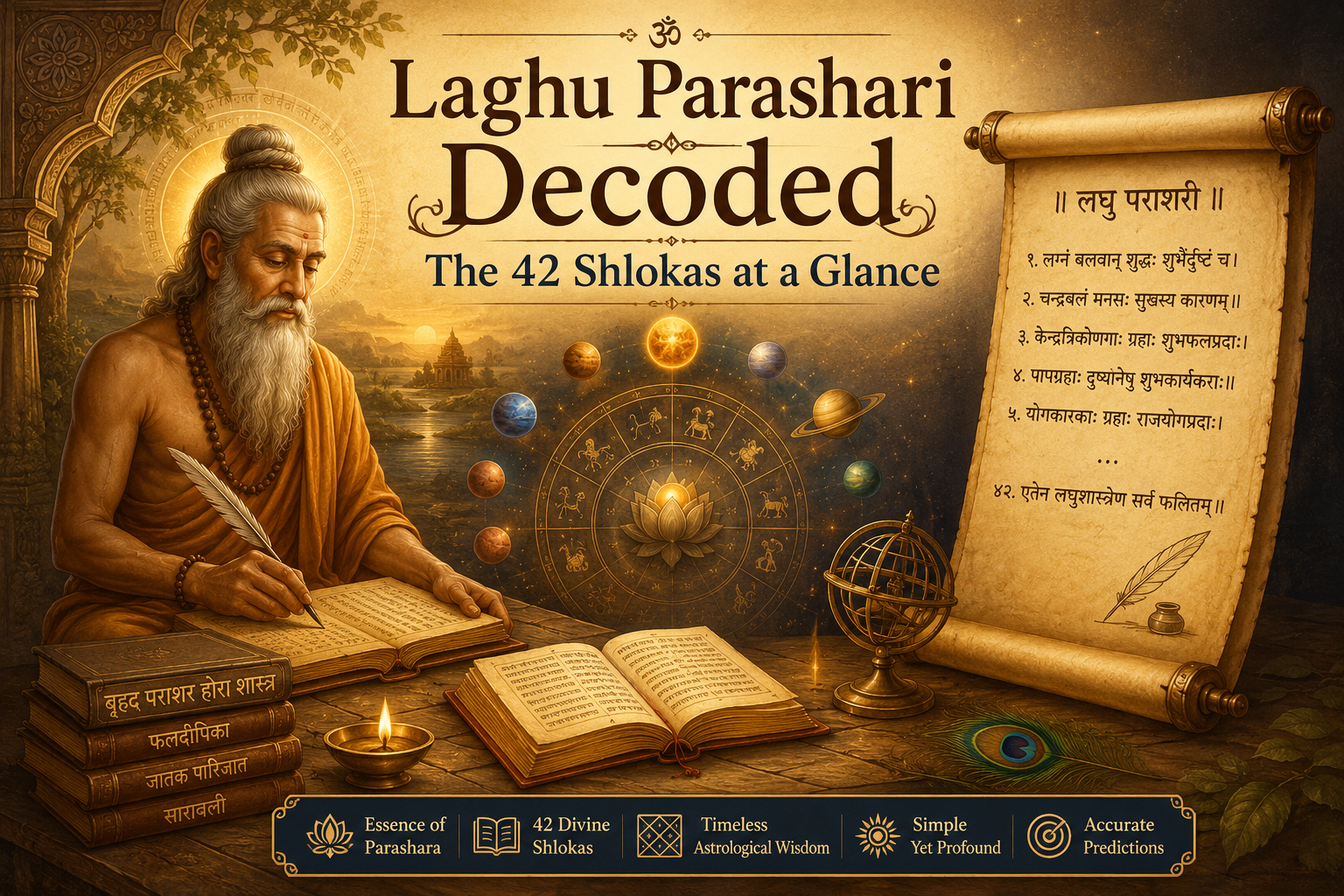
Laghu Parashari
The 42 Shlokas of the Ududayapradeepa — At a Glance
|
|
Laghu Parashari (also called Ududayapradeepa, and studied in South India as part of the Jataka Chandrika) is a 42-verse condensation of Brihat Parashara Hora Shastra, composed to teach how planets behave specifically in their Vimshottari Dasha — a different question from how they behave natally. It is organized into five short chapters. The rules below are a study summary of the classic’s structure and teaching points, not a literal verse-by-verse translation.
|
|
The Four House-Groups Every Rule Comes Back To
|
|
Trikona
1 · 5 · 9
Always auspicious — benefic or malefic lord alike
|
Kendra
1 · 4 · 7 · 10
Turn neutral — lose their natural benefic/malefic character
|
Trishadaya
3 · 6 · 11
Always inauspicious — even a natural benefic turns evil here
|
2nd, 8th, 12th
Special Cases
2nd/12th: neutral, take on associations. 8th: deadly unless also Lagna lord
|
|
|
The Five Chapters
|
| Ch. |
Name |
Shlokas |
Core Concern |
| 1 |
Samajna Adhyaya (opening) |
1–5 |
Invocation, scope, and the planetary aspect rules |
| 2 |
Samajna Adhyaya (houses) |
6–13 |
Nature of house lords — Trikona, Kendra, Trishadaya, 2nd/8th/12th |
| 3 |
Yoga Adhyaya |
14–22 |
How Kendra + Trikona lords combine into Rajayoga |
| 4 |
Ayu / Maraka Adhyaya |
23–28 |
Longevity — identifying the Maraka (death-inflicting) houses and planets |
| 5 |
Dasha-Bhukti Adhyaya |
29–42 |
Rules for timing when Yoga/Maraka results actually fructify |
|
|
Chapter 1 · Shlokas 1–5 — Scope & Aspects
- Invocation to Saraswati, then a statement of purpose: teach Parashara’s Nakshatra-Dasha (Vimshottari) principles, not Ashtottari.
- Assumes the reader already knows basic astrology — houses, signs, planetary natures — and focuses only on Dasha-specific rules.
- Aspects: every planet fully aspects the 7th house from itself. Saturn additionally aspects the 3rd and 10th; Jupiter the 5th and 9th; Mars the 4th and 8th — these three “special drishtis” carry full strength, not partial glances.
|
|
|
Chapter 2 · Shlokas 6–13 — Nature of House Lords
- Trikona lords (1, 5, 9) give good results, period — regardless of whether the planet is a natural benefic or malefic.
- Trishadaya lords (3, 6, 11) give bad results, period — even a natural benefic turns harmful here.
- Kendra lords (1, 4, 7, 10) go neutral — benefics stop being purely good, malefics stop being purely bad — unless the same planet is also a Trikona lord, in which case it becomes a powerful Yogakaraka (e.g., Mars for Cancer or Scorpio Lagna).
- 2nd & 12th lords have no fixed nature of their own; they simply channel the quality of whatever they’re conjoined with or occupy.
- 8th lord is inherently harmful (it is the 12th — house of loss — counted from the 9th, house of fortune) unless it is also the Lagna lord, in which case the placement redeems it.
- Kendradhipatya Dosha: the “blemish of owning a quadrant” hits natural benefics hardest — worst for Jupiter and Venus, less for Mercury, least for the Moon — especially severe when the same planet also rules a Maraka house (2nd or 7th).
- Rahu & Ketu have no fixed result of their own; they strongly take on the character of the house they sit in and the planet they’re conjoined with.
|
|
|
Chapter 3 · Shlokas 14–22 — Yoga (Rajayoga Combinations)
- Yoga = a working relationship between a Kendra lord and a Trikona lord. Four kinds of relationship are recognized, in descending strength: mutual sign-exchange > mutual aspect (with one in its own sign) > aspect from one’s own dispositor > simple conjunction.
- A relation is cleanest (“unblemished”) when neither planet’s other sign falls in a Trishadaya or 8th house. Such combinations give the fullest Rajayoga.
- Even blemished Kendra/Trikona lords can still form a good Yoga if related to each other — but if both are blemished, the combination fails to produce Rajayoga.
- Relationships specifically involving the 9th and 10th lords (strongest Trikona and strongest Kendra) are graded as the most powerful class of Rajayoga; exchange between them outranks mere co-placement, which outranks a one-sided aspect.
- A single planet ruling both a Kendra and a Trikona (a true Yogakaraka) is auspicious on its own; benefics can give good results in their Dasha even without any special relation, but a malefic Yogakaraka generally needs the relationship to show its best results.
- Rahu/Ketu placed in a Kendra or Trikona and connected to another Kendra/Trikona lord can themselves generate an effective Yoga.
- If the 9th and 10th lords also happen to rule the 8th and 11th houses respectively, their relationship is not Yoga-forming — the Trishadaya/8th blemish overrides it.
|
|
|
Chapter 4 · Shlokas 23–28 — Longevity & Maraka Planets
- The 2nd and 7th houses are the fixed Marakasthanas (death-inflicting houses) of any chart.
- A Maraka lord is far more dangerous when it also occupies a Maraka house — that combination is considered nearly impossible to fully neutralize.
- Among the Maraka lords, some planets are graded as harsher agents of misfortune than others depending on which additional house(s) they own — the text works through planet-by-planet gradations rather than treating all Marakas as equal.
- The Sun and Moon, when they happen to be 8th lords, are treated as comparatively milder than other planets in the same position.
- Saturn is singled out for special treatment as a Maraka, given how often he ends up ruling a Marakasthana across different ascendants.
- Only the strongest Marakas are capable of actually ending life in their Dasha; weaker ones instead bring illness, loss, or hardship during their periods.
|
|
|
Chapter 5 · Shlokas 29–42 — Dasha-Bhukti Timing Rules
- Results depend on the relationship (or lack of one) between the ruling Dasha lord and the running Bhukti lord — related pairs release their Yoga together; unrelated pairs give more mixed or muted results.
- A Bhukti lord that is itself an unrelated Yogakaraka can still deliver good results on its own strength during another planet’s Dasha.
- A functionally neutral Bhukti lord tends to soften or moderate whatever the Dasha lord was already signifying, rather than overriding it.
- When a Dasha and Bhukti pair together are both Kendra-Trikona (Yogakaraka) lords, that period is marked out as when a standing Rajayoga actually fructifies.
- Conversely, when a Dasha-Bhukti pair are both Maraka-linked planets, that period is flagged as risky for health, status, or longevity.
- Rahu and Ketu Dasha-Bhuktis are read through whichever house/planet they are tied to, exactly as in Chapter 2 — they don’t have an independent signature.
- Dashas of purely Trishadaya or 8th-house lords are treated as periods of struggle unless redeemed by a simultaneous Trikona connection.
- A specific rule is devoted to the Venus–Saturn Dasha-Bhukti combination, and another set of closing verses lists specific Rajayoga configurations the earlier chapters build toward.
|
|
|
Seven Maxims to Hold in Memory
|
|
1. Trikona lords (1-5-9) are always good — natural nature doesn’t matter.
|
2. Trishadaya lords (3-6-11) are always bad — same rule, reversed.
|
|
3. Kendra lords go neutral, unless they double as Trikona lords — then they’re a Yogakaraka.
|
4. The 8th lord is a wrecker of fortune — unless it’s also the Lagna lord.
|
|
5. Yoga needs a relationship — exchange beats mutual aspect beats dispositor’s aspect beats plain conjunction.
|
6. The 2nd and 7th are fixed Maraka houses — their lords, and any relationship they hold, decide danger.
|
|
7. Rahu and Ketu never have an independent signature — they borrow entirely from the house they occupy and the planet they join.
|
|
|
This is a structural study summary of Laghu Parashari (Ududayapradeepa), 42 shlokas in five chapters, based on the Parashari system of Vimshottari Dasha interpretation. For the exact Sanskrit verses and word-by-word commentary, refer to a full annotated translation (e.g., O.P. Verma’s Laghu Parasari — Jataka Chandrika, or K.S. Charak’s Laghu Parashari: An Exquisite Exposition of Vimshottari Dasha).
|
|
Leave a Reply