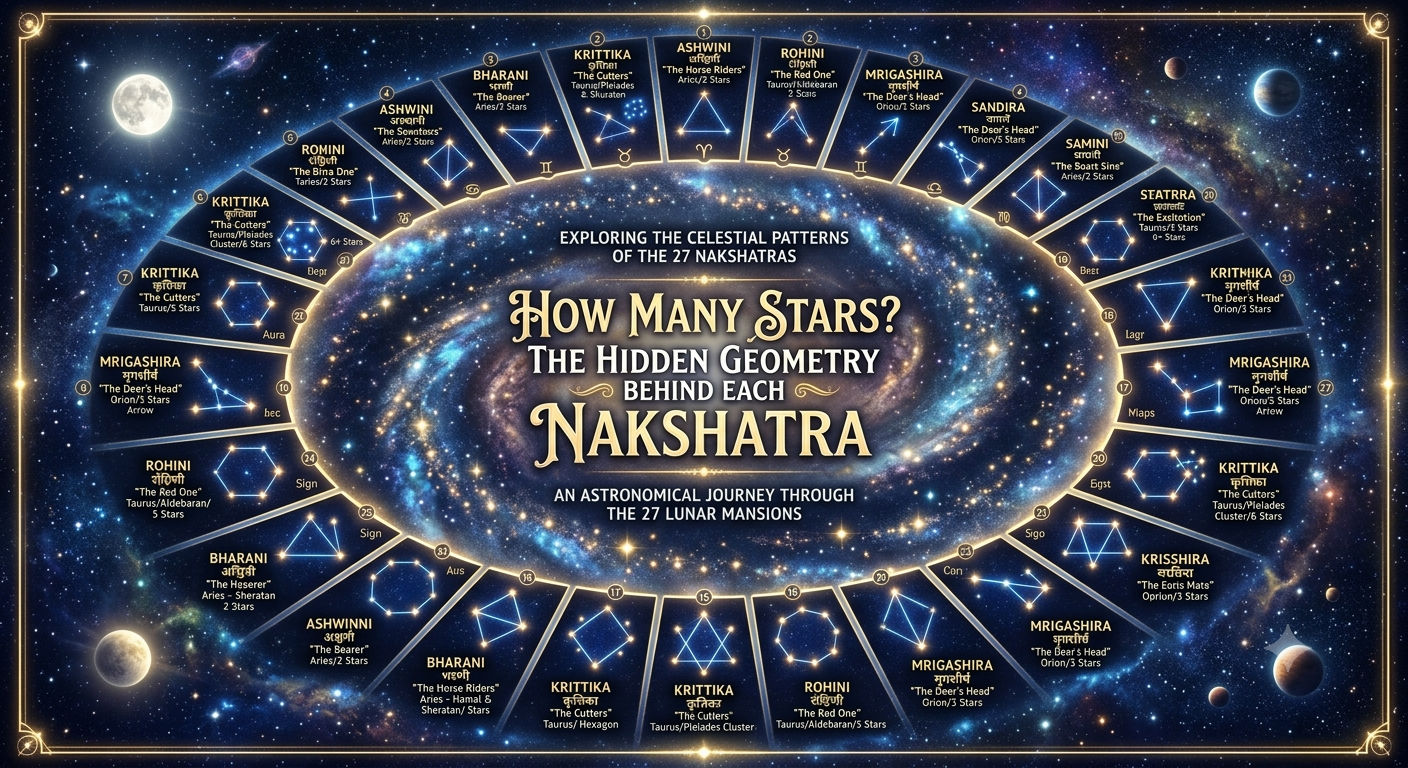
Star Count as Destiny: Mapping the Nakshatras’ Celestial Architecture
A Stellar-Geometry Hypothesis
Nakshatra study keeps circling back to guṇa, gaṇa, deity and planetary lordship — the star count itself is rarely treated as a serious variable. One distinction is worth holding onto from the outset:
A nakshatra is simultaneously:
- a fixed 13°20′ division of the ecliptic;
- an observational region of the celestial sphere;
- an asterism composed of one or more traditionally recognised stars;
- a mansion represented by a principal star or yogatārā;
- a symbolic, mythological and astrological field.
These five layers are related, but they are not identical. A nakshatra containing “five stars” does not mean that only five physical stars exist in that region. It means that the traditional observer selected five visually significant stars to form its recognisable celestial figure.
The Bṛhat Saṁhitā preserves a traditional sequence of star counts for the nakshatras:
The text also states that these numbers were used as “stellar periods” in certain forms of timing.
Modern astronomical research distinguishes the larger nakshatra zone from the principal yogatārā. Every zone contains numerous visible and invisible stars, but one conspicuous star was selected as its principal marker.
What follows, then, is offered as a stellar-geometry hypothesis — not as established classical doctrine.
The Central Hypothesis
The number and arrangement of stars may describe how the nakshatra distributes its consciousness.
Nakshatra Behaviour = Number of Stars + Geometric Organisation + Brightness Hierarchy + Symbol + Deity
Or more precisely:
N = Q + G + H + S + D
Where:
- Q = quantity of visible constituent stars
- G = geometry created by them
- H = hierarchy: one dominant star or several comparable stars
- S = traditional symbol
- D = presiding deity
The number does not independently produce the behaviour. It tells us how many centres of activity must cooperate before the nakshatra can express itself.
The Numerical Archetypes
One-Star Nakshatras: The Singular Principle
A single-star asterism produces no visible internal relationship. There is no triangle, pair, network or cluster. Everything is concentrated through one luminous point.
This suggests: singular purpose; self-definition; independence; intensity; concentration; difficulty diluting one’s identity; unusually direct expression of the deity.
The three one-star nakshatras are Ārdrā, Citrā, and Svāti.
Ārdrā is ruled by Rudra, Citrā by Tvaṣṭṛ, and Svāti by Vāyu. All three deities represent relatively autonomous cosmic forces: Rudra destroys and transforms; Tvaṣṭṛ designs and fashions; Vāyu moves freely and cannot be contained.
Thus the solitary-star group appears to produce self-propelled forces. They do not require a collective to begin their action.
1 star = concentration + autonomy + undivided agency
Its shadow becomes: singularity → isolation, extremity or self-absorption.
Two-Star Nakshatras: The Axis Principle
Two points create a line. The two-star nakshatras are Uttara Phālgunī, Pūrvāṣāḍhā, and Pūrvabhādrapadā.
A pair naturally represents: two parties; exchange; agreement or opposition; movement from one condition to another; polarity; relationship; choice.
These nakshatras are therefore unlikely to operate entirely through solitary action. Their karma often appears through an encounter between two poles. Uttara Phālgunī concerns alliance, patronage and contractual bonds. Pūrvāṣāḍhā concerns purification, assertion and the overcoming of opposition. Pūrvabhādrapadā carries the image of two front legs of a funeral cot and a two-faced being.
The geometry is remarkably compatible with the symbolism.
2 stars = self–other axis + polarity + transfer
Its constructive form is partnership. Its shadow is division: alliance or conflict.
Three-Star Nakshatras: The Triangular Principle
Three points create the first closed geometric figure: the triangle. The three-star nakshatras are Aśvinī, Bharaṇī, Mṛgaśīrṣa, Puṣya, Jyeṣṭhā, and Śravaṇa. (Pūrvabhādrapadā is sometimes identified this way in alternative sources, although the Bṛhat Saṁhitā sequence gives it two.)
Three introduces: process; mediation; beginning–middle–end; observer–object–experience; creation–preservation–completion; movement beyond binary conflict. A pair can remain locked in opposition. A third point creates direction and resolution.
3 = duality + mediating intelligence
This can be seen clearly in Aśvinī, where the twin physicians do not merely exist as a pair; they perform a third function—healing. Bharaṇī similarly connects the bearer, what is being borne, and the destination or transformation of what is carried. Mṛgaśīrṣa creates seeker, sought object, and path of pursuit. Puṣya creates nourisher, recipient, and nourishment. Śravaṇa creates speaker, listener, and transmitted knowledge.
Shadow: three may generate perpetual movement among alternatives — searching, triangulation or incomplete closure.
Four-Star Nakshatra: The Structural Principle
Anurādhā alone carries four stars in the traditional sequence. Four points permit the formation of a square, a cross, a stable enclosure, four directions, and a social or ritual structure.
Anurādhā’s deity is Mitra, the divine principle of friendship, agreement and social cohesion, and the fit between deity and geometry here is striking. Mitra does not merely represent emotional friendship; Mitra represents the principle by which separate beings remain bound within an agreement. Four stars suggest that Anurādhā does not build relationship as a simple pair. It builds a relational structure.
4 = order + reciprocity + stable network
This may explain why Anurādhā often has an instinct for alliances, communities, organisations, disciplined devotion, and friendship maintained across distance. Its shadow is excessive accommodation to the group, or maintaining loyalty after a structure has lost its soul.
Five-Star Nakshatras: The Organising Hand
Five is the most frequently repeated stellar number, alongside three. The five-star nakshatras are Rohiṇī, Punarvasu, Maghā, Hasta, Viśākhā, and Dhaniṣṭhā.
Five has several natural correspondences: five fingers; five senses; five elements; a central point surrounded by four directions; human agency; manipulation of the material world. Five therefore appears to be the number of organised embodiment — neither a simple triangle nor a large collective, but complex enough to create differentiated function while remaining manageable.
5 = central intelligence + fourfold execution
Rohiṇī (creation): governed by Prajāpati; symbols include the cart, chariot, temple and growing tree. Five stars suit the principle of organising matter into a living form — not merely fertile, but form-producing.
Punarvasu (restoration): governed by Aditi, the unbounded mother. The five-star pattern may indicate restoration of an organised whole after disruption — not random expansion, but the recovery of proper arrangement.
Maghā (ancestral order): governed by the Pitṛs. Five stars suggest not one ancestor but a structured ancestral institution — sensitivity to lineage, rank, inherited roles, family systems and established seats of authority.
Hasta (the hand): perhaps the cleanest numerical-symbolic fit in the whole system. Hasta means “hand,” and its five stars mirror the five fingers. Its deity, Savitṛ, represents activation and creative impulsion — intelligence capable of taking hold of something and shaping it.
5 stars + hand + Savitṛ = skill made operative
Viśākhā (directed branching): means the forked or branched one. Five stars allow one centre to produce several pathways. Its deities, Indra and Agni, already introduce dual power — the five-star figure may describe diverse forces being concentrated toward one conquest.
Dhaniṣṭhā (coordinated rhythm): connected with the Vasus and the drum. Five-star organisation suggests coordinated timing — synchronisation, collective timing, social rhythm, and prosperity generated through coordination.
Shadow of five: because five permits manipulation and control — skill, but also strategic control.
Six-Star Nakshatras: The Cluster Principle
The six-star nakshatras are Kṛttikā and Āśleṣā. This pairing is extremely revealing: both are powerful collective formations, but their organisation is fundamentally different.
Kṛttikā: traditionally associated with the Pleiades. Its six visible stars became the six Kṛttikā mothers who nurtured Kārttikeya — six distinguishable powers, or six nurturers producing one concentrated force. This helps explain its combination of nourishment and severity, protection and cutting, collective support and individual excellence, purification through heat.
Āśleṣā: also has six stars, but its deity is the serpent collective. Kṛttikā’s six powers appear as distinct flames or mothers; Āśleṣā’s six powers are perceived as intertwined coils — entanglement, binding and systemic intelligence.
This is one of the more important patterns to emerge from the comparison: star count alone is insufficient. The manner in which the stars are perceptually joined is equally important. Āśleṣā thinks through connections; its strength lies in recognising hidden dependencies, and its shadow is making those dependencies so tight that freedom becomes difficult.
Eight-Star Nakshatras: The Council Principle
The eight-star nakshatras are Pūrvaphālgunī, Uttarāṣāḍhā, and Uttarabhādrapadā. Eight introduces a larger collective order: eight directions, enclosure, distribution of power, a council, multiple guardians, a complete field around a centre.
Pūrvaphālgunī: its deity Bhaga distributes fortune, pleasure and one’s allotted share — eight stars fitting the principle of distributing resources across a social field.
Uttarāṣāḍhā: governed by the Viśvedevas, the collective or universal gods. Its eight-star constitution naturally suits a council of divine principles — success through aligning several universal virtues rather than one exceptional talent.
8 stars + Viśvedevas = victory through coalition of virtues
Uttarabhādrapadā: its deity, Ahirbudhnya, is the serpent of the depths. Here eight does not signify visible social enjoyment but a complete enclosure around something hidden — the capacity to contain deep emotion, hold collective suffering, preserve hidden knowledge and remain steady under prolonged pressure.
Shadow of eight: a large organised field can become burdensome — collective authority or collective weight.
Eleven-Star Mūla: The Root Network
Mūla contains eleven stars in the traditional count — one of the clearest symbol-number correspondences in the entire system. Mūla means root, foundation, origin, underground cause.
Eleven does not readily produce a simple classical polygon for the unaided observer; it is more easily perceived as a branching or irregular network. Roots behave similarly: they branch asymmetrically, disappear beneath the surface, and one root divides into several while separate branches remain connected to one origin.
Thus Mūla’s eleven-star constitution may signify causal multiplicity beneath apparent unity. What appears above ground as one event may have eleven hidden roots below it.
11 = complex hidden causation + irreducibility to a simple explanation
Mūla therefore investigates by dismantling. It is dissatisfied with the first explanation because its stellar figure itself suggests that the visible point is supported by an extensive concealed system. Shadow: root analysis may become compulsive deconstruction — Mūla may continue digging even after sufficient truth has been discovered.
Thirty-Two-Star Revatī: The Living Caravan
Revatī contains thirty-two stars in the traditional count. Its deity is Pūṣan, the nourisher, pathfinder and protector of travellers and animals. Its symbol is frequently represented by fish, a pair of fish, a drum or a journey.
Thirty-two is not a small council; it is a population. Unlike Śatabhiṣā’s hundred, however, thirty-two is still countable and differentiated. Revatī is therefore better understood as a caravan, a herd, a shoal of fish, a travelling community — many beings being guided through one passage.
This makes sense of Pūṣan’s role: a guide is unnecessary when there is only one fixed point, but becomes essential when many individual beings must move safely together.
Revatī = many lives + one path + protective intelligence
Its higher expression is shepherding: guiding the lost, completing journeys, helping transitions, protecting vulnerable beings, and ensuring that no member of the group is abandoned. Its shadow is becoming responsible for too many people, paths or unfinished stories.
The Hundred Stars of Śatabhiṣā: The Field Principle
Śatabhiṣā literally carries the idea of “a hundred healers” or “a hundred medicines.” Its traditional count is one hundred — present simultaneously in the name, the stellar tradition, the healing symbolism, the image of a circle, and the Varyůṇian field of invisible order.
Śatabhiṣā should not be treated as a normal large constellation. One hundred functions symbolically as a number beyond easy individualisation. At this level, the stars cease to behave like persons in a group; they become a field.
100 = distributed intelligence + anonymity + systemic operation
Śatabhiṣā may therefore correspond with networks, populations, data, epidemiology, scientific systems, collective healing, invisible surveillance, decentralised expertise, and one problem attacked from numerous points. A single physician treats a patient directly; a hundred physicians imply a system of medicine.
Varuṇa governs encompassing order, boundaries, cosmic law and that which surrounds.
100 stars + circle + Varuṇa = an encompassing regulatory field
Its shadow is impersonalisation: the individual may become a case, number or data point inside a system.
Complete Stellar Matrix
| Nakshatra | Stars | Geometric Principle | Deity / Symbol | Behavioural Hypothesis |
|---|---|---|---|---|
| Aśvinī | 3 | Triangle / process | Twin healers plus healing act | Fast intervention; connects problem, remedy and recovery |
| Bharaṇī | 3 | Containment process | Yama and the bearer | Carries something through pressure toward transformation |
| Kṛttikā | 6 | Cluster / two triangles | Six mothers, fire and cutting | Multiple forces consolidate into one purified result |
| Rohiṇī | 5 | Organising centre | Prajāpati, cart and growth | Arranges matter into productive, beautiful form |
| Mṛgaśīrṣa | 3 | Directional triangle | Seeker, object and trail | Curiosity operates through continuous pursuit |
| Ārdrā | 1 | Singular force | Rudra and storm | Concentrated disruption; uncompromising emotional truth |
| Punarvasu | 5 | Reorganisation | Aditi and return | Restores scattered elements to their proper condition |
| Puṣya | 3 | Nourishment circuit | Bṛhaspati, milk and flower | Links giver, nourishment and recipient |
| Āśleṣā | 6 | Interwoven cluster | Nāgas and coils | Reads dependencies; binds through hidden connections |
| Maghā | 5 | Institutional centre | Pitṛs and throne | Organises lineage, status and inherited authority |
| Pūrvaphālgunī | 8 | Social enclosure | Bhaga, bed and enjoyment | Creates shared pleasure, hospitality and circulation |
| Uttaraphālgunī | 2 | Contractual axis | Aryaman and alliance | Defines reciprocity, obligation and long-term partnership |
| Hasta | 5 | Five-fingered agency | Savitṛ and hand | Captures, crafts, repairs and makes intention tangible |
| Citrā | 1 | Singular design | Tvaṣṭṛ and jewel | Individual vision; seeks the one perfect form |
| Svāti | 1 | Independent point | Vāyu and young shoot | Autonomous movement, adaptation and self-directed growth |
| Viśākhā | 5 | Branching organisation | Indra–Agni and forked path | Coordinates several drives toward one achievement |
| Anurādhā | 4 | Square / social structure | Mitra and lotus | Builds durable friendship, devotion and networks |
| Jyeṣṭhā | 3 | Hierarchical triangle | Indra and protective emblem | Mediates authority, threat and responsibility |
| Mūla | 11 | Root network | Roots and foundational power | Investigates hidden causes; dismantles surface explanations |
| Pūrvāṣāḍhā | 2 | Contesting axis | Waters and winnowing | Purifies identity through opposition and separation |
| Uttarāṣāḍhā | 8 | Council | Viśvedevas | Victory through alignment of multiple virtues |
| Śravaṇa | 3 | Transmission triangle | Viṣṇu, ear and footsteps | Connects source, listener and preserved knowledge |
| Dhaniṣṭhā | 5 | Rhythmic organisation | Vasus and drum | Synchronises people, resources and timing |
| Śatabhiṣā | 100 | Distributed field | Varuṇa, circle and healers | Systemic diagnosis, networks and collective repair |
| Pūrvabhādrapadā | 2 | Threshold axis | Two-faced form and cot | Moves between incompatible realities or states |
| Uttarabhādrapadā | 8 | Deep enclosure | Serpent of the depths | Contains collective emotion and hidden force |
| Revatī | 32 | Caravan or shoal | Pūṣan and fish | Guides numerous beings safely through transition |
The counts in this table follow the 27-fold sequence transmitted in the Bṛhat Saṁhitā.
The Distribution of Nakshatras by Stellar Architecture
Grouping the twenty-seven nakshatras by how many stars they contain, rather than by name, produces its own picture — one where a small number of architectures repeat again and again, and only a handful stand apart.
| Stars | Nakshatras | Names |
|---|---|---|
| 1 | 3 | Ārdrā, Citrā, Svāti |
| 2 | 3 | Uttara Phālgunī, Pūrvāṣāḍhā, Pūrvabhādrapadā |
| 3 | 6 | Aśvinī, Bharaṇī, Mṛgaśīrṣa, Puṣya, Jyeṣṭhā, Śravaṇa |
| 4 | 1 | Anurādhā |
| 5 | 6 | Rohiṇī, Punarvasu, Maghā, Hasta, Viśākhā, Dhaniṣṭhā |
| 6 | 2 | Kṛttikā, Āśleṣā |
| 8 | 3 | Pūrvaphālgunī, Uttarāṣāḍhā, Uttarabhādrapadā |
| 11 | 1 | Mūla |
| 32 | 1 | Revatī |
| 100 | 1 | Śatabhiṣā |
| Total | 27 | 240 stars |
What the Distribution Reveals
The most common stellar architectures are three stars and five stars, with six nakshatras each. Together they account for 12 of the 27 nakshatras — 44.4 percent — pointing to processing experience and organising manifestation as the dominant work of the nakshatra system.
The Central Band
Twenty-one of the twenty-seven nakshatras — 77.8 percent — contain between one and six stars. Twenty-four contain no more than eight stars — 88.9 percent. The median nakshatra contains five stars, making five the most representative stellar architecture in the system.
Why the Average Is Misleading
The arithmetic average across all 27 nakshatras is 240 ÷ 27 = 8.89 stars. But that figure is pulled almost entirely out of shape by Śatabhiṣā (100), Revatī (32) and Mūla (11).
Remove Śatabhiṣā and Revatī: 108 ÷ 25 = 4.32
Remove Mūla as well: 97 ÷ 24 = 4.04
Once the three largest architectures are set aside, the underlying zodiac settles at a four-to-five-star system — far closer to the median of five than the raw average of 8.89 would imply.
A Three-Level Architecture
Compact consciousness (1–3 stars): 12 nakshatras, focused on singular agency, polarity and process.
Organised consciousness (4–8 stars): 12 nakshatras, focused on structure, skill, coordination and social order.
Expanded consciousness (11–100 stars): Mūla, Śatabhiṣā and Revatī, representing hidden networks, collective systems and universal guidance.
The Deepest Interpretation
The distribution suggests that the soul spends most of its journey learning how to experience and how to organise experience. Only the final large stellar architectures expand consciousness toward networks, systems and universal completion.
Most nakshatras train the individual. A few reveal the network. Only the largest reveal the collective field.
The Most Important Patterns
1. The Largest Asterisms Govern Collectives
The three highest counts are Śatabhiṣā (100), Revatī (32), and Mūla (11). All three deal with realities larger than the personal ego: Śatabhiṣā with systems, populations and collective healing; Revatī with herds, travellers and communities in passage; Mūla with extensive networks of hidden causation.
11 → 32 → 100 | hidden network → guided population → impersonal field
Mūla investigates the network. Revatī guides the network. Śatabhiṣā regulates or heals the network.
2. The Solitary Stars Belong to Elemental Cosmic Forces
The one-star nakshatras are ruled by Rudra, Tvaṣṭṛ, and Vāyu — not primarily domestic or social deities, but forces of destruction, creation and movement. Thus one star seems to correlate with unmediated agency.
3. Five-Star Nakshatras Organise Manifestation
The five-star group includes creation through Rohiṇī, restoration through Punarvasu, lineage through Maghā, manual skill through Hasta, ambition through Viśākhā, and rhythm and wealth through Dhaniṣṭhā. Their common denominator is not temperament — it is organisation. Each takes several components and brings them under a governing centre.
4. Eight-Star Nakshatras Distribute or Contain Collective Power
The eight-star nakshatras deal with distributed fortune, universal virtues, and deep collective containment. Eight therefore appears less personal than five but more structured than eleven, thirty-two or one hundred — it represents the council level of consciousness.
5. The Symbols May Originate Partly in Visual Geometry
Research into constellations across cultures suggests that star groupings are not entirely arbitrary. Human observers repeatedly group stars according to brightness, proximity and perceptual principles similar to Gestalt organisation. That raises a real possibility: the nakshatra symbol may not have been arbitrarily imposed upon the sky. In some cases, the visual structure of the asterism may have inspired or reinforced the symbol.
The strongest candidates are Hasta (five stars, five-fingered hand), Kṛttikā (six stars, six mothers), Mūla (eleven-star root network), Śatabhiṣā (one hundred stars, one hundred healers), Revatī (thirty-two stars resembling a shoal), Uttaraphālgunī (two stars, contractual partnership), Pūrvabhādrapadā (two stars, two-faced symbol), and Anurādhā (four-star structure, Mitra’s organised friendship).
A New Predictive Principle
Taken together, this points toward another way of dividing the nakshatras — not only by guṇa, gaṇa, deity, planetary lord or muhūrta category, but by stellar social architecture:
| Singular (1 star) | “I act from one concentrated centre.” |
| Axial (2 stars) | “I define myself through another pole.” |
| Process (3 stars) | “I connect two conditions through a third function.” |
| Structural (4 stars) | “I stabilise relationship through order.” |
| Operative (5 stars) | “I organise several faculties around one centre.” |
| Cluster (6 stars) | “I combine multiple active forces.” |
| Council (8 stars) | “I distribute power across an organised collective.” |
| Network (11 stars) | “I operate through branching causes.” |
| Population (32 stars) | “I guide many differentiated beings.” |
| Field (100 stars) | “I operate through a system larger than individual identity.” |
The Stellar Architecture Formula
Nakshatra Expression = Cardinality × Topology × Mythic Function
Cardinality — how many recognised stars are involved?
Topology — how do they relate: isolated, paired, triangular, enclosed, clustered, branching, dispersed, circular?
Mythic function — what does the deity do through this geometry?
For example:
Hasta = 5 × hand-like organisation × Savitṛ’s activation
= the power to make intention tangible
Śatabhiṣā = 100 × distributed field × Varuṇa’s encompassing order
= the power to diagnose and regulate an entire system
Revatī = 32 × moving multitude × Pūṣan’s guidance
= the power to ensure safe completion for many travellers
The Navaka Symmetry: A Hidden Numerical Pattern
The twenty-seven nakshatras are traditionally divided into three groups of nine — the three navakas. Adding up the stellar counts within each navaka reveals a pattern that is easy to overlook when the twenty-seven numbers are read as one continuous string.
| Navaka | Nakshatras | Total Stars | Average |
|---|---|---|---|
| First Navaka | Aśvinī → Āśleṣā | 35 | 3.89 |
| Second Navaka | Maghā → Jyeṣṭhā | 34 | 3.78 |
| Third Navaka | Mūla → Revatī | 171 | 19.0 |
The first two navakas are almost perfectly balanced — 35 against 34. For two-thirds of the zodiac, the stellar architecture stays remarkably consistent, which fits a soul learning through experiences that remain personal, relational and human in scale.
The third navaka looks dramatically different at 171. But the imbalance is not spread evenly across its nine nakshatras — it is concentrated almost entirely in two of them.
171 − (Śatabhiṣā 100 + Revatī 32) = 39
Once Śatabhiṣā and Revatī are set aside, the remaining seven nakshatras of the third navaka total 39 — close to the 35 and 34 of the first two navakas. The apparent break in the pattern turns out to be created almost entirely by these two outliers, not by the third navaka as a whole.
Reading the Navakas as Stages of the Soul
First Navaka — the soul discovers itself. The questions are personal: who am I, how do I survive, what must I learn?
Second Navaka — the soul learns to function within society. Relationships, duty, power, achievement, family and responsibility take centre stage.
Third Navaka (excluding Śatabhiṣā and Revatī) — the soul begins exploring destiny itself. The questions grow larger than individual success: purpose, legacy, transformation, karma, foundations.
Śatabhiṣā — the scale suddenly expands. Consciousness stops operating through individuals and starts seeing systems, humanity, collective healing, networks. The question shifts from “what happens to me?” to “how does the whole system function?”
Revatī — consciousness becomes universal. It is no longer concerned with one traveller but with the entire caravan: completion, protection, guidance, and ensuring that every soul reaches its destination. The question changes once more, from “what is my destiny?” to “how can all beings complete their journey?”
The Grand Insight
The zodiac does not gradually become cosmic. For eighteen nakshatras — two full navakas — the stellar architecture stays on a strikingly stable, human scale. Even most of the final nine continue at that same scale. Then, almost suddenly, two nakshatras step outside it entirely.
Śatabhiṣā expands consciousness into vast collective systems. Revatī expands it into universal guidance and completion. Rather than simply closing the zodiac, these two nakshatras appear to open it beyond the individual altogether.
Final Finding
The number of stars does not appear to describe whether a nakshatra is good, bad, strong or weak. It appears to describe something more subtle: the number of stars describes the scale and architecture through which the nakshatra performs its work.
A one-star nakshatra concentrates. A two-star nakshatra polarises. A three-star nakshatra processes. A four-star nakshatra stabilises. A five-star nakshatra organises. A six-star nakshatra clusters or entwines. An eight-star nakshatra governs a council. An eleven-star nakshatra branches beneath the surface. A thirty-two-star nakshatra guides a population. A hundred-star nakshatra becomes a field.
This should not replace traditional nakshatra interpretation. It adds a previously underused astronomical layer:
Deity tells us what acts.
Symbol tells us what the action resembles.
Star geometry tells us how the action is organised.
That is the deeper research direction: the nakshatra as a celestial architecture of consciousness.

A visual summary of the stellar-geometry framework outlined above.
Leave a Reply